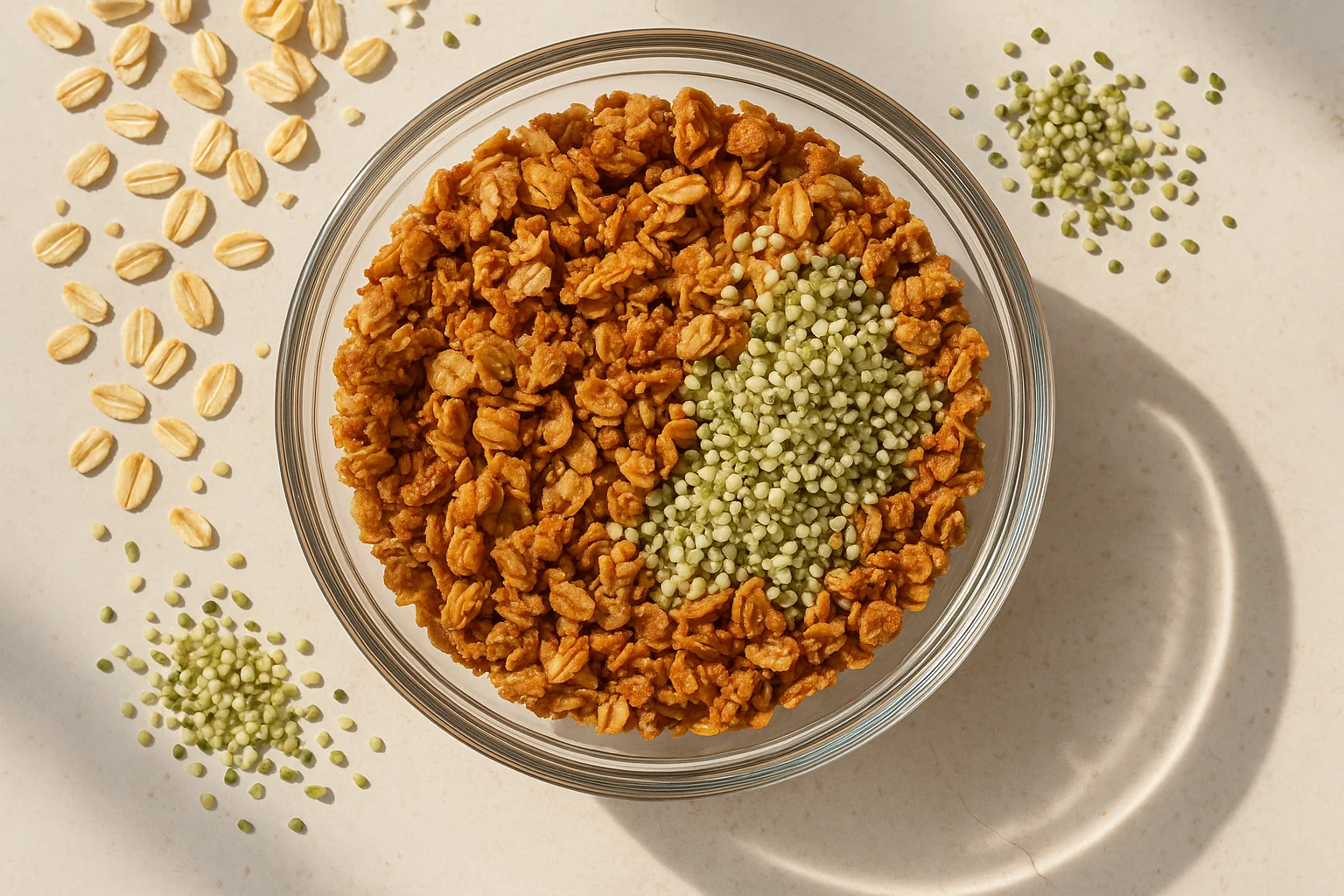

Homemade granola with hemp seeds: crunchy and sugar-free
Crunchy granola with hulled hemp seeds, with no added sugar. Proportions, temperature of 160 degrees, and the moment when the seeds go into the jar.
Store-bought granola has one recurring problem: the ingredient list starts with oats, and the second or third item is glucose-fructose syrup. In homemade, you decide on every spoonful, and the entire list fits in nine items, eight of which you usually have in your kitchen. Hulled hemp seeds add what oats lack: 31.6 g of protein and 48.8 g of fat per 100 g (USDA FoodData Central, record 170148). Baking takes 25-30 minutes, you add the seeds only after cooling, and one baking sheet yields about 500 g of granola, or eight servings for a week of breakfasts. Below you will find the proportions, temperature, order of steps, and one caveat about hemp protein that you won’t read on the packaging.
KEY INFORMATION
• Hulled hemp seeds contain 31.6 g of protein and 48.8 g of fat per 100 g (USDA FoodData Central, record 170148).
• Lysine is the first limiting amino acid in them, and the PDCAAS of hulled seeds is 63-66% (House et al., Journal of Agricultural and Food Chemistry, 2010).
• Hulling removes fiber: 4.0 g remains per 100 g compared to 27.3 g in flaxseed.
• Add seeds after cooling the granola, never before baking.
• Each additional 7 g of fiber per day is associated with a 9% lower risk of cardiovascular diseases (Threapleton et al., BMJ, 2013).
Why do hemp seeds fit granola better than chia?
Because they add protein and fat where granola has almost only carbohydrates. Hulled hemp seeds have 31.6 g of protein per 100 g, flaxseed 18.3 g, and chia 16.5 g (USDA FoodData Central, records 170148, 169414, and 170554). The difference compared to the two most popular alternatives is almost double.
If you come across a completely different number elsewhere, it is usually not a mistake, but a different raw material under the same name. House et al. (Journal of Agricultural and Food Chemistry, 2010) separated hemp products and provided separately: whole seeds 24.0% protein, hulled 35.9%, and cake after oil pressing 40.7%. For granola, you take hulled seeds. The difference between 31.6 and 35.9 falls within the variability between batches of seeds and between methods of determination.
There is, however, a caveat that commercial descriptions do not provide. The same study states that lysine is the first limiting amino acid in all studied hemp products, and the PDCAAS of hulled seeds falls within the range of 63-66%. All essential amino acids are present, just not in proportions that allow lysine to complement grains. In a bowl with oats, this has no practical significance, as no one eats granola as the sole source of protein. It has it when someone sells hemp seeds as “complete protein.”
The advantage is not complete, either. Hulling removes the seed coat, and with it fiber: hulled seeds contain 4.0 g per 100 g compared to 27.3 g in flaxseed and 34.4 g in chia. For fiber, you reach for oats and flaxseed in this granola, and for protein, you reach for hemp. In the kitchen, hemp seeds win in another way: they do not require soaking like chia or grinding like flaxseed, so you can add them directly to the jar.
From our kitchen trials, there is a thing that recipes usually do not record: granola hardens while cooling, not in the oven. When you take the tray out, the layer is still soft, and that is how it should be. If you bake it to crunchiness detectable when hot, after cooling you will get something with the consistency of a cracker. So take the granola out based on color and smell, not sound.
How much protein and fiber does one serving of granola have?
A serving is 60 g of finished granola, which is about one-eighth of the baking sheet. The hemp seeds alone contribute about 2 g of protein: the recipe calls for 50 g for eight servings, and hulled seeds have 31.6 g of protein per 100 g (USDA FoodData Central, record 170148). The rest is contributed by oats and flaxseed.
More interesting is the fiber. Threapleton et al. calculated in a meta-analysis of 22 cohort studies that each additional 7 g of fiber per day is associated with a 9% lower risk of cardiovascular diseases, with a relative risk of 0.91 and a confidence interval of 0.88-0.94 (BMJ, 2013). This is an observational relationship from cohort studies, not the effect of one bowl, but the direction repeats across the entire dataset and also applies to cereal fiber, which is from oats.
With plant milk, granola becomes a complete breakfast. If you prefer it as a topping, check out our recipe for smoothie bowl with hemp seeds, where the crunchy layer goes on top.
What ingredients do you need?
The proportions yield about 500 g of finished granola, or eight servings of 60 g. Everything except the hemp seeds, nuts, and dried fruits goes on the baking sheet before baking.
- 300 g of rolled oats, not instant
- 50 g of unsweetened coconut flakes
- 30 g of flaxseed, whole or ground
- 50 g of hulled hemp seeds, added after baking
- 3 tablespoons of unrefined coconut oil
- 4 tablespoons of honey or agave syrup
- 1 teaspoon of ground cinnamon
- pinch of sea salt
- optionally 50 g of nuts and 50 g of dried fruits, also after baking
Rolled oats are thicker and remain whole after baking, while instant oats crumble to dust. Coconut oil is used in this recipe because it remains solid at room temperature and, after cooling, binds the granola into loose clusters. Cold-pressed hemp oil is not suitable here, as explained further in the baking section.
It is worth knowing what “sugar-free” means here. There is no white sugar or glucose-fructose syrup in this granola, but honey and agave syrup are simple sugars, just in smaller amounts and with their own flavor. The same compromise is described in our recipe for fitness cookies with hemp seeds without sugar.
How to bake granola step by step?
Active work takes ten minutes, baking 25-30 minutes, cooling another fifteen. The rest happens without you. The two most important numbers are: 160 degrees and a layer thickness of no more than 1.5 cm.
Safety: Do not use cold-pressed hemp oil for baking. For this recipe, use coconut or sunflower oil, and add hemp oil only to the finished, cooled granola or to the bowl before serving.
- Preheat the oven to 160 degrees, top and bottom heat, without convection. Line a large baking sheet with parchment paper.
- In a large bowl, mix the oats, coconut flakes, flaxseed, cinnamon, and salt.
- In a small pot, melt the coconut oil with honey or agave syrup. Heat to 50-60 degrees, do not boil. Pour over the dry ingredients and mix so that each flake is coated with fat.
- Spread the mixture on the baking sheet in a layer of 1-1.5 cm. Do not compact, the granola should lie loosely.
- Bake for 12-15 minutes, remove, stir with a spatula, and level the layer. Return and bake for another 12-15 minutes until golden brown.
- Cool the granola on the baking sheet to room temperature, about fifteen minutes. Only then add the hulled hemp seeds, along with nuts and dried fruits. Transfer to a glass jar with a lid.
How to modify the recipe to your needs?
Granola tolerates substitutions better than most baked goods because there is no dough that needs to rise. You can change the grain base, sweetener, and additions, as long as the fat-to-dry-matter ratio remains roughly the same.
A gluten-free version can be made with buckwheat flakes, puffed amaranth, and millet instead of oats. The texture comes out lighter and finer, and the baking time is shortened by a few minutes because these flakes are thinner than rolled oats.
For a chocolate version, add 2 tablespoons of cocoa to the dry ingredients before baking, and after cooling, mix in hemp seeds and chopped chocolate with 85% cocoa content.
Hemp flour will increase the protein content, but first check which one you are buying, as two different products are sold under the same name. Rusu et al. studied flour from whole seeds: the fat content reaches 28%, and fiber exceeds 26% compared to 0.61% in wheat flour type 550 (Plants, 2021). Siano et al. studied flour from the cake after oil pressing: 30.7% protein compared to 24.8% in the seeds themselves, with 13.6% fat (Molecules, 2018). The cake flour is leaner and absorbs moisture more, while the whole seed flour is fattier. In granola, substitute at most 30 g of flakes with it. Our recipe for hemp flour crackers shows hemp flour in the main role.
The most common mistake is too high a temperature. At 180 degrees, it browns on the outside before drying on the inside. Keep it at 160 degrees without convection and peek through the window instead of opening the door.
Frequently asked questions
When to add hemp seeds to granola?
After cooling the granola to room temperature, never before baking. The fat in hemp seeds is over 80% polyunsaturated (Callaway, Euphytica, 2004), and such fatty acids do not tolerate long heating well. Adding seeds to cold granola costs nothing and takes half a minute.
Is granola with hemp seeds a complete protein?
Not in the sense that trade uses this term. House et al. found that lysine is the first limiting amino acid in all studied hemp products, and the PDCAAS of hulled seeds is 63-66% (Journal of Agricultural and Food Chemistry, 2010). All essential amino acids are present, but not in ideal proportions.
How to get crunchy granola without clumps?
Three conditions: 160 degrees without convection, a layer no thicker than 1.5 cm, and one stirring halfway through baking. Do not open the oven more often, as each opening lowers the temperature and part of the sheet bakes slower. Hardening occurs while cooling, not in the oven.
Can granola be made without honey?
Yes. You can replace honey with agave syrup, maple syrup, date syrup, or ground dates soaked in water, counting 4-5 dates for 2 tablespoons of water. The taste will be less caramel-like, and the granola will be just as crunchy, as crunchiness is due to fat and temperature, not the type of sweetener.
How long can you store granola with hemp seeds?
In a sealed glass jar at room temperature for up to two weeks, in the fridge for up to four. Keep the jar away from the kettle and sink, as granola absorbs moisture from the air and softens. Hemp seeds added after cooling do not shorten this period.
We do not carry hulled hemp seeds or hemp flour in the store at Bucha. The hemp food products we have are collected in the hemp food category.
This article is for informational and educational purposes and does not replace consultation with a doctor. If you are pregnant, breastfeeding, taking medications, or have chronic conditions, consult the use of supplements or herbs with a specialist.
Author: Michał Waluk · Published: 2026-05-29 · Updated: 2026-08-16