
Iron every other day instead of daily: what studies on hepcidin have discovered
Hepcidin after an iron dose closes the intestine for a day. What exactly did Moretti 2015 and Stoffel 2017 measure: doses, populations, results, and EFSA's limit.
The recommendation to take iron daily or twice a day was made before the hormone regulating its absorption was known. Since 2015, it has been known that the iron dose itself raises hepcidin levels, and elevated hepcidin closes the intestine to the next portion. A team from Zurich measured this with stable isotopes first in women taking iron daily and twice daily, and two years later directly compared the daily scheme with the alternating one. This article describes what exactly was measured in both studies, in whom, for how many days, and with what results, as well as where popular discussions attribute things to these works that are not present in them. The text is not an instruction for taking iron: the scheme and dose are determined by a doctor based on ferritin and morphology results.
KEY INFORMATION
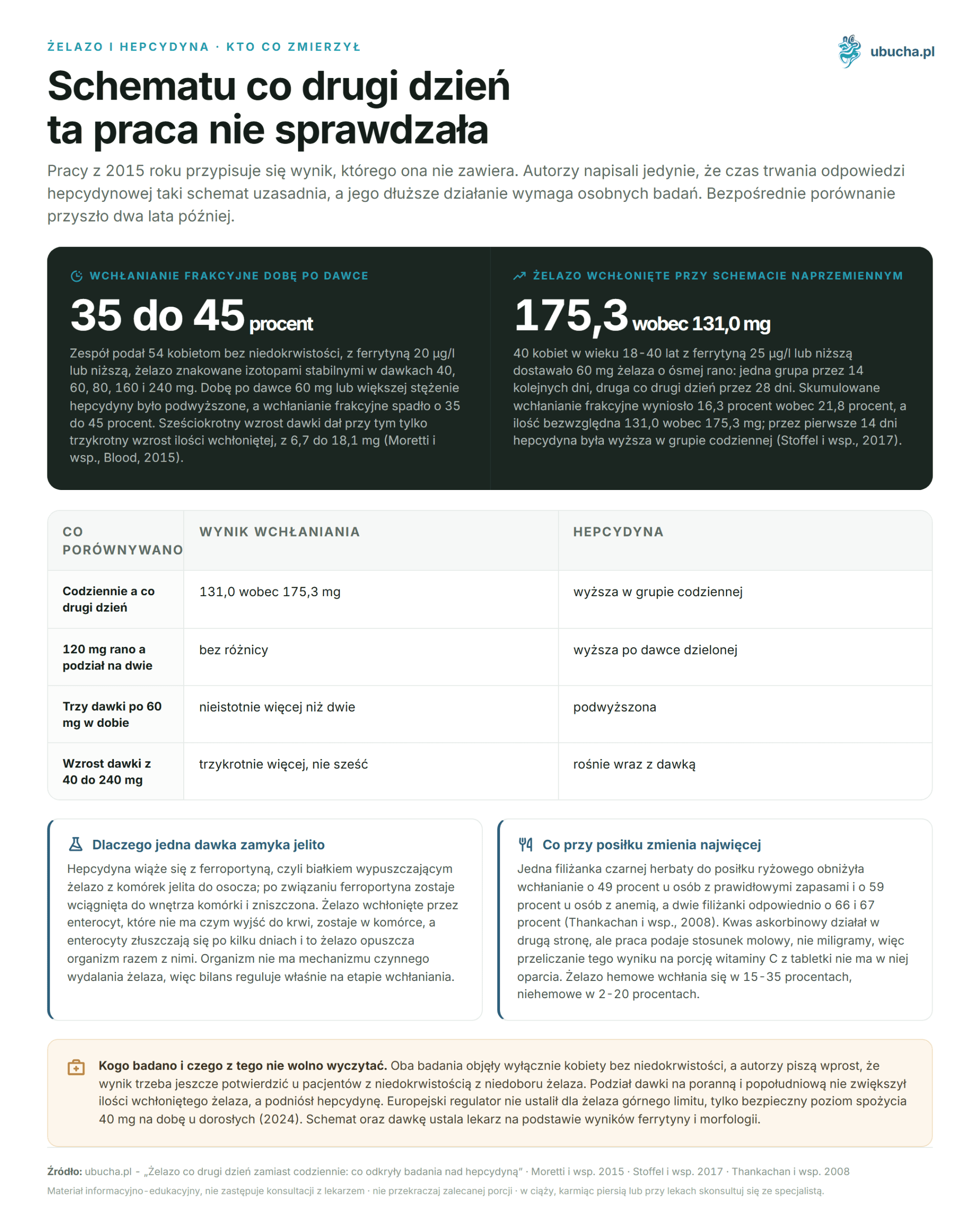
• In the study by Stoffel et al., 40 women with ferritin of 25 µg/l or lower absorbed a total of 175.3 mg of iron at doses every other day compared to 131.0 mg at daily doses (The Lancet Haematology, 2017).
• The mechanism is described by hepcidin: 24 hours after a dose of 60 mg or more, its concentration was elevated, and fractional absorption was lower by 35 to 45 percent (Moretti et al., Blood 2015).
• Splitting the dose into morning and afternoon did not increase the amount of absorbed iron but raised hepcidin.
• EFSA in 2024 did not establish an upper limit for iron, only a safe intake level of 40 mg per day for adults.
• Both studies included only women without anemia, and the authors state directly that the results have not yet been transferred to patients with iron deficiency anemia.
What is hepcidin and how does it regulate iron absorption?
Hepcidin is a liver peptide hormone that binds to ferroportin, a protein that releases iron from intestinal cells into the plasma. After binding, ferroportin is internalized and destroyed. The more hepcidin, the less iron passes from the intestine to the blood (Ganz, Physiological Reviews 2013).
The feedback works both ways. Hepcidin levels are regulated by the iron in the plasma and the size of the stores, and its activity is reduced by the activity of erythrocyte precursors, which consume the most iron. With empty stores, hepcidin decreases, and the intestine allows more absorption. With full stores, it increases and allows less.
Iron absorbed by the enterocyte, which has no way to exit into the blood, remains in the cell. Enterocytes shed after a few days, and this iron leaves the body with them. The body has no active mechanism for excreting iron, so the balance is regulated precisely at the absorption stage (Abbaspour et al., Journal of Research in Medical Sciences 2014).
This loop explains why absorption from a tablet is never a constant value. It depends on the iron stores at the time of the dose, the size of the dose itself, and when the previous one was taken. The last of these components was taken up by the Zurich studies.
What was measured in the Moretti study from 2015?
The Moretti team administered stable isotope-labeled iron to 54 women without anemia, with ferritin of 20 µg/l or lower. The doses were 40, 60, 80, 160, and 240 mg, given at 8 a.m. on an empty stomach for one or two consecutive days. A separate, third part included 13 women and three doses of 60 mg within a day (Blood, 2015).
One day after a dose of 60 mg or more, the serum hepcidin concentration was elevated, and fractional absorption decreased by 35 to 45 percent. With increasing dose, the fraction of absorbed iron decreased, but the absolute amount increased. A sixfold increase in dose, from 40 to 240 mg, resulted in only a threefold increase in the amount absorbed, from 6.7 to 18.1 mg.
In the third part, the total amount of iron absorbed from three doses, two morning and one afternoon, was not significantly greater than from two morning doses. It is worth remembering what was not in this work: the authors did not check the every other day scheme. They only wrote that the duration of the hepcidin response justifies such a scheme, and its longer action requires separate studies. Popular summaries usually attribute a result to this work that it does not contain.
What did the comparison of the alternating scheme with the daily one show?
The direct comparison was only provided by the study by Stoffel et al. from 2017. Forty women aged 18-40 years with ferritin of 25 µg/l or lower received 60 mg of iron at 8 a.m.: one group for 14 consecutive days, the other every other day for 28 days (The Lancet Haematology, 2017).
The cumulative fractional absorption was 16.3 percent in the daily group versus 21.8 percent in the alternating group. The cumulative amount absorbed was 131.0 mg and 175.3 mg, respectively. For the first 14 days, the hepcidin concentration was higher in the daily group.
The second part of the same study included 20 women and compared 120 mg once in the morning with a split of 60 mg in the morning and 60 mg in the afternoon. There was no difference in absorption, either in fraction or in absolute amount. However, the hepcidin concentration was higher after the split dose. Splitting the dose did not help, but in this trial, it also did not reduce absorption by itself.
Both parts of this work were funded by the Swiss National Science Foundation; the funding declaration does not mention the manufacturer of the preparation. The authors conclude with a caveat that is usually missing in popular summaries: the result still needs to be confirmed in patients with iron deficiency anemia, as only women without anemia were studied. Separately, we described what is known about fatigue with low ferritin without anemia.
What really changes iron absorption from a meal?
The two most measured factors are: ascorbic acid increases non-heme iron absorption, while polyphenols decrease it. In an isotopic study of twenty young women in India, half of whom had iron deficiency anemia, one cup of black tea with a rice meal reduced absorption by 49 percent in those with normal stores and by 59 percent in those with anemia. Two cups reduced it by 66 and 67 percent, respectively (Thankachan et al., The American Journal of Clinical Nutrition 2008).
Ascorbic acid in the same study increased absorption by 270 percent at a molar ratio of 2:1 to iron and by 343 percent at 4:1 in individuals with normal stores, and by 291 and 350 percent in those with anemia. The study provides the molar ratio, not milligrams, so converting this result to a serving of vitamin C from a tablet has no basis in it.
An earlier study measured only polyphenolic beverages with a bread meal. Beverages containing 100-400 mg of polyphenols per serving reduced iron absorption by 60 to 90 percent, and black tea alone by 79 to 94 percent. Cocoa reduced it by 71 percent, chamomile by 47 percent (Hurrell et al., British Journal of Nutrition 1999). Adding milk to coffee and tea changed little in this regard.
A separate factor is the form of iron. Heme iron, from meat, poultry, and fish, is absorbed at 15-35 percent and is little affected by the rest of the meal. Non-heme iron, from plants and most oral preparations, is absorbed at 2-20 percent and is strongly dependent on what is on the plate next to it (Abbaspour et al., 2014).
Why does inflammation cut off access to iron?
Hepcidin does not respond solely to the state of stores. Its synthesis is also stimulated by inflammatory signals, including interleukin 6 and activin B (Ganz, 2013). In infection or chronic inflammation, hepcidin levels rise, ferroportin disappears from the surface of cells, and iron is trapped in stores instead of entering the blood.
The purpose of this mechanism is defensive. Bacteria need iron to grow, so the body limits their access. The cost is that during active inflammation, oral iron is absorbed worse, and the laboratory picture no longer corresponds to actual stores.
Ferritin is an acute phase protein and rises during inflammation regardless of stores. WHO explicitly includes this in the thresholds: deficiency in an adult is diagnosed with ferritin below 15 µg/l, but with a concurrent infection or inflammatory state, the threshold is raised to 70 µg/l, and in children under five years of age from 12 to 30 µg/l. Therefore, ferritin is read together with an inflammation marker, most often with CRP.
The consequence concerns the interpretation of the result, not the dosing. Ferritin taken during an infection or exacerbation of a chronic disease may appear normal with empty stores. On the other side of this balance, regarding the risk of excess iron, there is a separate article. The effects of deficiency in the youngest are discussed in a text about cognitive development in children.
Frequently asked questions
Does iron every other day absorb better than daily?
In the study by Stoffel et al. from 2017, 40 women without anemia absorbed a total of 175.3 mg of iron at doses of 60 mg every other day for 28 days compared to 131.0 mg at the same doses for 14 days daily. The absorbed fraction was 21.8 versus 16.3 percent.
How long after an iron dose does elevated hepcidin persist?
The Moretti team measured that one day after a dose of 60 mg or more, the serum hepcidin concentration was still elevated, and fractional absorption was reduced by 35 to 45 percent. This hepcidin response time was indicated by the authors as a reason to check the alternating scheme in the next study.
Does splitting the dose into morning and afternoon make a difference?
In the second part of the Stoffel study, 20 women received 120 mg in the morning or 60 mg in the morning and 60 mg in the afternoon. There was no difference in absorption, either in fraction or in absolute amount. However, the hepcidin concentration was higher after the split dose.
Who were the subjects of these studies?
Only women without anemia. In Moretti, 54 participants with ferritin of 20 µg/l or lower, in Stoffel, 40 and 20 participants aged 18-40 years with ferritin of 25 µg/l or lower. The authors of the second study note that the results have not yet been confirmed in patients with anemia.
What level of iron does EFSA consider safe?
In its 2024 opinion, EFSA did not establish a tolerable upper intake level for iron, as the data did not allow for it. Instead, it provided a safe intake level of 40 mg per day for adults, including pregnant and breastfeeding women. This indicator is applied more narrowly than the limit.
Do tea and coffee really block iron absorption?
Yes, and the effect is significant. Beverages containing 100-400 mg of polyphenols per serving reduced iron absorption from a bread meal by 60 to 90 percent, and black tea alone by 79 to 94 percent. A cup of tea with a rice meal reduced it by 49 to 59 percent.
Supplements available in the store at Bucha are collected in the supplements category, but none of them replace testing ferritin and morphology or a doctor’s decision on the intake scheme.
This article is for informational and educational purposes and does not constitute medical advice. Before starting supplementation, consult your doctor, especially if you are taking medications regularly, are pregnant or breastfeeding, or have a chronic illness.
Author: Michał Waluk · Published: 2026-08-09 · Updated: 2026-08-16