
THC, CBD and Sleep Architecture: What Polysomnography Shows
THC, CBD and sleep architecture. What polysomnography showed in 1449 individuals, why the number 20-30% REM suppression has no source, and what is unknown about cessation.
Many cannabis users say that marijuana helps them fall asleep, and the first part of this statement is consistent with the literature: THC can shorten the time it takes to fall asleep. The second part, the thesis about permanent destruction of sleep structure, is based in Polish internet on a number without a source. Sleep architecture is a polysomnographic measurement, not an assessment from a survey, so only studies that recorded sleep in a laboratory are decisive. This text collects them together with the number of participants and methods, shows what they really imply for THC and cannabidiol, and directly names those places where measurement simply does not exist. You will also find an explanation of why the popular time frames for sleep recovery after cessation have no support in any work.
KEY INFORMATION
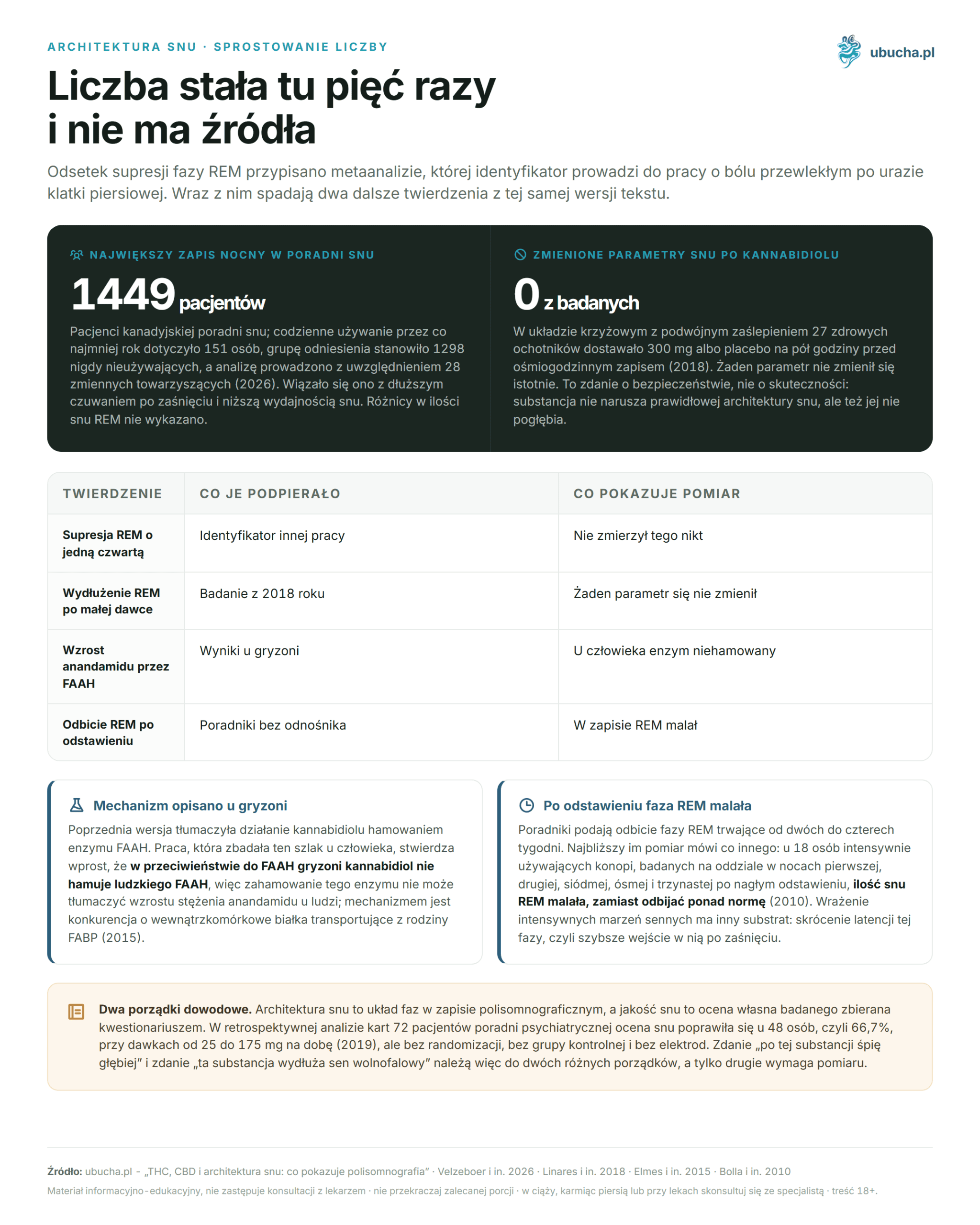
• In the largest polysomnographic analysis, 1449 patients from sleep clinics, chronic daily cannabis use was associated with longer wakefulness after falling asleep and lower sleep efficiency. No difference in the amount of REM sleep was found.
• The repeated number “REM suppression of 20-30%” has no source that can be identified. The identifier that supported it leads to a study on chronic pain after chest injury.
• In the only controlled study with polysomnography, 300 mg of CBD in 27 healthy volunteers did not change any sleep parameter compared to placebo.
• The claim that CBD raises anandamide by inhibiting the FAAH enzyme is false for humans. CBD does not inhibit human FAAH.
• In the polysomnographic recording over thirteen nights of abstinence from cannabis, the amount of REM sleep decreased, not increased. The frame of “2-4 weeks of REM rebound” is not provided by any of these works.
What is sleep architecture and how does it differ from sleep quality?
Sleep architecture is the arrangement and proportions of stages in a polysomnographic recording: three stages of non-rapid eye movement sleep, marked as N1, N2, and N3, and the REM phase, repeating in cycles of about 90 minutes. Stage N1 is falling asleep, N2 is light sleep, and N3 is slow-wave sleep, the deepest sleep. Measurement requires simultaneous recording of brain activity, eye movements, and muscle tension. In a typical adult, the REM phase occupies about one-fifth of the night, and its share increases in subsequent cycles.
Sleep quality is something else. It is a self-assessment of the subject, collected by questionnaire, and no phase can be read from it. The distinction is the basis of this text, as a significant portion of claims about the effects of cannabinoids on sleep stages comes from studies that did not measure phases at all. Actigraphy, which records movement from a wristband, lies in the middle: it estimates sleep and wake time but does not distinguish phases.
The practical consequence is that the statement “I sleep deeper after this substance” and the statement “this substance prolongs slow-wave sleep” belong to two different orders of evidence. The first comes from feeling, the second requires electrodes. Therefore, with every claim about sleep phases, it is worth checking whether the work under the reference actually performed polysomnography.
What does polysomnography show in people who regularly use cannabis?
The most extensive measurement to date involved 1449 adult patients from a Canadian sleep clinic. Chronic use was defined as daily for at least a year and involved 151 individuals; the reference group consisted of 1298 individuals who had never used. Nine parameters of night recording were analyzed, considering 28 accompanying variables. Chronic use was associated with longer wakefulness after falling asleep, as well as lower sleep efficiency and a greater share of stage N1 (Velzeboer et al., Sleep, 2026).
Two things in this result are important and both are often overlooked. First, the set of studied parameters also included the amount of REM sleep and its presence, and no significant difference was found for them. Second, the authors themselves caution that most participants had moderate or severe sleep apnea, so generalizing to the general population is limited. The study is cross-sectional, so it does not determine causation.
The second source is a review of polysomnographic changes with substance use, including nicotine, caffeine, alcohol, cocaine, opioids, and cannabis, and six sleep parameters. The authors emphasize that the effects differ depending on whether it is about intoxication, withdrawal, or chronic use, and that sleep disturbances increase the risk of relapse (Garcia and Salloum, The American Journal on Addictions, 2015). In a study of 87 individuals seeking treatment for cannabis use, the polysomnographic recording in home conditions showed that only 19.5% of participants achieved the recommended 7-9 hours of sleep (Pacek et al., Experimental and Clinical Psychopharmacology, 2017).
Where did the number “20-30% REM suppression” come from and why are we removing it?
This number stood in the previous version of this article five times and was attributed to a meta-analysis in the journal Sleep Medicine Reviews from 2020. The identifier given under it leads to a study on the prevalence of chronic pain after chest injury. A title query about the meta-analysis of cannabis and sleep in this journal returns nothing. The work on which the main argument of the text stood does not exist in that form, and the number has no support in any source that could be found.
So what can be said about the mechanism? That THC is a strong agonist of the CB1 receptor, and these receptors are densely distributed in structures regulating the sleep-wake cycle. This is an anatomical description, not a measurement of the effect size in humans. Transitioning from such a description to a specific percentage would require a study that measured that percentage, and such a study does not exist in the available literature.
A reliable summary of the direction gives a literature review on cannabis and sleep: THC may shorten sleep latency but worsen its quality in the long term, and the entire body of research on cannabis and sleep is described by the authors as a field in its early stages with mixed results (Babson et al., Current Psychiatry Reports, 2017). The direction is therefore documented, but the scale is not.
How does CBD perform in the only controlled study with polysomnography?
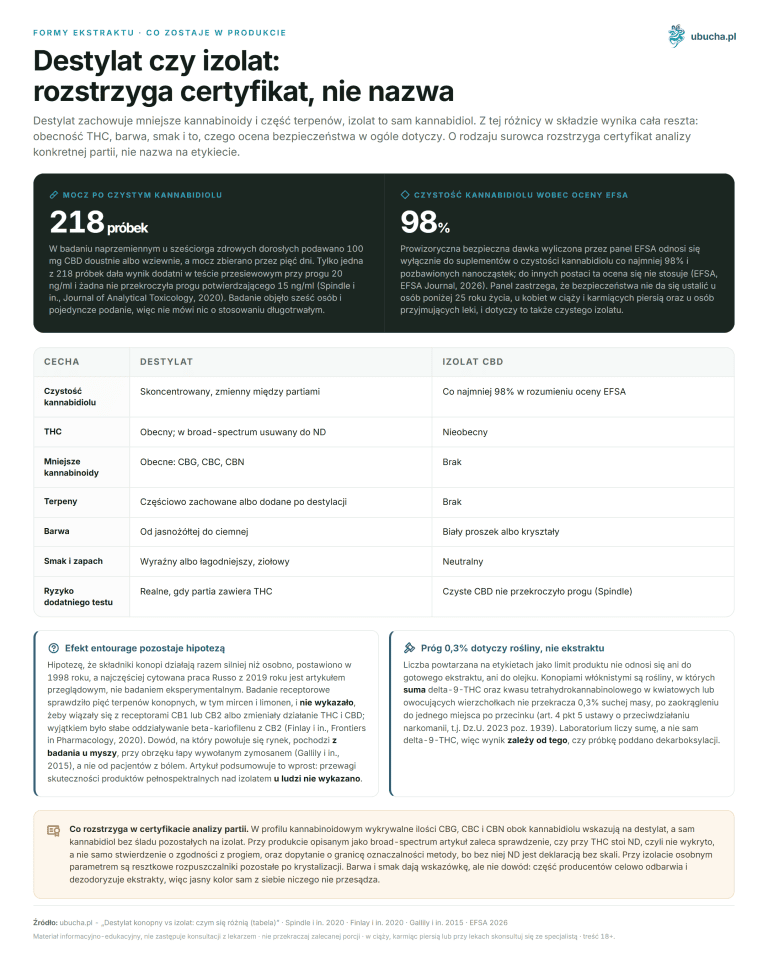
Neutrally, and that is the entire result. Twenty-seven healthy volunteers received in a crossover double-blind design 300 mg of cannabidiol or placebo half an hour before an eight-hour polysomnographic recording. No parameter changed significantly. The authors conclude that acute administration of anxiolytic doses of cannabidiol does not seem to interfere with the sleep-wake cycle, and the results suggest that the substance does not disrupt the normal architecture of sleep (Linares et al., Frontiers in Pharmacology, 2018).
This is a statement about safety, not efficacy, and the difference is fundamental. It is determined by comparison with benzodiazepines and antidepressants, which do change the structure of sleep. It does not mean, however, that cannabidiol deepens sleep or prolongs the REM phase. The claim of a slight prolongation of REM after low doses, which stood in the previous version of this text, has no support in this study or in any other polysomnographic recording.
Separately, the mechanism needs to be clarified. The previous version explained the action of cannabidiol by inhibiting the FAAH enzyme. The work that examined this pathway in humans states directly that unlike rodent FAAH, cannabidiol does not inhibit human FAAH, so the inhibition of this enzyme cannot explain the increase in anandamide levels in humans after its administration; the mechanism is competition for intracellular transport proteins from the FABP family (Elmes et al., The Journal of Biological Chemistry, 2015).
What do clinical studies say about CBD and perceived sleep quality?
The most frequently cited is a retrospective analysis of charts from 72 adult patients from a psychiatric clinic. Anxiety was the main reason for seeking help in 47 individuals, poor sleep in 25. In the first month, anxiety assessment improved in 57 patients, or 79.2%, and sleep assessment improved in 48 patients, or 66.7%. The authors note that the sleep result varied in subsequent months, unlike the anxiety result. Doses ranged from 25 to 175 mg per day, with almost all patients receiving 25 mg (Shannon et al., The Permanente Journal, 2019).
The limitations of this work are serious, and the authors do not hide them. It is a case series without randomization and without a control group, cannabidiol was administered as an adjunct to ongoing treatment, and sleep was assessed by questionnaire, not polysomnography. Therefore, this study does not yield any conclusions about sleep phases and cannot be used as evidence regarding architecture.
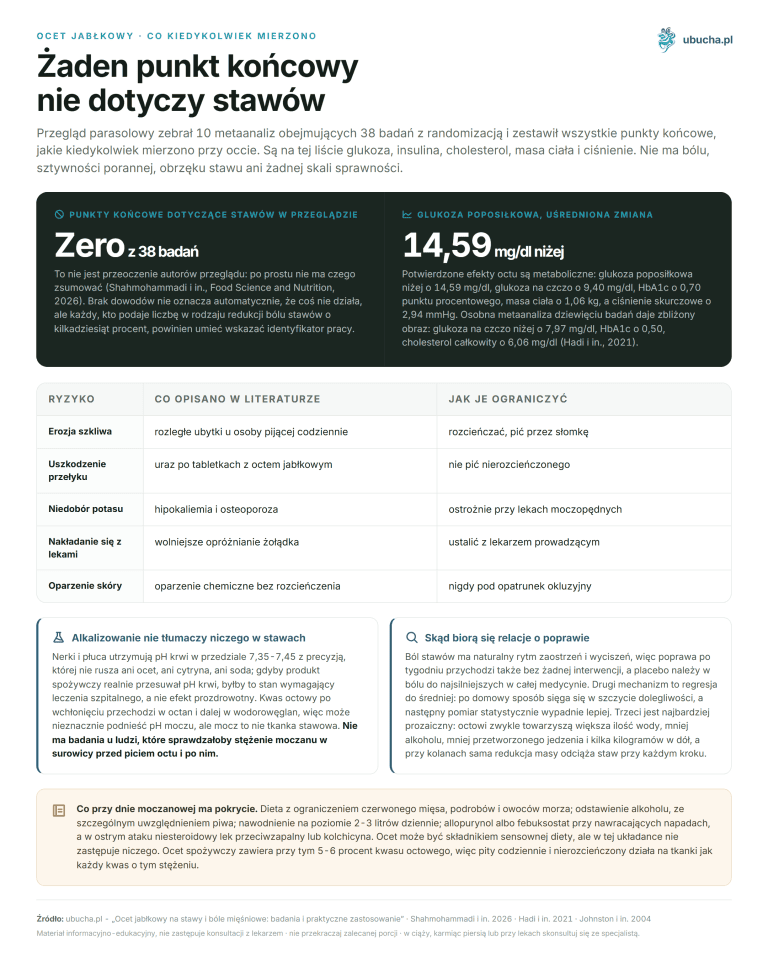
The comparison of both orders looks like this: in objective measurement, cannabidiol changed nothing, in self-assessment by patients, sleep improved in two-thirds, but unstably and without a comparison group. Both things are true at the same time. More about clinical evidence has been gathered in the post about how CBD affects sleep and insomnia.
What to really expect after stopping THC?
Popular guides provide a REM rebound lasting from two to four weeks and full normalization after four to eight weeks. None of these frames has support in any work that could be identified, and the closest measurement says something different. In the polysomnographic recording of 18 individuals who intensively used cannabis, conducted in the department on the nights of the first, second, seventh, eighth, and thirteenth after sudden cessation, total sleep time, sleep efficiency, and the amount of REM sleep decreased, while wakefulness after falling asleep and periodic limb movements increased (Bolla et al., Sleep Medicine, 2010).
The amount of REM sleep in this recording therefore decreased instead of rebounding above normal. The impression of very intense, often disturbing dreams has a different substrate: the shortening of REM latency, meaning a faster entry into it after falling asleep. These are two different measures, and mixing them is the source of a significant portion of misunderstandings surrounding cessation.
For a person who is stopping, the practical difference is significant. Worse sleep in the first two weeks is documented and predictable, but it is not evidence that one cannot sleep without the substance. Thirteen nights is also the entire horizon of this study, so it does not answer the question about a longer perspective. The course of withdrawal has been outlined separately in the post about how long the effects of cannabis withdrawal last.
How do cannabis and alcohol and benzodiazepines compare?
The comparison makes sense because all these substances are sought for the same reason. A review of polysomnographic changes includes alcohol along with cannabis and leads to a conclusion that is not visible from the perspective of a single substance: the sleep picture depends on whether we measure it during intoxication, during withdrawal, or during chronic use (Garcia and Salloum, 2015). A substance that shortens the time to fall asleep is therefore not the same as a substance that improves sleep structure.
Benzodiazepines and Z-drugs change sleep structure in a measurable and documented way, making them a reference point for the conclusion from Linares’ study. Cannabidiol in this one controlled measurement behaved differently than they did, meaning it changed nothing. This does not imply superiority in efficacy; it solely indicates a lack of disruption to structure with a single dose in healthy individuals.
It is also worth remembering a separate layer of risk that does not arise from the comparison of efficacy. A WHO report notes the inhibition of some cytochrome P450 enzymes by cannabidiol, while also noting that it is unclear whether this occurs at physiological concentrations. Therefore, combining it with sleeping pills should not be treated as neutral. EFSA states directly that the safety of cannabidiol cannot be established today in individuals under 25 years of age, in pregnant and breastfeeding women, and in individuals taking medications simultaneously (EFSA, EFSA Journal, 2026).
Frequently Asked Questions
Does THC shorten REM sleep?
The direction is described, the scale is not. In the largest polysomnographic analysis, involving 1449 patients from sleep clinics, chronic daily cannabis use was associated with longer wakefulness after falling asleep and lower sleep efficiency, but no difference in the amount of REM sleep was found. The circulating number of 20-30% has no source.
Does CBD disrupt sleep architecture?
In the only controlled study with polysomnography, it did not disrupt it. Twenty-seven healthy volunteers received 300 mg of cannabidiol or a placebo before an eight-hour recording, and no parameter changed significantly. This is a conclusion about safety, not evidence that the substance deepens sleep.
Does CBD raise anandamide by inhibiting FAAH?
Not in humans. The work that checked this states that unlike the enzyme in rodents, cannabidiol does not inhibit human FAAH, so the inhibition of this enzyme does not explain the increase in anandamide in humans. The mechanism is competition for intracellular transport proteins from the FABP family.
How long does it take to restore sleep after stopping THC?
It is unknown, as the longest recording covered thirteen nights. In this study of 18 people, total sleep time, sleep efficiency, and the amount of REM sleep decreased throughout the observation period. The frames of two to eight weeks, repeated in guides, do not come from any work that could be identified.
Why do I have very vivid dreams after stopping cannabis?
This is due to the shortening of REM latency, meaning a faster entry into dreams after falling asleep. This is a different measure than the amount of REM sleep, which decreased in the available polysomnographic recording after cessation. The symptom is temporary and fits within the picture of cannabis withdrawal syndrome.
Does CBD help with sleep?
The evidence is weak and comes from self-assessments of patients. In a series of 72 cases, sleep improved in 66.7% of individuals in the first month, but the result varied over time, the study had no control group, and sleep was assessed by questionnaire. The best-documented effect of cannabidiol remains anxiety reduction.
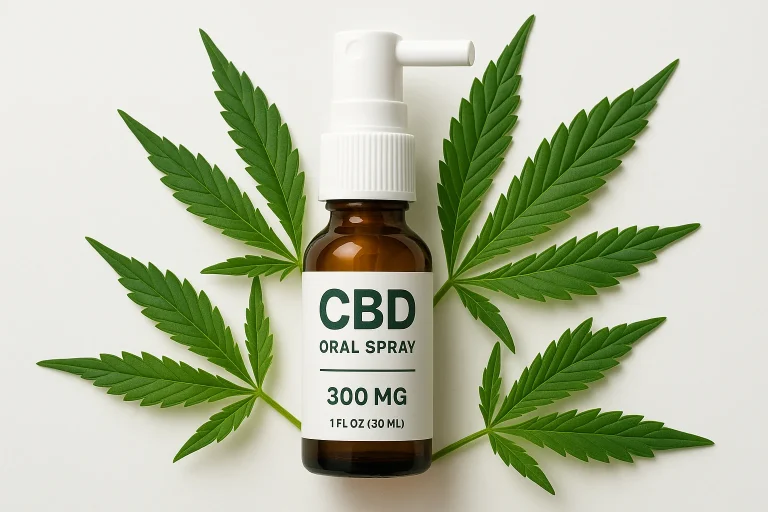
Products with cannabidiol in the form of oil can be found in the hemp oils category.
This article is for informational and educational purposes and does not constitute medical advice. Before starting to use cannabis or CBD for therapeutic purposes, consult a doctor, especially if you are taking other medications, are pregnant, or breastfeeding.
Author: Michał Waluk · Published: 2026-08-09 · Updated: 2026-08-16