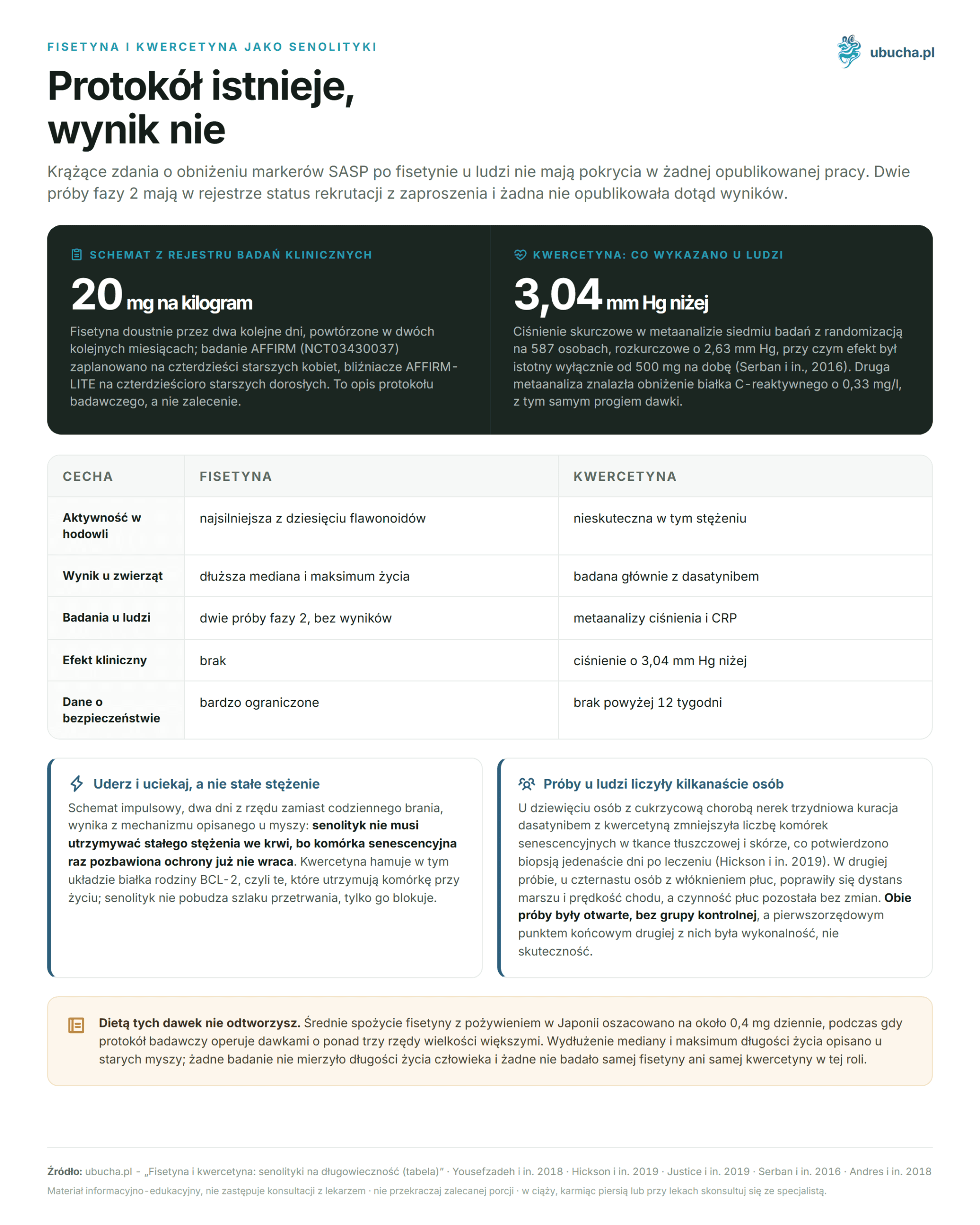

Fisetin and Quercetin: Senolytics for Longevity (Table)
Fisetin and quercetin as senolytics: how they differ, what has been shown in mice and what in humans, what doses have been studied, and what known risks and interactions exist.
Fisetin and quercetin are two flavonoids that have transitioned from a category of nutraceutical curiosity to the center of aging research over the past few years. The reason is specific: in the first published senolytic study in humans, a three-day treatment with dasatinib and quercetin reduced the number of senescent cells in adipose tissue and skin within eleven days (Hickson et al., EBioMedicine 2019). Fisetin, on the other hand, has proven to be the strongest senolytic among ten tested flavonoids. This article compares both compounds in a table and shows where the boundary lies between what has been demonstrated in mice and what has been confirmed in humans. This boundary is sharper than the descriptions of supplements suggest: strong results concern rodents and cell cultures, while trials in humans have so far involved only a few dozen people and measured biomarkers, not lifespan. We provide with each number the material from which it was obtained.
KEY INFORMATION
• Fisetin was the strongest senolytic among ten tested flavonoids (Yousefzadeh et al., EBioMedicine 2018).
• Quercetin lowers blood pressure and CRP in meta-analyses, but only from 500 mg per day.
• No study has shown an extension of life in humans.
• Data on safety beyond 12 weeks do not exist.
What are senolytics and where did the interest in these flavonoids come from?
Senolytics are compounds that selectively kill senescent cells, which have stopped dividing, do not die, and secrete pro-inflammatory proteins known as the SASP phenotype. Senescent cells are rare in young individuals and increase with age in many tissues simultaneously. The mechanism of action of senolytics involves temporarily shutting down the survival pathways that these cells use to defend themselves against their own apoptosis.
The interest in these two flavonoids arose from a single review. The Yousefzadeh team examined a panel of ten flavonoids for senolytic activity on aging mouse and human fibroblasts. Fisetin performed best at a concentration of 5 micromoles, at which quercetin did not work at all, while luteolin and curcumin showed weak activity (Yousefzadeh et al., EBioMedicine 2018).
Quercetin entered this story earlier and through a different route: as a component of a pair with dasatinib, an oncology drug. It is this combination, not quercetin alone, that entered the first trials in humans. Quercetin itself is a well-studied plant flavonoid with anti-inflammatory effects, but its senolytic role is based on its interaction with dasatinib.
Why do cells age and stop dying?
Because senescence is a defense mechanism that becomes less effective with age. Most cells in the body have a limited number of divisions, related to telomere shortening. When telomeres become too short or when a cell suffers serious DNA damage, it enters a state of permanent cell cycle arrest. This prevents the proliferation of damaged cells that could become cancerous.
The problem begins later. The immune system increasingly fails to remove such cells, so they accumulate in tissues. They secrete a cocktail of pro-inflammatory proteins that affect their neighbors and drive chronic low-grade inflammation. In Hickson’s study, among the reduced SASP factors were interleukin 1-alpha, interleukin 6, and metalloproteinases MMP-9 and MMP-12.
Senescent cells defend themselves against apoptosis through survival pathways referred to as SCAP. Quercetin inhibits proteins of the BCL-2 family, which keep the cell alive. It is worth noting the direction of action, as it is often reversed in popular descriptions: a senolytic does not stimulate the survival pathway, but blocks it, removing the protection from the senescent cell and allowing it to die.
What is the difference between fisetin and quercetin?
Both compounds belong to flavonols, the same subclass of flavonoids, but differ in their action profile and state of documentation. Fisetin has stronger preclinical data as a senolytic, while quercetin has more studies in humans, but they concern different endpoints: blood pressure and inflammation markers, not aging. The table below summarizes what can be attributed to specific publications.
| Feature | Fisetin | Quercetin |
|---|---|---|
| Chemical class | Flavonol | Flavonol |
| Food sources | Strawberries (highest concentration), apples, persimmons, grapes, onions, cucumbers | Red onions, capers, kale, apples with skin |
| Senolytic activity in culture | Strongest of ten tested flavonoids | Ineffective at the concentration where fisetin worked |
| Result in animals | Extension of median and maximum lifespan in old mice | Mainly studied in combination with dasatinib |
| Studies in humans | Two phase 2 trials ongoing, with no published results | Meta-analyses of blood pressure and CRP; senolytic trials only with dasatinib |
| Documented clinical effect | None | Systolic pressure lower by 3.04 mm Hg, CRP lower by 0.33 mg/l |
| Oral bioavailability | Low | Low |
| Safety data | Very limited, no long-term data | Adverse events rare and mild, no data above 12 weeks |
Two rows of this table usually fall out of marketing materials, yet they determine the most: the row on studies in humans and the row on documented clinical effect. Fisetin today has a stronger laboratory story and a weaker clinical one than quercetin, even though it is often presented the other way around in supplement descriptions.
What doses of fisetin were used in clinical studies?
The protocol from the clinical trial registry looks like this: fisetin 20 mg per kilogram of body weight orally for two consecutive days, repeated in two subsequent months. This is the scheme of the AFFIRM study (NCT03430037), a phase two trial with placebo planned for forty older women. A twin study, AFFIRM-LITE (NCT03675724), includes forty older adults.
One thing that needs to be said clearly: both studies have a recruitment status of invitation in the registry and neither has published results yet. Circulating statements online about the reduction of SASP markers after fisetin in humans have no backing in any published work. The protocol exists, the result does not.
This same impulse scheme, two days in a row instead of daily intake, arises from the mechanism described in mice by the Yousefzadeh team. A senolytic does not need to maintain a constant concentration in the blood because a senescent cell, once deprived of protection, does not return. The authors called this hit and run action. We provide this number as a description of the research protocol, not as a recommendation. Converting it to your own body weight and reaching for a supplement is exactly the move that the study result does not justify, because such a result does not yet exist.
What do studies on quercetin in humans show?
Real effects, but modest and concerning the heart and inflammation, not aging. A meta-analysis of seven randomized studies involving 587 people showed a reduction in systolic blood pressure by an average of 3.04 mm Hg and diastolic by 2.63 mm Hg, with the effect being significant only in studies with a dose of at least 500 mg per day (Serban et al., J Am Heart Assoc 2016).
The second meta-analysis, also of seven studies, found a reduction in C-reactive protein levels by 0.33 mg/l, again with a threshold of 500 mg per day (Mohammadi-Sartang et al., Eur J Clin Nutr 2017). It is worth noting that both works converge on this same dose threshold, although they measured completely different parameters.
For seasonal allergies, the situation looks weaker than popular narratives suggest. Mast cell stabilization and inhibition of histamine release is a mechanism mainly described in cell cultures, and clinical trials in allergic rhinitis are few and small. If you are looking for details on this topic, we expand it separately in the post about quercetin for allergies and immunity. Here, one sentence suffices: mechanistic evidence is strong, clinical evidence is still thin.
Are fisetin and quercetin safe and what do they interact with?
Short-term yes, long-term no one has checked this. A safety review published in Molecular Nutrition and Food Research included supplements with quercetin at doses up to 1000 mg per day and found that adverse events were reported rarely and were mild. At the same time, the authors stated directly that there is a lack of data to assess the safety of use above twelve weeks at doses of 1000 mg and higher (Andres et al., Mol Nutr Food Res 2018).
This same review pointed out three warning signals from animal studies. Quercetin may enhance nephrotoxic effects in already damaged kidneys. It may promote tumor development, especially in estrogen-dependent cancers. It also shows interactions with some drugs, altering their bioavailability, which has been documented in both animals and humans.
The practical implications of these three points are clear. Individuals with kidney disease, those who have had hormone-dependent cancer, and those taking medications regularly should discuss supplementation with their doctor, rather than choosing it independently. For fisetin, there is even less data than for quercetin, so caution should be appropriately greater, not less due to a lack of reports of harm. A lack of reports is not the same as proof of safety.
What has really been proven in humans, and what comes from studies in mice?
The boundary lies exactly where marketing likes to blur it. Lifespan extension has been demonstrated in mice: fisetin administered to old mice restored tissue homeostasis, reduced age-related pathologies, and extended both median and maximum lifespan. This is a strong result and comes from work funded by public funds and foundations, not from a supplement manufacturer.
In humans, we have two small open trials, both with the dasatinib plus quercetin pair. In a study of nine individuals with diabetic kidney disease, a three-day treatment reduced the number of senescent cells in adipose tissue and skin, confirmed by biopsy eleven days after treatment ended (Hickson et al. 2019). In the second study, involving fourteen individuals with idiopathic pulmonary fibrosis, the six-minute walk distance, walking speed, and time to rise from a chair improved, while lung function and biochemical tests remained unchanged (Justice et al., EBioMedicine 2019).
Both trials were open-label, without a control group, and involved a few dozen people. The primary endpoint of the pulmonary fibrosis study was feasibility, meaning the percentage of participants who completed the study, not efficacy. The authors described the impact on SASP factors as ambiguous. No study measured human lifespan, and none studied fisetin or quercetin alone in this role.
How do flavonoids fit into a broader longevity strategy?
As an addition at the end of the list, not as its beginning. Lifestyle interventions have incomparably stronger evidence than any single supplement: regular exercise, adequate sleep, and maintaining body weight. Against this backdrop, flavonoids are a complement, the effect of which in humans has still not been measured.
In longevity circles, fisetin and quercetin are compared with other studied compounds, mainly NAD precursors and resveratrol. Such combinations are based on mechanistic reasoning, rarely on randomized studies in humans. We have gathered evidence for one of these pathways separately, comparing NAD+ and NMN for longevity, and the picture there is very similar: mechanism described, clinical outcome undetermined.
You cannot replicate these doses through diet, and it makes no sense to pretend otherwise. The average intake of fisetin from food in Japan is estimated at about 0.4 mg per day, while the research protocol operates with doses over three orders of magnitude higher. Strawberries have the highest concentration among the described food sources, but this difference cannot be compensated for with a plate. If you are looking for a starting point, a diet rich in polyphenols is more sensible than a single compound, and supplements stand at the end of that list.
Frequently Asked Questions
What are senolytics and why are fisetin and quercetin in this group?
Senolytics are compounds that selectively eliminate senescent cells, which have stopped dividing, do not die, and secrete pro-inflammatory proteins. Fisetin has proven to be the strongest senolytic among ten tested flavonoids in cell culture, and quercetin entered this group as a component of a pair with dasatinib, an oncology drug.
What doses of fisetin were used in studies?
In the AFFIRM study (NCT03430037), the protocol stipulates 20 mg per kilogram of body weight for two consecutive days, repeated in two subsequent months, in forty older women. The study has not yet published results. This is a description of the research protocol, not a recommendation for self-administration.
Does quercetin work for allergies?
The mechanism of mast cell stabilization has been mainly described in cell cultures, and clinical trials in allergies are few and small. Documented effects of quercetin in humans concern something else: blood pressure and C-reactive protein, in both cases from a dose of at least 500 mg per day.
Can fisetin and quercetin be taken together?
There are no studies that have tested such a combination in humans. Both compounds belong to flavonols and no negative interactions between them have been described, but the absence of a described interaction is not the same as demonstrated safety. Combinations of both compounds are based on mechanistic reasoning, not on clinical trial results.
What are natural sources of fisetin and quercetin?
Fisetin is found in strawberries, apples, persimmons, grapes, onions, and cucumbers, with strawberries having the highest concentration among them. Quercetin is provided by red onions, capers, and kale. The average intake of fisetin from diet in Japan is estimated at about 0.4 mg per day, which is a fraction of the research doses.
Do senolytics really extend life in humans?
No study has shown this. Extension of median and maximum lifespan has been described in old mice after fisetin. Trials in humans counted nine and fourteen people, were open-label, without a control group, and measured biomarkers and physical fitness, not lifespan.
Is quercetin supplementation safe?
With short-term use, adverse events have been reported rarely and were mild, but there is simply no data above twelve weeks at doses of 1000 mg and higher. Animal studies indicated risks with damaged kidneys and estrogen-dependent tumors, as well as interactions altering drug bioavailability.
This article is for informational and educational purposes only and does not constitute medical advice. Before starting supplementation, consult with a doctor, especially if you are taking medications regularly, are pregnant or breastfeeding, or have chronic illnesses.
Author: Michał Waluk · Published: 2026-08-09 · Updated: 2026-08-15