
Iron and Child Cognitive Development: Why Deficiency Harms Learning
Does iron deficiency harm learning and does supplementation reverse it? Three meta-analyses and a 10-year observation: populations, numbers, and limits of conclusions.
Anemia affects 40 percent of children aged 6 to 59 months worldwide, according to WHO, and its most common nutritional cause is iron deficiency. However, the question parents ask is different: does it really affect learning, and does supplementation reverse it? The answer cannot be summed up in one sentence. The data looks different for school-aged children, different for infants without anemia, and even more different for the lasting consequences of severe deficiency from the early years of life. This article compiles studies that separate these three questions, along with group sizes, populations, and what the authors did not demonstrate. It does not include dosages: these are determined by a pediatrician after examinations.
KEY INFORMATION
• WHO estimates that 40 percent of children aged 6-59 months worldwide have anemia.
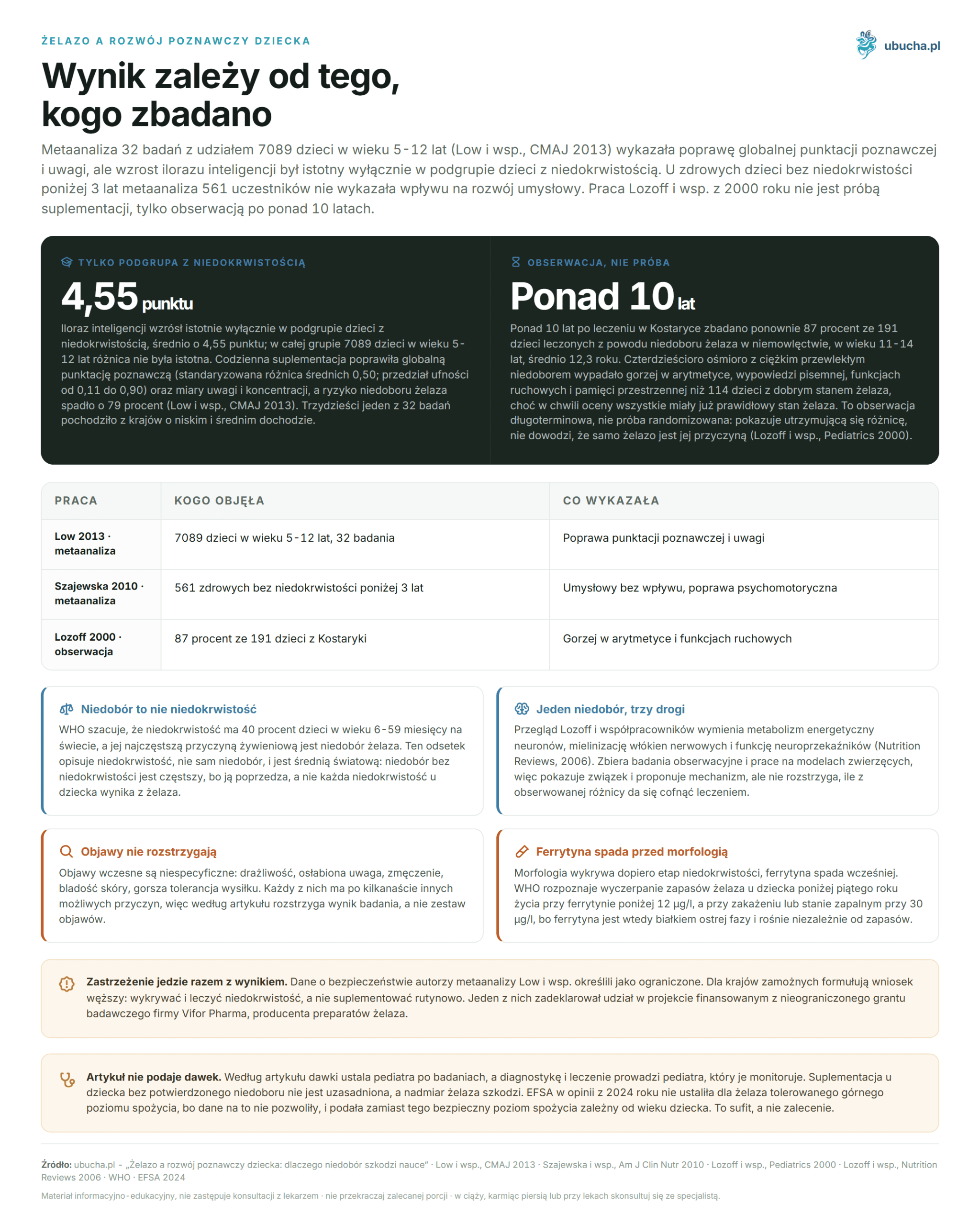
• In a meta-analysis of 32 studies involving 7089 children aged 5-12 years, supplementation improved overall cognitive scores, but the intelligence quotient significantly increased only in children with anemia (Low et al., CMAJ 2013).
• In healthy children without anemia under 3 years, a meta-analysis of 561 participants showed no impact on mental development (Szajewska et al., 2010).
• More than 10 years after treatment, children with severe chronic deficiency in infancy still performed worse in arithmetic and motor functions (Lozoff et al., Pediatrics 2000).
• WHO recognizes iron depletion in a child under five years of age with ferritin below 12 µg/l, and in inflammatory states at 30 µg/l.
How does iron deficiency change the developing brain?
Three pathways are mentioned together by the review of Lozoff and colleagues: through energy metabolism of neurons, through myelination of nerve fibers, and through neurotransmitter action (Nutrition Reviews, 2006). These are not three separate hypotheses, but three levels of the same deficiency.
Myelination involves surrounding nerve fibers with a sheath that speeds up signal conduction. It occurs most intensively in early childhood and requires iron. Iron is also needed for the enzymes of the respiratory chain, and neurons are among the most energy-consuming cells in the body.
The third mechanism concerns neurotransmitters. The review indicates dysfunction of their function as one explanation for long-term consequences. The studies collected in this review describe poorer cognitive, motor, and socio-emotional functioning in children with deficiency, as well as persistent neurophysiological differences observed from preschool age to adolescence.
The boundary of these findings is as important as the findings themselves. The review collects observational studies and work on animal models. It shows that a relationship exists and proposes its mechanism, but does not determine how much of the observed difference can be reversed by treatment. This question is only resolved by interventional studies.
How many children are affected according to WHO?
WHO states that 40 percent of children aged 6 to 59 months, 37 percent of pregnant women, and 30 percent of women aged 15 to 49 years worldwide have anemia. The most common nutritional cause is iron deficiency, although deficiencies of folates and vitamins B12 and A also play a role.
These percentages describe anemia, not iron deficiency itself, and are a global average. Iron deficiency without anemia is more common, as it precedes it. Conversely, the relationship is also not complete: not every anemia in a child results from iron.
This ambiguity is a source of constant misinterpretation in popular texts. The percentage of children with anemia is sometimes cited as the percentage of children with iron deficiency, and the global average as a regional figure. On the WHO page dedicated to anemia, there are no separate percentages for Central and Eastern Europe, so the numbers attributed to this organization for our region require verification at the source before someone repeats them.
The conclusion for a parent is simple. Global statistics say nothing about a specific child; the result of their examination determines it.
What have meta-analyses of supplementation in children really shown?
There are two, and they say different things because they studied different subjects. The work by Low and colleagues included 7089 children aged 5-12 years from 32 studies. The work by Szajewska and colleagues included healthy children without anemia under 3 years, with 561 participants in quantitative comparisons.
| Study | Who it included | What it showed |
|---|---|---|
| Low et al., CMAJ 2013 | 7089 children aged 5-12 years, 32 studies, 31 in low- and middle-income countries | improvement in overall cognitive scores and attention; significant increase in intelligence quotient only in children with anemia |
| Szajewska et al., Am J Clin Nutr 2010 | healthy children without anemia under 3 years, 561 participants in the meta-analysis | no impact on mental development and behavior; improvement in psychomotor development scale |
| Lozoff et al., Pediatrics 2000 | 87 percent of 191 children from Costa Rica, reassessed at ages 11-14 | persistent poorer performance in arithmetic, written expression, and motor functions |
In school-aged children, daily supplementation improved overall cognitive scores (standardized mean difference 0.50; confidence interval from 0.11 to 0.90) and measures of attention and concentration. The intelligence quotient significantly increased only in the subgroup of children with anemia, on average by 4.55 points; in the entire studied group, the difference was not significant. The risk of anemia decreased by half, and the risk of iron deficiency by 79 percent (Low et al., CMAJ 2013).
A caveat must be provided along with the result. Thirty-one of the 32 studies were conducted in low- and middle-income countries, and the authors described safety data as limited. For wealthy countries, they formulate a narrower conclusion: detect and treat anemia, rather than routinely supplement. One of the authors declared participation in a project funded by an unrestricted research grant from Vifor Pharma, a manufacturer of iron preparations.
The second picture concerns the youngest without anemia. Supplementation did not significantly affect the scale of mental development (weighted mean difference 1.66; confidence interval from minus 0.14 to 3.47), but improved the psychomotor development scale (4.21; from 2.31 to 6.12). No impact on behavior was found, nor on the effect of supplementation during pregnancy on the child’s intelligence quotient (Szajewska et al., The American Journal of Clinical Nutrition 2010).
Do deficits from infancy reverse?
Not fully, at least in the best-documented long-term observation. The study by Lozoff and colleagues included children from a suburban area of San Jose in Costa Rica, treated for iron deficiency in infancy and reassessed at ages 11 to 14 (Pediatrics, 2000).
87 percent of the original 191 participants were reassessed, averaging 12.3 years of age. At the time of this assessment, all children had normal iron status and were growing normally. Forty-eight children with severe chronic deficiency in infancy were compared with 114 children who had good iron status before or after treatment.
After accounting for background factors, differences remained significant in arithmetic achievements, written expression, motor functions, and some cognitive processes, including spatial memory. More children from this group repeated a grade or were referred for remedial classes. Parents and teachers consistently reported more problems with anxiety, mood, relationships, and attention.
It should be noted what this study does not prove. It is a long-term observation, not a randomized trial, so it shows a persistent difference between groups but does not prove that iron itself is the sole cause. The authors cautiously conclude that severe chronic deficiency in infancy indicates children who remain at risk for developmental and behavioral issues more than a decade after treatment.
How is iron deficiency diagnosed in a child?
By blood testing, not by sight. WHO recognizes iron depletion in a child under five years of age with ferritin below 12 µg/l, and with coexisting infection or inflammatory state at 30 µg/l, as ferritin is an acute phase protein and increases then regardless of stores.
Early symptoms are nonspecific: irritability, weakened attention, fatigue, pale skin, poorer exercise tolerance. Each has several other possible causes, so the test result determines it, not the set of symptoms. Morphology detects only the stage of anemia; ferritin drops earlier.
On the dietary side, the difference concerns the form of iron. Heme iron, from meat, poultry, and fish, is absorbed at 15-35 percent and is little dependent on the rest of the meal. Non-heme iron, from plants and fortified products, is absorbed at 2-20 percent and is strongly dependent on what is next to it: ascorbic acid raises it, while polyphenols, calcium, and phytates lower it (Abbaspour et al., 2014). The same mechanism governs absorption from oral preparations, described in the text about iron every other day.
The upper limit is provided by EFSA. In its opinion from 2024, it did not establish a tolerated upper level of intake for iron, as the data did not allow it, and instead provided a safe level of intake: from 10 mg per day for ages 1-3 years to 35 mg at ages 15-17 years, and for infants 4-11 months, 5 mg from fortified foods and supplements. This is a ceiling, not a recommendation.
Supplementation in a child without confirmed deficiency is not justified, and excess iron is harmful. Diagnosis and treatment are conducted by a pediatrician who monitors it. Which preparations for children make sense is described in a separate guide, and the risk of excess is discussed in an article on iron overload.
Frequently Asked Questions
How does iron deficiency affect a child’s brain?
A review by Lozoff and colleagues indicates three pathways: energy metabolism of neurons, myelination of nerve fibers, and neurotransmitter function. The observations collected describe poorer cognitive, motor, and socio-emotional functioning in children with deficiency, from preschool age to adolescence (Nutrition Reviews, 2006).
Does iron supplementation improve learning outcomes?
In a meta-analysis of 32 studies involving 7089 children aged 5-12 years, daily supplementation improved overall cognitive scores and attention measures. The intelligence quotient significantly increased only in anemic children, by 4.55 points. Thirty-one of the 32 studies were conducted in low- and middle-income countries.
Does iron help children who are not anemic?
In healthy children under 3 years without anemia, a meta-analysis of 561 participants did not show a significant impact on mental development or behavior. Improvement was noted in the psychomotor development scale. Supplementation during pregnancy did not affect the child’s intelligence quotient (Szajewska et al., 2010).
Can deficits from infancy be reversed?
In an observation from Costa Rica, children with severe chronic deficiency in infancy performed worse in arithmetic, written expression, and motor functions even at ages 11-14, despite having normal iron status at the time of assessment. This is an observation, not a randomized trial (Pediatrics, 2000).
At what ferritin level is deficiency indicated in a child?
WHO recognizes iron depletion in a child under five years of age with ferritin below 12 µg/l. With coexisting infection or inflammatory state, the threshold is raised to 30 µg/l, as ferritin is an acute phase protein. The result is interpreted by a pediatrician along with morphology.
How much iron does EFSA consider safe for children?
In 2024, EFSA did not establish an upper limit for iron, as the data did not allow it. It provided a safe intake level: from 10 mg per day for ages 1-3 years to 35 mg per day for ages 15-17 years, and for infants 4-11 months, 5 mg per day. This is a ceiling, not a recommendation.
This article is for informational and educational purposes and does not constitute medical advice. Before starting supplementation, consult a doctor, especially if you are taking medications regularly, are pregnant or breastfeeding, or have a chronic illness.
Author: Michał Waluk · Published: 2026-08-09 · Updated: 2026-08-16