
Iron for Fatigue in Women Without Anemia: The Key Ferritin Threshold
Ferritin below 50 µg/l and fatigue despite normal morphology: what did the Vaucher 2012 study measure, whose threshold is this, and who funded the trial.
Normal morphology, normal hemoglobin, yet fatigue persists. The question of whether iron is responsible for it has one well-measured answer: a randomized trial from 2012, in which 198 women with low ferritin and normal hemoglobin received either iron or placebo for 12 weeks. However, the results of this trial are often misrepresented online, along with the numbers and the ferritin threshold it refers to. This article shows exactly what was measured in it, whose threshold of 50 µg/l it really is, who it includes, what the study did not show, and who funded it. It also illustrates where the line is drawn between the inclusion criterion for one trial and the threshold for diagnosing deficiency, as these two numbers are often confused. The text does not replace diagnostics or a doctor’s decision about treatment.
KEY INFORMATION
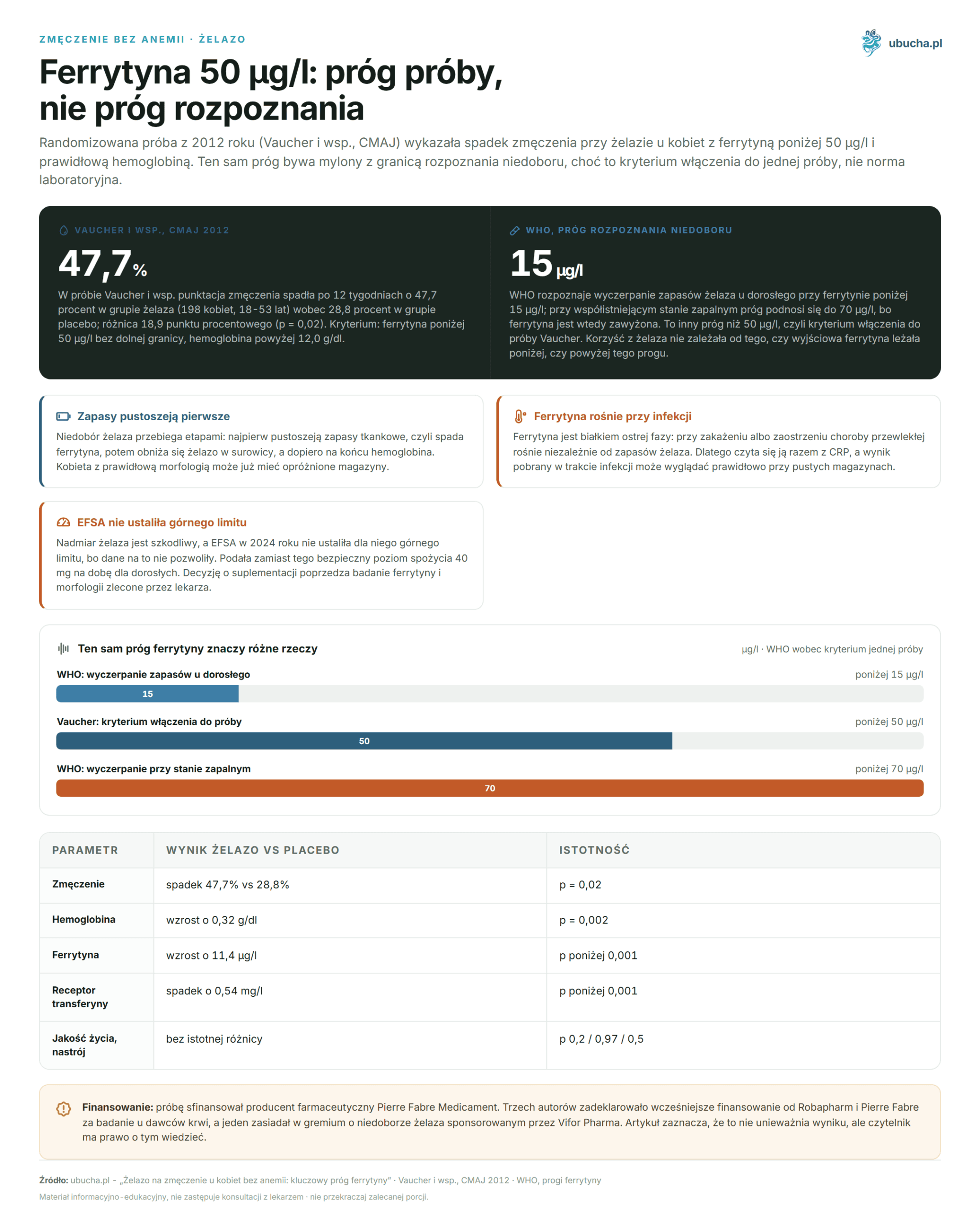
• In the Vaucher trial, fatigue scores decreased by 47.7 percent after 12 weeks in the iron group compared to 28.8 percent in the placebo group (CMAJ, 2012).
• The inclusion criterion was ferritin below 50 µg/l with hemoglobin above 12.0 g/dl; there was no lower limit for inclusion.
• WHO recognizes depletion of iron stores in an adult at ferritin below 15 µg/l, and with inflammatory condition at 70 µg/l.
• The study did not show an impact on quality of life, depressive symptoms, or anxiety, and the benefit did not depend on whether ferritin was below 15 µg/l.
• The trial was funded by the pharmaceutical manufacturer Pierre Fabre Medicament.
Why does ferritin drop earlier than hemoglobin?
Because hemoglobin is the last to give way. Iron deficiency occurs in stages: first, tissue stores are depleted, meaning ferritin drops, then serum iron decreases, and only finally does hemoglobin drop. A woman with normal morphology may therefore already have empty stores.
Ferritin is a protein that stores iron, and its concentration in serum reflects the size of these stores. Iron itself is needed not only for oxygen transport. It also participates in DNA synthesis and electron transport, which is involved in energy production in the cell (Abbaspour et al., Journal of Research in Medical Sciences 2014).
The most common cause of iron deficiency in women is heavy menstrual blood loss. This distinguishes this group from men and from postmenopausal women, in whom deficiency occurs less frequently and requires separate explanation by a doctor.
However, the ferritin result has a limitation that is easy to forget. Ferritin is an acute phase protein, so during infection or exacerbation of chronic disease, it rises independently of iron stores. Therefore, it is interpreted together with an inflammatory marker, most often with CRP, and a result obtained during an infection may appear normal despite empty stores.
What did the Vaucher study from 2012 measure?
It was a randomized placebo-controlled trial conducted in the practices of 44 family doctors in France. It included 198 women aged 18-53 who complained of fatigue and had ferritin below 50 µg/l with hemoglobin above 12.0 g/dl. One hundred two of them received 80 mg of elemental iron in the form of ferrous sulfate daily, ninety-six received placebo, for 12 weeks (Vaucher et al., CMAJ 2012).
The baseline ferritin was an average of 22.5 µg/l in the iron group and 23.3 µg/l in the placebo group. The primary endpoint was the fatigue score on the Current and Past Psychological Scale.
| Parameter after 12 weeks | Result in the iron group versus placebo |
|---|---|
| Fatigue score | decrease of 47.7 percent versus 28.8 percent; difference of 18.9 percentage points (p = 0.02) |
| Hemoglobin | increase of 0.32 g/dl (p = 0.002) |
| Ferritin | increase of 11.4 µg/l (p below 0.001) |
| Soluble transferrin receptor | decrease of 0.54 mg/l (p below 0.001) |
| Quality of life, depression, anxiety | no significant difference (p respectively 0.2; 0.97; 0.5) |
The authors’ interpretation is more cautious than the headlines that followed it. Supplementation should be considered for women with unexplained fatigue and ferritin below 50 µg/l, and effectiveness should be assessed through blood tests after six weeks. The statement about six weeks pertains to measuring blood markers, not the moment when the patient feels a difference.
Whose threshold is 50 µg/l and who does it include?
It is an inclusion criterion for one clinical trial, not a boundary for diagnosing iron deficiency. Its authors proposed in the summary the same value as a boundary for considering supplementation in menstruating women with unexplained fatigue. It is neither a laboratory norm nor a recommendation from a scientific society.
Diagnostic thresholds are provided by WHO and are clearly lower. In an adult, depletion of iron stores is diagnosed at ferritin below 15 µg/l, in children under five years at 12 µg/l. With concurrent infection or inflammatory condition, these thresholds rise to 70 and 30 µg/l respectively, as ferritin is then elevated.
Thus, between 15 and 50 µg/l lies an area where WHO does not yet speak of deficiency, while the Vaucher trial measured improvement in fatigue scores. These are two different questions: one about diagnosing a condition, the other about response to intervention. The same number in a child, in a pregnant woman, and during an infection means something different.
This is where the discrepancy that the patient sees in their own result comes from. A value around 20 µg/l may be printed as within the norm, even though it lies below the value that the authors of this trial indicated as the boundary for considering supplementation. The reference range describes the distribution of results in the reference population, not the point at which symptoms appear. This is determined by the doctor, who sees the whole picture. The very scheme of taking it is a separate issue, described in the text about iron taken every other day.
Who funded the study and what did it not show?
The trial was funded and sponsored by Pierre Fabre Medicament, a pharmaceutical manufacturer. Three authors declared previous funding from Robapharm and Pierre Fabre in a study on iron supplementation in blood donors, and one of them participated in a panel dedicated to iron deficiency, sponsored by Vifor Pharma. This does not invalidate the result, but the reader has the right to know.
The work itself is also more cautious than its popular summaries suggest. The improvement pertained to fatigue scores and indicators of iron metabolism. However, no significant impact was found on quality of life, the severity of depressive symptoms, or anxiety.
It was also not confirmed that the lower the ferritin, the greater the benefit. The authors checked this directly and stated that the effect of iron on fatigue, quality of life, and hemoglobin was independent of whether the baseline ferritin was below or above 15 µg/l.
One limitation is worth repeating separately. The study included menstruating women with unexplained fatigue and normal hemoglobin. It says nothing about men, postmenopausal women, or individuals whose fatigue has another, diagnosed cause. Fatigue persisting despite normal results requires diagnostics, not another supplement; we write more broadly about this in the text about chronic fatigue. The risk on the other side of the scale is discussed in a separate article on excess iron.
Frequently Asked Questions
Can you have fatigue from iron deficiency without anemia?
In the Vaucher study, 198 women aged 18-53 with ferritin below 50 µg/l and hemoglobin above 12.0 g/dl reported fatigue. After 12 weeks, fatigue scores decreased by 47.7 percent in the iron group compared to 28.8 percent in the placebo group (CMAJ, 2012).
What ferritin level is associated with fatigue in women?
The discussed trial included women with ferritin below 50 µg/l. This is the criterion of one study, not a diagnostic threshold. WHO recognizes depletion of iron stores in an adult at ferritin below 15 µg/l, and with concurrent inflammatory condition at 70 µg/l, as ferritin is then elevated.
How quickly can you see the effect of iron supplementation?
The authors proposed assessing effectiveness through blood tests after six weeks of treatment. This recommendation pertains to measuring markers, not the moment when the patient feels a difference. The study reports the endpoint after 12 weeks, and earlier fatigue measurements are not presented in the main text.
Does lower ferritin mean greater benefit from iron?
No. The authors checked this directly and stated that the effect of iron on fatigue, quality of life, and hemoglobin was independent of whether the baseline ferritin was below or above 15 µg/l. The intuition of greater benefit with deeper deficiency was not confirmed in this trial.
Is ferritin a better indicator than morphology?
They answer different questions. Morphology detects anemia, which is a late stage of deficiency. Ferritin describes tissue stores and decreases earlier. In the discussed trial, all participants had normal hemoglobin, yet supplementation raised it by an average of 0.32 g/dl compared to placebo.
Is iron supplementation without confirmed deficiency safe?
Excess iron is harmful, and EFSA in 2024 did not establish an upper limit for it, as the data did not allow for that. It provided a safe intake level of 40 mg per day for adults. The decision to supplement should be preceded by testing ferritin and morphology ordered by a doctor.
Supplements available in the store at Bucha are gathered in the supplements category, but none of them replaces ferritin testing or a conversation with a doctor about the cause of fatigue.
This article is for informational and educational purposes and does not constitute medical advice. Before starting supplementation, consult with a doctor, especially if you are taking medications regularly, are pregnant or breastfeeding, or have a chronic illness.
Author: Michał Waluk · Published: 2026-08-09 · Updated: 2026-08-16