
Convection vs Conduction vs Hybrid Vaporizer: How They Work (Table)
Convection, conduction, and hybrid in a vaporizer: what are the differences, how do they heat, what temperature makes sense, and what measurements have shown comparing vapor to smoke.
The heating method is one of the most important parameters of a vaporizer and also the most poorly described in stores. The difference between convection and conduction is not just a matter of terminology. It determines how quickly the device is ready, how evenly it delivers the load, and how much it costs. Additionally, there is temperature, around which a lot of repeated advice has accumulated without verification. The most popular of these, to start from the lower end of the range, diverges from the only measurement that compared vapor from a vaporizer with smoke at several settings. The result of this measurement is discussed below and is less obvious than most guides suggest. Below we break down the three heating systems into their components, show what has really been measured and what no one has checked so far, and suggest what to look for when purchasing a device.
KEY INFORMATION
• Convection heats the load with a stream of hot air, conduction through contact with a heated chamber, hybrid combines both mechanisms.
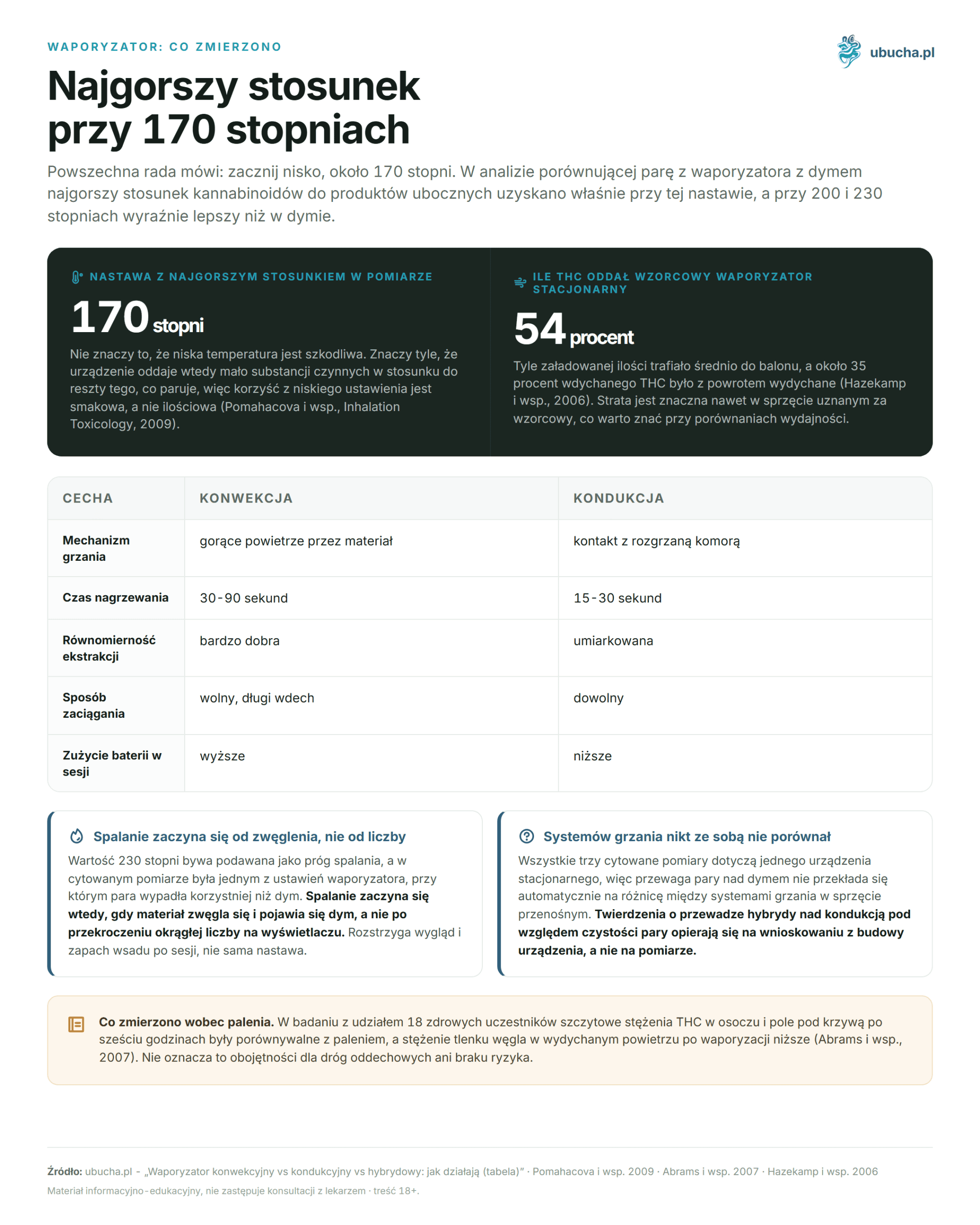
• In HPLC measurement, the ratio of cannabinoids to byproducts in vapor from a vaporizer was clearly better at 200 and 230 degrees than in smoke, and worst at 170 degrees (Pomahacova et al., Inhalation Toxicology, 2009).
• In a study involving 18 people, vaporization produced THC levels comparable to smoking with lower carbon monoxide levels in exhaled air (Abrams et al., Clinical Pharmacology and Therapeutics, 2007).
How does convection heating work in a vaporizer?
In a convection system, the heater heats the air, and only that air passes through the load. The material does not touch the heating element at any point. Heat is carried by the stream, so it reaches the entire volume of the chamber evenly, just like in an oven with convection.
The practical effect is even extraction. The load does not get scorched from the bottom or remain raw at the top, because there is no point with a temperature higher than the rest. The vapor is therefore cleaner in taste. The price is the way of inhaling: a convection device requires a slow and long inhale, because the airflow does the work. Jerky, short inhales give poor results in such equipment and can be mistaken for a defect in the device.
The second cost is in currency. The heating element must quickly raise the temperature of the flowing air and maintain it with varying inhalation intensity, which requires control and materials resistant to high temperatures. Therefore, with similar build quality, a convection vaporizer costs more than a conduction one. If you are just getting familiar with the construction of these devices, the entire mechanism is described in the post how a vaporizer works.
How does conduction heating work in a vaporizer?
Conduction is heating through contact. The material lies on a heated plate or adheres to the walls of the chamber and absorbs heat directly from them, just like food in a pan. This solution is simpler in design and therefore dominates in budget devices and some mid-range equipment.
The main advantage is the readiness time. A conduction chamber reaches its operating temperature in about fifteen to thirty seconds, because it does not need to heat the air stream, only the metal or ceramic itself. When using it outside the home, this difference is noticeable and can be more important than the quality of the vapor.
The weakness is unevenness. The part of the load touching the wall heats up faster than the one in the middle of the chamber, creating hotter spots than the rest. At higher settings, these can mean local charring of the material before the rest even starts to release vapor. This can be easily remedied: pack the load evenly, do not overfill the chamber, and mix the material halfway through the session. This works, but requires remembering to do it every time. The second practical effect of contact with the wall is that in a conduction chamber, the material starts to heat up as soon as the device reaches temperature, even when you are not inhaling. Therefore, sessions cannot be extended indefinitely with breaks in such equipment.
What are the differences between the three heating systems in the table?
The following comparison organizes the parameters that realistically differentiate these three solutions. Descriptive ratings refer to comparisons within the category of dry herb vaporizers and are not a reference to smoking. Heating times are typical ranges for portable devices, not specifications for a specific model.
| Feature | Convection | Conduction | Hybrid |
|---|---|---|---|
| Heating mechanism | Hot air through the material | Contact with a heated chamber | Combination of both methods |
| Heating time | 30-90 s | 15-30 s | 20-60 s |
| Purity of vapor taste | High | Medium | High |
| Evenness of extraction | Very good | Moderate | Good |
| Load utilization | High | Medium | High |
| Temperature control | Very precise | Good | Precise |
| Inhalation method | Slow, long inhale | Any | Moderately slow |
| Battery consumption per session | Higher | Lower | Medium |
| Who it suits | Those valuing vapor quality | Beginners, with a lower budget | Those looking for a compromise |
The price ranges in the table are intentionally absent. The ranges provided in guides refer to different markets and diverge from what is actually on the shelf. In the category of vaporizers at Bucha’s store, there are five models available in the range from 374 to 499 PLN (as of August 15, 2026).
Is a hybrid vaporizer the best compromise?
A hybrid combines both mechanisms in one chamber: the walls transfer heat through contact, while the passing air is heated at the same time. The material starts to work immediately after insertion, and the airflow adjusts the rest of the load later in the session. For most people using the equipment outside the home, this is a reasonable default choice.
However, it is worth naming the thing as it is: since in a hybrid the material touches the heated chamber, the risk of uneven heating does not disappear. It is limited because the airflow equalizes the temperature within the load, but the hybrid is not a contactless design. Assurances that there are no hotter spots than the rest are marketing, not a description of physics.
A hybrid also does not replace the best purely convection solutions. Stationary devices with a pump that pushes hot air allow maintaining a set temperature without the load touching the heating element, which provides the most consistent extraction. The difference is only noticeable when you care about consistency between sessions, not convenience.
It is also worth knowing what is not known about hybrids. None of the studies comparing vapor to smoke have compared heating systems, so claims of hybrid superiority over conduction in terms of vapor purity are based on inferences from the device’s construction, not measurements.
What vaporization temperature should you choose?
This is where guides often miss the mark. The common advice is: start low, around 170 degrees. Meanwhile, in HPLC analysis comparing vapor from a Volcano vaporizer with smoke from a hemp cigarette, the worst ratio of cannabinoids to byproducts was obtained precisely at 170 degrees, while clearly better than smoke at 200 and 230 degrees (Pomahacova et al., Inhalation Toxicology, 2009).
This does not mean that low temperature is harmful. It means that at 170 degrees, the device releases few active substances compared to the rest of what vaporizes, so the benefit of a low setting is taste rather than quantity. If you care about load efficiency, the middle of the working range is a better starting point than its lower limit.
It is also worth dispelling the number 230 degrees, which many guides cite as the combustion threshold. In the cited measurement, it was one of the vaporizer settings, and the vapor obtained at it performed better than smoke. Combustion begins when the material chars and smoke appears, not after exceeding a round number on the display. The appearance and smell of the load after the session determine this, not the setting itself. This topic is more broadly covered in the post what temperature to choose during vaporization.
We noticed when comparing store descriptions that adjusting by one degree is sometimes presented as an advantage in itself. In practice, what matters is whether the device maintains the set value under heavy inhalation, and you cannot read that from the product card.
What is the best material for the heating chamber?
Regardless of the heating system, the chamber is in contact with the vapor you inhale, so its material matters. Ceramic is the standard in higher-end equipment: it is chemically resistant within the working temperature range and provides a neutral taste. Surgical-grade stainless steel performs similarly in terms of safety, is cheaper, and more mechanically durable, although some users detect a slightly metallic taste in a new device. Titanium mainly appears in concentrate equipment.
The list of things to avoid is shorter and more specific: plastic components in the vapor path, aluminum chambers without coating, and cheap silicone seals right next to the heating element. At high temperatures, low-quality materials can release compounds you do not want to inhale.
A practical test before purchase is simple. Manufacturers who have something to boast about provide the material of the chamber and vapor paths directly in the technical description. Silence on this point does not prove anything in itself, but with heating equipment, it is a reason to ask the seller.
How to clean and maintain the heating chamber?
Cleaning applies equally to convection, conduction, and hybrid. Residues of material remain in the chamber after each session, oxidize at high temperatures, and over time change the taste of the vapor and clog the air paths. A sensible rhythm is quick cleaning every few sessions and a more thorough cleaning about once a month with daily use.
For a conduction chamber, a soft brush from the set and a cotton swab moistened with isopropyl alcohol are sufficient. A convection chamber additionally requires cleaning the air channels, as they determine the operation of this system. The screens near the chamber clog with dust and after some time restrict airflow enough that the device seems broken, although it just needs to be replaced.
Clean the mouthpiece most often, as it comes into contact with the mouth. Remove it, soak it in isopropyl alcohol, rinse it with warm water, and dry it completely before reassembling. Moisture left in the mouthpiece promotes the growth of microorganisms, especially when the equipment circulates among several people. The full procedure, divided into parts, is described in the post cleaning the vaporizer.
Stationary or portable vaporizer?
The division between heating systems intersects with the division between stationary and portable equipment, and these two axes can easily be confused. A stationary device is powered from a socket, so it can maintain a constant temperature without worrying about the battery and without compromises in the size of the heating element. There, pure convection with an air pump has the best conditions.
In portable equipment, each of these parameters is limited. The battery discharges, the heater must be small and light, and heating time becomes a parameter that determines whether the equipment is even used. Therefore, in this class, hybrids and conduction dominate: they are more energy-efficient and ready faster than full convection.
The choice comes down to one question: do you use the equipment in one place, or do you carry it with you? With constant access to a socket, it is worth considering a stationary device with convection. On the go, a hybrid or conduction will be more practical. There is no solution that is better overall, only better and worse matched.
What do measurements say about vaporization compared to smoking?
Vaporizers were created to release active substances without igniting the material, and thus without incomplete combustion products. The most frequently cited measurement is the Abrams study: 18 healthy participants in a hospital setting compared the Volcano vaporizer with hemp smoked in a cigarette, at three different THC contents, over six days of study. Peak THC levels in plasma and area under the curve after six hours were comparable, while carbon monoxide levels in exhaled air after vaporization were lower (Abrams et al., Clinical Pharmacology and Therapeutics, 2007).
Additionally, there is the measurement of the device itself. Hazekamp and colleagues checked how much THC the Volcano actually delivers: on average, about 54% of the loaded amount reached the balloon, and about 35% of inhaled THC was exhaled again (Hazekamp et al., Journal of Pharmaceutical Sciences, 2006). This is an important context for performance comparisons: the loss is significant even in stationary equipment considered exemplary.
What these studies do not say: none of them compared convection with conduction. All three cited measurements concern one stationary device, so the advantage of vapor over smoke does not automatically translate into a difference between heating systems in portable equipment. This comparison simply has not been published yet. A comparison of vaporization itself with other methods of use is detailed in the post bong vs vaporizer vs joint.
What to pay attention to when buying a vaporizer?
Start with the heating system and match it to how you plan to use the equipment, not to what sounds better in the description. The second point is the range and method of temperature regulation: smooth adjustment offers more possibilities than a switch with three levels, as long as the device maintains the value under load. The third is the material of the chamber, where ceramic and stainless steel are a reasonable minimum.
Next come things that are only thought of after purchase: battery capacity and charging time, weight and size, compatibility with a water adapter if you want to connect the equipment to a bong, and the availability of consumable parts. Screens and seals are replaced regularly, so the lack of spare parts shortens the life of the device more than any malfunction.
Finally, warranty and service. A vaporizer is a heating device used daily, and the heating element is its most stressed part. Before you pay, check the warranty period in the product card and who handles repairs in Poland. A short warranty on electronics of this class is a warning sign.
Frequently Asked Questions
What is the difference between a convection vaporizer and a conduction vaporizer?
In a convection vaporizer, hot air flows through the material and the load does not touch the heating element. In a conduction vaporizer, the material lies on a heated surface and absorbs heat through contact. Convection provides more even extraction and a cleaner taste, while conduction heats up faster, uses less energy, and is cheaper to produce.
Which type of vaporizer is better for beginners?
Usually conduction or hybrid: they heat up in about fifteen to sixty seconds, cost less, and forgive mistakes in inhalation. A convection vaporizer requires a slow, long inhale and some practice, but in return provides more even extraction and more precise temperature control.
Is a hybrid vaporizer better than a convection vaporizer?
Not always, although it can be more convenient. A hybrid heats the load with contact and air at the same time, so it starts up faster than pure convection. Since the material still touches the heated chamber, heating inconsistencies are limited, but not eliminated. The most consistent extraction is provided by stationary devices with full convection.
What is the best temperature for vaporizing herbs?
It depends on the purpose, but the lower end of the range is not a safe default choice. In HPLC analysis, the ratio of cannabinoids to byproducts was worst at 170 degrees, and better at 200 and 230 degrees than in smoke (Pomahacova et al., Inhalation Toxicology, 2009). Low settings provide a lighter taste at the expense of load efficiency.
How long does it take for a convection vaporizer to heat up?
Convection devices usually need thirty to ninety seconds, conduction devices from fifteen to thirty, and hybrids fall in between. These are typical ranges for portable equipment; the specific time depends on the model, power of the heating element, and chamber capacity, so check it in the product card.
Is vaporization better than smoking?
In terms of combustion products, measurements favor vaporization. In a study involving 18 people, THC levels in plasma were comparable to smoking, while carbon monoxide levels in exhaled air were lower (Abrams et al., Clinical Pharmacology and Therapeutics, 2007). This does not mean it is harmless to the respiratory system or without risk.
This article is for informational and educational purposes. It contains internal links to product categories available in Bucha’s store. Prices and specifications may change: check the current data on the product page before purchasing.
Author: Michał Waluk · Published: 2026-08-09 · Updated: 2026-08-15