
Supplements for Autumn and Immunity: What to Take to Survive Winter Without Getting Sick
Vitamin D, zinc, vitamin C, elderberry, quercetin, and probiotics compared to what studies have really shown. No dosages to measure and no promises.
Every autumn, millions of Poles reach for immunity supplements, hoping this season will be better than the last. Some of these ingredients have solid research behind them, while others rely solely on tradition and advertising budgets, and the line between the two rarely falls where the packaging suggests. This text organizes the six most commonly purchased items according to what randomized studies and meta-analyses have shown: how many people were involved, how long the observation lasted, and what the outcome was. Separately, we indicate what is not worth buying and what provides more than the rest combined. You will not find a dosage table or a ready protocol for the season here, as the amount is determined by a doctor based on testing, not an article based on a calendar.
KEY INFORMATION
• A meta-analysis of 25 randomized studies involving 11,321 people showed that vitamin D reduces the risk of acute respiratory infections, most strongly in individuals with severe deficiency.
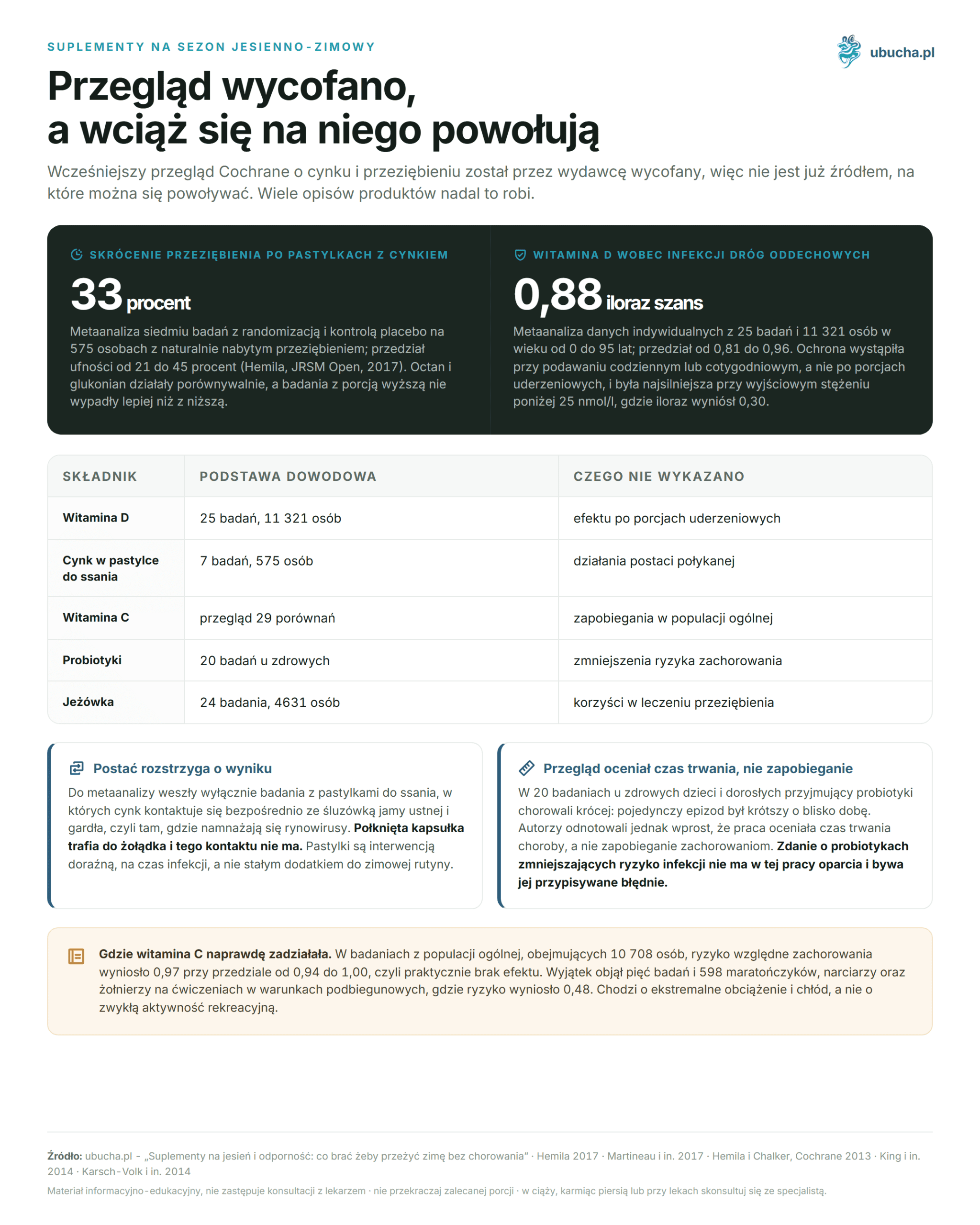
• Zinc lozenges shortened the duration of a cold by 33 percent in a meta-analysis of seven studies involving 575 people.
• Vitamin C does not prevent colds in the average person; it shortens them by 8 percent in adults and 14 percent in children.
• A Cochrane review of 24 studies involving 4,631 participants found no benefits from echinacea in treating colds.
• This text does not provide dosages to measure. The numbers describe the course of studies, not recommendations for the reader.
Why is vitamin D at the top?
Because it is the only one on this list with evidence from a meta-analysis of individual participant data, which is the strongest form of research synthesis. The analysis included 25 randomized studies with double-blind trials involving 11,321 people aged 0 to 95 years. Vitamin D supplementation reduced the risk of acute respiratory infections, with an adjusted odds ratio of 0.88 and a confidence interval from 0.81 to 0.96 (Martineau et al., BMJ, 2017).
Two details from this study change the picture more than the number itself. Protection occurred in individuals taking vitamin D daily or weekly, not in those receiving single large doses. In this very group, the effect was significantly stronger in individuals with a baseline level of 25(OH)D below 25 nmol/l, where the odds ratio was 0.30 with a confidence interval from 0.17 to 0.53. Above this threshold, the benefit was much smaller, with an odds ratio of 0.75.
In Poland, this is significant because from October to March, the angle of sunlight practically excludes skin synthesis, and deficiency is common in the population (Płudowski et al., Nutrients, 2023). The reference point for safety is the upper tolerable intake level established by EFSA: 100 micrograms per day for adults, reaffirmed in the 2023 opinion (EFSA Panel on Nutrition, 2023). This is a ceiling that should not be exceeded, not a recommendation.
Does zinc really shorten a cold?
In a specific form, yes, and it is one of the better-calculated effects in the entire category. A meta-analysis of seven randomized studies with placebo control, involving 575 people with naturally acquired colds, showed a reduction in symptom duration by an average of 33 percent, with a confidence interval from 21 to 45 percent (Hemila, JRSM Open, 2017).
Form is crucial here. Only studies with lozenges were included in the analysis, where zinc directly contacts the mucosa of the mouth and throat, where rhinoviruses multiply. A swallowed capsule goes to the stomach, and that contact does not occur. The author also checked whether the form of the salt and the size of the dose changed the outcome: acetate and gluconate worked comparably, and studies with a higher dose did not perform better than those with a lower dose.
It should also be noted that there is a caveat that advertisements do not repeat. An earlier Cochrane review on zinc and colds, which many product descriptions still refer to, has been withdrawn by the publisher, so it is no longer a source that can be cited. Zinc lozenges are an emergency intervention, for the duration of the infection, not a permanent addition to the winter routine. More about the element itself is discussed in the post zinc for immunity and acne.
Does vitamin C prevent colds?
In the average person, it does not prevent, and this is a result repeated on the largest sample in this field. A Cochrane review included 29 comparisons involving 11,306 participants. In studies from the general population, involving 10,708 people, the relative risk of illness was 0.97 with a confidence interval from 0.94 to 1.00, indicating practically no effect (Hemila and Chalker, Cochrane, 2013).
The exception is narrow and clear. In five studies involving a total of 598 marathon runners, skiers, and soldiers in training under polar conditions, the relative risk was 0.48 with a confidence interval from 0.35 to 0.64, meaning about half as many illnesses. This concerns extreme physical stress and cold, not ordinary recreational activity.
However, the duration of illness changes. With continuous intake, in the studies included in the review, the duration of a cold was shortened by 8 percent in adults and 14 percent in children. It is worth noting what this effect is based on: it concerns continuous use before illness onset. In seven studies where vitamin C was administered only after symptoms appeared, no consistent effect was found at all.
How much does sleep matter for immunity?
More than would be suggested by the proportion of space that supplement packaging devotes to this topic. In an experimental study, 164 healthy individuals aged 18 to 55 wore a motion sensor measuring sleep for a week, after which they were quarantined and infected with rhinovirus administered nasally. For the next five days, they were observed to see who would develop cold symptoms (Prather et al., Sleep, 2015).
The result was unequivocal in direction. Individuals sleeping less than five hours had an odds ratio of 4.50, and those sleeping five to six hours had an odds ratio of 4.24, compared to those sleeping more than seven hours. With sleep of six to seven hours, there was no longer a difference. The confidence intervals were very wide, which is not surprising with 164 participants, so the exact size of the effect remains uncertain, though the direction does not.
The relationship held after accounting for antibody levels before infection, season, body mass, and health habits. Sleep fragmentation, unlike its length, had no association with illness. The practical conclusion is uncomfortable for the entire category of purchases: none of the preparations on this list has an effect of this scale.
Does elderberry really work?
It has one well-described and clearly limited randomized study. Sixty patients aged 18 to 54, with flu-like symptoms lasting no longer than 48 hours, received elderberry syrup or placebo for five days. Symptoms resolved in the elderberry group on average four days earlier, and patients used fewer emergency medications (Zakay-Rones et al., Journal of International Medical Research, 2004).
The authors themselves noted that the result requires confirmation in a larger study, and for two decades, no such confirmation of comparable strength has emerged. It also concerns a strictly defined situation: treatment of an already initiated flu infection, not preventive sipping of syrup throughout the winter. In this latter role, the data is much weaker.
Separately, it is worth remembering the safety of the raw material. Raw elderberries and leaves contain cyanogenic glycosides and can cause nausea and vomiting, which is why only preparations from thermally processed raw material are used. A comparison with a related raw material can be found in the post aronia and elderberry for immunity.
What is known about quercetin?
Much less than its presence in immunity preparations suggests. The most frequently cited human study involved 40 trained cyclists, randomly assigned to quercetin or placebo. The preparation was taken for three weeks, including a three-day block of very intense cycling. In the two weeks following this block, one person out of twenty in the quercetin group developed an upper respiratory infection, compared to nine out of twenty in the placebo group (Nieman et al., Medicine and Science in Sports and Exercise, 2007).
The authors also checked whether this could be explained by an improvement in immune parameters, and no such improvement was found. NK cell activity, lymphocyte proliferation, and immunoglobulin A secretion in saliva did not differ between groups. The mechanism of the observed effect remains undetermined.
The study group was small and very specific, as it involved athletes after deliberately induced training overload. Transferring this result to a person who goes to work in the fall and occasionally jogs has no basis in the data. Quercetin thus remains in the category of promising, not confirmed.
Do probiotics support immunity in winter?
They affect the course of infections, not whether one will occur, and this difference is significant here. A systematic review included 20 randomized studies in healthy children and adults. Participants taking strains from the Lactobacillus and Bifidobacterium genera were ill for a shorter duration: the number of days of illness per person was lower, and a single episode was shorter by nearly a day (King et al., British Journal of Nutrition, 2014).
The authors noted directly that the shortening of illness was not associated with an increase in the number of episodes, but also that the review assessed duration, not prevention of illness. The statement about probiotics reducing the risk of infection is not supported in this work and is sometimes incorrectly attributed to it.
The number of days absent from school or work also decreased. However, the heterogeneity between studies was large, and it could not be explained by subgroup analysis, which the authors themselves indicate as a reason for caution. How to choose a strain and why the form of the preparation matters is discussed in the post probiotic for the intestines: how to choose a strain.
What is not worth buying for immunity?
Echinacea, if you expect a therapeutic effect. A Cochrane review included 24 studies with double-blind trials and 4,631 participants. None of the twelve comparisons regarding prevention showed a statistically significant difference, and of the seven studies measuring the duration of colds, only one showed an effect (Karsch-Volk et al., Cochrane, 2014).
The authors allow for the possibility of a weak preventive benefit from some preparations, as the results of preventive studies aligned in one direction, though not significantly. They themselves define the clinical significance of such an effect as questionable. A separate problem is that under one name, preparations from different species and different parts of the plant, with varying compositions, are hidden.
The second item is preparations from bovine colostrum advertised as a source of antibodies. Immunoglobulins are proteins and are subject to digestion in the stomach and intestine, and the intestine of an adult human does not allow them to pass in an intact form as a newborn’s intestine does. The third is very high doses of vitamin C, where excess is excreted in urine, increasing the risk of osmotic diarrhea and oxalate stone formation.
What to start with instead of buying everything at once?
By determining whether there is anything to supplement at all. The only item on this list that makes sense as a constant action throughout the season is vitamin D, and its justification comes from a blood test result, not from the calendar. Testing the level of 25(OH)D costs less than several months of blind supplementation and allows the doctor to tailor the approach to the individual.
The rest of the substances described above are emergency or conditional interventions. Zinc lozenges and elderberry have data for the onset of infection, not for continuous use. Probiotics shorten the duration of illness but do not reduce the chance of getting sick. Quercetin has one study in athletes. None of these items requires buying in advance for the entire winter.
Things that have shown the greatest effect in studies are not supplements. Sleep shorter than six hours was associated in the study with rhinovirus infection with several times higher odds of getting sick. This is a reference point against which a few percent shortening of a cold seems modest. More broadly about the entire approach, we write in the post how to improve the body’s immunity, and you can find the preparations in the supplements category.
Frequently Asked Questions
When to start supplementation for the autumn-winter season?
For vitamin D, the starting point is testing the level of 25(OH)D, preferably before the season, as from October, skin synthesis in Poland practically ceases. Zinc lozenges and elderberry have data for the onset of infection, not for continuous use throughout the winter.
Does vitamin D protect against respiratory infections?
A meta-analysis of 25 studies involving 11,321 people showed a reduced risk of acute respiratory infections, with an adjusted odds ratio of 0.88. The effect was strongest in individuals with a baseline level of 25(OH)D below 25 nmol/l and only with daily or weekly administration.
Does zinc shorten the duration of a cold?
In a meta-analysis of seven studies involving 575 people, zinc lozenges shortened the duration of a cold by 33 percent, with a confidence interval from 21 to 45 percent. The effect applies only to lozenge forms, as swallowed capsules do not contact the throat mucosa.
Does elderberry really work for the flu?
In a randomized study of sixty patients with flu-like symptoms, elderberry syrup reduced symptoms by an average of four days compared to placebo. This is one study from two decades ago, concerning treatment of an ongoing infection, not prevention throughout the season.
Does vitamin C prevent colds?
In the average person, no: in a Cochrane review, the relative risk was 0.97 with a range from 0.94 to 1.00. It shortens the illness by 8 percent in adults and 14 percent in children. The exception is individuals under extreme physical stress and cold.
Do probiotics reduce the risk of infections in winter?
A review of 20 randomized studies showed a reduction in the duration of illness by nearly a day and fewer days of absence, but it assessed the course of infections, not their prevention. The claim of reduced risk of illness is not supported in this work.
This article is for informational and educational purposes and does not replace consultation with a doctor. If you are pregnant, breastfeeding, taking medications, or have chronic conditions, consult the use of supplements or herbs with a specialist.
Author: Michał Waluk · Published: 2026-06-22 · Updated: 2026-08-11