
Biohacking for Beginners: 5 Supplements to Start with in 2026
Five supplements most often recommended for beginners, compared with what has actually been shown in humans. No promises, no doses, with sources provided.
Biohacking promises that you can outsmart your own biology with a capsule. The data says otherwise. In a cohort of 19,893 adults observed for nearly 16 years, those who adopted a complete set of five basic habits had a mortality risk of 0.37 compared to those who did not adopt any. No supplement comes close to such an effect. This does not mean that supplements are useless: they make sense where they complement a measured deficiency or have a measurable effect on people. This text goes through five substances most often recommended for beginners and separates what has been shown in human studies from what comes from cell cultures, mice, or directly from sales materials.
KEY INFORMATION
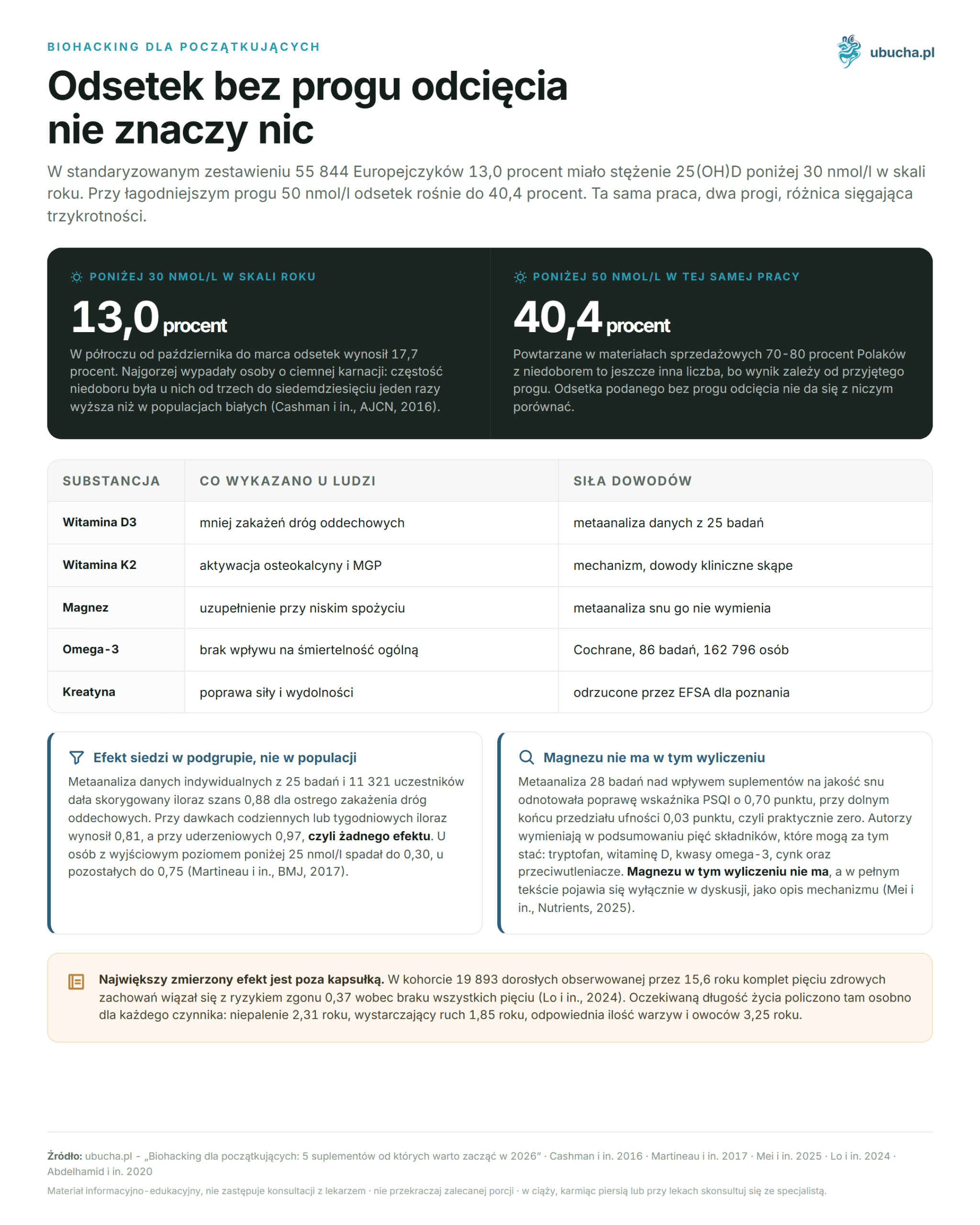
• In a standardized assessment of 55,844 Europeans, 13.0% had a 25(OH)D concentration below 30 nmol/l over the year, and 17.7% in the six months from October to March (Cashman et al., AJCN, 2016).
• Vitamin D supplementation reduced the risk of respiratory infections by 12%, but the clear effect was only observed in individuals with initially very low levels.
• EFSA concluded in 2024 that a causal relationship between creatine and improved cognitive function has not been demonstrated.
• A Cochrane review involving 162,796 participants found no effect of omega-3 fatty acids from capsules on overall mortality.
Do supplements really “hack biology”?
No. The greatest measured impact on lifespan comes from habits, not capsules. In a Taiwanese cohort of 19,893 adults observed for 15.6 years, the complete set of five healthy behaviors was associated with a mortality risk of 0.37 compared to the absence of all five (Lo et al., JMIR Public Health and Surveillance, 2024).
These five behaviors are not smoking, sufficient physical activity, appropriate intake of fruits and vegetables, moderation in alcohol, and maintaining a proper body weight. In the same study, the expected lifespan was calculated separately for each factor: not smoking provided 2.31 years, sufficient movement 1.85 years, and an appropriate amount of fruits and vegetables 3.25 years. To this list, sleep should be added, which the authors did not measure but which affects recovery, immunity, and mood.
A supplement works on a different scale. Even a well-documented intervention, such as administering vitamin D for the prevention of respiratory infections, yields a change in risk of several percent in the population. This is a real effect, but it is not “hacking biology”; it is merely closing a nutritional gap.
Therefore, the order matters. If you sleep five hours, do not exercise, and smoke, a supplementation protocol costing 250 PLN per month will not make up for those losses. A sensible sequence looks the opposite of what most guides suggest: first sleep and movement, then diet, and only at the end supplementing what the diet and sunlight do not provide.
We have noticed while organizing texts about supplements that the most frequently repeated mistake is not choosing the wrong product but buying a supplement instead of solving the problem that caused it.
Who really needs vitamin D3 with K2?
Primarily individuals with low baseline levels. In a standardized assessment of 55,844 Europeans, 13.0% had a 25(OH)D concentration below 30 nmol/l over the year, and in the six months from October to March, 17.7% (Cashman et al., American Journal of Clinical Nutrition, 2016). With a milder threshold of 50 nmol/l, the percentage rises to 40.4%. The worst results were seen in individuals with dark skin: the frequency of deficiency was from three to seventy-one times higher than in white populations.
This number explains why vitamin D tops most lists. At the latitude of Poland, skin synthesis under UVB radiation in winter months is negligible, and diet covers only a small part of the demand. The repeated claim in sales materials that “70-80% of Poles are deficient” is, however, a different number than the above, as the result depends on the threshold used, and with two thresholds from one study, the difference can reach threefold. The percentage of deficiency given without a cutoff threshold means nothing and cannot be compared to anything.
As for the effect: a meta-analysis of individual data from 25 studies and 11,321 participants showed that supplementation reduced the risk of acute respiratory infections (adjusted odds ratio 0.88). The distribution of this effect is instructive. With daily or weekly doses, the odds ratio was 0.81, while with bolus doses, it was 0.97, indicating no effect. In individuals with baseline levels below 25 nmol/l, the odds ratio dropped to 0.30, while in others, it was 0.75 (Martineau et al., BMJ, 2017).
Vitamin K2 is added to D3 due to the mechanism, not a hard clinical outcome: K2 activates osteocalcin and MGP, which direct calcium to the bones. Randomized studies with hard endpoints for the combination of D3 and K2 are few, so treat this as a reasonable precaution, not as a proven benefit. You can find preparations with D3 and K2 in the supplements section.
What does magnesium do, and what does it not do?
Magnesium is a cofactor for hundreds of enzymatic reactions and is involved in ATP production and nerve conduction. This is a biochemical fact. The conclusion that adding magnesium will improve sleep for everyone does not follow from this, and the evidence from human studies is less robust than the popularity of this supplement suggests.
Let’s start with diagnostics, as this is where the myth is most persistent. Measuring magnesium in serum tells little about body resources: about 1% of the total pool is found in the blood, while the rest is stored in bones and inside cells. A normal result does not rule out intracellular deficiency, and an abnormal one usually indicates an advanced problem. The repeated figure of “60-80% of the population has magnesium deficiency” describes something different than it suggests: it comes from consumption assessments against dietary norms, not from measurements of nutritional status in people. Lower than normal consumption and identified deficiency are two different things.
The form of the preparation mainly affects tolerance. Magnesium oxide is poorly absorbed and often causes loose stools. Organic salts, such as citrate, lactate, and glycinate, are better absorbed and less likely to irritate the gastrointestinal tract. Threonate is sometimes marketed as “reaching the brain,” but human studies are few and small.
A meta-analysis of 28 randomized studies on the impact of supplements on sleep quality noted an improvement in the PSQI score of 0.70 points, with the lower end of the confidence interval being 0.03 points, which is practically zero (Mei et al., Nutrients, 2025). In the summary, the authors list five ingredients that may be responsible: tryptophan, vitamin D, omega-3 fatty acids, zinc, and antioxidants. Magnesium is not included in this list. In the full text of the paper, it appears only in the discussion as a description of the mechanism, not as a position counted in the analysis.
Do omega-3 capsules protect the heart and brain?
Not in the way the label promises. A Cochrane review included 86 randomized studies and 162,796 participants and found no effect of long-chain omega-3 fatty acids on overall mortality (relative risk 0.97) or cardiovascular events (0.96), in both cases with high certainty of evidence (Abdelhamid et al., Cochrane Database of Systematic Reviews, 2020). For stroke, the result was 1.02, and the certainty of evidence was rated as moderate.
The signals that survived this analysis are two, and both are weak: a slight reduction in deaths from coronary disease and coronary events, in both cases with low certainty of evidence. The authors state how many people need to be included in the intervention to prevent one event: 334 for coronary deaths and 167 for events. The third finding is stronger but concerns something else: capsules lower triglycerides by about 15%, depending on the dose, with high certainty of evidence. All of this is far from the slogan “foundation for the heart.”
It is worth separating two things that marketing combines. Consumption of fatty fish is associated in observational studies with better health outcomes, but fish is not just EPA and DHA: it also contains protein, iodine, selenium, and vitamin D, and often also what was not eaten instead of it. A capsule isolates two fatty acids from this context and performs much worse in randomized studies.
Where capsules still have justification: in individuals who do not eat fish at all and in vegans, for whom the source of DHA is algae. You can assess the quality of the preparation by the declared content of EPA and DHA per serving and the TOTOX oxidation index, provided in the analysis certificate. Keep the oil in the fridge after opening.
Does ashwagandha actually lower cortisol?
One randomized study says yes, but it is one small study. Chandrasekhar and colleagues administered a high-concentration root extract to 64 individuals with chronic stress for 60 days. Serum cortisol levels dropped by 27.9% compared to 7.9% in the placebo group, and the perceived stress score dropped by 44.0% compared to 5.5% (Chandrasekhar et al., Indian Journal of Psychological Medicine, 2012).
The limitations are obvious. There was only one center, and the sample was small. The authors declare in the paper a lack of funding source and no conflict of interest, but in the methods description, they state that the used preparation is the KSM-66 extract provided by Ixoreal Biomed. Reductions of 70-80% in subscale scores are unusually large for a herbal intervention and warrant treating the result cautiously until it is replicated by an independent team.
A newer meta-analysis of 20 studies with 1,249 participants found moderate effects for memory (standardized mean difference 0.52), attention and processing speed (0.29), and muscle strength (0.58), as well as a slight increase in testosterone (0.33) (Zhu et al., Frontiers in Pharmacology, 2026). Subgroup analyses tell more than the overall result: strength gains were observed only in physically active individuals, where the effect was 1.03, and in non-trained individuals, it did not occur at all. Body mass and percentage of body fat did not change in any group.
A separate issue is endurance. In a study by Choudhary et al. involving 50 healthy active adults, the average increase in VO2max after eight weeks was 4.91 compared to 1.42 in the placebo group, and after twelve weeks, it was 5.67 compared to 1.86 (Choudhary et al., Ayu, 2015). The percentages circulating online do not correspond to what this paper reports: it reports absolute gain, not relative, and no percentage value can be read from it. Look for ashwagandha and other adaptogens in the herbs section.
What is known about creatine, and what is overinterpretation?
Creatine has solid evidence for improving exercise performance and strength gains. The International Society of Sports Nutrition considers monohydrate safe and effective in this regard for healthy adults (Kreider et al., JISSN, 2017). The problem arises with promises regarding the brain.
The EFSA panel considered in 2024 a health claim linking creatine to improved cognitive function and rejected it. In the panel’s assessment, the effect on working memory appeared only with very high intake for several days, disappeared with lower and continuous use, and studies in sick individuals did not confirm any effect. The conclusion was: no causal relationship was demonstrated (EFSA Journal, 2024).
A meta-analysis of 16 studies with 492 participants from the same year yielded similar results. A slight improvement in memory (standardized mean difference 0.31) and attention time was noted, but no improvement in overall cognitive performance or executive functions was found (Xu et al., Frontiers in Nutrition, 2024).
An earlier systematic review of six studies with 281 participants adds an important detail: in young individuals, cognitive test results remained unchanged, and vegetarians responded better than meat-eaters, but only in memory tasks; in other areas, there was no difference (Avgerinos et al., Experimental Gerontology, 2018). This fits the mechanism of replenishing stores rather than boosting them beyond normal. Creatine is currently not available in Bucha’s assortment, so we do not sell this item and have no reason to exaggerate it.
Why not start with NMN and resveratrol?
Because one of them does not yet have approval to enter the EU market, and the other barely reaches the bloodstream. NMN, or nicotinamide mononucleotide, is subject to new food regulations in the EU. In 2026, the EFSA panel assessed synthetic beta-NMN as safe as a source of niacin, at a dose of up to 300 mg per day, for adults excluding pregnant and breastfeeding women (EFSA Journal, 2026). However, the EFSA opinion is an assessment of safety, not a trading permit. For an ingredient to legally hit the shelf, the European Commission must list it on the EU list of new foods through a separate regulation, and that step has not yet been taken.
The assessment of effectiveness is also not encouraging. A meta-analysis of randomized studies on NMN and nicotinamide riboside in individuals aged 61 to 83 found no effect on muscle mass, grip strength, or walking speed (Prokopidis et al., Journal of Cachexia, Sarcopenia and Muscle, 2025). A broader meta-analysis of NAD+ precursors showed an improvement in the lipid profile, but it was mainly due to niacin, not NMN, and was accompanied by an increase in blood glucose levels (Zhong et al., Nutrition and Metabolism, 2022). In healthy individuals, the authors saw almost nothing.
Resveratrol has a different problem. In a study with an isotopically labeled compound, absorption of an oral dose of 25 mg was at least 70%, but only trace amounts of unchanged resveratrol were detected in the plasma, below 5 ng/ml; the rest was already conjugated with sulfate or glucuronic acid (Walle et al., Drug Metabolism and Disposition, 2004). Good absorption does not equate to tissue availability. The loud results about lifespan extension come from yeast, nematodes, and mice, and attempts to transfer them to humans yield inconsistent results.
The organizing principle is simple: a substance from small studies on animal models goes to the end of the list, not the beginning. Before you spend hundreds of PLN a month on a molecule on the edge of research, check if you have filled in what can be measured with a cheap blood test.
How to introduce supplements to know what works?
Individually and with a reference point. If you start five preparations in the same week, you will not determine which improved sleep and which caused loose stools. Introduce one at a time at two-week intervals and record a few simple indicators before starting and after eight weeks.
For the journal, four columns are sufficient: sleep hours, subjective energy in the morning on a scale from one to five, concentration ability in the afternoon, and symptoms you want to track. This is cheaper than any tracker and much more related to your question. For vitamin D, add a measurement of 25(OH)D before starting and after three months, as here the measurement really makes a difference.
| Substance | What has been shown in humans | Strength of evidence |
|---|---|---|
| Vitamin D3 | Lower risk of respiratory infections, clearly only at low baseline levels | Meta-analysis of individual data, 25 studies |
| Vitamin K2 | Activation of osteocalcin and MGP, no hard endpoints for the combination with D3 | Mechanism, clinical evidence scarce |
| Magnesium | Supplementation with low intake, impact on sleep less than repeated | Meta-analysis of sleep does not mention magnesium in conclusions |
| Omega-3 | No effect on overall mortality and cardiovascular events | Cochrane, 86 studies, 162,796 people |
| Ashwagandha | Decrease in cortisol and stress scale scores, moderate cognitive effects | Small studies, extract provided by the manufacturer |
| Creatine | Improvement in strength and performance, no demonstrated effect on overall cognitive performance | Strong for exercise, rejected by EFSA for cognition |
Discontinue the preparation for four weeks after a quarter of use and compare your notes. If nothing changes, you have your answer and savings. Our experience with organizing such lists is that after such a trial, usually two items remain, not five.
Frequently Asked Questions
What should beginners start with in biohacking?
Start with habits, not capsules. In a cohort of 19,893 adults, the complete set of five healthy behaviors, namely not smoking, physical activity, consuming fruits and vegetables, moderation in alcohol, and maintaining a proper body weight, was associated with a mortality risk of 0.37 compared to those who did not follow any of the five. Supplements only make sense as a complement to a measured deficiency.
Is a blood test necessary before supplementation?
For vitamin D, it makes sense, as the concentration of 25(OH)D in serum is a cheap and reliable indicator, and in a 2017 BMJ meta-analysis, the effect of supplementation was several times stronger in individuals with initially very low levels. For magnesium, serum testing tells little, as about 1% of the body’s resources are found in the blood.
Does creatine improve memory and concentration?
The EFSA panel concluded in 2024 that a causal relationship between creatine and improved cognitive function has not been demonstrated. A meta-analysis of 16 studies from the same year found a slight improvement in memory but no change in overall cognitive performance. In Avgerinos’ review, test results remained unchanged in young participants.
Does ashwagandha actually lower cortisol?
In a randomized study by Chandrasekhar in 2012 involving 64 individuals with chronic stress, serum cortisol levels dropped by 27.9% compared to 7.9% in the placebo group. This is one small study from one center, and the extract was provided by its manufacturer, so treat the result as a premise, not as conclusive evidence.
Do omega-3 capsules protect the heart?
A Cochrane review from 2020 included 86 studies and 162,796 participants and found no effect of omega-3 fatty acids on overall mortality or cardiovascular events, with high certainty of evidence. A slight reduction in deaths and coronary events was noted, but with low certainty of evidence. Fish in the diet is different from a capsule.
Why are NMN and resveratrol not a good starting point?
NMN is subject to new food regulations in the EU, and until it is listed by the Commission on the EU list, it cannot be traded, although EFSA assessed it as safe. A 2025 meta-analysis found no effect of NMN on muscle mass or strength in older adults. Resveratrol is well absorbed, but only trace amounts of unchanged compound remain in the plasma.
If after reading this summary you want to start with one item, check the supplements section. You can read more about preparations marketed for memory and concentration in the post Supplements for Concentration and Memory, and about changing needs after forty in the post Supplements for Women Over 40.
This article is for informational and educational purposes only and does not constitute medical advice. Before starting supplementation, consult your doctor, especially if you are taking medications regularly, are pregnant or breastfeeding, or have chronic illnesses.
Author: Michał Waluk · Published: 2026-06-22 · Updated: 2026-08-15