
NAC for Chronic Bronchitis and COPD: What Cochrane Says
Cochrane review 2019: 38 studies, 10,377 participants, NNTB 8. We check if the dose of NAC changes the effect and why older studies gave better results.
N-acetylcysteine has been used as a mucolytic drug since the 1960s, and the question of whether it reduces the number of exacerbations in chronic obstructive pulmonary disease now has an answer based on a large body of research. The current Cochrane review included 38 randomized studies involving 10,377 individuals and estimates that to prevent one additional person from experiencing an exacerbation over an average of nine months, mucolytic treatment must be applied to eight (Poole et al., Cochrane, 2019). Below, we show where this number comes from, why earlier studies suggested a clearly greater benefit, and what the review says about the impact of dosage on effect size. We separate two things that are usually conflated in discussions: the result for the entire group of mucolytic drugs and the result for N-acetylcysteine alone.
KEY INFORMATION
• Cochrane review from 2019: 38 studies, 10,377 participants, NNTB 8.
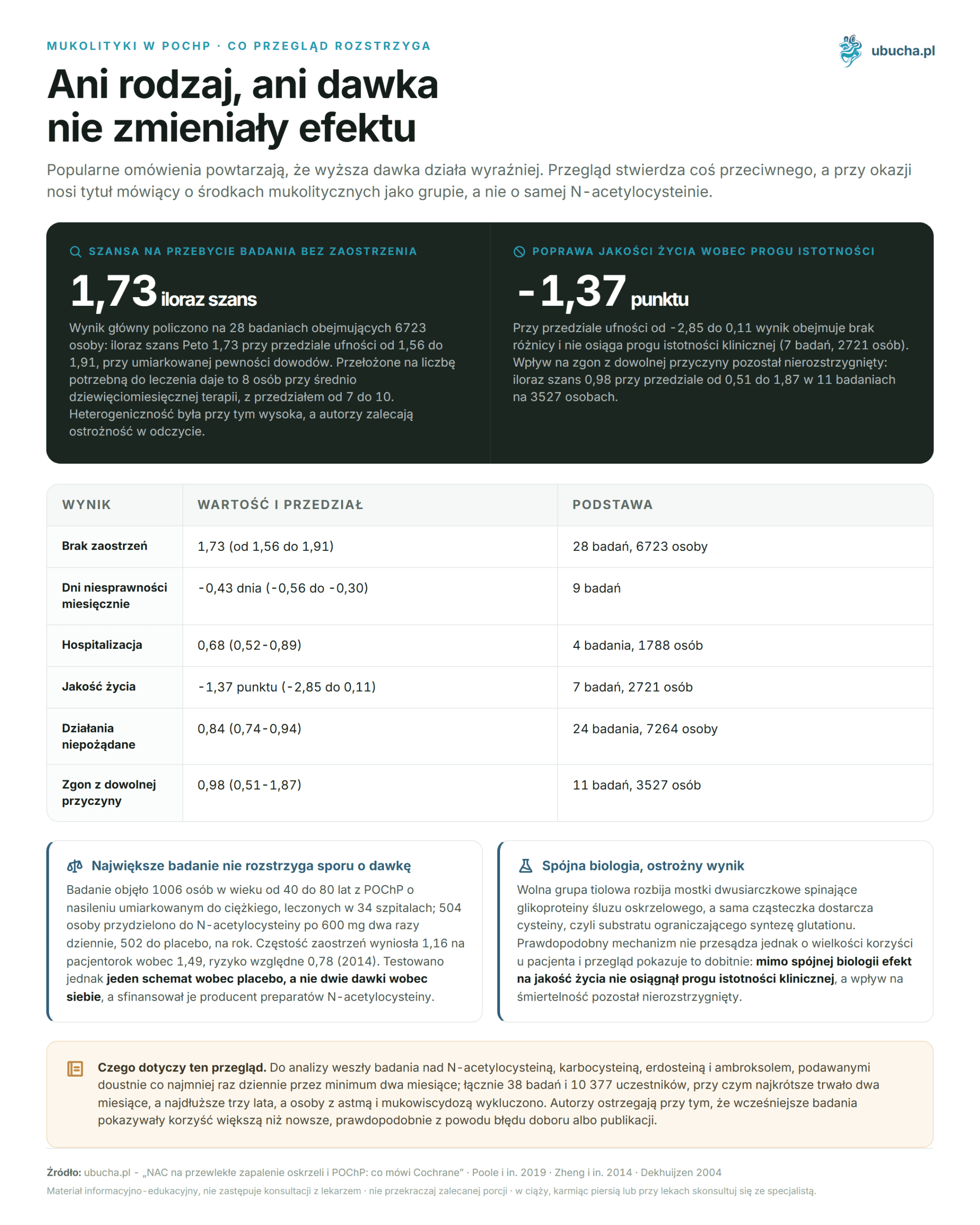
• Chance of completing the study without exacerbation: Peto odds ratio 1.73, confidence interval from 1.56 to 1.91, moderate certainty of evidence. The number needed to treat is 8, with a range from 7 to 10.
• Neither the type nor the dose of mucolytic changed the effect size; neither did the severity of the disease or the number of previous exacerbations.
• Improvement in quality of life did not reach the clinical significance threshold, and its confidence interval includes no difference.
• The authors of the review warn that earlier studies showed a greater benefit than newer ones, likely due to selection or publication bias.
What exactly did the Cochrane review from 2019 show?
The review is titled regarding mucolytic agents, not just N-acetylcysteine, and this distinction changes the interpretation of the results. The analysis included studies on N-acetylcysteine, carbocisteine, erdosteine, and ambroxol, administered orally at least once daily for a minimum of two months. A total of 38 studies and 10,377 participants; the shortest lasted two months, the longest three years. Studies involving individuals with asthma and cystic fibrosis were excluded (Poole et al., Cochrane, 2019).
The main result was calculated on 28 studies involving 6,723 individuals. Those taking mucolytics had a greater chance of completing the study period without exacerbation than those taking placebo: the Peto odds ratio was 1.73 with a confidence interval from 1.56 to 1.91, with moderate certainty of evidence. Translated into the number needed to treat, this gives eight individuals over an average nine-month therapy, with a range from seven to ten. Heterogeneity was high, and the authors recommend caution in interpretation.
| Outcome | Value and confidence interval | Basis | Certainty |
|---|---|---|---|
| No exacerbations during the study period | OR Peto 1.73 (1.56-1.91) | 28 studies, 6,723 individuals | moderate |
| Days of disability per person per month | -0.43 days (-0.56 to -0.30) | 9 studies | moderate |
| Hospitalization | OR Peto 0.68 (0.52-0.89) | 4 studies, 1,788 individuals | moderate |
| Quality of life | -1.37 points (-2.85 to 0.11) | 7 studies, 2,721 individuals | moderate, below the clinical significance threshold |
| Adverse events | OR 0.84 (0.74-0.94) | 24 studies, 7,264 individuals | moderate |
| Death from any cause | OR Peto 0.98 (0.51-1.87) | 11 studies, 3,527 individuals | moderate, inconclusive result |
Does the dose of N-acetylcysteine change the effect size?
Popular discussions repeat that a higher dose works significantly better. The Cochrane review states the opposite: neither the type nor the dose of mucolytic affected the effect size, nor did the severity of the disease or the number of exacerbations in the history. This finding has practical significance, as it undermines the most frequently repeated argument for increasing the dose and the belief that individuals with frequent exacerbations will benefit particularly (Poole et al., Cochrane, 2019).
The largest single study in this area remains the Chinese PANTHEON. It included 1,006 individuals aged 40 to 80 with moderate to severe COPD, treated in 34 hospitals; 504 individuals were assigned to N-acetylcysteine in 600 mg tablets taken twice daily, 502 to placebo, for one year. The exacerbation rate was 1.16 per patient-year compared to 1.49 in the placebo group, with a relative risk of 0.78 and a confidence interval from 0.67 to 0.90 (Zheng et al., Lancet Respir Med, 2014). The study was funded by Hainan Zambon Pharmaceutical, the manufacturer of N-acetylcysteine preparations, which the authors disclose in the publication.
It is worth noting what this result does not answer. PANTHEON tested one dosing regimen against placebo, not two doses against each other, so it does not resolve the dosing dispute. The resolution comes only from comparisons between studies in the Cochrane review, and it is unfavorable to the thesis of the superiority of higher doses.
How does N-acetylcysteine affect the respiratory tract?
The mechanism is twofold, and both pathways are well described. The first acts locally: the molecule has a free thiol group that breaks disulfide bonds linking glycoproteins in bronchial mucus. The mucus becomes thinner, and its removal by ciliary movement and the cough reflex is easier. This is the mucolytic action that began the use of this substance in pulmonology.
The second pathway is systemic. N-acetylcysteine provides cysteine, which is a limiting substrate for the synthesis of glutathione, the main intracellular antioxidant. In COPD, glutathione stores are depleted by chronic oxidative stress from tobacco smoke, dust, and recurrent infections. The antioxidant properties of this substance and their significance in COPD were separately described by Dekhuijzen in the European Respiratory Journal (Dekhuijzen, Eur Respir J, 2004).
However, the probable mechanism does not determine the magnitude of benefits for the patient, and the Cochrane review shows this clearly: despite coherent biology, the effect on quality of life did not reach the clinical significance threshold, and the impact on mortality remained inconclusive. Other plant substances studied for respiratory ailments are discussed in the text about eucalyptol and the respiratory tract.
Why did older reviews report a greater benefit?
The discrepancy between earlier and current estimates is real, and the authors of the Cochrane review discuss it directly. Earlier studies showed a greater effect than newer ones, and a likely cause was indicated as a higher risk of selection bias or publication bias in older trials. Longer studies also yielded a smaller effect than shorter ones. The authors conclude that the benefit of treatment may not be as large as earlier evidence suggested.
A good illustration is an earlier systematic review from 2000. Of the 39 identified studies, eleven were deemed valid and correct, analyzing data from 2,011 patients with chronic bronchitis, and the result regarding exacerbations was calculated on nine of them. Without exacerbation, 48.5 percent of those taking N-acetylcysteine completed the study compared to 31.2 percent taking placebo, which, with treatment periods from 12 to 24 weeks, gave a number needed to treat of 5.8 with a range from 4.5 to 8.1 (Stey et al., Eur Respir J, 2000).
Comparing both numbers is instructive, although it requires a caveat: the observation periods are not identical, so the comparison is indicative. The older review gave 5.8, the current one gives 8. Those who cite only the first value present the reader with a more favorable picture than that which results from a fuller body of evidence today. This same review from 2000 also found no impact of cumulative dose on efficacy, which aligns with the later finding of Cochrane.
What place does N-acetylcysteine have alongside inhaled medications?
The basis for treating COPD remains inhaled bronchodilators, and in selected stages, inhaled glucocorticoids. They have a significantly stronger evidence base for improving lung function and controlling symptoms, and the Cochrane review on mucolytics does not address them and does not serve as an alternative to them.
It is also worth noting one conceptual shift. The authors of the Cochrane review describe mucolytics as oral medications taken chronically and evaluate them in that role, while popular discussions present N-acetylcysteine solely as a supplement. The results of the review pertain to the first of these applications. The decision to include this substance in COPD treatment is up to the attending physician, as it depends on the course of the disease and the other medications being taken. This article deliberately does not provide any dosing regimen.
There is also a reason not to treat safety data as closed. In the meta-analysis, adverse events occurred slightly less frequently than with placebo, but several studies that could not be included reported many, averaging five events per person during the observation period. For respiratory ailments of another origin, a review of traditional raw materials can be useful, as in the text about mullein for cough.
Frequently Asked Questions
How many studies were included in the Cochrane review on mucolytics?
The current edition from 2019 included 38 randomized studies involving 10,377 participants. However, the result regarding exacerbations was calculated based on 28 studies involving 6,723 individuals, as not all studies reported this endpoint. This distinction changes the interpretation of the strength of evidence (Poole et al., Cochrane, 2019).
Does the review concern only N-acetylcysteine?
No. The review assesses oral mucolytics as a group, including carbocisteine, erdosteine, and ambroxol. Attributing the entire result to N-acetylcysteine alone is an overinterpretation. The authors also note that the type of mucolytic did not change the effect size (Poole et al., Cochrane, 2019).
Does a higher dose of N-acetylcysteine work better?
The Cochrane review does not confirm such a relationship. Neither the dose nor the type of mucolytic changed the effect size, nor did the severity of the disease or the number of previous exacerbations. An earlier systematic review from 2000 also found no impact of cumulative dose on efficacy (Stey et al., Eur Respir J, 2000).
Does N-acetylcysteine improve quality of life in COPD?
The mean change was -1.37 points, but the confidence interval from -2.85 to 0.11 includes no difference, and the value itself did not reach the clinical significance threshold of 4 points. Therefore, the correctly interpreted result is: the impact on quality of life is limited in these data (Poole et al., Cochrane, 2019).
Does N-acetylcysteine prolong life in COPD patients?
The data do not resolve this. The Peto odds ratio for death from any cause was 0.98 with a confidence interval from 0.51 to 1.87, calculated on 11 studies and 3,527 individuals. The interval is too wide to confirm or exclude an impact on mortality (Poole et al., Cochrane, 2019).
Can N-acetylcysteine replace inhaled medications?
No. The Cochrane review compared mucolytics to placebo, not to inhaled medications, so it does not provide a basis for substituting one for the other. The basis for COPD treatment remains inhaled pharmacotherapy, and any additions are decided by the attending physician (Poole et al., Cochrane, 2019).
Did the studies on N-acetylcysteine include people with asthma?
No. The authors of the Cochrane review excluded studies involving people with asthma and cystic fibrosis, so no conclusions regarding asthma, including safety conclusions, can be drawn from this review (Poole et al., Cochrane, 2019). A related topic is discussed in the text about N-acetylcysteine and respiratory infections.
This article is for informational and educational purposes and does not constitute medical advice. Before starting supplementation, consult your doctor, especially if you are taking medications regularly, are pregnant or breastfeeding, or have a chronic illness.
Author: Michał Waluk · Published: 2026-08-09 · Updated: 2026-08-16