
How to Legally Sell CBD in Poland: A Guide for Entrepreneurs (FAQ)
THC threshold, novel food status, GIS notification, and advertising rules. Check what a CBD product must meet before it goes on sale in Poland.
Poland does not have a separate law on CBD, and this is the first thing to understand before opening a store. The legality of a product is determined at the intersection of four legal orders: the Act on Counteracting Drug Addiction, food law, regulations on novel food, and labeling rules. Each of them is responsible for a different aspect, and none covers the whole. This guide navigates through these regulations in the order that an entrepreneur realistically encounters them: from THC content in the raw material, through product classification and sanitary notification, to the limits of what can be written on the label and in advertising. For each threshold and procedure, we provide the legal basis so you can verify it yourself. The legal status described below takes into account changes effective from August 27, 2026.
KEY INFORMATION
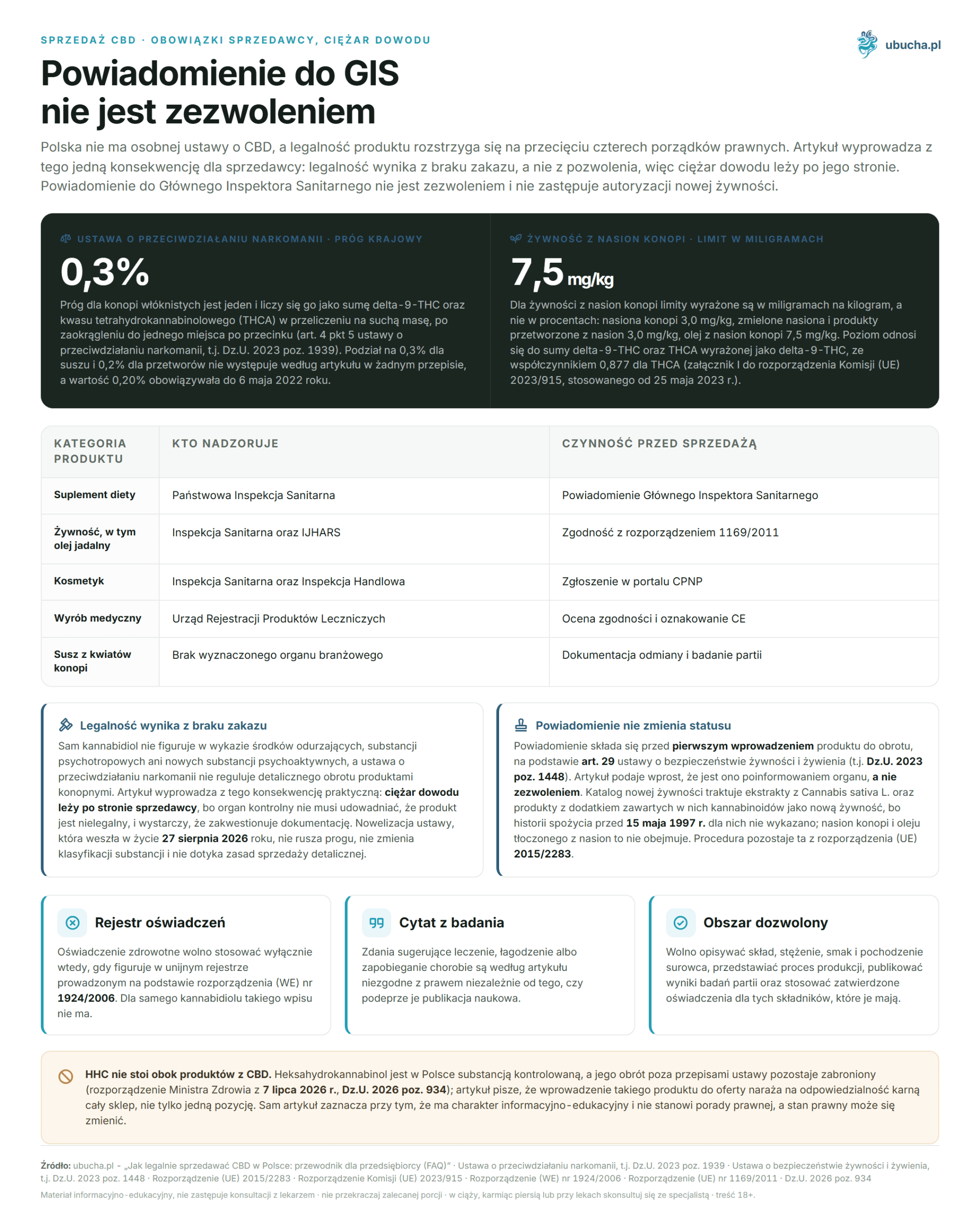
• The threshold for industrial hemp is 0.3% and is calculated as the sum of delta-9-THC and THCA, rounded to one decimal place (art. 4 pkt 5 of the Act on Counteracting Drug Addiction).
• The division into 0.3% for dried flowers and 0.2% for processed products does not appear in any regulation; the value of 0.20% was valid until May 6, 2022.
• Cannabis extracts with cannabinoids are treated as novel food in the EU and require a procedure under Regulation 2015/2283.
• A notification to the Chief Sanitary Inspector is not a permission and does not replace the authorization of novel food.
• HHC is a controlled substance in Poland, so it cannot be offered alongside CBD products.
Is selling CBD legal in Poland?
Yes, selling CBD products is permissible in Poland, but no regulation states this explicitly. Cannabidiol itself is not listed among controlled substances, psychotropic substances, or new psychoactive substances, and the Act on Counteracting Drug Addiction does not regulate the retail trade of cannabis products. Therefore, legality arises from the absence of a prohibition, not from a permission.
The practical consequence is that the burden of proof lies with the seller. You must demonstrate that the raw material comes from hemp within the threshold, that the product is correctly classified, and that its description does not attribute therapeutic effects to it. The regulatory authority does not have to prove that the product is illegal; it is enough for them to challenge the documentation.
It is worth immediately noting the boundary of the offer. HHC, or hexahydrocannabinol, is a controlled substance in Poland, and its trade outside the provisions of the Act remains prohibited (Regulation of the Minister of Health of July 7, 2026, Journal of Laws 2026, item 934). A store that places HHC alongside CBD oils shifts the entire assortment into a completely different legal regime.
The amendment to the Act on Counteracting Drug Addiction, which came into force on August 27, 2026, does not change anything here. It does not affect the THC threshold, does not change the classification of substances, and does not touch on retail sales rules. A broader context has been gathered in the text about the legality of hemp and CBD in Poland and the European Union.
How much THC can a legal cannabis product contain?
The threshold is 0.3% and is singular. Industrial hemp refers to Cannabis sativa L. plants, in which the total content of delta-9-THC and tetrahydrocannabinolic acid (THCA) in the flowering or fruiting tops, from which the resin has not been removed, does not exceed 0.3% based on dry mass, rounded to one decimal place.
The basis is art. 4 pkt 5 of the Act of July 29, 2005, on Counteracting Drug Addiction (consolidated text Journal of Laws 2023, item 1939) as amended by the Act of March 24, 2022 (Journal of Laws 2022, item 763), effective from May 7, 2022. Previously, the value was 0.20%, and it can only be mentioned in a historical context today. The division into 0.3% for dried flowers and 0.2% for extracts, which circulates in industry guides, has no basis in any regulation.
The method of calculation changes the result of laboratory testing, so it is not a mere editorial detail. A laboratory that provides only delta-9-THC without THCA will give a result that is lower than the statutory definition. When ordering a batch test, request the sum of both compounds.
EU law leads to the same value but through a separate path. From January 1, 2023, hemp varieties eligible for support under the Common Agricultural Policy can contain up to 0.3% THC (art. 4 sec. 4 of Regulation (EU) 2021/2115); previously, the EU threshold was 0.2%. The national threshold corresponds to the EU one, but does not derive from it. These are two separate regulations with the same number.
Separately, there are limits for food from hemp seeds, expressed in milligrams per kilogram, not in percentages.
| Product | Highest permissible level |
|---|---|
| Hemp seeds | 3.0 mg/kg |
| Ground seeds and other processed products from seeds | 3.0 mg/kg |
| Hemp seed oil | 7.5 mg/kg |
The level refers to the sum of delta-9-THC and THCA expressed as delta-9-THC, with a coefficient of 0.877 for THCA (Annex I to Commission Regulation (EU) 2023/915, applicable from May 25, 2023).
Is CBD considered novel food under EU law?
This question determines the entire sales model and is often overlooked. Novel food is food that has not been significantly consumed by humans in the EU before May 15, 1997, according to art. 3 of Regulation (EU) 2015/2283 (Chief Sanitary Inspectorate, Novel Food).
The Inspectorate refers in this matter to the novel food catalogue maintained by the European Commission, which indicates whether a given ingredient requires a procedure. The catalogue treats extracts from Cannabis sativa L. and products with added cannabinoids as novel food, as there is no documented history of consumption prior to 1997 (European Commission’s novel food catalogue).
Hemp seeds and cold-pressed seed oil are not included, as their consumption before the cutoff date is documented. The boundary therefore runs not between hemp and the rest of the world, but between seeds and extracts from flower parts. The same oil can be regular food or novel food depending on what has been added to it.
For the seller, this means one very practical limitation. A sanitary notification is not an authorization of novel food and does not change the product’s status. If you build your offer on extracts, be aware that the authority may challenge the product itself, not just its label. What to pay attention to on the purchasing side is described in the text about warning signals when purchasing CBD supplements.
How to classify a product and who supervises it?
The classification determines which authority controls you, what procedure you must go through before selling, and what can be written on the packaging. The same extract sold as a dietary supplement, cosmetic, or medical device is subject to three different regimes, and transitioning between them is not a matter of description on the page.
| Category | Supervision | Action before sale | Claims |
|---|---|---|---|
| Dietary supplement | State Sanitary Inspection | Notification to the Chief Sanitary Inspector | Only from the EU register |
| Food, including edible oil | Sanitary Inspection and IJHARS | Compliance with Regulation 1169/2011 | Only from the EU register |
| Cosmetic | Sanitary Inspection and Trade Inspection | Registration in the CPNP portal | No therapeutic claims |
| Medical device | Office for Registration of Medicinal Products | Conformity assessment and CE marking | In accordance with the intended use |
| Dried hemp flowers | No designated industry authority | Variety documentation and batch testing | None |
A dietary supplement is the path best described procedurally and therefore most often chosen. You submit a notification before the first introduction of the product to the market, based on art. 29 of the Act of August 25, 2006, on food safety and nutrition (consolidated text Journal of Laws 2023, item 1448). This is done through the electronic service of the Sanitary Inspection (notification of product introduction to the market), not through the RASFF system, which is used for alerts about hazards.
What to start selling step by step?
The order matters because some actions block the next ones. Business registration is the simplest step and usually the least risky; the problem begins with the documentation of the raw material, which cannot be supplemented after the fact when the inspector is already in the warehouse.
| Stage | What needs to be done |
|---|---|
| 1. Registration | Entry in CEIDG or KRS with codes from the applicable Polish Classification of Activities |
| 2. Suppliers | Certificate of analysis for each batch, variety from the EU catalogue, manufacturer’s declaration of conformity |
| 3. Batch testing | Cannabinoid profile with the sum of delta-9-THC and THCA, pesticides, heavy metals, microbiology |
| 4. Notification | Sanitary notification for each supplement before introduction to the market |
| 5. Online store | Regulations compliant with the Consumer Rights Act, privacy policy, right of withdrawal |
When it comes to business activity codes, be careful about the source. From January 1, 2025, a new Polish Classification of Activities is in effect (Journal of Laws 2024, item 1936), so codes copied from older guides may no longer exist. The basis for the store’s regulations is the Act of May 30, 2014, on consumer rights (consolidated text Journal of Laws 2024, item 1796).
If you are considering your own cultivation of raw material instead of purchasing, that is a separate procedure with an entry in the register maintained by KOWR. The conditions are described in the text about whether it is possible to legally cultivate industrial hemp in Poland.
What cannot be written in CBD advertising?
The boundary is sharper than most new sellers realize. Health claims can only be used if they have been approved and entered in the EU register under Regulation (EC) No. 1924/2006 (EUR-Lex). There is no such entry for cannabidiol, as the ingredient has not even undergone the novel food procedure.
Therefore, anything suggesting treatment, alleviation, or prevention of disease is excluded. Statements like “alleviates depression,” “helps with cancer,” or “replaces psychotropic drugs” are illegal regardless of whether you support them with a scientific publication. A quote from a study does not change the product’s status; it merely documents the intention to attribute therapeutic effects to it.
However, there remains a considerable area of permissible content. It is allowed to describe the composition, concentration, flavor, and origin of the raw material, present the production process, publish batch test results, and use approved claims for those ingredients that have them. If the oil contains fatty acids with an approved claim, it is permissible to refer to that claim for that ingredient, not for cannabidiol. Food labeling requirements remain in force (Regulation (EU) No. 1169/2011).
We have noticed that stores investing in educational content build visibility more stably than those based on paid campaigns, and this has a systemic reason: large advertising platforms maintain their own policies for the cannabis category, which are changed without notice and are independent of Polish law. Before planning your advertising budget, check the current policy of a specific platform, rather than relying on industry summaries from a few years ago.
Frequently Asked Questions
How much THC can a legal cannabis product contain?
The threshold is 0.3% and is calculated as the sum of delta-9-THC and THCA based on dry mass, rounded to one decimal place (art. 4 pkt 5 of the Act on Counteracting Drug Addiction, consolidated text Journal of Laws 2023, item 1939). The value of 0.20% was valid until May 6, 2022, and is now only a historical fact.
Does the 0.3% threshold result from EU regulations?
No. The national threshold corresponds to the EU one but has its own basis in the Act on Counteracting Drug Addiction, as amended by the Act of March 24, 2022 (Journal of Laws 2022, item 763). EU law allows 0.3% from January 1, 2023, under Regulation (EU) 2021/2115; previously, it was 0.2%.
Is a notification to GIS sufficient to sell CBD extract?
No. A notification is an informing of the authority, not a permission, and does not change the status of the ingredient. Cannabis extracts containing cannabinoids are treated as novel food, so they require a procedure under Regulation (EU) 2015/2283. A mere entry in the notification register does not replace this obligation.
Are hemp seeds and hemp seed oil also considered novel food?
No, because their consumption in the EU before May 15, 1997, is documented. Novel food only applies to extracts from flower parts and products to which cannabinoids derived from them have been added. The same seed oil can therefore have different statuses depending on what has been added to it.
What claims can be used in the description of a CBD product?
It is permissible to describe the composition, concentration, origin of the raw material, and the production process, as well as to publish batch test results. Health claims can only be used if they are listed in the EU register maintained under Regulation (EC) No. 1924/2006. There is no such entry for cannabidiol, so any statements about treatment are excluded.
Can I sell HHC alongside CBD products?
No. HHC is a controlled substance in Poland, and its trade outside the provisions of the Act on Counteracting Drug Addiction remains prohibited (Regulation of the Minister of Health of July 7, 2026, Journal of Laws 2026, item 934). Introducing such a product into the offer exposes the entire store to criminal liability, not just one item.
If you want to see how the description and labeling look in practice from the seller’s side, browse the product cards in the hemp oil category in the u Bucha store.
This article is for informational and educational purposes only and does not constitute legal advice. The legal status described in the article is valid as of the date of publication: regulations regarding cannabis may change. Before making a decision, consult a lawyer or current legal acts.
Author: Michał Waluk · Published: 2026-08-09 · Updated: 2026-08-10