
Transdermal Patch vs Regular Ointment: When the Substance Enters the Bloodstream
When does the substance from the skin preparation enter the blood, and when does it only work locally? The epidermal barrier, permeators, and the difference between ointment and patch.
The skin is the largest organ of the body and also a barrier that effectively prevents most substances from entering. This barrier underlies the difference between two products that sit next to each other in the store and look similar. An ointment usually works locally: the active substance remains in the skin and the tissue beneath it. A transdermal patch is designed exactly the opposite, to break through the barrier and introduce the drug into the bloodstream at a specified rate. This text shows where the line is drawn between the two, how to recognize it in the composition of the preparation, and why the term “transdermal” on a cosmetic package does not mean the same as in the name of a drug.
KEY INFORMATION
• First-generation transdermal systems are suitable only for small, lipophilic substances effective in small doses (Prausnitz and Langer, Nature Biotechnology, 2008).
• An ointment without permeators primarily works locally; a transdermal patch is designed to deliver the substance to the blood continuously.
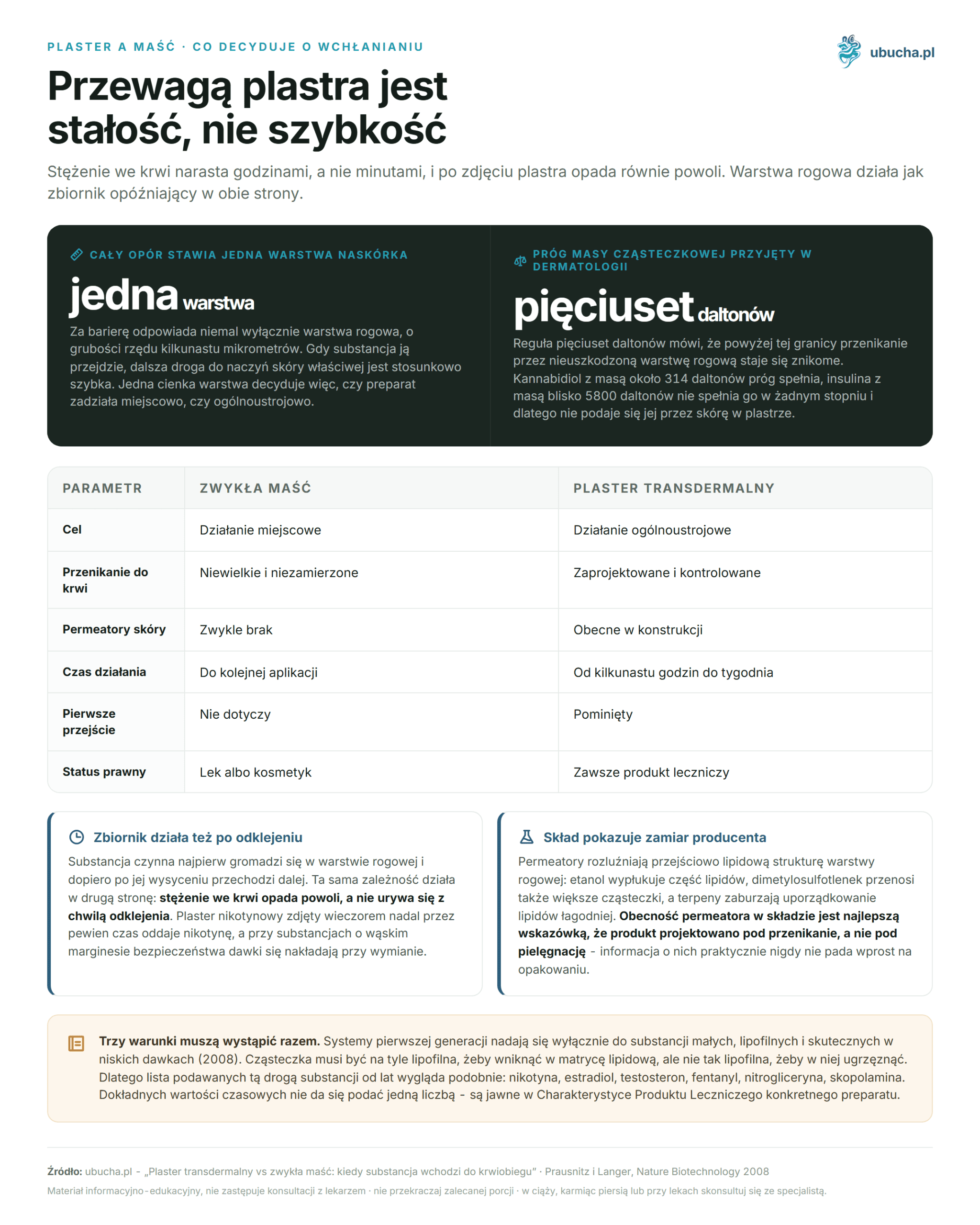
• The advantage of the patch is the stability of delivery, not speed: the concentration in the blood increases over hours, and after removing the patch, it decreases slowly.
• A transdermal patch is a medicinal product requiring registration. A cream described as “transdermal” can be a cosmetic, although its claims must also be supported by evidence.
How is the skin barrier constructed and why is it difficult to cross?
The barrier is almost exclusively the outermost layer of the epidermis, the stratum corneum. It is about several micrometers thick, yet it retains most molecules that come into contact with the skin surface. The rest of the journey is much easier.
The skin consists of the epidermis, dermis, and subcutaneous tissue. The stratum corneum is made up of flat, dead keratinocytes embedded in a lipid matrix composed of ceramides, cholesterol, and free fatty acids. This arrangement, described as bricks in mortar, is highly hydrophobic. It thus retains both water-soluble molecules, which find it difficult to enter the lipid layer, and molecules that are too large to squeeze between the lipids.
A substance that is to reach the bloodstream from the skin surface must successively overcome the stratum corneum, the living layers of the epidermis, and the dermis. Only in the dermis is there a dense network of capillaries. This is an important detail: once the substance passes through the stratum corneum, the further journey to the bloodstream is relatively quick. Therefore, all resistance is posed by this thin layer, and it determines whether the preparation will act locally or systemically.
What is the difference between a transdermal patch and a regular ointment?
The difference is not just in how much substance penetrates into the blood. It lies in the intention: these are two different therapeutic goals, two different constructions, and two different paths to market approval.
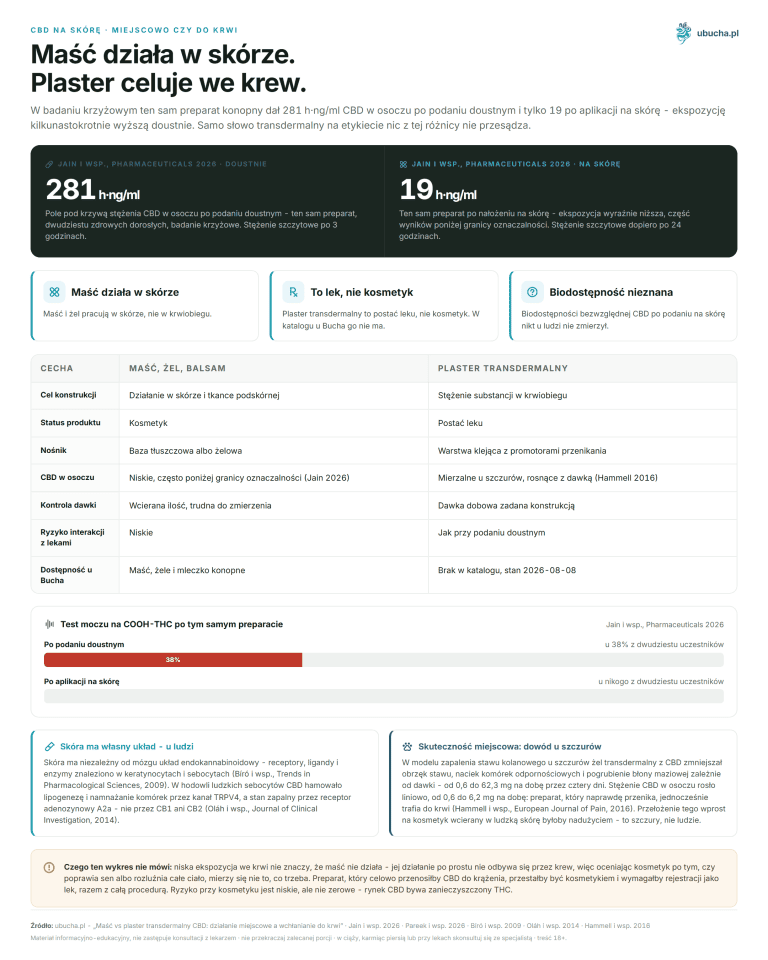
| Parameter | Regular Ointment | Transdermal Patch |
|---|---|---|
| Purpose | Local action | Systemic action |
| Penetration into the blood | Minimal and unintended | Designed and controlled |
| Skin permeators | Usually absent | Present in the system’s design |
| Increase in blood concentration | Not the goal of the preparation | Slow, measured in hours |
| Wearing or action time | Until the next application | From several hours to a week |
| First-pass metabolism | Not applicable | Skipped, the substance goes directly into the blood |
| Legal status | Drug or cosmetic, depending on composition and purpose | Always a medicinal product |
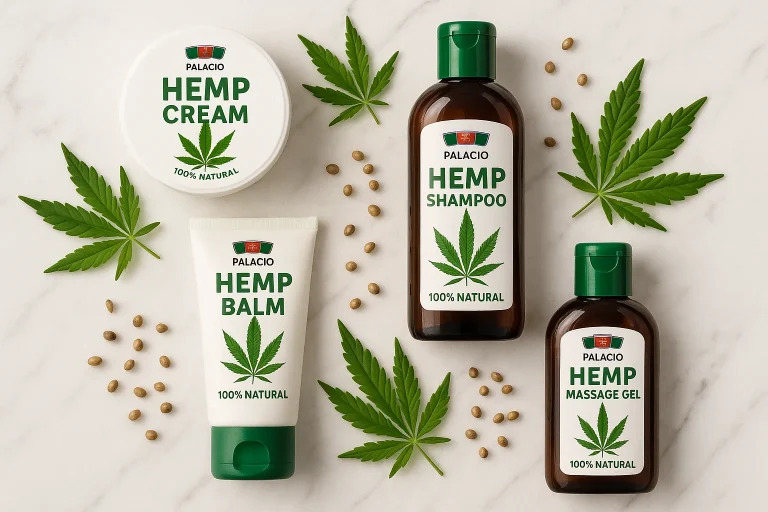
| Examples | Arnica ointment, hemp cream, menthol gel | Nicotine patch, estradiol, fentanyl, nitroglycerin |
The row about legal status is often simplified, and it is worth reading it carefully. An ointment is not by definition a cosmetic: an ointment with an active substance that has a therapeutic effect is a drug and undergoes registration just like a patch. A cosmetic is a preparation whose task remains to care for the skin’s surface.
What substances are suitable for transdermal delivery?
Very few. Prausnitz and Langer in a review published in Nature Biotechnology described first-generation transdermal systems as suitable for small, lipophilic substances effective in low doses (Prausnitz and Langer, 2008). These three conditions must occur together.
Molecular weight is the first sieve. In dermatology, there is a rule of five hundred daltons: above this threshold, penetration through the intact stratum corneum becomes negligible. Cannabidiol has a mass of about 314 daltons and meets the threshold, while insulin, with a mass of nearly 5800 daltons, does not meet it at all, which is why insulin is not administered through the skin in patch form. The second sieve is solubility. The substance must be lipophilic enough to penetrate the lipid matrix but not so lipophilic that it gets stuck in it instead of moving on to the aqueous environment of the dermis. The third sieve is potency: since only a fraction of the administered amount passes through the skin, the substance must act in doses of milligrams or smaller.
The same review organizes attempts to circumvent these limitations into three generations of solutions.
- The first generation is the classic patch without assistance, limited to a narrow group of substances described above.
- The second generation adds assistance: chemical permeators and ultrasound, and separately iontophoresis, which is the only one that allows real-time control of the delivery rate.
- The third generation targets the stratum corneum directly: microneedles, thermal ablation, microdermabrasion, electroporation. Here, the aim is large molecules, and among the clinical trial subjects, the authors mention insulin and the flu vaccine.
A regular patch bought at a pharmacy usually belongs to the first generation, although the authors note that second-generation solutions have also made it into clinical practice. Therefore, the list of substances administered this way has looked similar for years: nicotine, estradiol, testosterone, fentanyl, nitroglycerin, scopolamine.
How do permeators work, i.e., substances that open the skin barrier?
Permeators are ingredients added to temporarily loosen the lipid structure of the stratum corneum. The mechanisms can vary, but the effect is the same: the barrier allows more to pass through than usual for a time. The presence of a permeator in the composition is the best indication that the manufacturer designed the product for penetration, not for care.
Ethanol is one of the simplest and most commonly used. It washes out some lipids from the stratum corneum and increases the fluidity of the lipid bilayers, thereby facilitating the diffusion of lipophilic substances. Dimethyl sulfoxide, known as DMSO, is a much stronger permeator and can also carry larger molecules, but it can be irritating, and users report a characteristic aftertaste and odor reminiscent of garlic. Terpenes and terpenoids, such as menthol, camphor, linalool, or eucalyptol, act more gently, disrupting the ordering of lipids without dissolving them on a large scale. This is one reason why essential oils end up in preparations intended for rubbing in.
We have noticed while reviewing labels that information about permeators is almost never stated directly. The buyer sees the phrase “penetrating deep into the skin,” and reads the composition only at home, if at all. Meanwhile, it is the composition that determines whether the preparation has a chance to work deeper than on the surface.
What happens after applying the patch?
The active substance begins to diffuse from the patch reservoir towards the skin, but first, it accumulates in the stratum corneum. This layer acts as a delaying reservoir: only after it is saturated does the substance move on to the vessels in the dermis. This is why the concentration in the blood increases over hours, not minutes, and why the patch is not suitable for situations where a quick effect is needed.
The same reservoir works after the patch is removed. The substance accumulated in the skin continues to diffuse, so the concentration in the blood decreases slowly, rather than dropping off immediately upon removal. The practical effect is visible with a nicotine patch worn for part of the day: removed in the evening, it still releases nicotine for a while. With substances that have a narrow safety margin, such as fentanyl, this effect must be taken into account when changing patches, as doses can accumulate.
Exact time values vary between products, and it is impossible to provide a single number for all patches. However, they are publicly available: you will find them in the Product Characteristics of the specific preparation, available in the register of medicinal products. This is the only source that is binding for a given patch.
Where to apply the patch and why should the site be changed?
Where the skin is thin, well-vascularized, and hairless. The thickness of the stratum corneum varies greatly across the body, and since it is the one that poses resistance, the application site realistically changes the absorption rate.
On the sole of the foot and on the hand, the stratum corneum is many times thicker than on the inner side of the forearm, as in these places the skin responds to pressure with thickening. Hence the practical list of good places: the inner side of the forearm, the outer side of the arm, the shoulder area, the abdomen, the upper back, and for scopolamine, the area behind the ear. Bad places include the hands, feet, elbows, and knees, as well as any densely haired area where the patch does not adhere well to the skin.
Changing the site with each patch replacement has two reasons. The first is irritation: the acrylic adhesive and permeators irritate the skin more the longer they act in one spot. The second is often overlooked but is more significant. Skin that is repeatedly exposed in the same place changes its properties, so absorption ceases to be repeatable. Separately, it is worth knowing that heat increases blood flow in the skin and accelerates absorption from the patch. A hot bath, sauna, or intense exercise can therefore raise the concentration of the substance in the blood, which can be dangerous with potent drugs, and this is why manufacturers include such warnings in the leaflet.
Does the patch interact with drugs the same way a tablet does?
Yes. Since the substance from the patch circulates in the blood, it undergoes the same interactions as the same substance taken orally. It is metabolized by the same enzymes, primarily from the cytochrome P450 family, and competes for them with other drugs in the same way. Skipping the first-pass effect through the liver changes the amount of substance that reaches the blood, but it does not exempt it from further metabolism.
This is a fundamental difference compared to locally acting ointments, where systemic interactions are negligible. So if a doctor asks about all medications taken, the patch is a medication and must be mentioned, even if it is not associated with taking medication. This also applies to over-the-counter patches.
Separately, the safety of the skin itself is at stake. Patches sometimes cause redness, itching, or contact dermatitis, with the more common cause being excipients, such as adhesives, permeators, and fillers, rather than the active substance. A reaction to the patch does not prove an allergy to the drug itself and does not determine that this substance cannot be taken by another route. In the case of persistent redness or blisters, the patch should be removed and a doctor consulted. We have gathered a comparison of absorption through different routes of administration in the text about methods of consumption and bioavailability.
How to check if the ointment really penetrates deeper?
By the composition, not by the slogan on the package. Phrases like “deeply penetrating formula” or “transdermally active” describe a marketing intention, not a measured depth of penetration, and are not equivalent to the registration of a transdermal system.
It is worth dispelling a common misunderstanding. The claim that a cosmetic can promise anything as long as it does not cause harm is false. Regulation (EU) No 655/2013 establishes common criteria for claims about cosmetic products and explicitly requires that claims, both explicit and implied, be supported by appropriate and verifiable evidence. A cosmetic, however, does not undergo registration as a drug and does not have to demonstrate the bioavailability of the ingredient in a clinical study, and this is the real difference compared to a patch.
A practical tip on the store shelf is simple. Ethanol high on the ingredient list, propanediol, butylene glycol, or dimethyl isosorbide is a signal that the manufacturer designed for penetration. Terpenes in a clear concentration, such as menthol above five percent, act similarly. If, however, the composition is opened by water, glycerin, shea butter, and vegetable oil, you have before you a care product that will work on the surface of the skin. Separately, we have described how this looks with specific cannabis products in texts about transdermal patches with CBD and about the difference between ointment and transdermal patch.
Frequently Asked Questions
When does the ointment enter the bloodstream, and when does it only work locally?
An ointment without permeators primarily works locally, as the stratum corneum retains most substances on the surface. Only a small amount penetrates into the blood, and this is not the goal of the preparation. Penetration increases when the skin is damaged or when the formula contains permeators, such as ethanol, DMSO, or terpenes.
What is the difference between a transdermal patch and an ointment?
A transdermal patch is a system designed to deliver a substance through all layers of the skin into the bloodstream at a constant rate, and it is always a medicinal product. An ointment acts on the tissue beneath the application site and can be either a drug or a cosmetic, depending on its composition and purpose.
What substances are suitable for transdermal delivery?
Small, lipophilic, and effective in low doses: such limitations were described by Prausnitz and Langer in Nature Biotechnology in 2008 for first-generation systems. In practice, these include nicotine, estradiol, testosterone, fentanyl, nitroglycerin, and scopolamine. Large molecules, such as insulin, require microneedles or other third-generation solutions.
Does a transdermal patch work faster than an ointment?
No. The substance first accumulates in the stratum corneum, so the concentration in the blood increases over hours. The advantage of the patch is the continuity and stability of delivery over many hours, not the speed of action. The exact time for a specific preparation is provided in its Product Characteristics.
Can a patch be applied to damaged skin?
No, it should only be applied to healthy, undamaged skin. A damaged epidermal barrier allows significantly more substances to pass through, so the actual absorbed dose no longer corresponds to the designed dose. With potent substances like fentanyl or nitroglycerin, this poses a risk of overdose.
Where is the best place to apply a transdermal patch?
On thin, well-vascularized, and hairless skin: the inner side of the forearm, the outer side of the arm, the abdomen, the upper back, and for scopolamine, the area behind the ear. Avoid hands, feet, elbows, and knees, where the stratum corneum is significantly thicker. Change the site with each patch replacement.
This article is for informational and educational purposes only and does not constitute medical advice. Before starting supplementation, consult a doctor, especially if you are taking medications regularly, are pregnant or breastfeeding, or have a chronic illness.
Author: Michał Waluk · Published: 2026-08-09 · Updated: 2026-08-15