
CBD and Allergic Rhinitis and Seasonal Allergies: Does It Alleviate (FAQ)
Does CBD alleviate allergic rhinitis? We check what has really been measured on mast cells, why there are no studies in humans, and what EFSA says about safety with medications.
Allergic rhinitis is one of the most common chronic diseases, with its prevalence in various populations estimated to range from 1% to 18% (Gutowska-Ślesik et al., Advances in Dermatology and Allergology, 2023). The pollen season annually pushes some patients towards alternative methods, and CBD regularly appears in these searches. This text separates two things that merge into one on the internet: what has actually been measured in cells and animals, and what has not been tested in humans with allergic rhinitis. Along the way, we clarify the explanation of the mechanism repeated in most guides, as the work that allegedly confirms it says the opposite. It also shows what the European food safety authority says today about the safety of CBD and why the reader of such an article usually belongs to the group for which this safety has not been established.
KEY INFORMATION
• CBD does not block H1 histamine receptors, so it does not work like cetirizine or loratadine.
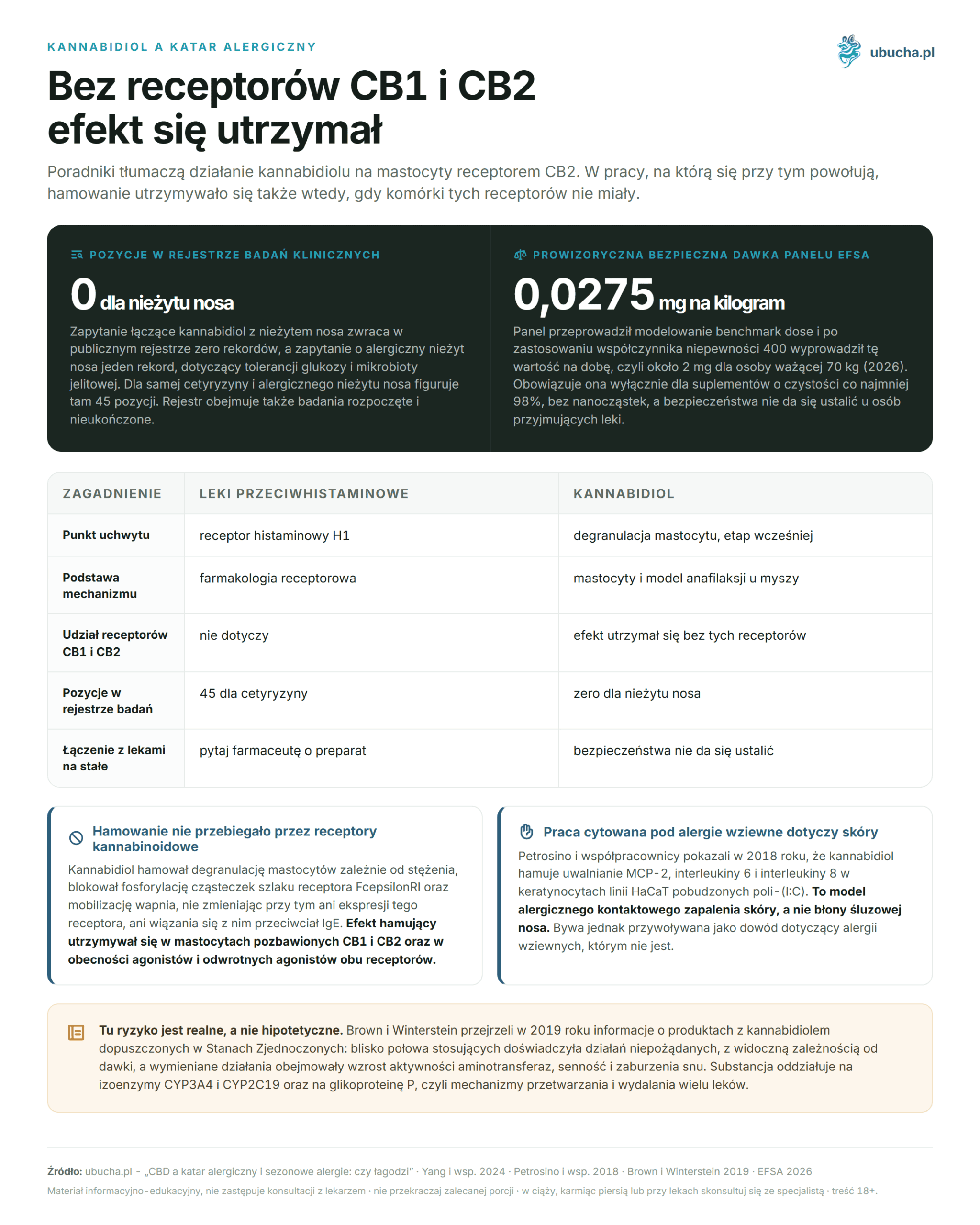
• Inhibition of mast cell degranulation has been demonstrated in cells and in mice, and the effect was maintained even when cells were deprived of CB1 and CB2 receptors (Yang et al., 2024).
• A query about cannabidiol and rhinitis in the clinical trial registry returns zero results.
• EFSA: the safety of CBD cannot be established for individuals taking medications.
Does CBD alleviate the symptoms of allergic rhinitis?
It is unknown, as no one has studied this in humans. There are premises from cell cultures and from animal models that explain why the idea has emerged. However, there is not a single clinical trial that has tested whether CBD reduces sneezing, watery rhinitis, or nasal itching in individuals allergic to pollen.
This statement can be verified without relying on our word. In the public clinical trial registry, a query combining cannabidiol with rhinitis returns zero records, and a query about cannabidiol and allergic rhinitis returns one record, which pertains to glucose tolerance and gut microbiota, i.e., something completely different. The registry also includes studies that have started and not been completed, so zero also means no ongoing trials.
Why is this important? Because a biologically plausible mechanism and clinical efficacy are two different things, and the distance between them can be enormous. The history of pharmacology is full of substances that inhibited the proper pathway in vitro and did nothing in patients. If you are looking for a broader discussion of the mechanism itself, we have described it separately in the text about whether CBD can alleviate allergy symptoms.
What did the study on mast cells really show?
The strongest work on this topic comes from 2024 and was published in Molecular Nutrition and Food Research. The researchers cultured mast cells from mouse bone marrow and from human umbilical blood and checked what CBD does to them after stimulation with an antigen.
The results are specific. CBD inhibited mast cell degranulation depending on the concentration, blocked the phosphorylation of signaling pathway molecules of the FcepsilonRI receptor, and calcium mobilization, while not changing either the expression of this receptor or its binding to IgE antibodies. Intraperitoneal administration of CBD reduced passive cutaneous anaphylaxis in mice, measured by ear swelling and the number of degranulated mast cells (Yang et al., 2024).
There is a finding in this work that overturns the popular explanation. The inhibitory effect was maintained in mast cells lacking CB1 and CB2 receptors and in the presence of agonists and inverse agonists of both receptors. In other words, the action of CBD on mast cells in this model did not proceed through cannabinoid receptors. The statement repeated in dozens of guides that CBD calms mast cells through the CB2 receptor has no basis in this study. Separately, it is known that mast cells indeed have an active CB2 receptor that inhibits their activation (Facci et al., PNAS, 1995), and mice lacking CB2 have an enhanced inflammatory phenotype (Turcotte et al., 2016). However, these are statements about the receptor, not about CBD.
Is CBD an antihistamine?
No. Antihistamines block the H1 histamine receptor, so released histamine cannot cause symptoms. CBD does not have such a target. The entire hypothesis concerns an earlier stage, namely the release of mediators by mast cells, and comes from studies on cells and animals.
| Issue | Antihistamines | CBD |
|---|---|---|
| Target | H1 histamine receptor | Mast cell degranulation, i.e., the stage before histamine release |
| Mechanism basis | Receptor pharmacology | Mouse and human mast cells and a mouse anaphylaxis model (Yang, 2024) |
| Involvement of cannabinoid receptors | Not applicable | Effect was maintained without CB1 and CB2 receptors |
| Entries in the clinical trial registry, as of August 16, 2026 | Cetirizine and allergic rhinitis: 45 | Cannabidiol and rhinitis: 0 |
| Use together with medications | Depends on the product, ask your pharmacist | EFSA: safety cannot be established |
One study is worth mentioning separately, as it is often cited as evidence for respiratory allergies, but it is not. Petrosino and colleagues showed in 2018 that CBD inhibits the release of MCP-2, interleukin 6, and interleukin 8 in HaCaT keratinocytes stimulated with poly-(I:C). This is a model of allergic contact dermatitis, not nasal mucosa (Journal of Pharmacology and Experimental Therapeutics, 2018).
What about CBD interactions with allergy medications?
This is the part where the risk is real, not hypothetical. Brown and Winterstein reviewed information about CBD products approved in the United States in 2019 and gathered data on adverse effects and interactions. In this data, nearly half of those using CBD experienced adverse effects, with a noticeable dose-dependent relationship.
Reported effects included increased aminotransferase activity, drowsiness, sleep disturbances, infections, and anemia. The authors point to a high likelihood of interactions because CBD interacts with biological targets involved in drug metabolism, namely isoenzymes CYP3A4 and CYP2C19, and with P-glycoprotein responsible for excretion (Brown and Winterstein, Journal of Clinical Medicine, 2019). Practical recommendations are general: consider reducing the dose of the substrate, monitor adverse effects, or look for alternative therapy.
Whether your allergy medication goes this route depends on the specific substance, and we cannot resolve that in this article. Ask your pharmacist and show them the packaging. Separately, it is worth knowing that the European panel assessing the safety of CBD noted a potential hepatotoxicity in studies in humans especially when used concurrently with other medications. Alternative ingredients studied in the context of allergies are discussed in texts about quercetin for allergies and immunity and about black seed oil.
What amount of CBD is considered safe?
The institutional answer is much more cautious than the market suggests. The EFSA panel conducted benchmark dose modeling based on subchronic studies compliant with good laboratory practice and, after applying an uncertainty factor of 400, derived a provisional safe dose of 0.0275 mg per kilogram of body weight per day. For a person weighing 70 kg, this amounts to about 2 mg daily (EFSA, 2026).
This value applies only to supplements with a CBD purity of at least 98%, without nanoparticles, produced under safe conditions, and with excluded genotoxicity. The panel states directly that the safety of CBD cannot be established for individuals under 25 years of age, for pregnant and nursing women, and for those taking medications. A reader seeking support for seasonal allergies often belongs to the last of these groups.
It is also worth knowing how much is really known about absorption. A systematic review of the pharmacokinetics of CBD in humans included 24 studies and established that absolute bioavailability was only measured for one route of administration, smoking, where it was 31%. No other route, including oral and sublingual, has been measured in any study (Millar et al., Frontiers in Pharmacology, 2018). Therefore, the percentage figures given for sublingual oils do not come from measurement.
Frequently Asked Questions
Does CBD alleviate allergic rhinitis?
It is unknown. There is no clinical study that has tested this in humans, and a query about cannabidiol and rhinitis in the public research registry returns zero results. The premises come from cell cultures and from a mouse anaphylaxis model. The mechanism is biologically plausible, but clinical efficacy remains unverified.
Does CBD act through CB2 receptors on mast cells?
In the study by Yang et al. from 2024, the inhibition of mast cell degranulation was also maintained in cells lacking CB1 and CB2 receptors. Therefore, the popular explanation referring to the CB2 receptor has no basis in this work. The CB2 receptor is indeed present on mast cells and inhibits their activation, but that is a separate finding.
Can CBD replace antihistamines?
No. Antihistamines block the H1 receptor, preventing histamine from causing symptoms. The scale of the difference is evident in the clinical trial registry: there are 45 entries for cetirizine and allergic rhinitis, while for cannabidiol and rhinitis, there are zero. Do not discontinue treatment prescribed by your doctor in favor of a supplement.
Can CBD be combined with allergy medications?
Ask your pharmacist before combining. CBD interacts with the isoenzymes CYP3A4 and CYP2C19 and with P-glycoprotein, which are mechanisms involved in the processing and excretion of many drugs (Brown and Winterstein, 2019). EFSA notes a potential hepatotoxicity, especially when used concurrently with other medications, and cannot establish safety in this group.
What amount of CBD is considered safe?
The EFSA panel derived a provisional safe dose of 0.0275 mg per kilogram of body weight per day, which is about 2 mg for a person weighing 70 kg. This applies only to supplements with a purity of at least 98%, without nanoparticles. Safety cannot be established for individuals under 25 years of age, pregnant women, nursing mothers, and those taking medications.
Can CBD exacerbate allergy symptoms?
A hypersensitivity reaction to a plant product is always possible, including with hemp extract. If allergic symptoms worsen or new ones appear after starting supplementation, discontinue use and consult a doctor or allergist. In severe allergies with anaphylaxis risk, no supplement can replace adrenaline or medical assistance.
This article is for informational and educational purposes only and does not constitute medical advice. Before starting to use cannabis or CBD for therapeutic purposes, consult a doctor, especially if you are taking other medications, are pregnant, or are breastfeeding.
Author: Michał Waluk · Published: 2026-08-09 · Updated: 2026-08-16