
How to Brew CBD Tea from Hemp? Guide 2026
Temperature 90-95°C, 10-15 minutes covered, and fat in the cup. A proven brewing protocol for hemp flower and an honest discussion about dosage and limits.
There is a belief about hemp tea that it delivers a specific number of milligrams of CBD per cup. It does not, because no one has measured it. Millar et al. reviewed 792 publications and found 24 with pharmacokinetic data on CBD in humans; the only route of administration with measured absolute bioavailability turned out to be inhalation, around 31%, and no one has attempted to measure this for oral administration (Millar et al., 2018). So what really depends on you when brewing? Three things: water temperature, brewing time, and the presence of fat in the cup. Each of these is supported by research and can be set in a home kitchen without special equipment. This guide walks you through all three step by step, providing proportions and times, and also clearly states what should not be expected from hemp tea.
KEY INFORMATION
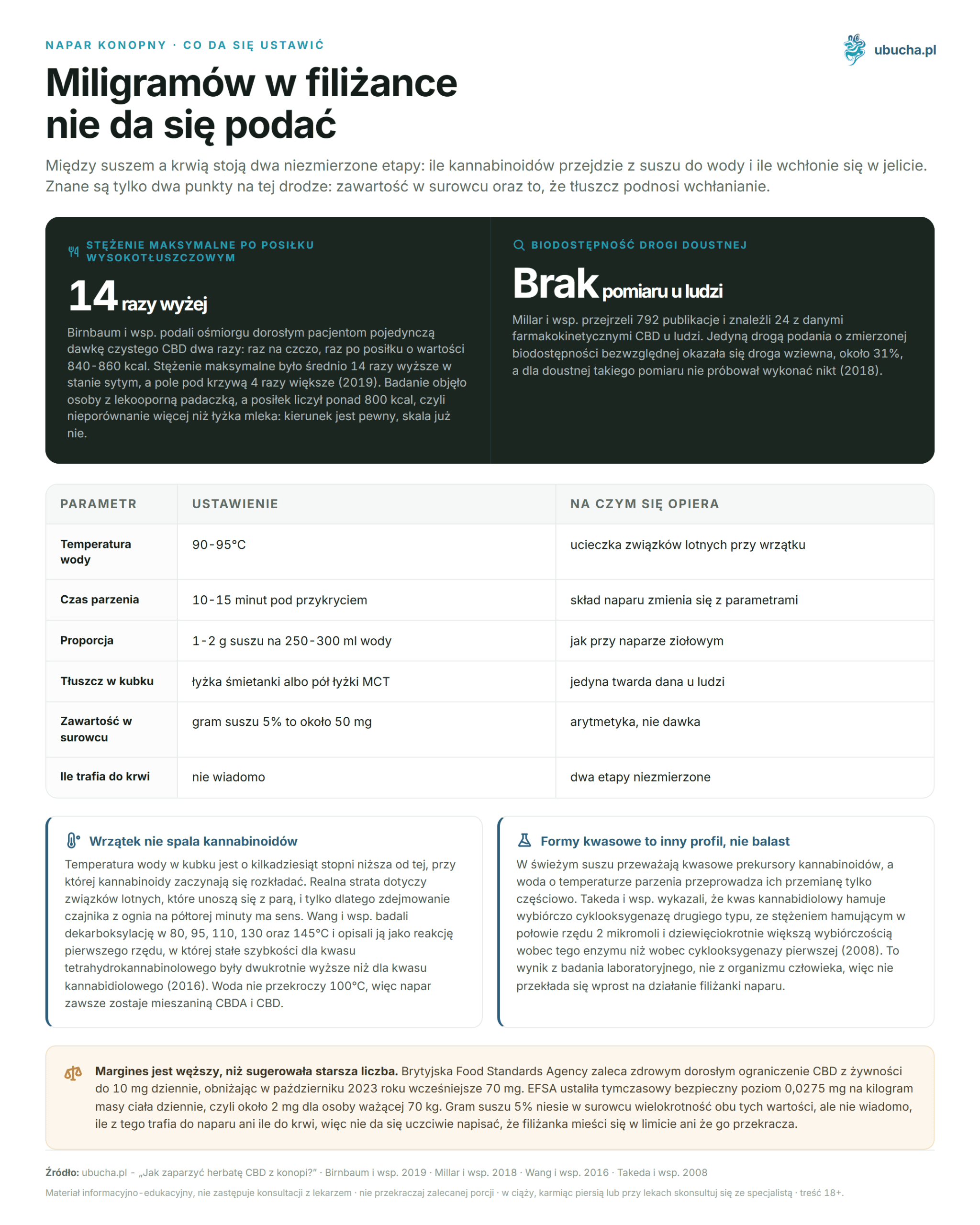
• Fat changes the dose: after a high-fat meal, the maximum concentration of CBD in the blood was 14 times higher, and total exposure was 4 times greater than in a fasting state (Birnbaum et al., 2019, eight patients).
• Water temperature: 90-95°C, because boiling water quickly strips the tea of volatile compounds.
• Brewing time: 10-15 minutes covered, for 1-2 g of ground flower and 250-300 ml of water.
• Daily limit: the British FSA recommends that healthy adults consume no more than 10 mg of CBD daily from food, lowering this position in October 2023 from the previous 70 mg.
• How much CBD you absorb from the tea, no one knows; the only measured route in humans is inhalation, around 31% (Millar et al., 2018).
What is hemp tea and how does it differ from regular tea?
It is an infusion made from dried flowers and leaves of hemp, not from the leaves of the tea bush. The name is conventional, as botanically they are only connected by the method of preparation. Instead of caffeine and theine, you get cannabinoids in both acidic and neutral forms, as well as terpenes responsible for the aroma of the strain.
The composition differs between the two plants at every level. Black or green tea carries caffeine, L-theanine, and polyphenols. Hemp infusion primarily carries cannabidiolic acid (CBDA) and cannabidiol (CBD), along with CBG, CBN, and trace amounts of tetrahydrocannabinol, which is defined to be low in legal flower. Additionally, there is a terpene profile: myrcene, pinene, linalool, beta-caryophyllene.
The taste is also different, and many people do not like it at first. Pure flower gives a distinctly herbal infusion, slightly nutty, with a hint of grass, much closer to chamomile tea than to regular tea. Adding mint, lemon balm, or chamomile softens this profile, as does a spoonful of honey.
The third difference concerns the chemistry of brewing itself. In fresh flower, acidic precursors of cannabinoids predominate, which lose their carboxyl group and convert to neutral forms under heat. Water at brewing temperature only partially facilitates this transformation, so the infusion always contains a mixture of both forms. This is not a loss, but a different profile than in oil, where the manufacturer has decarboxylated it for you.
Acidic forms are not a burden. Takeda et al. showed that cannabidiolic acid selectively inhibits cyclooxygenase type 2, with a half-maximal inhibitory concentration of around 2 micromolar and nine times greater selectivity for this enzyme than for cyclooxygenase type 1 (Takeda et al., 2008). This is a result from a laboratory study, not from the human body, so it does not directly translate to the effect of a cup of tea, but it explains why tea and oil are not two versions of the same product.
Why does hemp tea need fat?
Because cannabidiol dissolves in fats, not in water, and without a carrier fat, a large part of what you extract from the flower passes through the intestine without absorption. This is the only element of preparation for which there is hard numerical data in humans.
Birnbaum et al. administered a single dose of pure CBD in a capsule to eight adult patients twice: once fasting, once after a high-fat meal of 840-860 kcal. The maximum concentration in the blood was on average 14 times higher in the fed state, and the area under the curve, which is the total exposure of the body to the substance, was 4 times greater (Birnbaum et al., 2019). Millar et al. reach a consistent conclusion in their review: maximum concentration increases in the fed state and in lipid-based preparations.
Two notes to avoid taking this result too far. The study involved eight patients with drug-resistant epilepsy, not healthy tea consumers. The meal was over 800 kcal, which is significantly more than a tablespoon of milk. The direction of action is therefore certain, but the scale is not. The practical conclusion is: add fat, but do not count on a tablespoon of cream to give you four times anything.
| Carrier | Serving per cup | Effect on taste | Notes |
|---|---|---|---|
| Milk 3.2% | 2-3 tablespoons | slight creaminess | contains lactose |
| 30% cream | 1 tablespoon | masks herbal bitterness | thickest consistency |
| MCT coconut oil | half a tablespoon | neutral | does not change texture |
| Clarified butter | 1 teaspoon | nutty note | lactose-free |
| Cocoa butter | about 3 g | slightly chocolatey | plant-based option |
Skim milk and light plant-based drinks have too little fat to change anything. The same mechanism governs the timing of oil intake, which we described separately in the post about whether to take CBD oil before or after eating.
What water temperature and how long to brew hemp tea?
Water at a temperature of 90-95°C and 10-15 minutes covered. Boiling water does not destroy cannabinoids, as they can withstand much higher temperatures, but it accelerates the escape of terpenes, which are responsible for aroma. Water that is too cool gives a watery and bland infusion.
How much heat is needed for the transformation of acidic forms is known quite precisely. Wang et al. studied the decarboxylation of hemp extracts at 80, 95, 110, 130, and 145°C for up to 60 minutes and described it as a first-order reaction, where the rate constants for tetrahydrocannabinolic acid were twice as high as for cannabidiolic acid (Wang et al., 2016). Water in the cup will not exceed 100°C, so the infusion always remains a mixture of CBDA and CBD.
Brewing time is a compromise between the strength of the infusion and bitterness. Hazekamp et al. conducted the first systematic, quantitative analysis of the composition of hemp tea and showed that the composition of the infusion changes along with the parameters of preparation, as well as how the raw material was previously stored (Hazekamp et al., 2007). In practical kitchen terms, this means that two cups from the same flower can differ if one brewed for five minutes and the other for fifteen.
Covering the cup may seem trivial, but it is not. Steam condenses on the saucer and returns to the infusion along with volatile compounds, instead of dispersing throughout the kitchen. If you do not have a kettle with a thermostat, boil the water and wait 60-90 seconds with the lid off. The same temperature threshold applies to other hot drinks with hemp, including CBD coffee.
One myth needs to be set aside in this context. Boiling water does not burn CBD, as the water temperature in the cup is several dozen degrees lower than the temperature at which cannabinoids begin to break down. The real loss concerns volatile compounds that escape with the steam, and that is why removing the kettle from the heat for a minute and a half makes sense. Citti et al. also remind us that the breakdown of acidic forms of cannabinoids is driven by three things at once: light, air, and heat, so a single brewing harms them less than a month of sitting in a transparent jar on a windowsill.
How to brew CBD tea from hemp step by step?
The entire procedure takes 15-20 minutes and requires three things: ground flower, carrier fat, and water at a temperature of 90-95°C. The following protocol adheres to what can be based on data: temperatures from decarboxylation studies, the influence of fat from Birnbaum’s study, and the principle of minimizing losses of volatile compounds.
- Grind the flower. Grind 1-2 g of the flower in a grinder or crush it with your fingers. A larger surface area allows for more efficient extraction, but do not grind to powder, as it will pass through the strainer and cloud the tea. A fraction of 1-3 mm works best.
- Heat the water to 90-95°C. Boil filtered water and wait 60-90 seconds or set the kettle thermostat to 95°C. Use 250-300 ml of water for every 1 g of flower, which is the same ratio as for herbal tea.
- Add fat to the empty cup. Pour in a tablespoon of whole milk, a tablespoon of 30% cream, half a tablespoon of MCT coconut oil, or a teaspoon of clarified butter. The fat should go into the vessel before the water to dissolve during brewing.
- Place the flower in the strainer and pour water over it. Put the ground flower into the infuser and pour enough water to fully submerge it. Without an infuser, pour the flower directly into the cup, and after brewing, strain through a fine sieve or coffee filter.
- Brew covered for 10-15 minutes. Cover the cup with a saucer or lid. Ten minutes is the minimum, fifteen gives a noticeably stronger brew, and after twenty minutes, bitterness starts to dominate. Do not stir during brewing.
- Remove the strainer, stir, and season. Distribute the fat throughout the volume, then sweeten with honey or add a slice of ginger. Drink immediately, as the aroma of the tea diminishes within a few minutes.
One change is worth trying if your infusion turns out bitter: pour the flower first with a small amount of water for thirty seconds, discard it, and then pour the proper amount. This technique comes from the gongfu brewing method and removes the finest powder, which is responsible for a significant part of the bitterness.
How much CBD does one cup of hemp tea provide?
This cannot be stated in milligrams, and any source that does is fabricating. Only two points are known on this path: how many cannabinoids are in the raw material and that fat increases absorption. Everything in between remains unmeasured.
The first point is simple arithmetic. A gram of flower with a declared content of 5% carries about 50 mg of cannabinoids, mostly in acidic form. The second point is defined by Millar et al.: among all routes of administration, only inhalation has been measured for absolute bioavailability in humans, which was around 31%; no such study has been conducted for oral administration, despite available intravenous preparations for comparison.
Between the raw material and the blood stand two unknown stages. The first is extraction: how many cannabinoids will actually pass from the flower to the water, since they dissolve poorly in it. The second is absorption in the intestine and first-pass metabolism in the liver. Hazekamp et al. showed that the first stage itself changes along with the parameters of preparation, so even it does not have a single value.
The practical conclusion is simpler than it seems. Hemp tea is a form with an inherently unpredictable dose, so treat it like herbal tea, not as a product measured in milligrams. Start with one cup using 1 g of flower, wait an hour and a half, and then assess. If you need a repeatable dose, tea is a poor tool, while a product with stated content per serving is a good one.
It is also worth knowing what you are waiting for. Millar et al. state that the maximum concentration after oral administration appears in a window from zero to four hours, and the half-life after chronic oral administration is counted in days, not hours. Therefore, do not expect either a quick onset or a sharp end of action after the infusion. This is one of the few areas where tea performs better than fast forms: if you are looking for gentle evening relaxation, a slow onset is an advantage, not a disadvantage.
How much hemp tea can you drink daily?
Less than older guides suggested. The British Food Standards Agency recommends that healthy adults limit their CBD intake from food to 10 mg daily, and this position was lowered in October 2023 from the previous 70 mg (FSA). The reason is not an acute threat, but concern about the effects of long-term higher doses, primarily on the liver.
The European reference point is even lower. EFSA has established a temporary safe level of cannabidiol intake at 0.0275 mg per kilogram of body weight per day, which is about 2 mg for a person weighing 70 kg (EFSA, February 2026). For individuals under 25 years of age, pregnant and breastfeeding women, and those taking medications, EFSA states directly that safety cannot be established.
Comparing these numbers with the arithmetic from the previous section leads to an uncomfortable conclusion that is worth stating plainly. A gram of 5% flower carries multiple times both reference values. It is unknown how much of this enters the infusion or how much into the blood, so it cannot be honestly stated that one cup is within the limit or exceeds it. It is only known that the margin is much narrower than the previously suggested 70 mg, and that when drinking daily, it is wiser to stick to one cup rather than three.
If you are taking medications regularly or have liver disease, determine the amount with a doctor or pharmacist instead of estimating it yourself.
What herbs to combine with hemp tea?
With those whose taste you like, because that is the only criterion for which there is a certain answer. Popular blends are based on herbal medicine tradition and flavor profile, not on studies of their combined effects, so treat the table below like a culinary recipe.
The proportion matters practically. Additions should be given in amounts corresponding to roughly one-tenth to one-third of the weight of the flower. More herbs mean more flavor from the addition, but also less room for the aroma of hemp, which is usually the reason you reach for this infusion.
| Blend | Proportion per 1 g of flower | Character | Time |
|---|---|---|---|
| Hemp with chamomile and lemon balm | teaspoon of herb blend | gentle, floral | evening |
| Hemp with lavender | pinch, 0.1-0.2 g | distinct, perfumed | evening |
| Hemp with ginger and turmeric | 2 g of fresh ginger | spicy, warming | day, definitely with fat |
| Hemp with mint | 2-3 leaves | refreshing | summer, also cold |
| Hemp with cinnamon and cardamom | half a stick of cinnamon | spicy | winter, well with ghee |
The blend with turmeric requires fat for the same reason as the flower itself: curcumin also dissolves in fats. An infusion with coconut milk works better here than with water. We have separately gathered comparisons of herbs used in the evening in the post about sleep teas.
Two practical notes to conclude. Herbs with a hard structure, like ginger root or a stick of cinnamon, need longer contact with water than delicate flowers, so add them to the cup earlier, and lavender or mint only after five minutes. And do not combine hemp infusion with herbs that have a distinct calming effect if you are taking sleeping or calming medications until you check this combination with a pharmacist. This is not excessive caution: combining several agents with a similar direction of action is the most common reason why a gentle infusion stops being gentle.
Does hemp tea help with sleep, stress, and pain?
Data concern cannabidiol in measured doses, not the infusion, and are less clear than they are usually presented. In situational stress, the result is strongest, while for sleep and pain, it is significantly weaker, and the difference between these areas is not visible in most guides.
Situational anxiety is studied using a simulated public speaking test. Linares et al. administered 150, 300, or 600 mg of CBD or placebo to 57 healthy men, and only the 300 mg dose significantly reduced anxiety during the speech; neither 150 nor 600 mg differed from placebo (Linares et al., 2019). The dose-response curve here has the shape of an inverted U, so more does not mean better.
For sleep, it is worth comparing two results side by side. Shannon et al. reviewed the documentation of 72 adult patients from a psychiatric clinic and noted a decrease in anxiety severity in 79.2% of them in the first month and an improvement in sleep in 66.7%, although the latter fluctuated over time (Shannon et al., 2019). This is a case series, without a control group. In a randomized, double-blind study, 300 mg of CBD did not change any polysomnography parameters in healthy volunteers, which the authors summarized by stating that cannabidiol does not disrupt the normal architecture of sleep (Linares et al., 2018).
For chronic pain, the honest answer is: there is no basis for recommendation. Boyaji et al. reviewed the available literature and stated that the only CBD product used in pain treatment is a drug combining CBD with THC in a 1:1 ratio, so it is impossible to attribute effects to cannabidiol itself, and over-the-counter supplements do not have studies confirming declared effectiveness (Boyaji et al., 2020). A warm infusion relaxes and calms, but that is the effect of the ritual and temperature itself.
When not to drink hemp tea?
During pregnancy, breastfeeding, in minors, and when taking medications metabolized by the liver. EFSA lists the same groups, stating that for individuals under 25 years of age, pregnant and breastfeeding women, and those taking medications, the safety of cannabidiol cannot be established today.
Drug interactions are a real problem here, not a formality. Cannabidiol affects the activity of liver enzymes from the cytochrome P450 family, the same ones that break down a large part of orally taken medications. The result can be an increase or decrease in the concentration of the drug in the blood without any visible signal. This especially concerns antiepileptic, anticoagulant, and antidepressant medications. For any ongoing treatment, ask a pharmacist before introducing daily infusion.
Healthy caution also includes three situations. Before a planned surgical procedure, stop the infusion according to the anesthesiologist’s recommendations. Before a doping test, remember that legal flower contains trace amounts of THC, and tests detect its metabolites regardless of whether you felt anything. In cases of advanced liver disease, leave the decision to the doctor, as this is the organ that led to the lowering of recommendations by the FSA.
Separately, it is worth remembering something trivial: hemp infusion is not a drink for children and should not be stored in the same cabinet as fruit teas. The flower in the bag looks and smells like tea herbs, so label the packaging instead of counting on household members to distinguish it themselves.
There is also a group that guides are silent about: individuals trying the infusion for the first time in the evening before a day requiring concentration. Since doses cannot be estimated, and the onset of action can be delayed by an hour and a half, make the first attempt on a day off. If you feel drowsiness, dizziness, or dry mouth, stop the infusion and do not increase the portion based on trial and error. Symptoms of this kind are usually mild and pass spontaneously, but they are also a signal that the dose from this particular flower turned out to be too high for you.
How to choose hemp flower for tea?
By smell, and only then by appearance and paperwork. Good flower for infusion is light green or greenish, smells distinctly of the strain, and does not crumble in your fingers like hay. Flower without aroma will give an infusion without aroma, as terpenes are the first to leave.
A certificate of analysis, or COA, is the only document that says anything certain about the content. It should state the share of CBD and CBDA, the presence of other cannabinoids, confirmation that the THC threshold has not been exceeded, and the absence of microbiological contaminants, heavy metals, and pesticide residues. Without a COA, you are buying a declaration, not a result.
The threshold is defined by law here. Industrial hemp is a plant in which the sum of delta-9-THC and tetrahydrocannabinolic acid in flowering or fruiting tops does not exceed 0.3% of dry mass, rounded to one decimal place; the basis is Article 4 point 5 of the Act of July 29, 2005 on Counteracting Drug Addiction (consolidated text Journal of Laws 2023 item 1939) as amended by the Act of March 24, 2022 (Journal of Laws 2022 item 763). The sum of both compounds counts, not just delta-9-THC. The national threshold corresponds to the EU threshold from Regulation (EU) 2021/2115, but it does not follow from it: these are two separate regulations of the same value.
Storage determines whether the flower will last until the last infusion. Acidic forms of cannabinoids break down under the influence of light, air, and heat (Citti et al., 2018), so a glass jar in a dark cupboard beats a plastic box on the counter. Prices in the flower category start today from 75 PLN for a 5 g package and reach 140 PLN for 10 g (catalog status as of August 10, 2026). We described practical differences between strains in the post about which CBD flower to choose for tea.
Frequently Asked Questions
How much CBD enters the body from one cup of hemp tea?
It is unknown, and no study has measured this. Millar et al. in 2018 stated that the absolute bioavailability of CBD in humans has only been determined for inhalation, around 31%. No such measurement has been made for oral administration, so any number of milligrams per cup is an unsupported estimate.
What is the best water temperature for brewing hemp tea?
The range is 90-95°C. Cannabinoids can withstand much higher temperatures, but boiling water accelerates the escape of terpenes responsible for aroma, and water below 80°C gives a watery brew. Without a kettle with a thermostat, just boil the water and wait 60-90 seconds with the lid off.
Does hemp tea work the same as sublingual oil?
No. Oil taken sublingually bypasses part of the liver metabolism and has a faster effect, usually within half an hour, while after tea, you have to wait longer. The tea has a less predictable dose because no one has measured how much CBD passes from the flower to the water.
Can children and pregnant women drink hemp tea?
No. EFSA states directly that for individuals under 25 years of age, pregnant and breastfeeding women, and those taking medications, the safety of cannabidiol cannot be established today due to data gaps. For any ongoing treatment, make the decision with a doctor.
How much hemp tea can you drink daily?
The British FSA recommends that healthy adults consume no more than 10 mg of CBD daily from food, lowering this position in October 2023 from the previous 70 mg. The temporary EFSA level is even lower, about 2 mg for a person weighing 70 kg. When drinking daily, one cup is more reasonable.
Why does hemp tea need fat?
Because cannabidiol dissolves in fats, not in water. Birnbaum et al. showed in eight patients that after a high-fat meal, the maximum concentration of CBD in the blood was 14 times higher, and total exposure was 4 times greater than in a fasting state. A tablespoon of milk or cream works in the same direction.
Does hemp tea contain THC and is it legal?
Legal flower contains at most 0.3% of the sum of delta-9-THC and tetrahydrocannabinolic acid, so in one gram of raw material, there are at most a few milligrams, and part of it passes into the water. Tea made from such flower is permissible for consumption, while a drug test may detect THC metabolites.
How long should you brew hemp tea?
From 10 to 15 minutes covered. Shorter brewing gives a weak tea, longer than twenty minutes extracts bitterness. Hazekamp et al. showed that the method of preparation significantly changes the composition of the tea, so sticking to a constant time is the only way to achieve a repeatable result.
You can find flower for infusion and ready blends in the categories hemp flower and teas.
Summary
Hemp tea is an herbal infusion, not a product measured in milligrams, and everything else follows from this one sentence. The three variables you can influence are water temperature in the range of 90-95°C, brewing time of 10-15 minutes covered, and the presence of fat in the cup. The first protects the aroma, the second determines the strength of the infusion, and the third is the only one with hard support in human studies.
What the infusion will not do: it will not provide a repeatable dose, will not replace pain treatment, and cannot be accounted for against the limits set by the FSA or EFSA, because no one has measured how much substance you absorb from it. If you are looking for predictability, reach for a product with stated content per serving. If you are looking for an evening ritual with a distinct herbal taste, brew one cup, add a spoonful of cream, and assess it after an hour.
This article is for informational and educational purposes and does not replace consultation with a doctor. If you are pregnant, breastfeeding, taking medications, or have chronic conditions, consult the use of supplements or herbs with a specialist.
Author: Michał Waluk · Published: 2026-04-27 · Updated: 2026-08-10