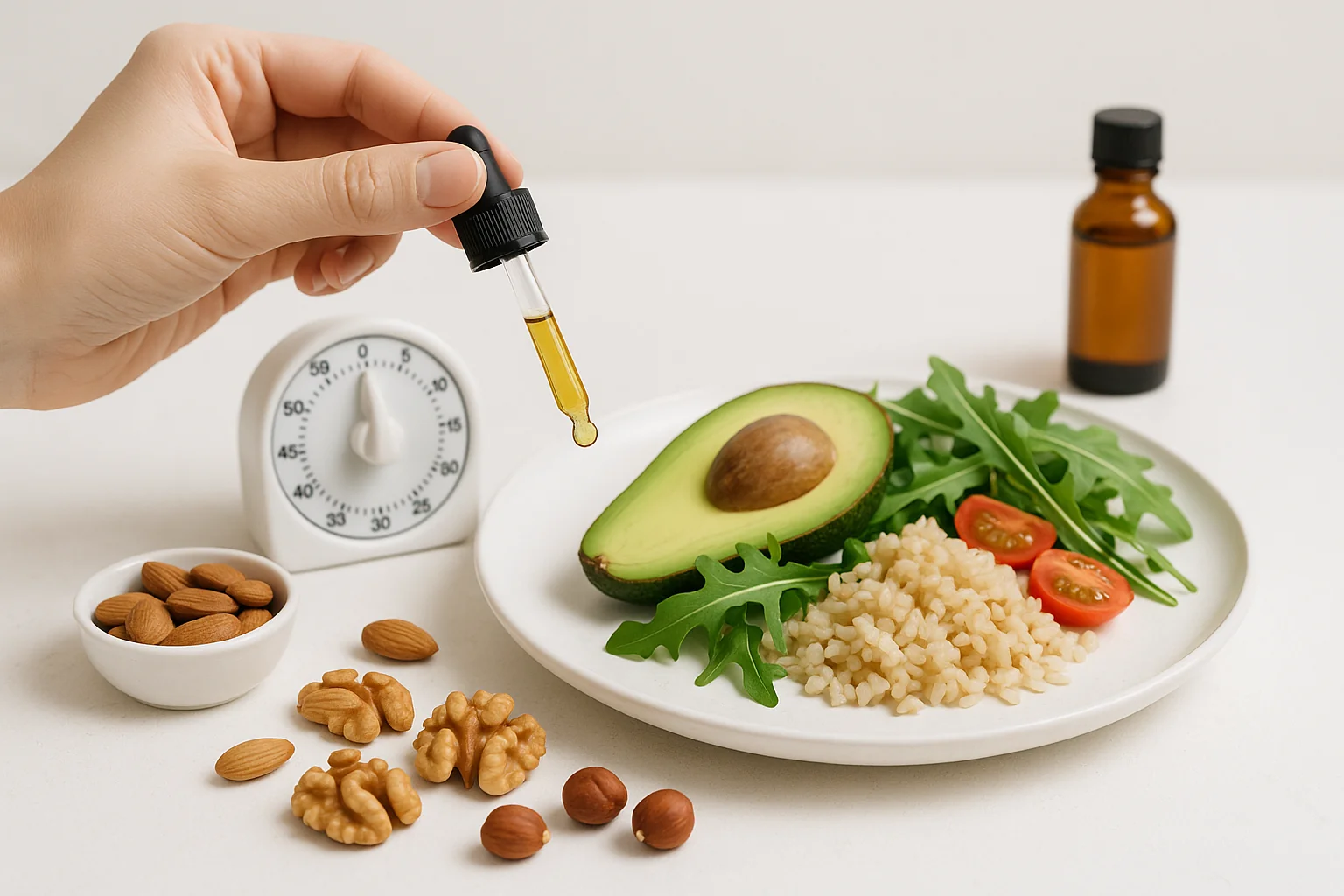

CBD Oil Before or After Eating? When to Take It for Best Effect
After a fatty meal, the peak concentration of CBD in the blood was 14 times higher than on an empty stomach. We check when to take the oil and what really changes with fat.
The timing of taking the oil comes up in readers’ questions more often than the dose itself. And rightly so, because it is not just a matter of convenience. In a study published in Epilepsia, eight adults with drug-resistant epilepsy took the same pure CBD capsule twice: once on an empty stomach and once after a fatty breakfast. After the meal, the peak concentration in the blood was on average fourteen times higher. The same dose, a different order of magnitude. Below, we explain where this difference comes from, how it relates to oil held under the tongue, what time of day to reach for the preparation, how coffee fits into the picture, and what today’s EFSA opinion says about the safe amount of CBD. Every number in this text has a reference to the work from which it comes.
KEY INFORMATION
• After a fatty breakfast (840-860 kcal), the peak concentration of CBD in the blood was on average 14 times higher, and total exposure was 4 times higher than on an empty stomach (Birnbaum et al., Epilepsia, 2019, eight patients).
• The absolute bioavailability of CBD in humans has only been measured after inhalation and is about 31 percent. No study has established it for the oral route (Millar et al., 2018).
• CBD inhibits the enzyme CYP1A2 and slows down the breakdown of caffeine: at 1500 mg of CBD per day, exposure to caffeine increased by 95 percent (Thai et al., 2021).
• EFSA derived a provisional safe dose of 0.0275 mg per kilogram of body weight per day, which is about 2 mg for a person weighing 70 kg.
• The safety of CBD cannot be established for individuals under 25 years of age, pregnant women, nursing mothers, and those taking medications (EFSA, 2026).
Why does a meal change CBD concentration in the blood?
Because CBD dissolves in fats, not in water. Fat in the intestine stimulates the secretion of bile, bile forms micelles, and only in micelles do CBD molecules pass through the intestinal wall into the blood. Without fat, this transport is poor, and a significant portion of the dose passes through the digestive tract unused.
The scale of the phenomenon was measured in a study by Birnbaum et al. published in Epilepsia in 2019. Eight adults with drug-resistant focal epilepsy took a single dose of capsules with 99 percent CBD twice: once without breakfast and once after a high-fat meal worth 840-860 kcal. Blood was drawn for 72 hours after each dose. After the meal, the peak concentration was on average 14 times higher, and total exposure calculated as the area under the curve was 4 times higher. No adverse events were reported.
Two things need to be said about this number right away. First, eight participants is a very small group, and the variability of results was enormous: the 90 percent confidence interval for the ratio of peak concentrations ranged from 7.5 to almost 32. Second, capsules with pure CBD were tested, not oil held under the tongue. However, the direction of the effect is independently confirmed by EFSA’s opinion from 2026, which states that the bioavailability of CBD is variable and depends on both the carrier and the food consumed.
How much CBD from the oil actually reaches the blood?
It is unknown, and that is an honest answer. A systematic review by Millar et al. from 2018 reviewed 792 works and found 24 with pharmacokinetic data in humans. Absolute bioavailability was measured for only one route of administration: inhalation, where it was about 31 percent.
No study has done this for the oral and sublingual routes, even though intravenous preparations, which are needed for such measurement, are available. This means that the percentages circulating online as “oral bioavailability of CBD” have no basis in human data. However, the same review provides measured facts: peak concentration increases in a fed state and in preparations with a fat carrier, the time to peak ranges from zero to four hours, and the half-life is from 1.4 to 10.9 hours after buccal spray and from two to five days with long-term oral use.
Holding the oil under the tongue does indeed bypass part of the first pass through the liver, which we discuss in more detail in the post about the first pass effect. However, you always swallow part of the dose with saliva, and that part behaves like a regular oral dose. What that part is has also not been measured in humans.
We noticed while organizing this text that two numbers repeated in the Polish internet as certainties, namely 6-15 percent oral bioavailability and 20-25 percent after a meal, do not lead to any work in humans. We removed them from here instead of copying them further.
What time of day should you take CBD oil?
There is no time that is good for everyone. It is more sensible to choose it based on why you are reaching for the preparation and to stick to it daily at a similar hour. Regularity provides a more predictable level in the blood than perfect timing with a meal, as the half-life of CBD is long and varies greatly between individuals.
| Why you reach for the oil | Suggested time | Why then |
|---|---|---|
| Calm during the day | In the morning, with a fatty breakfast | A meal raises concentration, and the morning time covers the hours of greatest load |
| Falling asleep | In the evening, after dinner | The time to peak concentration reaches four hours, so a dose just before sleep can be late |
| Symptoms persisting all day | Daily dose split between morning and evening | Two times smooth out concentration fluctuations better than one |
| Mental work | In the morning or at noon | Evening time has no advantage here and makes it difficult to assess what worked |
The table organizes practice, not research results. No work has compared morning CBD intake with evening intake for the same indication in humans, so treat these rows as a starting point for your own observations, not as a scientific determination. We discuss evening use separately in the post about whether the oil alone is enough for sleep.
What fats to choose for a meal with CBD?
Regular fats from a regular meal. In the Birnbaum study, a breakfast worth 840-860 kcal was used, but that was an extreme condition chosen to see the maximum effect. We have not found a study that checked how much fat is enough, so no specific number of grams is confirmed here.
In practice, it is about ensuring that the meal contains fat at all: avocado, nuts, olive oil on salad, peanut butter, fatty fish, full-fat dairy. Black coffee consumed on the go is not such a meal, and that is the simplest explanation for why the morning dose of oil is sometimes received weaker than the evening one. The type of fat is secondary to whether fat is present in the meal at all.
A separate matter is the carrier of the preparation itself. Millar’s review notes that peak concentration increases in preparations with a fat carrier, and EFSA explicitly mentions the carrier as a factor changing bioavailability. This does not exempt you from a meal, as there are a few milliliters of fat in a bottle of oil, while there are several grams on a plate. The differences between the carriers themselves are discussed in the post MCT vs olive oil.
Can CBD be combined with coffee and tea?
Yes, but it is not a neutral combination. CBD inhibits CYP1A2, the enzyme that breaks down caffeine. In a phase one study in healthy adults, at 750 mg of CBD twice a day, exposure to a single dose of 200 mg of caffeine increased by 95 percent, and its half-life extended from 5.4 to 10.9 hours (Thai et al., 2021).
Before you translate this to your morning coffee, read the conditions of that study. The daily dose was 1500 mg of pure CBD, which is a multiple of what is found in food products. Of the sixteen enrolled individuals, nine completed the treatment, and six discontinued it due to elevated liver tests. This finding primarily speaks about the enzyme itself, and only secondarily about a cup of coffee with a few drops of oil.
The other side was checked separately. In a study by Ferretti et al. from 2024, 54 young adults took 200 mg of caffeine together with either a placebo or CBD at doses ranging from 25 to 240 mg. Participants’ feelings did not differ between groups, and no adverse effects occurred, although the authors themselves call the result preliminary. The practical conclusion is therefore calm: at food quantities, there is no warning signal, and individuals sensitive to caffeine can simply observe whether coffee does not work longer than usual. For herbal teas, we did not reach comparable data from these two studies and therefore do not assert anything in either direction.
How long does it take to see effects and how much CBD is safe daily?
The time to peak concentration ranges in Millar’s review from zero to four hours, shortest after inhalation, and longest after oral and sublingual administration (Millar et al., 2018). The assessment of effectiveness is usually postponed by several weeks, as a single dose says nothing about the effect of regular use.
This has a pharmacokinetic basis, not just customary. The same review provides a half-life of two to five days with chronic oral administration, meaning the substance accumulates in the body for many days before a steady level is established. What happens next with the receptors cannot be described fairly today: we have not found a study in humans that measured changes in cannabinoid receptor density after several weeks of CBD use, so we removed the sentences describing them from this entry. More about the time frames themselves is discussed in the text when CBD works.
The upper limit is currently set by EFSA. The panel derived a provisional safe dose using the benchmark dose method of 0.0275 mg per kilogram of body weight per day, which gives about 2 mg for a person weighing 70 kg, with an uncertainty factor of 400. This value applies only to supplements with a purity of CBD of at least 98 percent and without nanoparticles. The safety of CBD cannot be established for individuals under 25 years of age, pregnant women, nursing mothers, and those taking medications.
Frequently Asked Questions
Should CBD be taken before or after eating?
After eating, preferably after a meal containing fat. In a study by Birnbaum et al. (Epilepsia, 2019), eight patients took the same dose once on an empty stomach and once after a fatty breakfast. After the meal, the peak concentration was on average 14 times higher, and total exposure was 4 times higher.
By how much does a meal increase CBD concentration in the blood?
On average, fourteen times for peak concentration, but the group consisted of eight people and the variability was large: the 90 percent confidence interval ranged from 7.5 to 32. Capsules with pure CBD were tested after a breakfast worth 840-860 kcal, so the numbers do not directly transfer to oil and a regular sandwich.
Does oil held under the tongue also require a meal?
The sublingual route bypasses part of the first pass through the liver, so it depends less on food. However, you always swallow part of the dose, and that part behaves like a regular oral dose. What that part is has not been measured in humans, so a meal with fat remains a more sensible choice than fasting.
Can CBD be taken with coffee?
CBD inhibits CYP1A2, the enzyme that breaks down caffeine. At 1500 mg of CBD per day, exposure to caffeine increased by 95 percent (Thai et al., 2021), but that dose is many times higher than what is found in food. At 25-240 mg of CBD with 200 mg of caffeine in 54 people, no differences or adverse effects were reported (Ferretti et al., 2024).
How much CBD is considered safe to take daily?
EFSA derived a provisional safe dose in 2026 of 0.0275 mg per kilogram of body weight per day, which is about 2 mg for a person weighing 70 kg. This applies only to supplements with a purity of at least 98 percent. Safety cannot be established for individuals under 25 years of age, pregnant women, nursing mothers, and those taking medications.
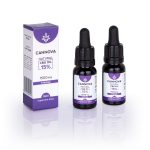
The oils available in the store at Bucha are collected in the oils category.
This article is for informational and educational purposes and does not constitute medical advice. Before starting to use cannabis or CBD for therapeutic purposes, consult a doctor, especially if you are taking other medications, are pregnant, or breastfeeding.
Author: Michał Waluk · Published: 2026-05-29 · Updated: 2026-08-15