
Acne - Treatment Using Cannabis and CBD
Cannabis and CBD in acne: what sebocyte studies showed, which cannabinoids help, how to use topical preparations, and what evidence does not show.
Common acne affects about 85% of people aged 12-24 and remains the most common skin disease in developed countries (Peyravian et al., 2022). Standard treatment works but has two weak points: side effects and increasing bacterial resistance to antibiotics. Therefore, since 2014, when Oláh’s team described the effect of cannabidiol on human sebaceous gland cells, cannabis has returned to dermatological discussion. This text shows exactly what these studies demonstrated, in which model, and with what reservations. We also separate two things that are often conflated in product descriptions: hemp seed oil and cannabinoid-containing extract. They are not the same raw material and do not work the same way.
KEY INFORMATION
• CBD inhibits lipid production in human sebocytes via TRPV4 channels and calms inflammation by blocking NF-kB (Oláh et al., 2014).
• Evidence comes from cell cultures and skin biopsies, not from studies on acne patients.
• CBG and CBGV in the same model increased lipid synthesis, so they are not candidates for oily skin.
• Hemp seed oil contains no cannabinoids. It is a carrier, not an active substance.
• A topical preparation is the first choice; oral form acts on accompanying factors.
Why is classic acne treatment sometimes insufficient?
Not because it does not work, but because it is hard to maintain and increasingly encounters bacterial resistance. Acne is a chronic inflammatory disease of the pilosebaceous unit, and its treatment requires months of consistency, not weeks.
The review by Moradi Tuchayi et al. (2015) states the problem directly. Treatment guidelines suffer from a lack of data allowing evidence-based recommendations. There is also no consensus on acne severity assessment criteria, complicating randomized studies’ conduct and comparison. Complex regimens combining several preparations reduce adherence, undermining therapy effectiveness.
The second problem concerns antibiotics. Adler et al. (2017) summarize that topical and oral antibiotics in acne lead to resistance in follicular bacteria and others, with clinical consequences. Recommendations lean toward avoiding antibiotics as sole therapy, combining them with agents of different mechanisms, and shortening administration duration.
The third problem is subtler. Dréno et al. (2020) describe that topical and systemic antibiotics disrupt the skin microbiome. Since microbiome imbalance contributes to acne, the drug partly works against its goal.
Untreated or poorly managed acne can have lasting consequences. Moradi Tuchayi et al. remind that the disease often leaves scars and significantly lowers quality of life. This argues for seeking supplements to standard therapy, not abandoning it.
How does the endocannabinoid system affect skin and sebum?
Skin has its own endocannabinoid system. CB1 and CB2 receptors, endocannabinoids like anandamide, and enzymes responsible for their breakdown are present in keratinocytes, sebocytes, melanocytes, and skin immune cells.
The review by Tóth et al. (2019) compiles two decades of research on this topic. The authors state that cannabinoid signaling in skin participates in maintaining balance, building and regenerating the epidermal barrier, and its dysregulation is linked to many common disorders.
The list includes atopic dermatitis, psoriasis, scleroderma, acne, hair growth and pigmentation disorders, keratin diseases, skin cancers, and itch. However, the authors emphasize this is translational potential, i.e., research direction, not ready therapies.
The practical conclusion is narrower than usually presented. The presence of a receptor in a cell only means there is a target. It does not indicate direction. The same system can increase lipid production at one activation level and inhibit it at another.
Therefore, for every claim about cannabis on skin, ask three things: which molecule was studied, at what concentration, and in which model. The statement “cannabis acts on the skin’s endocannabinoid system” is true but carries no useful information for choosing a cosmetic.
Does CBD really reduce sebum production?
In laboratory studies, yes, and this is the best-documented effect of cannabidiol on skin. Oláh et al. (2014) applied CBD to cultured human sebocytes and human skin biopsies and described three simultaneous effects: inhibition of lipid production, reduction of sebaceous gland cell proliferation, and calming of inflammatory response.
The authors tested two stimuli that increase lipogenesis. The first was arachidonic acid. The second was a combination of linoleic acid with testosterone, closer to what happens in skin under androgen influence. CBD inhibited both, and the inhibition of cell division occurred via TRPV4 channel activation.
| Effect | Described mechanism |
|---|---|
| Less lipids | TRPV4, disruption of ERK1/2 MAPK pathway, reduction of NRIP1 protein |
| Fewer sebocyte divisions | Also via TRPV4 |
| Weaker inflammation | Adenosine A2a receptor, increased TRIB3, NF-kB blockade |
However, it must be said what this study lacks. There are no patients, no lesion counting or acne severity scale, and no percentage “sebum reduction” value circulating in cosmetic descriptions. The authors cautiously conclude that the combination of three effects makes CBD a promising candidate for acne treatment.
The closest human study is Ali and Akhtar (2015). Healthy volunteers applied twice daily for twelve weeks a cream with 3% hemp seed extract on one cheek and base cream on the other. The treated side had significantly lower sebum levels and less redness after this time. This was a small group without acne, so the result is a premise.
Which cannabinoids affect acne and which do not?
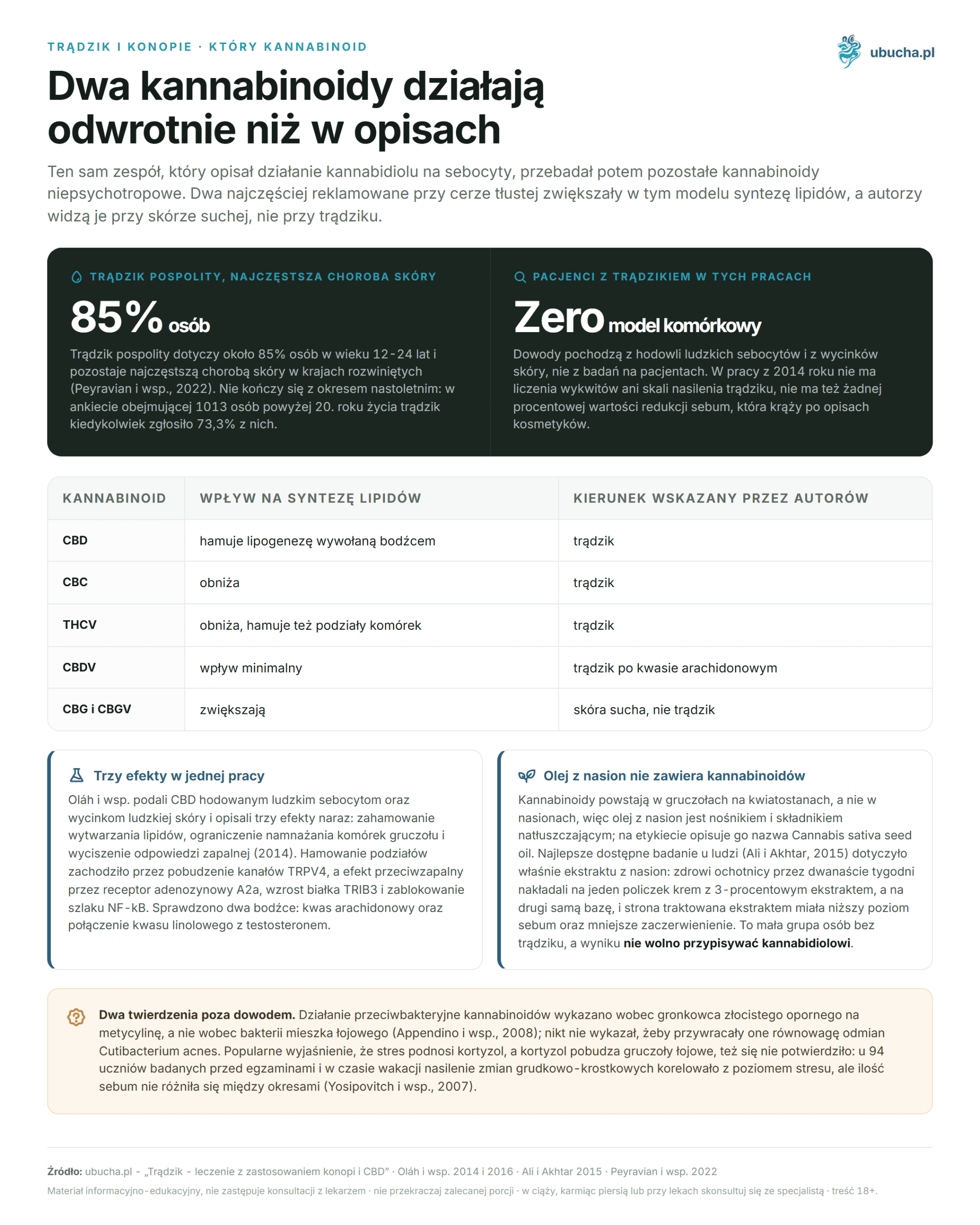
Not all act the same, and two most often advertised for oily skin behave oppositely to product descriptions. This is the most important correction to popular cannabis content on acne.
The same team that described CBD’s action later tested other non-psychotropic cannabinoids. In Oláh et al. (2016), baseline lipid synthesis in human sebocytes was inhibited by CBC and THCV, CBDV had minimal effect, and CBG and CBGV increased it. Lipogenesis induced by arachidonic acid was lowered by CBC, CBDV, and THCV, with THCV also inhibiting cell proliferation.
The authors’ conclusion is clear and worth remembering. They see CBG and CBGV as substances with potential for dry skin syndrome, and candidates for anti-acne agents are CBC, CBDV, and especially THCV. All tested cannabinoids showed anti-inflammatory effects on sebocytes stimulated by lipopolysaccharide.
| Cannabinoid | Effect on baseline lipid synthesis | Direction indicated by authors |
|---|---|---|
| CBD | Inhibits stimulus-induced lipogenesis (2014 study) | Acne |
| CBC | Lowers | Acne |
| THCV | Lowers, also inhibits cell division | Acne |
| CBDV | Minimal effect | Acne, after arachidonic acid stimulation |
| CBG and CBGV | Increase | Dry skin, not acne |
A separate thread concerns bacteria. Appendino et al. (2008) showed that five main cannabinoids, including CBD and CBG, strongly act on methicillin-resistant Staphylococcus aureus strains. However, the study did not test sebaceous follicle bacteria, so applying this result to acne remains a hypothesis. If you are interested in CBC alone, we described it in detail in the text about what cannabichromene is.
How does hemp seed oil differ from cannabinoid extract?
In composition and action. Hemp seed oil contains no CBD or THC because cannabinoids are produced in glands on flowers, not seeds. Flower extracts contain cannabinoids, and these are the subject of sebocyte studies. The first case is labeled Cannabis sativa seed oil.
This distinction has practical consequences. Hemp seed oil is a good, light carrier and emollient ingredient but does not modulate sebaceous gland function via the endocannabinoid system because it contains none. A product advertised as “hemp oil” may contain not a milligram of the substance you seek.
It is worth noting that the best available human study, Ali and Akhtar 2015, concerned seed extract, not a CBD preparation. The result was beneficial for sebum and redness, showing that the seed fat fraction contributes something. However, this result should not be attributed to cannabidiol.
For flower extracts, THC content also matters, with a specific threshold. For industrial hemp, it is 0.3%, counted as the sum of delta-9-THC and tetrahydrocannabinolic acid (THCA), rounded to one decimal place. This distinction changes lab test results because delta-9-THC alone gives a lower value than the sum of both compounds.
The national basis is Article 4 point 5 of the Act of July 29, 2005, on counteracting drug addiction, as amended by the Act of March 24, 2022 (Journal of Laws 2022 item 763). The national threshold corresponds to the EU threshold introduced by Regulation (EU) 2021/2115 but does not derive from it. These are two separate regulations with the same numerical value.
How does CBD affect skin inflammation?
It calms it, and this is the second well-described direction of cannabidiol action. In Oláh et al. 2014, the anti-inflammatory effect in sebocytes occurred via the adenosine A2a receptor, increased TRIB3 protein, and NF-kB pathway blockade, the main switch of inflammatory response in the cell.
A broader picture is given by the review of Atalay et al. (2019), dedicated to CBD’s antioxidant and anti-inflammatory properties. The authors describe cannabidiol as a non-psychoactive compound with documented anti-inflammatory and antioxidant effects, studied among others in diseases related to oxidative stress.
The review by Peyravian et al. (2022) relates most closely to acne. The authors note that CBD and other cannabis components, including seeds, reduced inflammation severity and pro-inflammatory cytokines TNF-alpha and IL-1-beta in acne-like conditions. The tested preparations were safe and well tolerated.
The same work explains why plant supplements are sought. The risk of side effects and antibiotic resistance in classic therapies reduces adherence and patient persistence. A preparation with a different mechanism and good tolerance can play an auxiliary role.
However, it must be noted that none of the above reviews provide a percentage decrease in cytokine levels in acne patients because such studies have not been conducted. Numbers circulating in product descriptions do not come from these works.
What is known about cannabinoids and the skin microbiome?
The microbiome itself is now understood differently than a decade ago, changing treatment thinking. Dréno et al. (2020) describe a shift: acne is not caused by overgrowth of Cutibacterium acnes bacteria but by loss of balance among its strains along with disruption of the entire skin microbiome.
A decrease in C. acnes strain diversity acts as a trigger for innate immunity, leading to skin inflammation. Acne shows dominance of one strain with a more aggressive profile than in healthy skin. Other bacteria, especially Staphylococcus epidermidis, also play a role, co-regulating skin balance with C. acnes.
The authors announce a therapy direction still emerging: targeting pathogenic strains while sparing commensal ones, instead of antibiotics hitting everything. They call these ecobiological therapies.
Where do cannabinoids fit in? For now, in the hypothesis field. Evidence for antibacterial action comes from Appendino et al. 2008 and concerns methicillin-resistant Staphylococcus aureus, not sebaceous follicle bacteria. No one has shown cannabinoids restore C. acnes strain balance.
A fair summary is: the hypothesis is reasonable and consistent with the mechanism but untested. The claim that a cannabis preparation inhibits acne bacteria while sparing beneficial ones goes beyond what anyone has studied.
Does CBD help with hormonal acne and adult acne?
There is a lack of studies directly answering this, though the problem is common and well documented. Acne does not end with adolescence and persists more often in women than men.
A survey by Collier et al. (2008) included 1013 people over 20 years old. Acne was reported ever by 73.3%. In the 20-29 age group, 50.9% of women vs. 42.5% of men reported it; in 30-39, 35.2% of women vs. 20.1% of men. The difference against women was statistically significant in all age groups over twenty.
The authors note a limitation: it is based on self-assessment, not medical examination. However, the magnitude is clear enough that adult acne is not marginal.
What does this mean for cannabinoids? The mechanism described by Oláh et al. in 2014 also involved the androgenic stimulus, as one tested system was linoleic acid combined with testosterone. This is a biological premise, not proof of effect in hormonal acne patients.
Practically, this means one thing. A cannabis preparation can accompany doctor-led treatment, but with suspected hormonal background, e.g., irregular menstruation or increased hair growth, the first step is diagnosis, not changing cosmetics.
How to safely incorporate a cannabis preparation into skincare?
Slowly and one at a time. A new active ingredient is introduced gradually, observing skin reaction, and never start two new preparations in the same week because irritation cause cannot be determined.
The first step is reviewing what you already use. If you use retinoids, salicylic acid, or benzoyl peroxide, separate them from the cannabis preparation in time: different times of day or alternate evenings. The second step is choosing the form for skin type, and the third is observation over weeks, not days.
- Oily and combination skin: lighter forms, i.e., serum or gel.
- Dehydrated or treatment-dried skin: cream with richer consistency.
- Look for stated extract content in percentages or milligrams per gram; lack of this prevents product comparison.
- Avoid formulas with alcohol high on the ingredient list and strongly concentrated essential oils.
- In the morning, close the routine with sunscreen regardless of season.
Set the evaluation date in advance before starting. A reasonable time is the eighth week for first assessment and twelfth for continuation decision. Acne skin improves and worsens in waves, so a single good or bad week measures nothing.
A simple record helps: photo in the same lighting once a week plus notes on sleep, stress, and changes in skincare. Without such a record, after three months you cannot reconstruct what actually worked. More on choosing formulas is in the text about whether cannabis cosmetics really work on skin.
What are side effects and contraindications?
When applied to skin, they are few because absorption into blood is negligible. Peyravian et al. (2022) note that tested cannabis extract preparations were safe and well tolerated in acne-like conditions.
For oral forms, the profile is better described. The review by Iffland and Grotenhermen (2017) confirms a favorable safety profile of cannabidiol in humans, with common side effects including fatigue, diarrhea, and changes in appetite and weight. Data mainly come from epilepsy and psychiatric disorder studies where CBD was given orally.
The same work points out two rarely mentioned gaps. First, more studies are needed on CBD’s effect on liver enzymes and drug transporters, as this affects interaction risk. Second, studies with larger participant numbers and longer administration periods are still lacking.
Practical contraindications for topical use are limited to obvious situations: cannabis allergy, open wound or active infection at application site, no interval with strong retinoids. In pregnancy and breastfeeding, safety data are lacking, so decide with a doctor.
If you take medications regularly and consider oral form, this is the time to talk to your doctor, not self-adjust dosage. For topical application, this conversation is less urgent but still worth mentioning to your dermatologist, especially before exfoliating procedures.
Do cannabinoids help with acne scars?
Data are preliminary and come from one small study not concerning acne scars. This is an important caveat because this work is sometimes cited as if it said otherwise.
Palmieri et al. (2019) observed 20 people: five with psoriasis, five with atopic dermatitis, and ten with scars resulting from these diseases. Participants applied a CBD-enriched ointment twice daily for three months.
They noted improvement in skin parameters measured by instruments: hydration, transepidermal water loss, elasticity, and clinical scales including psoriasis severity index. No irritant or allergic reactions were observed.
However, limitations are serious. It was a retrospective study without control group or randomization, on twenty people, concerning scars from diseases other than acne. The authors themselves call it a spontaneous observation.
The practical conclusion is cautious. A cannabinoid preparation may support skin care after inflammation subsides, but for atrophic acne scars, documented dermatological procedures are effective. The best method for scars remains preventing their formation by early treatment of inflammatory lesions.
Does oral CBD support acne treatment from within?
Indirectly and only in a narrow scope, and the popular explanation of this mechanism turned out to be wrong. It is worth tracing the mistake because most guides repeat it.
The standard version is: stress raises cortisol, cortisol stimulates sebaceous glands, so stress reduction lowers sebum. Yosipovitch et al. (2007) tested this on 94 students examined once before exams and once during holidays. The severity of papulopustular lesions correlated with stress level, but sebum amount did not differ between high and low stress periods.
The authors conclude directly that psychological stress in adolescents does not affect sebum production amount, and acne worsening is linked to stress by another mechanism. The stress-acne link is real but not via sebaceous gland.
Regarding oral CBD itself, data concern anxiety and sleep, not skin. Shannon et al. (2019) analyzed records of 72 adult psychiatric outpatients. Anxiety severity decreased in the first month in 57 patients (79.2%) and remained lower. Sleep quality improved in 48 (66.7%), but this fluctuated over time.
This was a case series without control group, not a randomized trial, and not about acne. Oral form thus makes sense only when tension or sleep problems accompany skin issues. Differences between topical and oral routes are analyzed in the text about topical action vs. blood absorption.
What have cannabis studies on acne not yet resolved?
Practically everything patients care about most: which concentration to use, how long, for whom, and with what effect measured by lesion count. This section exists so you don’t have to guess where knowledge ends.
The review by Nickles and Lio (2020) states this bluntly. Available data indicate possible benefit in acne, chronic itch, and atopic dermatitis, but existing studies are small and poorly designed. The authors call clearly for well-designed randomized trials before promoting cannabinoids in skin disease treatment.
Their practical advice for doctors is that dermatologists should know existing evidence and discuss it with patients. This is different from discouraging cannabinoids and completely different from recommending them.
| Question | State of knowledge |
|---|---|
| Which extract concentration works best | No studies comparing concentrations in acne patients |
| How much do lesion counts decrease | Not measured in any randomized study |
| How long does treatment last | Longest human observation is twelve weeks |
| Does it affect skin microbiome | Not studied regarding follicular bacteria strains |
| Does it help with acne scars | One study on 20 people, concerning scars from other diseases |
This table is not to discourage. It sets expectations where evidence stands so spending decisions are informed. A cosmetic with cannabis extract can be a reasonable skincare element and not an acne therapy.
Summary: is it worth including cannabis in acne skincare?
Cannabis has a strong biological basis and weak clinical basis in acne. Oláh et al. 2014 showed three simultaneous effects on human sebocytes, and Nickles and Lio 2020 add that patient studies are still lacking. Both statements are true simultaneously.
This leads to cautious use: topical preparation as first choice, one new ingredient at a time, assessment after eight weeks, decision after twelve. Oral form only when tension or sleep problems accompany skin issues.
Two corrections to popular content are worth remembering. CBG and CBGV increased lipid synthesis in sebocytes, so the promise of CBG for oily skin contradicts the study usually cited. And hemp seed oil is a carrier without cannabinoids, not an active substance.
Standard treatment remains the reference point. Acne with nodules, cysts, or scars belongs to a dermatologist, and a cannabis preparation can accompany but not replace this treatment. The earlier you start treating inflammatory lesions, the fewer marks remain.
Frequently Asked Questions
Does CBD really help with acne?
The biological basis is real, clinical evidence is weak. Oláh et al. (2014) showed on human sebocytes and skin biopsies that CBD inhibits lipid production, limits cell proliferation, and calms inflammation. However, no randomized study was conducted on acne patients, so clinical efficacy has not been measured.
What CBD concentration is most effective for acne?
It is unknown because no one has compared concentrations in acne patients. The commonly recommended 3-5% circulating online does not come from clinical studies. The only human study, Ali and Akhtar (2015), tested a cream with 3% hemp seed extract, which contains no cannabinoids.
Is CBG better than CBD for oily skin?
No, studies indicate the opposite. In Oláh et al. (2016), CBG and CBGV increased baseline lipid synthesis in human sebocytes, and the authors see them as candidates for dry skin. For anti-acne direction, they indicated CBC, CBDV, and especially THCV.
Does hemp seed oil work the same as CBD extract?
No. Hemp seed oil contains no CBD or THC because cannabinoids are produced in the flower glands, not in seeds. It works as a light carrier and emollient ingredient but does not affect the sebaceous gland via the endocannabinoid system. On the label, you can recognize it by the name Cannabis sativa seed oil.
How long does it take to see effects from using a cannabis preparation?
Realistically, from eight to twelve weeks of regular use twice daily. Acne skin improves and worsens in waves, so assessment after a single week measures noise, not the product’s effect. It is worth setting the evaluation date before starting treatment and sticking to it.
Does oral CBD help with acne?
Only indirectly and only where the problem is tension or sleep. Shannon et al. (2019) described a series of 72 patients whose anxiety severity decreased in the first month in 79.2% of cases, and sleep improved in 66.7%. This was not an acne study nor a randomized trial.
Does a cannabis preparation interact with acne medications?
When applied to the skin, absorption into the blood is negligible, so the risk is low. For oral form, Iffland and Grotenhermen (2017) indicate the need for further studies on CBD’s effect on liver enzymes and drug transporters. If you take medications regularly, discuss the oral form with your doctor.
Do cannabinoids help with acne scars?
Data are preliminary and do not concern acne scars. Palmieri et al. (2019) observed 20 people with psoriasis, atopic dermatitis, and scars from these diseases, noting after three months improved skin hydration and elasticity. The study was retrospective without a control group.
If you want to compare compositions of available cannabis extract formulas, browse cannabis cosmetics and check what we wrote above: raw material type and stated extract content.
This article is informational and educational and does not constitute medical advice. Before starting cannabis or CBD for therapeutic purposes, consult a doctor, especially if you take other medications, are pregnant, or breastfeeding.
Author: Michał Waluk · Published: 2026-04-27 · Updated: 2026-08-10