
Hemp tea: how it works, when to drink it and how it differs from CBD oil
Hemp tea is an infusion from Cannabis sativa L. How it works, how much cannabidiol really gets into the cup, and how it differs from CBD oil.
Hemp tea seems like a simple product, but more misunderstandings have arisen around its effects than around oil. The most common concerns numbers: tables circulating online state how much cannabidiol a cup contains and what percentage of it is absorbed, although no one has measured either of these values for the infusion. Another misunderstanding concerns the role of the infusion itself, presented sometimes as a cheaper substitute for oil, sometimes as a sleeping aid. Neither of these roles fits it, which is a shame because hemp tea has its real advantages, and there is no need to invent them. Below, I separate what has been measured from what has been added: the mechanism of action, the real content of cannabidiol in a cup, the brewing method that changes anything, and a fair comparison with CBD oil. Separately, I explain where the legal boundary lies in the kitchen, as two very similarly looking herbs are subject to completely different regulations.
KEY INFORMATION
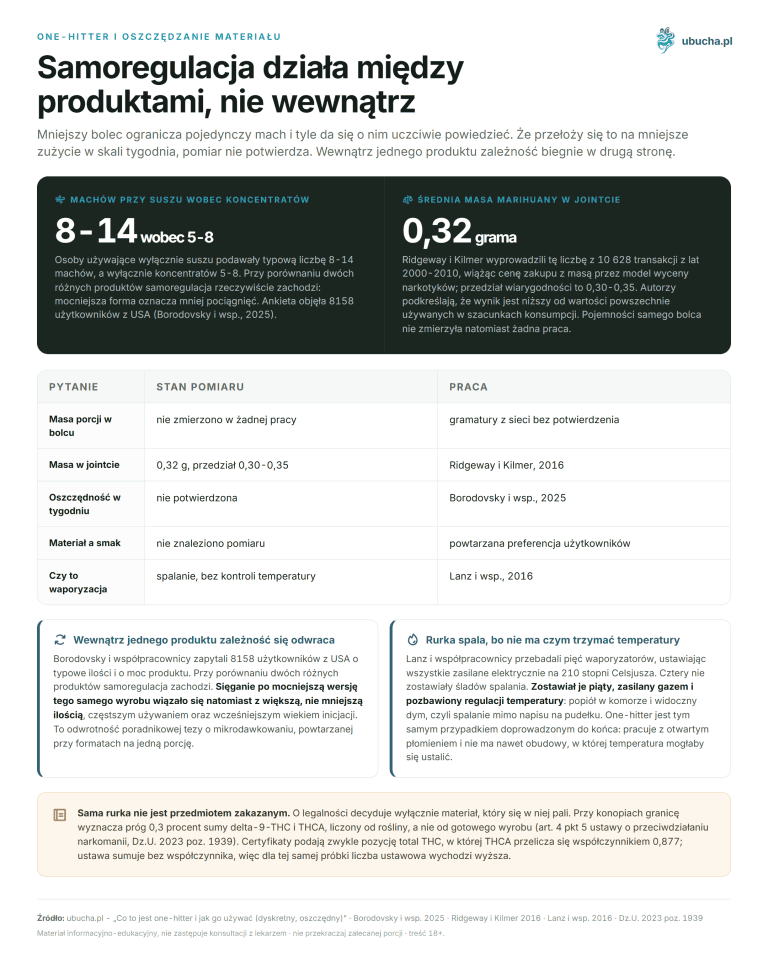
• The absolute bioavailability of cannabidiol has only been measured in humans for the inhalation route and was 31%; no study has established it for oral administration (Millar et al., Frontiers in Pharmacology, 2018).
• Cannabidiol is lipophilic, so it dissolves poorly in water; adding fat to the cup changes the amount of substance in the infusion.
• Hemp tea from industrial hemp contains no more than 0.3% of the sum of delta-9-THC and THCA, which is an amount of no psychoactive significance.
• EFSA provides a temporary safe dose of 0.0275 mg/kg body weight per day, which is about 2 mg for a person weighing 70 kg.
How does hemp tea work?
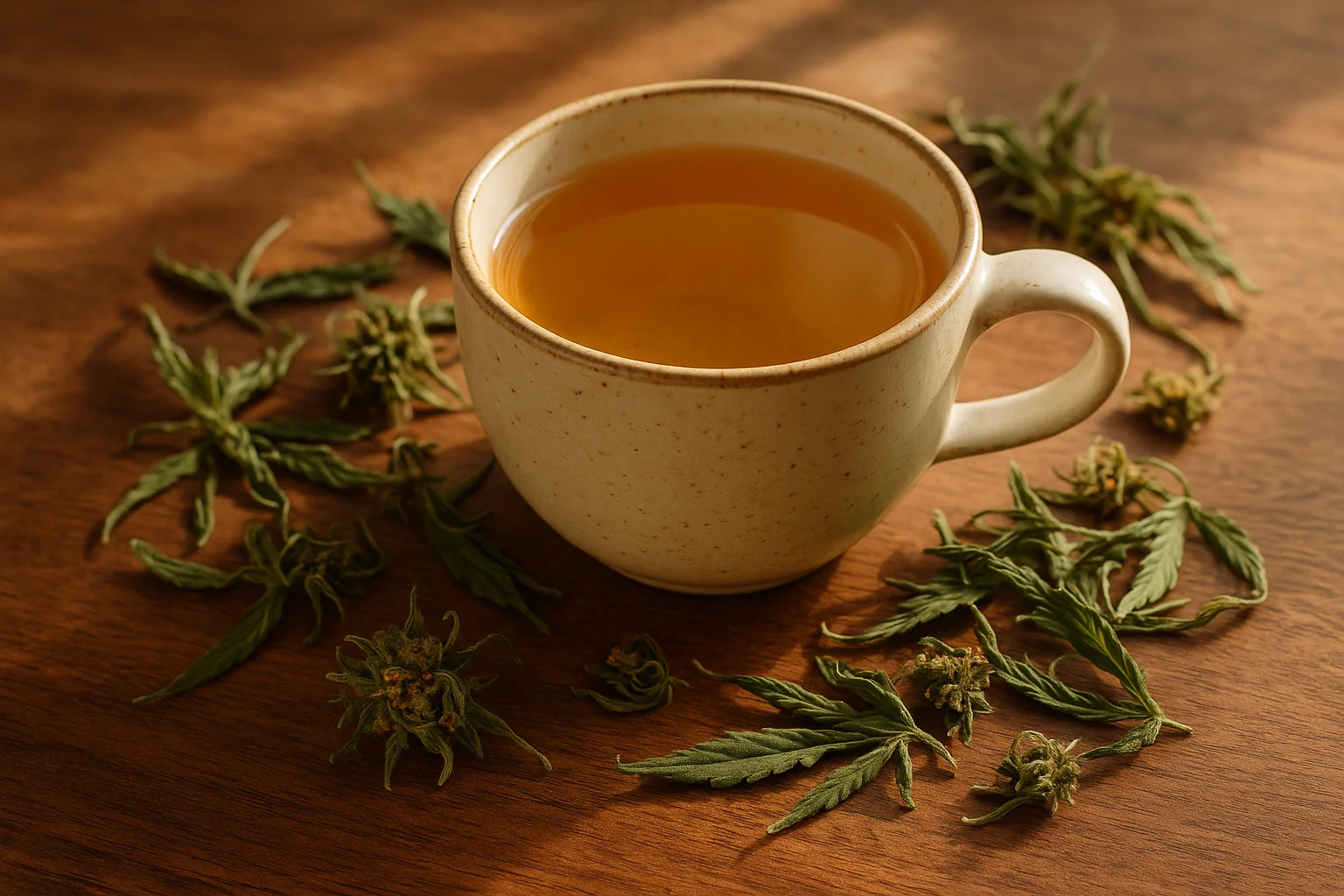
Hemp tea is not an extract of cannabidiol itself, but a water infusion from Cannabis sativa L. herb, which means a mixture of many substances with different solubilities. Some of them dissolve well in water, some hardly at all, and this difference determines how the infusion works.
The chemical composition of the plant is described in a review by Andre et al. (Frontiers in Plant Science, 2016), which discusses cannabinoids, terpenes, and phenolic compounds along with their biosynthetic pathways and trichomes, where these substances are produced. Cannabinoids are the best-studied group, but not the only biologically active one.
Itself, cannabidiol interacts with the endocannabinoid system and serotonin receptors 5-HT1A, which is associated with its anxiolytic effect. Among the terpenes present in the herb, beta-caryophyllene is the best documented: Gertsch et al. (PNAS, 2008) showed that it selectively binds to the CB2 receptor with a Ki value of 155 nM and acts as its agonist, and in mice lacking this receptor, the anti-inflammatory effect disappeared.
However, there is a caveat that guides are silent about. Results like this were obtained at concentrations and doses incomparable to what a cup of infusion carries, and beta-caryophyllene is also poorly soluble in water. They describe the properties of the molecule, not the effectiveness of the tea. A warm drink in itself has a calming effect, which does not need to be attributed to cannabinoids.
How much cannabidiol is in a cup of hemp tea?
The honest answer is: less than would result from the content of the raw material, and no one knows the exact number for a specific cup. The reason is chemical. Cannabidiol is lipophilic, so it dissolves poorly in water, and most of it remains in the plant material, which you throw away with the strainer.
The composition of the hemp infusion was quantitatively measured by Hazekamp et al. (Journal of Ethnopharmacology, 2007), systematically checking how the conditions of preparation, storage, and processing of the raw material change it. This is still a fundamental work on the phytochemistry of hemp tea, but its results concern a specific raw material from Dutch pharmacies and do not directly transfer to any herb from the shelf.
Therefore, numbers like “a cup contains from so many to so many milligrams” should be treated with caution. They depend on the content of cannabidiol in the raw material, the amount of herb, the volume of water, whether there was fat in the cup, and the time and temperature of brewing. Producers declare the percentage in dry mass, not the content in the brewed infusion, so the conversion always remains an estimate.
We have noticed that the most common mistake is not in choosing the herb, but in brewing it like black tea: boiling water, three minutes, without fat. A teaspoon of fat in the cup and longer brewing under cover change more than buying a more expensive raw material with a higher percentage.
Is it allowed to brew tea from hemp herb at home?
Yes, if the herb comes from industrial hemp, and no, if it comes from a pharmacy. This distinction determines the legal qualification of the entire activity, and the appearance of the raw material does not help in this, as after brewing, one does not differ from the other in any visible way.
Industrial hemp is a plant in which the sum of delta-9-THC and tetrahydrocannabinolic acid does not exceed 0.3% when converted to dry mass, according to art. 4 point 5 of the Act of July 29, 2005 on Counteracting Drug Addiction (t.j. Dz.U. 2023 poz. 1939), as amended by the Act of March 24, 2022 (Dz.U. 2022 poz. 763). Herb that meets this condition is a plant product, and brewing it is no different from brewing lemon balm.
The situation is different with hemp herb other than industrial hemp, issued on prescription. The law calls giving a narcotic substance a new form processing (art. 4 point 20), and responsibility for processing arises from art. 53. Preparing an infusion, butter, or baked goods from such raw material meets this definition.
A prescription does not change this, although it is claimed otherwise online. Art. 33a of the Act allows hemp herb as a raw material for prescription drugs, i.e., those prepared in a pharmacy by a pharmacist. There is no regulation exempting the patient from responsibility for independently giving the raw material a new form in their own kitchen.
When to drink hemp tea?
The most sense is in the evening, and not because the infusion has proven sedative effects, but because its strengths are ritualistic. A warm drink, a break from the screen, and a repetitive time work to calm down regardless of the content of cannabinoids.
It is worth honestly separating two levels. Cannabidiol has documented anxiolytic effects, but in human studies, doses an order of magnitude higher than what the infusion can carry were used. The contextual effect, i.e., the association of time and activity with rest, is probably stronger in the case of tea than the pharmacological one, and there is nothing discrediting in that.
In the morning, hemp infusion is sometimes chosen as a substitute for coffee by those sensitive to caffeine. It contains no caffeine, so it does not stimulate, but it also does not eliminate drowsiness. If you are looking for a substitute that will really get you going, hemp tea will not be it.
During the day, it works as a break, not as a remedy for tension. The first cup rarely makes an impression, and that is normal; people who stick to this habit describe rather gradual habituation than a distinct single effect. We have outlined a practical brewing protocol in the text about how to brew CBD tea from hemp.
How does hemp tea differ from CBD oil?
They differ in everything except the raw material: concentration, dose repeatability, speed of action, and role in daily routine. The question “which is better” is therefore poorly posed, as they are tools for different applications, not two versions of the same product.
The most interesting difference concerns what is not known about both forms. A review by Millar et al. (Frontiers in Pharmacology, 2018) gathered 24 works with pharmacokinetic data in humans and found that the absolute bioavailability of cannabidiol was established only for the inhalation route, where it was 31%. No study has established it for oral and sublingual administration, even though there are intravenous preparations that would allow it. Therefore, tables assigning specific absorption percentages to the infusion or oil have no backing in the data.
| Feature | Hemp tea | CBD oil |
|---|---|---|
| Dose repeatability | low, depends on brewing | high, measured with a pipette |
| Composition | water extract from the whole herb | extract in a carrier oil |
| Speed of action | slower, through the digestive tract | faster when taken sublingually |
| Role | ritual, sensory experience | measured supplementation |
How to brew hemp tea?
Three things change the result: the presence of fat, the temperature of the water, and covering. The rest is of secondary importance. An infusion prepared like regular black tea loses the most, and this is the most common way of brewing hemp.
Add fat to the empty cup before pouring so that it works during brewing. A teaspoon of hemp oil, clarified butter, or a few tablespoons of whole milk works well. Plant-based milk will also work, although coconut milk has more fat than oat milk, so the difference can be noticeable.
Use water below boiling. Boiling water evaporates volatile terpenes responsible for the aroma faster, and these are one of the reasons why one drinks an infusion from the herb, not a solution of isolate. If you do not have a kettle with regulation, it is enough to boil water and wait a few minutes.
Brew covered, longer than black tea. A plate or saucer retains steam with terpenes, which would otherwise escape from the cup. Over-brewing does not increase the content of cannabinoids, but it does extract bitterness from chlorophyll, so a few minutes is a reasonable compromise. Add honey at the end, to the cooled infusion. More about the raw material itself and choosing the concentration is written in the text about CBD herb for tea.
For whom is hemp tea not safe?
For three groups indicated directly by EFSA and for people taking medications metabolized by pathways influenced by cannabidiol. For other adults, the infusion from industrial hemp is well tolerated, but that does not mean it is neutral.
EFSA derived a temporary safe dose of cannabidiol in 2026 at the level of 0.0275 mg per kilogram of body weight per day, which is about 2 mg for a person weighing 70 kg, and noted that it applies only to supplements with a purity of at least 98%. Separately, it stated that safety cannot be established for individuals under 25 years of age, for pregnant and breastfeeding women, and for those taking medications. The panel also noted the potential hepatotoxicity in humans, primarily revealed in combination with medications.
Drug interactions are a real, not a theoretical problem here. A review by Brown and Winterstein (Journal of Clinical Medicine, 2019) indicates the influence of cannabidiol on CYP3A4 and CYP2C19 and on P-glycoprotein and assesses the risk of interactions with commonly used medications as high. With the infusion, exposure is low, but it increases when someone combines tea with oil.
Children are a separate matter and it is worth naming it directly, as it can be confused. Data on the safety of cannabidiol in children come from studies on a pharmaceutical preparation used in drug-resistant epilepsy under medical supervision, not from wellness products. For children, better choices are infusions of lemon balm or chamomile. We write about the raw material itself and how it differs from marijuana in the text about CBD herb.
Frequently asked questions
How much cannabidiol does hemp tea contain?
No one knows the exact number for a cup. Cannabidiol is lipophilic, so it dissolves poorly in water, and the result depends on the raw material, the amount of herb, the presence of fat, and the time and temperature of brewing. Producers declare the percentage in dry mass, not the content in the brewed infusion.
How to brew hemp tea to extract more cannabidiol?
Add fat to the cup before pouring, use water below boiling, and brew covered for longer than black tea. Fat is the most important here because cannabidiol does not dissolve in water. Covering retains volatile terpenes that would otherwise escape with the steam.
Does hemp tea work faster than CBD oil?
No. The infusion passes through the entire digestive tract, so it works slower than oil taken sublingually. However, it is worth knowing that no one has measured the exact bioavailability values for both routes in humans; the only measured route is inhalation, 31% (Millar et al., 2018).
Does hemp tea contain THC?
It contains trace amounts. The legal raw material comes from industrial hemp, in which the sum of delta-9-THC and THCA does not exceed 0.3% dry mass (art. 4 point 5 of the Act on Counteracting Drug Addiction). In a cup of infusion, this corresponds to an amount of no psychoactive significance.
Can hemp tea be combined with CBD oil?
Yes, but then it is worth calculating how much cannabidiol you are taking in total. EFSA provides a temporary safe dose of 0.0275 mg/kg body weight per day, which is about 2 mg for a person weighing 70 kg. When taking medications simultaneously, the safety of cannabidiol cannot be established.
Is it allowed to brew tea from pharmacy-grade herb?
No. Giving a narcotic substance a new form is called processing by law (art. 4 point 20), and responsibility arises from art. 53. A prescription does not change this: art. 33a allows hemp herb as a raw material for prescription drugs prepared in a pharmacy, not for home infusions.
Is hemp tea addictive?
There is no data indicating the addictive potential of the infusion from industrial hemp, and the THC content is trace. EFSA in its 2026 assessment indicates other areas of risk: liver, pregnancy and lactation, age under 25, and simultaneous medication use.
Herbs and blends for brewing can be found in the hemp tea category.
This article is for informational and educational purposes and does not replace consultation with a doctor. If you are pregnant, breastfeeding, taking medications, or have chronic conditions, consult the use of supplements or herbs with a specialist.
Author: Michał Waluk · Published: 2026-06-22 · Updated: 2026-08-11