
CBD water-soluble (nanoemulsion): does it absorb better than oil (table)
A study in humans did not show higher CBD exposure from nanoemulsion than from oil. What does nanoemulsion really change and where do the bioavailability percentages come from.
Nanoemulsions of CBD are sold with the claim of several times higher bioavailability. However, a study that compared both forms head-to-head in humans states otherwise: the total exposure of cannabidiol in plasma did not differ between sesame oil and the self-nanoemulsifying system, although the nanoemulsion provided a more predictable absorption profile (Izgelov et al., European Journal of Pharmaceutics and Biopharmaceutics, 2020). This is a significant difference: predictability and potency are not the same. In this article, we show what was actually measured in CBD absorption studies, where the popular bioavailability percentages came from, and when paying extra for carrier technology makes sense. You will also see which free habit change yields an effect comparable to what the industry promises, and what the European safety assessment does not say about nanoemulsions.
KEY INFORMATION
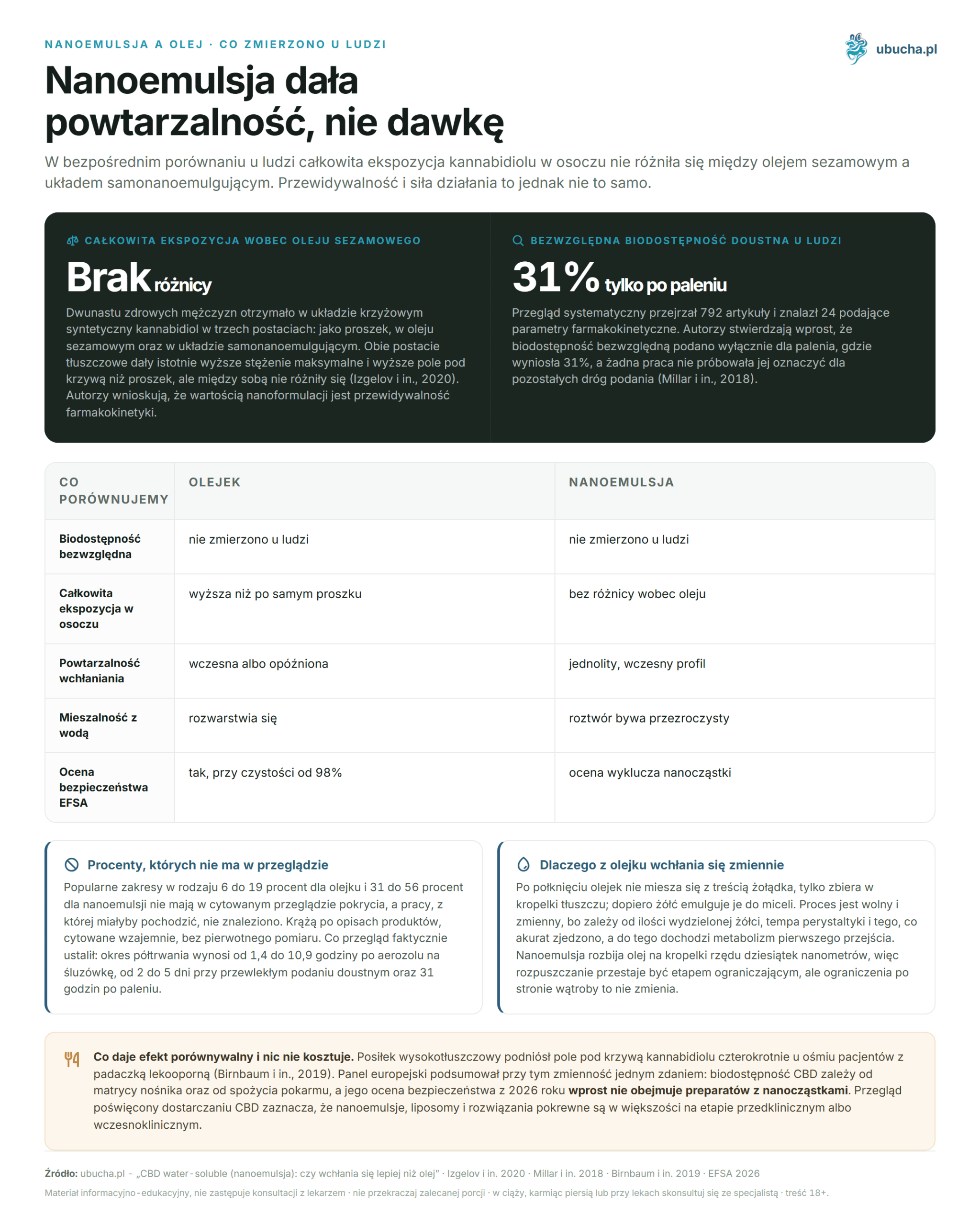
• In a crossover study of 12 healthy men, the nanoemulsion did not provide higher CBD exposure in plasma than sesame oil, but ensured a uniform, early absorption profile (Izgelov et al., 2020).
• No one has measured the absolute oral bioavailability of CBD in humans; the only absolute value reported is 31% after smoking (Millar et al., Frontiers in Pharmacology, 2018).
• A high-fat meal increased the area under the CBD curve fourfold in eight patients with drug-resistant epilepsy (Birnbaum et al., Epilepsia, 2019).
• The EFSA safety assessment panel’s 2026 report does not directly include nanoparticle products.
• The emulsifier polysorbate 80 altered the microbiota in mice even at relatively low concentrations (Chassaing et al., Nature, 2015).
Why does CBD from oil absorb poorly?
Because cannabidiol is a lipophilic molecule, and the gastrointestinal tract is an aqueous environment. After swallowing, the oil does not mix with the stomach contents but collects into fat droplets. Only bile emulsifies them into micelles, in which CBD can pass through the intestinal wall into the bloodstream.
This process is slow and variable, as it depends on the amount of bile secreted, the rate of peristalsis, and what you have eaten. Additionally, there is first-pass metabolism: before CBD reaches the systemic circulation, the liver converts a significant portion into metabolites with different properties. Authors of studies on oral administration describe this susceptibility to first-pass metabolism as the main obstacle in oral formulation. We have described this mechanism separately in a post about first-pass effect.
The result is that two people taking the same drop of oil may have plasma concentrations that differ multiple times. The EFSA panel summarized this in a 2026 assessment with one sentence: the bioavailability of CBD is variable and depends on the carrier matrix and food intake (EFSA, EFSA Journal, 2026). The entire nanoemulsion technology is an attempt to address this variability.
How does CBD nanoemulsion work?
The nanoemulsion breaks down the oil containing cannabidiol into droplets of sizes in the tens of nanometers, which greatly increases the contact surface with the aqueous phase. With the same volume of oil, the contact surface increases by orders of magnitude, and dissolution ceases to be a limiting step for absorption.
Technically, it looks like this: cannabidiol is mixed with emulsifiers, water, and carrier oil, and the mixture is passed through a high-pressure homogenizer or microfluidizer, which reduces the droplets to the desired size. A variation of this approach is the self-nanoemulsifying system, abbreviated as SNEDDS, which creates nano-droplets only upon contact with gastrointestinal fluids. It is this SNEDDS that was studied in comparison to sesame oil. The finished preparation can be transparent and mixes with water without separation.
A related, though different technology is liposomes: cannabidiol is enclosed in double-layer phospholipid vesicles mimicking the cell membrane. A review dedicated to CBD delivery notes that these and similar solutions are mostly at the preclinical or early clinical stage, rather than established practice (Millar et al., Pharmaceuticals, 2020). We discuss the liposomal form in a separate post about liposomal CBD.
Does nanoemulsion absorb better than oil?
According to a direct comparison in humans: no in terms of quantity, but yes in terms of repeatability. Twelve healthy men received synthetic cannabidiol in three forms in a crossover design: as a powder, in sesame oil, and in a self-nanoemulsifying system. Both fat forms provided significantly higher maximum concentration and higher area under the curve than the powder.
However, the difference between oil and nanoemulsion went in a different direction than marketing suggests. The total exposure in plasma did not differ between these two forms. However, pure oil provided early absorption in some participants and delayed absorption in others, while SNEDDS provided a uniform, early profile in all (Izgelov et al., 2020). The authors conclude that the value of nanoformulation is the predictability of pharmacokinetics, not a greater dose reaching the blood.
| What are we comparing | CBD oil | CBD water-soluble (nanoemulsion) | How do we know this |
|---|---|---|---|
| Absolute oral bioavailability | Not measured in humans | Not measured in humans | Millar et al., 2018: the only absolute value reported is 31% after smoking |
| Total exposure in plasma | Higher than after pure CBD powder | No difference compared to sesame oil | Izgelov et al., 2020: 12 healthy men, crossover design, single dose |
| Repeatability of absorption | Two patterns: early and delayed, depending on the individual | Uniform, early profile | Izgelov et al., 2020 |
| Impact of a fatty meal | Area under the curve four times higher after a high-fat meal | Declared as lower, no comparative measurement | Birnbaum et al., 2019: eight patients with drug-resistant epilepsy |
| Mixability with water | Separates | Mixes, solution can be transparent | Physicochemical property of the system |
| Covered by EFSA safety assessment | Yes, with purity of cannabidiol at least 98% | No: assessment excludes nanoparticle products | EFSA, 2026 |
| Typical use | Sublingual or oral administration | Beverages and powders for dissolving | Market practice |
Where do the CBD bioavailability numbers come from?
From reviews that say less than they are credited with. A systematic review of the pharmacokinetics of cannabidiol in humans reviewed 792 articles and found 24 that provided pharmacokinetic parameters. Its authors state directly that absolute bioavailability was reported only for smoking, where it was 31%, and that no study attempted to measure it for other routes of administration (Millar et al., Frontiers in Pharmacology, 2018).
Popular ranges like 6 to 19 percent for oil and 31 to 56 percent for nanoemulsions have no coverage in this review, and we have not found a study from which they originated. They circulate in product descriptions, mutually cited, without original measurement. If a seller gives you a percentage of bioavailability, ask for the publication in which it was measured.
What the review actually established: the half-life of cannabidiol is from 1.4 to 10.9 hours after aerosol administration to the oral mucosa, from 2 to 5 days with chronic oral administration, and 31 hours after smoking. The area under the curve and maximum concentration increase with dose, and the peak comes faster after inhalation than after oral administration. The peak is also higher after a meal and in fat forms. We expand the comparison of routes of administration in the post about CBD bioavailability.
Does a meal with fat replace nanoemulsion?
In terms of effect size, it looks surprisingly good. In a study involving eight adults with drug-resistant epilepsy, a single dose of capsules containing 99% pure cannabidiol was given once fasting and once after a high-fat meal of 840 to 860 kilocalories. The maximum concentration was on average fourteen times higher in the fed state, and the area under the curve four times higher.
The variability was large. The 90% confidence intervals for the ratio of values after the meal to values fasting ranged from 7.47 to 31.86 for maximum concentration and from 3.42 to 7.82 for the area under the curve (Birnbaum et al., Epilepsia, 2019). This study involved eight individuals, not a population, and concerns a single administration. But the direction is clear and consistent with what the Millar review says about the impact of fat.
The practical conclusion is simple and free. Before you pay extra for carrier technology, check if you are even taking the oil with food containing fat. The variable that the user controls has an effect size comparable to what the descriptions of nanoemulsions promise, and it costs nothing. The comparison is indirect, as it comes from two different studies, but the difference in order of magnitude is telling. An egg, avocado, or a spoonful of oil will suffice.
Are emulsifiers in nanoemulsions safe?
This is a valid question, as nanoemulsions cannot be made without emulsifiers. The most commonly used are sunflower or soy lecithin and polysorbate 80, all approved for food. However, approval for food does not mean the topic is closed.
A study published in Nature found that in mice, two commonly used emulsifiers, carboxymethylcellulose and polysorbate 80, caused chronic low-grade inflammation and metabolic syndrome at relatively low concentrations, and in predisposed animals, colitis. Experiments on germ-free mice and microbiota transplants showed that changes in the microbiota were necessary and sufficient for this (Chassaing et al., Nature, 2015). Note the phrasing about low concentrations: product descriptions sometimes reverse this to “only at high doses.”
Separately, it is worth knowing that the provisional safe dose of cannabidiol calculated by the EFSA panel, about 2 mg per day for a person weighing 70 kg, applies only to supplements with at least 98% purity and free of nanoparticles. Nanoemulsion products are not included in this assessment. The safety of cannabidiol cannot be established in individuals under 25 years of age, in pregnant and breastfeeding women, and in individuals taking medications.
For whom does nanoemulsion make sense, and who gains nothing?
It makes sense where the form of administration matters, not the size of the absorbed dose. If you want to add cannabidiol to a beverage, oil will separate, while nanoemulsion will mix uniformly. This is a real, verifiable advantage and applies to beverages, powders, and products dissolved in water. We describe liquid forms more broadly in the post about hemp water and shots.
The second rationale is repeatability. A person for whom the oil works faster at times and slower at others may gain more from a uniform absorption profile than from the concentration size alone. This is suggested by Izgelov’s work and is how the authors justify the sense of nanoformulation.
However, a person who takes oil sublingually or with a meal containing fat and who cares about a full plant profile gains nothing. Nanoemulsions are usually made from isolate, as terpenes hinder the stabilization of the system, so along with water solubility, the rest of the plant components disappear. Additionally, there is the price and the fact that the EFSA safety assessment does not cover this form. The rule that organizes this choice is simple: if you buy a nanoemulsion, you are buying convenience of administration and repeatability, not a stronger effect of the same dose.
Frequently asked questions
What is CBD water-soluble?
It is cannabidiol enclosed in a nanoemulsion or liposomes, allowing it to mix with water. CBD itself is lipophilic and does not mix with water. The nanoemulsion breaks oil droplets down to sizes in the tens of nanometers, which greatly increases the contact surface with the aqueous phase and makes dissolution no longer a limiting factor for absorption.
Does CBD water-soluble absorb better than oil?
In a direct comparison in humans, the total exposure of cannabidiol in plasma did not differ between sesame oil and the self-nanoemulsifying system. However, the nanoemulsion provided a uniform, early absorption profile, while the oil resulted in delayed absorption in some participants (Izgelov et al., 2020). The study involved 12 healthy men.
What is the bioavailability of CBD from oil?
It has not been measured in humans. A systematic review of 24 studies with pharmacokinetic parameters states that absolute bioavailability was only measured for smoking, where it was 31%, and that no study attempted to measure it for oral administration (Millar et al., Frontiers in Pharmacology, 2018). The circulating percentage ranges do not have coverage there.
Is it worth taking CBD oil with food?
Yes, and it is probably the cheapest change you can make. In a study involving eight patients with drug-resistant epilepsy, a high-fat meal of 840 to 860 kilocalories increased the area under the CBD curve fourfold, and the maximum concentration fourteenfold compared to fasting (Birnbaum et al., Epilepsia, 2019).
Does CBD water-soluble have an entourage effect?
Usually not, because most such products are made from isolate. Terpenes and other plant components hinder the stabilization of the nanoemulsion, so manufacturers avoid them. The certificate of analysis of the batch determines this: if the cannabinoid profile shows only cannabidiol, the product was made from isolate, regardless of the plant image on the packaging.
Are emulsifiers in nanoemulsions safe?
They are approved for food, but the topic is not closed. In mice, carboxymethylcellulose and polysorbate 80 at relatively low concentrations caused chronic low-grade inflammation and altered the microbiota, and these changes were necessary and sufficient for the occurrence of metabolic syndrome (Chassaing et al., Nature, 2015). The EFSA safety assessment of nanoparticle products does not include this.
Can CBD water-soluble be administered in ways other than orally?
No. Commercially available products are intended solely for oral administration or as an additive to beverages. They are not sterile and are not suitable for intravenous or intramuscular administration, as this would risk embolism and infection. The form of the carrier does not change the route of administration for which the product has been approved.
Classic oils, to which most of the described studies refer, can be found in the category hemp oils in the u Bucha store.
This article is for informational and educational purposes only and does not constitute medical advice. Before starting to use cannabis or CBD for therapeutic purposes, consult your doctor, especially if you are taking other medications, are pregnant, or breastfeeding.
Author: Michał Waluk · Published: 2026-08-09 · Updated: 2026-08-15