
CBD impact on the brain and nervous system: what neurology and research say
How CBD affects the brain: 5-HT1A and GABA-A receptors, neuroprotection, memory, and anxiety. We check what has been measured in humans and what only in rodents.
Today, two extremely different things are said about the impact of CBD on the brain: either that it is a substance with unproven effects, or that it protects neurons and rebuilds the nervous system. The truth lies in a less spectacular but much more interesting place. The neurobiology of cannabidiol is well described at the receptor level, fairly well in animal models, and very modestly in humans, with one neurological indication having full drug registration. This imbalance is the most important aspect of the whole topic, as most statements circulating on the internet come from the first level, while sounding like conclusions from the third. Below, we go through the mechanisms one by one, with one question asked for each: on whom was it measured and at what dose.
KEY INFORMATION
• CBD does not stimulate the CB1 receptor; it mainly acts through 5-HT1A, GABA-A, TRPV1, and increases the concentration of anandamide (Campos et al., 2012).
• Blocking the 5-HT1A receptor abolishes the anxiolytic effect of CBD in animals (Resstel et al., 2009).
• The only registered neurological indication is treatment-resistant epilepsy, not the prevention of brain diseases.
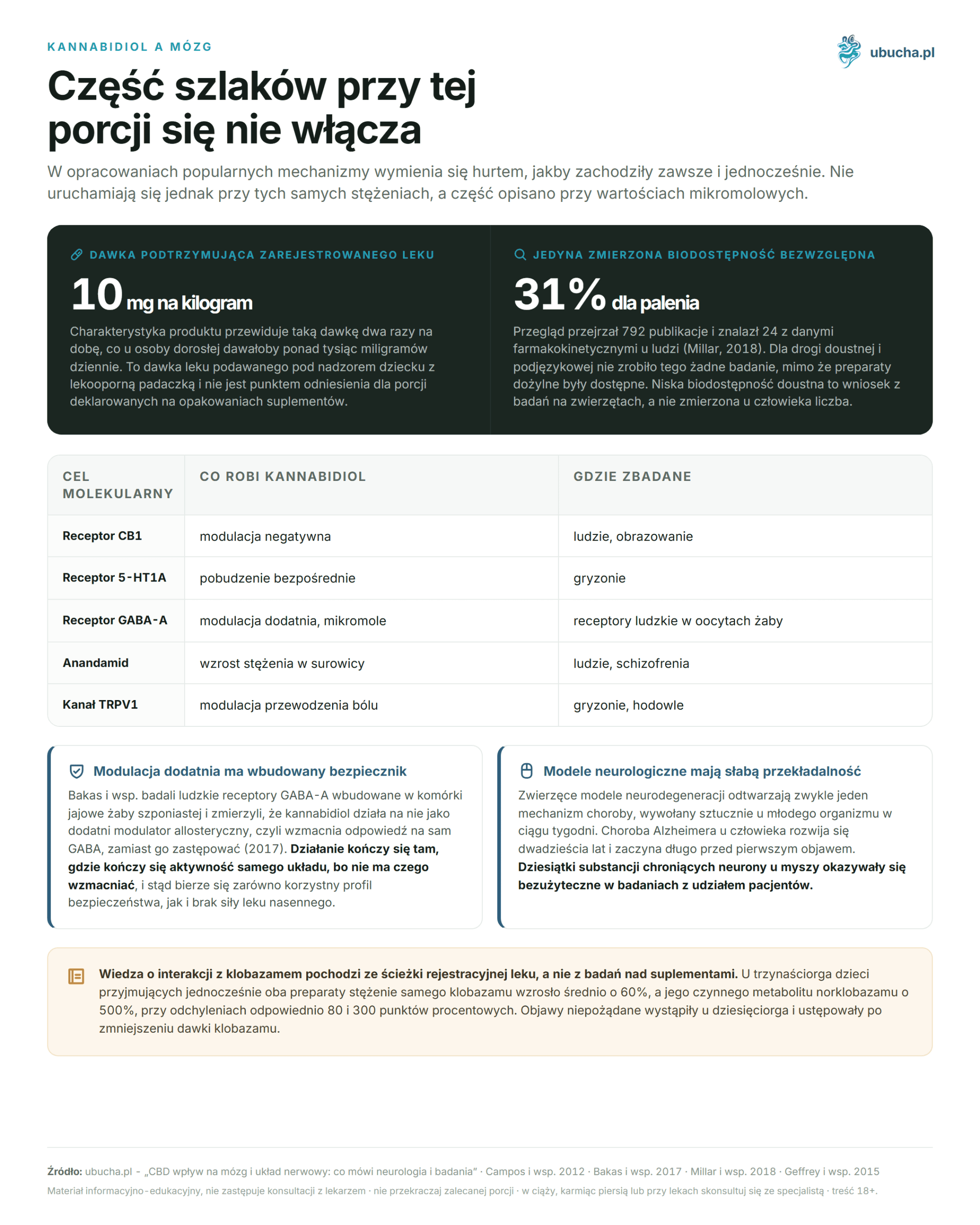
• No study has measured the absolute oral bioavailability of CBD in humans; the only measured value pertains to smoking and is 31% (Millar et al., 2018).
• A review of clinical data did not show any potential for addiction (Iffland and Grotenhermen, 2017).
How does CBD affect the brain?
Unlike THC, and this distinction is the basis for everything else. THC stimulates the CB1 receptor in the brain, which is responsible for the psychoactive effect. CBD does not do this. It behaves as a negative allosteric modulator towards CB1, meaning it changes the shape of the receptor so that it responds less to its own agonists, including THC.
Thus, CBD exerts its effects through other pathways. It acts on serotonin receptors 5-HT1A, influences GABA-A receptors, interacts with TRPV1 channels involved in pain conduction, and increases the concentration of anandamide, an endogenous cannabinoid. The review by Campos et al. (Philosophical Transactions of the Royal Society B, 2012) collects these pathways and formulates a sharper conclusion than is usually summarized: the mechanisms of CBD are not uniform, but depend on which effect you are measuring. The anxiolytic and antidepressant effects are mainly attributed to the 5-HT1A pathway, the formation of new neurons and the extinction of aversive memory are likely due to anandamide, and the antipsychotic effect is probably linked to TRPV1 channels.
This has a practical consequence that is rarely mentioned. Since CBD is not a CB1 agonist, conclusions from studies on marijuana, THC, or synthetic cannabinoids cannot be transferred to it. Meanwhile, popular texts often do this, and the difference can be not only quantitative but also directional.
| Molecular target | What CBD does | Effect | Where studied |
|---|---|---|---|
| CB1 receptor | negative modulation | weakens THC action | humans, imaging |
| 5-HT1A receptor | direct stimulation | reduces anxiety, stress response | rodents |
| GABA-A receptor | positive modulation, micromolar concentrations | mild sedation | human receptors in frog oocytes |
| Anandamide | increase in serum concentration | accompanies improvement of psychotic symptoms | humans, schizophrenia |
| TRPV1 channel | modulation | influence on pain conduction, antipsychotic effect | rodents, cultures |
The last column of this table is more important than the first three. The difference between cell culture and a randomized study is not a degree of certainty, but two different types of knowledge. Cell culture indicates that something is possible. A clinical study indicates that something happens in a human taking a specific dose.
What does CBD do with serotonin and GABA?
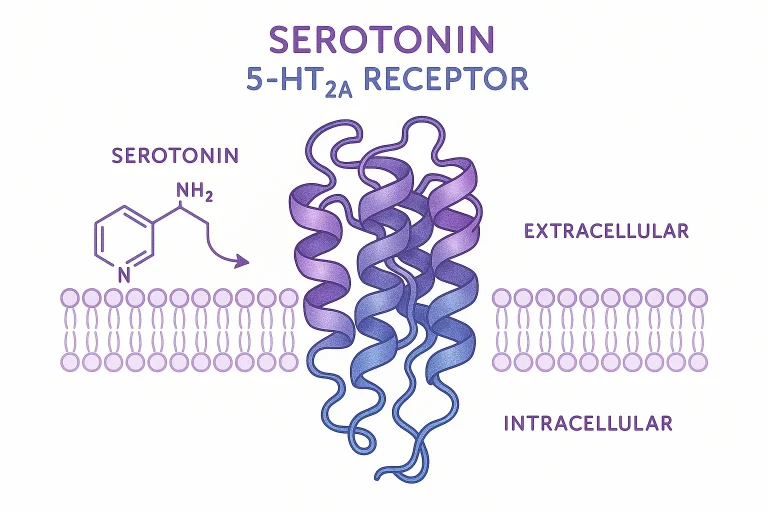
It acts on both systems, but not in the way one might expect from psychiatric drugs. CBD does not raise serotonin levels in the synaptic cleft, as SSRI drugs do. It binds directly to the 5-HT1A receptor, and this is sufficient to elicit a behavioral effect.
The strongest evidence for this pathway is negative and therefore particularly convincing. Resstel et al. (British Journal of Pharmacology, 2009) showed that administering a 5-HT1A receptor antagonist to animals abolishes the anxiolytic and cardiovascular effects of CBD in an acute stress immobilization model. Earlier work by Campos and Guimarães (Psychopharmacology, 2008) showed the same after injecting CBD directly into the dorsolateral periaqueductal gray. If removing one receptor abolishes the effect, that receptor is essential to the mechanism.
With GABA, the situation is different. Bakas et al. (Pharmacological Research, 2017) studied human GABA-A receptors embedded in frog oocytes and measured that CBD acts on them as a positive allosteric modulator, meaning it enhances the response to GABA itself, rather than replacing it. The authors checked separately whether this occurs at the benzodiazepine binding site and ruled out this possibility. The strength is also different: the effect appeared at micromolar concentrations, while benzodiazepines act in the nanomolar range.
Positive modulation has a built-in safety mechanism that agonism does not have. The action of CBD ends where the activity of the GABA system ends, as there is nothing to enhance. This is one of the reasons for the favorable safety profile of cannabidiol and also a reason why one should not expect it to have the strength of a sleeping pill.
Not all these pathways activate at the same concentrations, and this is probably the most often overlooked subtlety. Bakas’s result pertains to micromolar concentrations, which are achieved in clinical studies operating with hundreds of milligrams. With the doses declared on the packaging of oils, some of the described mechanisms simply do not activate, although they are often listed in popular literature as if they always and simultaneously occur.
Does CBD protect neurons?
In animal and cell models, yes; in humans, it is unknown. This distinction is often blurred in the entire topic, and it weighs the most because it determines whether someone will start treating the supplement as a prevention for disease.
The mechanism is credible. Campos et al. (2012) describe the antioxidant and anti-inflammatory effects of cannabidiol as independent of CB1 and CB2 receptors, and they directly link the inhibition of oxidative and nitrosative stress to its neuroprotective effect. All these observations come from preclinical studies, and the authors do not claim anything else.
What is lacking is research on humans. No clinical study has yet been published showing that CBD slows the progression of Alzheimer’s, Parkinson’s, or multiple sclerosis. Animal models in neurology have a particularly poor history of translatability: dozens of substances that protect neurons in mice have proven useless in studies involving patients. Caution is not an exaggeration here, but a conclusion drawn from the experience of the entire field. The state of evidence regarding one of these diseases has been separately outlined in our entry on CBD in the therapy of Alzheimer’s disease.
The discrepancy does not arise from the negligence of researchers. Animal models of neurodegeneration usually replicate one mechanism of the disease, artificially induced in a young organism over weeks. Alzheimer’s disease in humans develops over twenty years and begins long before the first symptom, so a substance blocking one pathway in mice encounters an advanced and multifaceted process in a patient.
Additionally, there is the blood-brain barrier and the question of how much cannabidiol actually reaches the blood. Here, it is worth correcting a statement that circulates across the internet in the form of a table with percentages for different routes of administration. A review by Millar et al. (Frontiers in Pharmacology, 2018) reviewed 792 publications, found 24 with pharmacokinetic data in humans, and concluded something different: absolute bioavailability was measured only after smoking and is 31%. For oral and sublingual routes, no study has done this, even though intravenous preparations were available. Low oral bioavailability is a conclusion from animal studies, not a measured number in humans.
Does CBD stimulate the formation of new neurons?
In the hippocampus of mice subjected to chronic stress, such an effect was observed, but transferring it to humans is speculative at this point. Neurogenesis in adult mammals occurs in a narrow area of the dentate gyrus of the hippocampus, and its role in humans remains a subject of dispute among neurobiologists.
A key experiment was conducted by Campos et al. (International Journal of Neuropsychopharmacology, 2013). Mice were subjected to fourteen days of unpredictable stress and were given CBD daily at a dose of 30 mg per kilogram of body weight, intraperitoneally. In unmodified mice, CBD increased the proliferation of hippocampal progenitor cells and abolished the anxiety-inducing effect of stress. In genetically modified mice, where the formation of new neurons could be turned off, the same protocol did not work at all. Neurogenesis is therefore not a side effect but a link in the mechanism.
However, three caveats must be made immediately. Thirty milligrams per kilogram of body weight administered intraperitoneally is an experimental condition far removed from oral supplementation by a human. The effect was observed in stressed animals, not in healthy ones. And the very existence of significant neurogenesis in the brain of an adult human is sometimes questioned. Therefore, CBD supplementation for “rebuilding neurons” has no support in the data.
However, the mechanism remains worth noting. For decades, it has been assumed that antidepressants work, among other things, by restoring neurogenesis damaged by chronic stress. If CBD fits into this scheme, its effect on mood would be spread over time, rather than immediate. Note that in Campos’s study, it was administered daily for two weeks, not as a single dose.
This is, however, a hypothesis worth knowing, not a reason for use. The distance between the statement “the mechanism is probable” and the statement “the substance works in humans” has consumed more promising molecules in neurology than in any other field of medicine.
In which neurological diseases does CBD have confirmed effects?
In treatment-resistant childhood epilepsy and only in the form of a registered drug. This is the only area where CBD has gone through a full path of randomized clinical trials and received approval as a medicinal product.
The Epidyolex preparation received permission from the European Commission on September 19, 2019, as an adjunct therapy for seizures in Lennox-Gastaut syndrome and Dravet syndrome, in patients from the second year of life and in combination with clobazam. Tuberous sclerosis was added later, after a randomized trial by Thiele et al. published in 2021 (JAMA Neurology). The product characteristics provide for a maintenance dose of up to 10 mg per kilogram of body weight twice a day, which in an adult would amount to over a thousand milligrams daily. This is a dose of a drug administered under supervision to a child with treatment-resistant epilepsy and is not a reference point for the doses declared on supplement packaging.
It is also worth noting a borderline case. Leweke et al. (Translational Psychiatry, 2012) compared CBD with amisulpride in patients with schizophrenia and obtained comparative improvement in symptoms with better tolerance, linking the effect to an increase in anandamide concentration. This is a psychiatric study, not a neurological one, and it did not lead to registration, but it is one of the best-designed studies on CBD in humans.
The registration in epilepsy also changed something that goes beyond the indication itself. Only registration studies provided solid data on the pharmacokinetics, drug interactions, and liver safety of cannabidiol, as they were required by the approval process. The most notable example was described by Geffrey et al. (Epilepsia, 2015): in thirteen children taking clobazam and CBD simultaneously, the concentration of clobazam itself increased on average by 60%, and its active metabolite norclobazam by 500%, with deviations of 80 and 300 percentage points, respectively. Adverse symptoms occurred in ten of them and subsided after reducing the clobazam dose. All our knowledge about this interaction comes from this path, not from studies on supplements.
How does CBD affect memory and concentration?
No improvement has been shown in healthy individuals, and marketing suggesting otherwise is several steps ahead of the data. The most interesting results concern not what CBD does alone, but what it does in the presence of THC.
Bhattacharyya et al. (Neuropsychopharmacology, 2010) administered THC or CBD to volunteers and imaged brain activity using functional resonance imaging. Both substances affected the same areas, but in opposite directions: THC disrupted processing in the striatum and prefrontal cortex and intensified psychotic symptoms, while CBD acted in the opposite way. The title of this work directly states the opposing effects, and that is its proper conclusion.
For practice, this means two things. CBD may weaken some of the adverse effects of THC, which is important for full-spectrum preparations. However, it does not mean that it improves memory or attention in someone who does not take THC. The topic of mental work has been developed separately in the text about CBD and concentration.
There is also a third possibility that cannot be confirmed or dismissed: improvement in focus resulting from reduced anxiety, not from an effect on attention. For someone whose tension interrupts work every few minutes, reducing it will increase efficiency, even though their ability to concentrate remains the same. A real effect, with a mechanism different from that in advertising.
The reverse side also exists. Fatigue and drowsiness are among the three most commonly reported adverse effects of CBD in clinical studies, and at higher doses, they can directly worsen performance on tasks requiring alertness. For someone who reaches for oil before work, the dose determines the direction of the effect, making this one of the few areas where “more” almost certainly means “worse”.
What does CBD do with anxiety and stress response?
It has the strongest data in humans among all discussed areas, but with one caveat that changes the entire practical implication: it concerns single doses in the hundreds of milligrams, administered in the laboratory before a specific stressor.
Crippa et al. (Journal of Psychopharmacology, 2011) administered a single dose of 400 mg of CBD or placebo to ten previously untreated patients with generalized social anxiety and measured cerebral blood flow using SPECT. Anxiety significantly decreased, and changes involved limbic and perilimic areas: less tracer uptake in the left hippocampal gyrus, hippocampus, and inferior temporal gyrus, and more in the right cingulate gyrus. The authors themselves called this work a preliminary report.
Bergamaschi et al. (Neuropsychopharmacology, 2011) went a step further. Twenty-four untreated patients with social phobia received a single dose of 600 mg of CBD or placebo one and a half hours before a simulated public speaking test, while twelve healthy volunteers underwent the same test without any preparation. After CBD, anxiety, discomfort, and the feeling of cognitive impairment dropped to the level of the healthy group.
The dose-effect relationship here is atypical and worth knowing before someone starts increasing doses on their own. Linares et al. (Revista Brasileira de Psiquiatria, 2019) administered 150, 300, or 600 mg of CBD or placebo to 57 healthy men before the same public speaking test. Only the middle dose was effective. Neither 150 mg nor 600 mg differed from placebo. The curve has the shape of an inverted U, so the intuition “if it helps, I will take more” fails with this substance.
Can the doses from anxiety studies be transferred to oil?
They cannot, and this is practically the most important sentence of this section. Six hundred milligrams taken at once is more than the entire ten-milliliter bottle of five percent oil contains. No one uses CBD this way, and the results obtained in the laboratory at such quantities say nothing about a few drops in the evening.
The only publication describing doses closer to market ones has the weakest design. Shannon et al. (Permanente Journal, 2019) reviewed the documentation of 103 patients from a psychiatric clinic, of which 72 were included in the analysis. Almost all received 25 mg of CBD per day in capsules, a few 50 or 75 mg, and in one person, the dose was gradually increased to 175 mg. Anxiety scores dropped in the first month for 57 individuals, or 79.2%, and remained at a lower level. The result for sleep looks worse than is repeated on the internet: it improved in the first month for 48 individuals, or 66.7%, but over three months of observation, it did not remain at a lasting level. This is a retrospective review of charts without a comparison group and without blinding, so it speaks to what was recorded in the office, not what the substance itself does. Details have been collected in the article on CBD for anxiety and fear.
The second thing concerns what was actually measured. All strong studies on CBD and anxiety concern acute situations: public speaking, experimentally induced stress, single exposure. Chronic anxiety disorders treated over weeks are a completely different clinical problem, and there is practically no solid data on CBD in this application. Transferring results from a single test to daily use over months is a leap that the data do not justify.
Is CBD safe for the brain?
The safety profile is good, and the most common problems do not concern the brain itself, but interactions with drugs. A review by Iffland and Grotenhermen (Cannabis and Cannabinoid Research, 2017) gathered clinical and preclinical data, finding no potential for addiction or withdrawal syndrome.
Adverse effects that this review lists as the most common are predictable: fatigue, diarrhea, and changes in appetite and body weight. They were mainly recorded in studies on epilepsy and psychotic disorders, where doses are counted in hundreds of milligrams. In the same studies, with simultaneous use of valproate, an increase in liver enzymes was observed.
The most important practical issue, however, concerns metabolism. CBD affects cytochromes CYP3A4 and CYP2C19, through which a significant portion of psychiatric and neurological drugs pass, including antiepileptics and some antidepressants. The case of clobazam described above shows the scale: a fivefold increase in the concentration of the active metabolite. Therefore, in the case of ongoing neurological or psychiatric pharmacotherapy, discussing with the attending physician is not a formality. We have separately outlined the issue of safe ranges in the text about how much CBD can be taken daily.
It is also worth clarifying a statement that circulates in product descriptions. Full-spectrum preparations contain trace amounts of THC, not zero, but it is not true that they fall “below the legal threshold” because of this. The threshold of 0.3% from Article 4 point 5 of the Act on Counteracting Drug Addiction (Journal of Laws 2023, item 1939, as amended by the Act of March 24, 2022, Journal of Laws 2022, item 763) describes the plant, not the finished product, and is calculated as the sum of delta-9-THC and tetrahydrocannabinolic acid, rounded to one decimal place. The THC content in oil is a different quantity measured in a different material. If you want to completely exclude THC, the appropriate choice is an isolate or broad-spectrum preparation, not a reduced portion of full spectrum.
There is also no data on long-term use, and the safety review states this directly. Its authors close the text with a list of unstudied things: there are no trials with a larger number of participants, there is a lack of data on chronic administration, and it is unknown whether CBD affects hormonal balance. The question of what daily administration of cannabidiol for a decade does simply has no answer. This is not a warning signal, but a gap in knowledge, but with a substance used chronically, it is worth naming it directly instead of replacing it with assurances of natural origin.
Frequently asked questions
How does CBD affect the brain?
Not like THC. CBD does not stimulate the CB1 receptor, but acts as a negative allosteric modulator towards it, and exerts its effects through 5-HT1A receptors, GABA-A, TRPV1 channels, and increasing the concentration of anandamide. The mechanisms are not uniform: they depend on which effect is being measured (Campos et al., 2012).
Does CBD protect neurons?
In animal and cell models, it shows antioxidant and anti-inflammatory effects that limit neuronal damage. In humans, there is no research confirming the neuroprotective effect, so transferring these results to the prevention of neurodegenerative diseases has no basis.
Is CBD addictive?
No. A review of clinical and preclinical data did not show any potential for addiction or withdrawal syndrome (Iffland and Grotenhermen, 2017). CBD does not act psychoactively in the way characteristic of THC.
How does CBD affect serotonin levels?
It does not raise its concentration like SSRI drugs. It acts directly on the 5-HT1A receptor, and blocking this receptor in animals abolishes the anxiolytic effect of CBD in an acute stress model (Resstel et al., 2009).
Does CBD improve concentration and memory?
In healthy individuals, there is no data to support this. Imaging studies show that THC and CBD act on the same brain areas in opposite directions (Bhattacharyya et al., 2010), which is not the same as improving cognitive functions.
Does CBD prevent neurodegenerative diseases?
There is no evidence for this in humans. Data comes from animal models and cell cultures, and no clinical study has shown that CBD delays the onset or progression of Alzheimer’s, Parkinson’s, or multiple sclerosis.
What doses of CBD were used in anxiety studies?
Single doses from 150 to 600 mg, in laboratory conditions. In 57 healthy men, only the 300 mg dose was effective, while 150 mg and 600 mg did not differ from placebo (Linares et al., 2019). This is a multiple of the doses declared on supplement packaging, and the results of these trials cannot be transferred to them.
How much CBD reaches the blood after ingestion?
It is unknown. A review of 24 studies with pharmacokinetic data in humans established that absolute bioavailability was measured only after smoking and is 31%, while no study has done this for oral or sublingual routes (Millar et al., 2018).
You can find oils available in the store in the category hemp oils.
This article is for informational and educational purposes and does not constitute medical advice. Before starting to use cannabis or CBD for therapeutic purposes, consult your doctor, especially if you are taking other medications, are pregnant, or breastfeeding.
Author: Michał Waluk · Published: 2026-06-22 · Updated: 2026-08-15