
Ginkgo biloba (Japanese ginkgo): properties, dosage and what it helps with
What ginkgo biloba has shown in human studies, and what it has not: dementia, tinnitus, claudication, and anxiety. Plus interactions to be aware of before reaching for it.
Ginkgo biloba is one of the best-researched plant materials in the world and at the same time one of the most mythologized. Advertisements promise memory improvement to anyone who reaches for a capsule. Research tells a narrower and more interesting story: in the largest clinical trial, ginkgo did not prevent dementia, in the latest Cochrane review it did not change anything in mild cognitive impairment, and in already diagnosed dementia, it had a small and uncertain effect. However, it has one indication with a solid numerical outcome and drug interactions that one should be aware of before taking the first tablet. Below, we separate one from the other, always with the number of participants and the observation time. You will not find a dosage table here, as for each of the discussed indications, the starting point is a diagnosis made by a doctor, not a self-selection of the preparation.
KEY INFORMATION
• The GEM study on 3069 individuals aged 75 and older, conducted for over six years, showed no reduction in the incidence of dementia or Alzheimer’s disease.
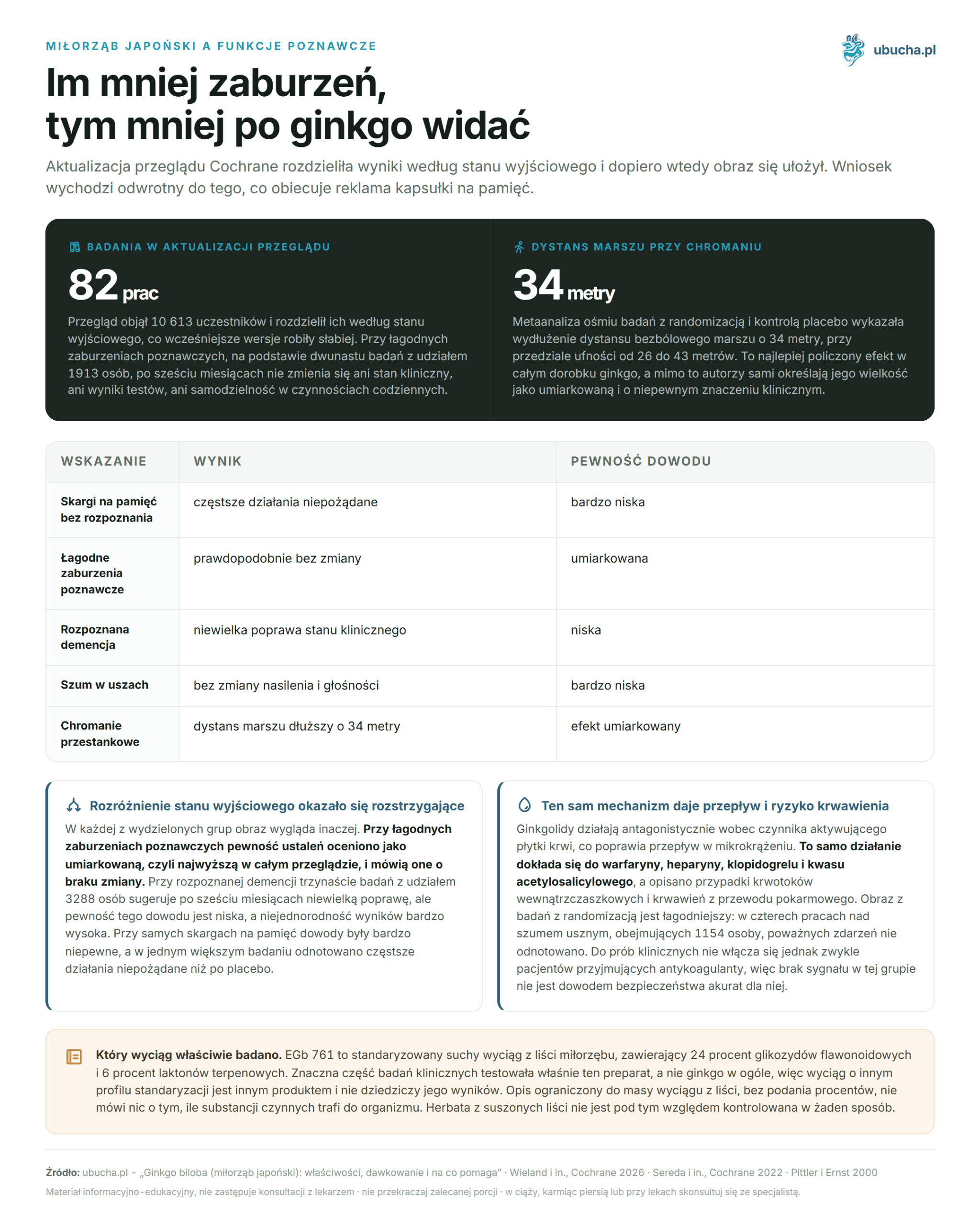
• The Cochrane review from 2026 included 82 studies and 10,613 participants: in mild cognitive impairment, ginkgo probably does not have an effect.
• In tinnitus, the Cochrane review from 2022 showed no benefits, and the certainty of the evidence was rated as very low.
• The best-calculated effect concerns intermittent claudication: an increase in pain-free walking distance by 34 meters.
• Ginkgo inhibits platelet aggregation. In anticoagulant medications and before planned surgery, the decision is made by the doctor.
What is EGb 761 and why does it determine research outcomes?
EGb 761 is a standardized dry extract from ginkgo leaves, containing 24 percent flavonoid glycosides and 6 percent terpenoid lactones, namely ginkgolides and bilobalide. A significant portion of clinical research on ginkgo tested this specific preparation, not ginkgo in general. Standardization means that each dose carries a repeatable amount of active substances, regardless of the batch of leaves and the time of harvest.
For the reader, this has practical consequences for interpreting research results. An extract with a different standardization profile is a different product and does not inherit the results obtained for EGb 761. A product described on the packaging solely as an extract from ginkgo leaves, without specifying percentages, may contain several times fewer flavonoids than the clinically tested extract, and this cannot be determined without analysis.
Another issue is ginkgolides, potentially allergenic components of the raw material, which are subject to restriction in pharmaceutical extracts. Tea made from dried leaves is not controlled in this regard, so its composition and content of active substances remain unknown. This is the first reason why research results on the extract should not be transferred to the infusion.
How does ginkgo biloba affect the brain and circulation?
The mechanisms have been described at the molecular level quite precisely and there are two. The flavonoids in the extract neutralize reactive oxygen species that damage the endothelium of blood vessels and neurons. Ginkgolides, on the other hand, act antagonistically to the platelet-activating factor, a protein responsible for their aggregation and for the contraction of small blood vessels.
The resultant effect of both actions is improved flow in the microcirculation, including in cerebral and peripheral vessels. This explains why indications with the best results concern ischemic states rather than mental performance in healthy individuals. Bilobalide also contributes protective effects towards neurons, described only in studies on cell cultures and animals, meaning at a level from which one cannot infer effectiveness in humans.
It should be noted here something that marketing often overlooks. A known and reliable mechanism is not proof of clinical efficacy. The same anti-aggregatory mechanism that is responsible for improved flow is behind the most serious risk associated with ginkgo, described later in the text. Related raw materials with vascular effects have been compared in the entry gotu kola: properties for memory, varicose veins, and wound healing.
Does ginkgo biloba prevent dementia?
No, and this is determined by the largest study in this field. The GEM trial included 3069 volunteers aged 75 and older, with normal cognitive functions or mild cognitive impairment, observed for a median of 6.1 years across five academic centers. Participants took ginkgo extract in a dose of 120 mg twice daily or placebo (DeKosky et al., JAMA, 2008).
Dementia was diagnosed in 523 individuals. The hazard ratio for ginkgo compared to placebo was 1.12 with a confidence interval from 0.94 to 1.33 for overall dementia and 1.16 with a range from 0.97 to 1.39 for Alzheimer’s disease. Values above one indicate that the point estimate slightly favored placebo over ginkgo, although the difference was not statistically significant. In individuals with mild cognitive impairment, the rate of transition to dementia also did not change.
Similarly, the question about memory in individuals without diagnosis yields the same result. In a randomized, double-blind trial, 230 volunteers over sixty, in good health, took ginkgo or placebo for six weeks. No differences were found in any learning, memory, attention, or verbal fluency tests, nor in self-assessment by participants and evaluations by their relatives (Solomon et al., JAMA, 2002).
What does the latest Cochrane review say about cognitive disorders?
The 2026 update of the Cochrane review included 82 studies involving 10,613 participants and divided the results according to baseline status, which earlier versions did less effectively (Wieland et al., Cochrane, 2026). This distinction proved decisive, as the picture looks different in each group.
In mild cognitive impairment, based on twelve studies involving 1913 individuals, ginkgo probably does not change either the overall clinical status, cognitive test results, or independence in daily activities after six months. The certainty of these findings was rated as moderate, which is the highest in the entire review. In subjective complaints about memory, without diagnosis, the evidence was very uncertain, and in one larger study, more adverse effects were reported than with placebo.
Conversely, the group with diagnosed dementia: thirteen studies involving 3288 individuals suggest a slight improvement in clinical status, cognitive results, and daily activities after six months. However, the certainty of this evidence is low, and the heterogeneity of results is very high. The practical conclusion is therefore the opposite of what advertising suggests: the fewer baseline disorders, the less visible effect from ginkgo.
Does ginkgo help with tinnitus?
According to the latest Cochrane review, there is insufficient evidence for this. The review included twelve randomized studies involving 1915 individuals with tinnitus, mostly comparing ginkgo with placebo (Sereda et al., Cochrane, 2022).
After compiling data from two studies involving 85 individuals, ginkgo did not change the severity of tinnitus measured by a questionnaire after three to six months, with the certainty of the evidence rated as very low. No difference was found in the loudness of tinnitus assessed audiometrically or in quality of life. The authors emphasize that the methodological quality of the included studies was mostly low or unclear, mainly due to poor description of allocation concealment and blinding. They also note that with such a subjective symptom as tinnitus, the placebo response can be strong, so future studies must maintain a much higher methodological rigor.
This same work, however, provides safety data based on four studies involving 1154 individuals: no serious adverse events, including bleeding or seizures, were reported in any group. The certainty of this finding is low, but it is worth knowing alongside warnings from case descriptions. We develop the topic separately in the entry ginkgo for tinnitus.
Does ginkgo increase walking distance in claudication?
This indication has the best-calculated effect in the entire ginkgo literature. Intermittent claudication means calf pain that occurs when walking, caused by narrowing of peripheral arteries and ischemia of working muscles. A meta-analysis of eight randomized studies with placebo control and double-blinding showed a significant increase in pain-free walking distance by 34 meters, with a confidence interval from 26 to 43 meters (Pittler and Ernst, American Journal of Medicine, 2000).
In studies with similar methodology, conducted on a treadmill at the same speed and incline, the difference was 33 meters with a range from 22 to 43 meters. Adverse effects were rare, mild, and transient.
However, the authors themselves rate the magnitude of this effect as moderate and of uncertain clinical significance. Thirty-some meters may be significant for someone who stops every hundred meters, and insignificant for someone else. Intermittent claudication is also a symptom of peripheral artery disease, which is a condition requiring causal treatment, not a state to be self-managed with a supplement.
Does ginkgo affect anxiety and mood?
The data is limited, but it exists and points to anxiety rather than depression. In a randomized, double-blind, placebo-controlled study, 107 patients with generalized anxiety disorder or adjustment disorder with anxiety were assigned to EGb 761 extract in one of two daily doses or to placebo for four weeks (Woelk et al., Journal of Psychiatric Research, 2007).
The score on the Hamilton anxiety scale improved by 14.3 points in the higher dose group, by 12.1 points in the lower dose group, and by 7.8 points after placebo. Both ginkgo groups performed significantly better than placebo, and the analysis showed a dose-dependent effect. The preparation was well tolerated.
This is one study, four weeks long and of moderate size, so it does not make ginkgo an anxiolytic. For depression, the evidence is much weaker, and using ginkgo instead of treatment with proven efficacy delays proper therapy. Anxiety and depressive disorders require diagnosis and management by a physician, not self-selection of a herbal preparation.
When is ginkgo biloba dangerous?
Primarily in combination with medications affecting coagulation. Ginkgolides inhibit the platelet-activating factor, thus adding their own anti-aggregatory action to that of warfarin, heparin, clopidogrel, acetylsalicylic acid, and new generation oral anticoagulants. Cases of intracranial hemorrhages and gastrointestinal bleeding have been reported in individuals using ginkgo.
The data from randomized studies is milder than from case reports: in four studies on tinnitus, involving 1154 individuals, no serious bleeding or seizures were reported. However, patients taking anticoagulants are usually not included in clinical trials, so the lack of signals in this group is not evidence of safety for them. In anticoagulant treatment, the decision is made by the attending physician, along with monitoring coagulation parameters.
Additionally, there are three situations requiring caution. Before a planned surgical procedure, ginkgo should be discontinued in advance, according to the recommendations of the surgical team. In epilepsy, a decrease in the seizure threshold has been reported, including in individuals taking antiepileptic medications. Ginkgo also affects cytochrome P450 isoenzymes, through which a significant portion of medications is metabolized, which is worth discussing with a pharmacist in polytherapy.
How to choose a ginkgo biloba preparation?
The first criterion is the declaration of standardization. The preparation should specify the content of flavonoid glycosides and terpenoid lactones or directly the name of the clinically tested extract. A description limited to the mass of the extract from leaves without specifying percentages does not indicate how much active substance will enter the body.
The second is the form. A capsule or tablet with a dry extract provides a repeatable composition, which an infusion from leaves does not ensure. The infusion may also be a source of ginkgolides in amounts that are not permitted in pharmaceutical extracts. We have gathered plant preparations with controlled standardization in the herbs category.
The third, and practically the most important, is the purpose. Regarding memory improvement in a person without diagnosed disorders, studies do not provide a basis for expecting anything, and no choice of preparation will change that. For symptoms requiring diagnosis, such as tinnitus, calf pain when walking, or memory deterioration, the first step is a visit to the doctor. We compared other raw materials supporting concentration in the entry herbs for concentration and focus.
Frequently Asked Questions
What is EGb 761 extract?
It is a standardized dry extract from ginkgo leaves containing 24 percent flavonoid glycosides and 6 percent terpenoid lactones. A significant portion of clinical research on ginkgo tested this specific preparation, so an extract with a different standardization does not automatically inherit the results obtained in those studies.
Does ginkgo biloba prevent dementia?
No. In the GEM study, 3069 individuals aged 75 and older took ginkgo or placebo for a median of 6.1 years. The hazard ratio for overall dementia was 1.12 with a confidence interval from 0.94 to 1.33, indicating no benefit.
Does ginkgo improve memory in healthy individuals?
Studies do not confirm this. In a randomized trial of 230 individuals over sixty, lasting six weeks, no differences were found compared to placebo in any learning, memory, attention, or verbal fluency tests, nor in self-assessment by participants and their relatives.
Does ginkgo help with tinnitus?
The Cochrane review from 2022 included twelve studies and 1915 individuals and did not show any change in the severity or loudness of tinnitus compared to placebo. The certainty of this evidence was rated as very low, and the methodological quality of the studies was mostly low.
Can ginkgo be combined with warfarin?
Not without a doctor’s supervision. Ginkgolides inhibit platelet aggregation and contribute to the action of anticoagulant medications, and cases of intracranial hemorrhages and gastrointestinal bleeding have been reported. In anticoagulant treatment, the decision is made by the attending physician, along with monitoring coagulation.
What is ginkgo’s best numerical outcome?
For intermittent claudication. A meta-analysis of eight randomized studies showed an increase in pain-free walking distance by 34 meters, with a confidence interval from 26 to 43 meters. The authors themselves describe the magnitude of this effect as moderate and of uncertain clinical significance.
This article is for informational and educational purposes and does not constitute medical advice. Before starting supplementation, consult with a doctor, especially if you are taking medications regularly, are pregnant or breastfeeding, or have a chronic illness.
Author: Michał Waluk · Published: 2026-06-22 · Updated: 2026-08-11