
Monacolin K (red rice) and cholesterol: what EU law says and what the risks are
Monacolin K is identical to lovastatin. How much is allowed to be sold in the EU, what warnings are mandatory, and why was the claim of 10 mg repealed.
Monacolin K is a rare case of a supplement ingredient that the EU authority has explicitly stated is chemically identical to a prescription drug. That drug is lovastatin. The consequences of this statement reach further than what is visible on packaging: within two years, the European Commission first limited the permissible content of monacolins in a daily portion and imposed mandatory warnings, and then repealed the health claim that the entire marketing communication of this category relied on. Below you will find what exactly these acts say, what the European Food Safety Authority ruled, and how much monacolin K is actually in a capsule. You will also see why the product described in guides as a mild alternative to pharmacological treatment can, in practice, be a second statin taken alongside the first, without the knowledge of the attending physician.
KEY INFORMATION
• Commission Regulation (EU) 2022/860 of June 1, 2022, requires that a single daily portion contains less than 3 mg of monacolin from fermented red rice (EUR-Lex).
• The same regulation imposes four mandatory warnings on the label, including a prohibition on consumption by individuals taking cholesterol-lowering medications.
• Commission Regulation (EU) 2024/2041 of July 29, 2024, removed the entry regarding red rice from the list of permitted health claims.
• EFSA in its opinion of June 25, 2018, considered the use of 10 mg daily to be a significant risk and could not identify any safe intake.
• Grapefruit juice increased the area under the curve of lovastatin concentration fifteenfold, not twofold.
What is monacolin K and why is it practically a statin?
Monacolin K is produced during the fermentation of rice by the mold Monascus purpureus. The EFSA panel stated in an opinion adopted on June 25, 2018, that monacolin K in its lactone form is identical to lovastatin, the active substance in several medicinal products approved in the EU for the treatment of hypercholesterolemia (EFSA Journal 2018). This is not an analogy or structural similarity. It is the same molecule.
The mechanism is therefore statin-like: competitive inhibition of HMG-CoA reductase, the enzyme limiting the rate of cholesterol synthesis in the liver (Xiong et al., Food Chem Toxicol 2019). This leads to a point that guides remain silent about: the profile of side effects and the list of drug interactions are the same as for lovastatin, because they concern the same substance.
Regulation 2022/860 describes this without mincing words. It refers to the characteristics of the medicinal product containing lovastatin, which warns of the risk of myopathy and rhabdomyolysis, increasing with concurrent use with certain other medications, and advises against the use of lovastatin by pregnant and breastfeeding women. An opinion from the Belgian Superior Health Council dated February 13, 2016, cited in the same act, speaks of harmful effects identical to those observed in patients taking statins.
How much monacolin K can be legally sold in the EU?
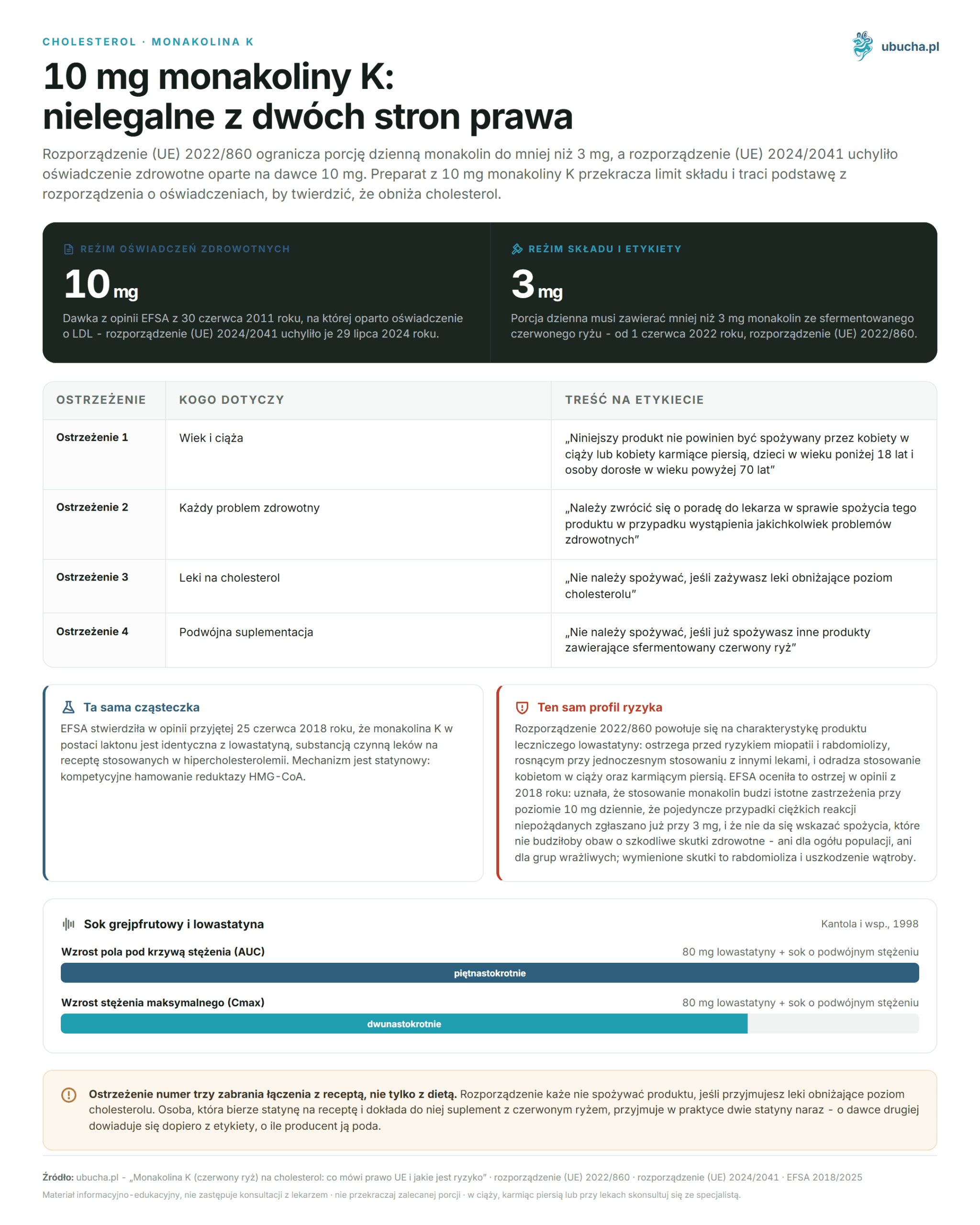
Less than 3 mg per daily portion. Commission Regulation (EU) 2022/860 of June 1, 2022, classified monacolins from fermented red rice into Part B of Annex III of Regulation 1925/2006, meaning substances subject to restrictions, and formulated the condition literally: a single serving of the product intended for daily consumption must contain less than 3 mg of monacolin.
The label must also state the number of servings intended for maximum daily consumption, the content of monacolins per serving, and a warning not to consume a daily amount equal to or greater than 3 mg. Additionally, there are four warnings mandated by the legislator.
| Requirement of Regulation (EU) 2022/860 | Wording |
|---|---|
| Permissible content | daily portion must contain less than 3 mg of monacolin from fermented red rice |
| Warning 1 | “This product should not be consumed by pregnant women or breastfeeding women, children under 18 years of age, and adults over 70 years of age” |
| Warning 2 | “Consult a doctor regarding the consumption of this product if any health problems occur” |
| Warning 3 | “Do not consume if you are taking cholesterol-lowering medications” |
| Warning 4 | “Do not consume if you are already taking other products containing fermented red rice” |
| Additional status | also included in Part C of Annex III, meaning substances subject to EU control |
The conclusion for the reader is simple and uncomfortable for the industry. A product advertised as providing 10 mg of monacolin K per day does not meet this condition and cannot be legally marketed in this form in the EU.
Did EFSA confirm that 10 mg of monacolin K lowers cholesterol?
It did confirm, but in 2011 and in a different matter, and since 2024 this decision is no longer valid. The sequence of events is decisive, so it is worth presenting it in full. EFSA’s opinion from June 30, 2011, recognized a causal relationship between the intake of monacolin K and the maintenance of normal LDL cholesterol levels at a daily dose of 10 mg, and on this basis, the claim was included in the list from Regulation 432/2012.
Seven years later, the same authority assessed safety. The EFSA panel concluded that the use of monacolins from red rice in dietary supplements raises significant concerns at a level of 10 mg daily, that individual cases of severe adverse reactions have been reported even at 3 mg daily, and that it is impossible to identify an intake that would not raise concerns about harmful health effects, either for the general population or for sensitive groups. The mentioned effects include rhabdomyolysis and liver damage.
The closure came in 2024. Commission Regulation (EU) 2024/2041 of July 29, 2024, removed the entry regarding Monascus purpureus from the annex to Regulation 432/2012 (EUR-Lex). Claims about monacolin K can no longer be used on food. A subsequent EFSA opinion, from 2025, reiterated the concerns from 2018 and added that the submitted data do not allow demonstrating safety even below 3 mg daily (EFSA Journal 2025).
How does monacolin K interact with medications and grapefruit?
Just like lovastatin, because it is the same substance. The best-measured interaction is grapefruit juice. In a crossover study involving ten healthy volunteers who drank juice at double concentration three times a day for two days, and on the third day took 80 mg of lovastatin, the maximum concentration of the drug increased about twelvefold, and the area under the curve of concentration increased fifteenfold (Kantola et al., Clin Pharmacol Ther 1998).
This is an order of magnitude, not a nuance. The authors conclude with the recommendation to avoid concurrent use of grapefruit juice with lovastatin and simvastatin. The mechanism is the blockage of first-pass metabolism by the CYP3A4 isoenzyme in the small intestine, so the interaction also includes other substances that inhibit this pathway.
The most serious risk, however, arises not from food but from doubling the treatment. Warning number three from the regulation states explicitly not to consume the product if you are taking cholesterol-lowering medications. A person who takes a prescription statin and adds a supplement with red rice is effectively taking two statins at once, with the dose of the second being learned from the label, if the manufacturer provides it. A completely different, non-statin approach to the same endpoint is described in the text about flaxseed and cholesterol.
How much monacolin K is actually in a capsule?
The variability is so great that the product name does not indicate the dose of anything. An analysis of twelve commercial red rice preparations, each declaring 600 mg of substance per capsule, showed monacolin K content ranging from 0.10 to 10.09 mg per capsule, and total monacolin from 0.31 to 11.15 mg. In four of the twelve products, elevated levels of citrinin were found (Gordon et al., Arch Intern Med 2010).
Seven years later, the picture did not improve. A study of 28 brands purchased in regular stores found no detectable monacolin K in two of them, and in the remaining 26, variability exceeded sixty times, from 0.09 to 5.48 mg per 1200 mg of raw material. When recalculated to the daily portion recommended by the manufacturer, the difference reached over one hundred twenty times, from 0.09 to 10.94 mg (Cohen et al., Eur J Prev Cardiol 2017).
Citrinin is a separate problem in this category. It is a mycotoxin produced by the same mold, described as nephrotoxic; the EFSA panel stated that at a level considered safe for the kidneys, concerns about genotoxicity and carcinogenicity cannot be excluded. The highest permissible level in dietary supplements based on fermented rice Monascus purpureus is 100 micrograms per kilogram and is currently positioned 1.7.1 in the annex to Commission Regulation (EU) 2023/915 (EUR-Lex).
Does coenzyme Q10 solve the problem of muscle pain?
The decrease is measured, but the benefit from supplementation is not. A meta-analysis of eight placebo-controlled arms showed that statin treatment reduces plasma coenzyme Q10 levels by 0.44 micromoles per liter (95% CI from -0.52 to -0.37), regardless of the type of statin and duration of therapy. However, the authors conclude that the clinical significance of this decrease requires further research (Banach et al., Pharmacol Res 2015).
This was later verified by an experiment. In a randomized double-blind study, 41 individuals with confirmed muscle pain after simvastatin continued taking it for eight weeks, with randomly added ubiquinol at a dose of 600 mg or placebo. Pain intensity increased equally in both groups, muscle strength and oxygen uptake did not change, and even slightly more people in the coenzyme group reported pain (Taylor et al., Atherosclerosis 2015).
From the same study comes a finding that changes the way we think about pain after statins. Of the 120 individuals reporting such complaints, only 36% reproduced symptoms under blinded conditions, meaning they had pain on the drug and did not have it on placebo. The rest associated their complaints with the drug, although they also occurred without it. Therefore, muscle pain with monacolin K should neither be underestimated nor automatically attributed to the preparation; only a doctor can resolve this, also because rhabdomyolysis is an emergency condition.
Frequently asked questions
How much monacolin K is allowed in a daily portion in the EU?
Less than 3 mg. Commission Regulation (EU) 2022/860 of June 1, 2022, requires that a single serving of the product intended for daily consumption contains less than 3 mg of monacolin from fermented red rice, and mandates a warning on the label not to consume a daily amount equal to or greater than 3 mg.
How does monacolin K differ from statins?
Not at all in chemical terms. EFSA stated in an opinion dated June 25, 2018, that monacolin K in its lactone form is identical to lovastatin, the active substance in prescription medications used for hypercholesterolemia. The same enzyme, the same profile of side effects, the same list of interactions. They differ in legal product status, not in the molecule.
Who should not consume fermented red rice?
Regulation 2022/860 requires a warning that the product should not be consumed by pregnant and breastfeeding women, children under 18 years of age, and individuals over 70 years of age. A separate warning prohibits consumption by those taking cholesterol-lowering medications and those already using another product containing red rice.
Is it permissible to state that monacolin K lowers cholesterol?
Not on food labels. Commission Regulation (EU) 2024/2041 of July 29, 2024, removed the entry regarding Monascus purpureus from the list of permitted health claims in the annex to Regulation 432/2012. The previous claim was based on an EFSA opinion from June 30, 2011, and on a daily dose of 10 mg.
Why is grapefruit juice mentioned separately?
Because the scale of interaction is exceptional. In ten healthy volunteers, grapefruit juice at double concentration increased the area under the curve of lovastatin concentration fifteenfold, and the maximum concentration about twelvefold (Kantola et al. 1998). The authors recommend avoiding such a combination. The reason is the inhibition of first-pass metabolism by CYP3A4.
Is the declared content on the packaging reliable?
It has been very variable. In twelve products with identical declarations, the content of monacolin K ranged from 0.10 to 10.09 mg per capsule (Gordon et al. 2010), and in 28 brands from 2017, the amount in a daily portion varied over one hundred twenty times (Cohen et al. 2017). The obligation to state the content on the label was only introduced by Regulation 2022/860.
Sklep u Bucha does not offer monacolin K or any product with fermented red rice; we reviewed the entire store’s offer as of August 8, 2026, and such an ingredient is not present. A related topic of soluble fiber is described in the entry about psyllium and cholesterol.
This article is for informational and educational purposes and does not constitute medical advice. Before starting supplementation, consult your doctor, especially if you are taking medications regularly, are pregnant or breastfeeding, or have a chronic illness.
Author: Michał Waluk · Published: 2026-08-09 · Updated: 2026-08-16