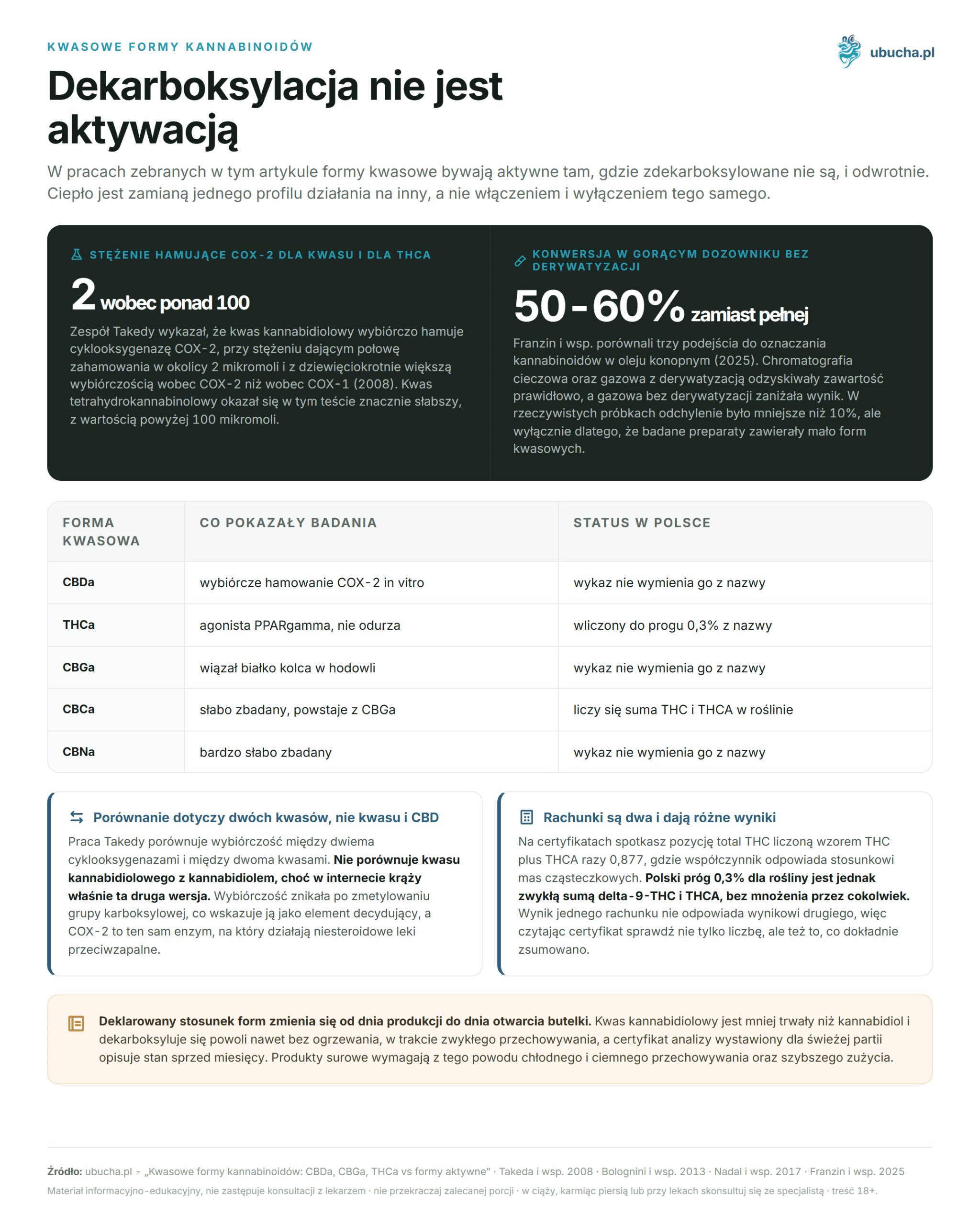

Acidic forms of cannabinoids: CBDa, CBGa, THCa vs active forms (table)
CBDa, CBGa, and THCa: how they differ from CBD, CBG, and THC, what studies have shown, how Polish law counts them, and why the certificate of analysis may be underestimated.
Almost the entire conversation about cannabis revolves around CBD and THC, which are substances that are practically absent in the living plant. The plant produces their acidic precursors: CBDa, THCa, and CBGa. Only heat detaches the carboxyl group from them and converts them into active forms. This is not a detail for chemists. Acidic forms have their own pharmacology, in several respects stronger than their decarboxylated counterparts, they appear differently in the certificate of analysis, and they are counted differently by Polish law. There is a lot of misinformation circulating about them, including one sentence repeated in almost every description of a \”raw\” product, which is based on a misreading of a paper from nearly twenty years ago. Below, we gather what is really known about acidic cannabinoids from research, where the laboratory ends and marketing begins, and what this means when purchasing oil.
KEY INFORMATION
• CBDa selectively inhibits cyclooxygenase COX-2, with nine times greater selectivity than for COX-1; THCa is significantly weaker in this regard (Takeda et al., Drug Metabolism and Disposition, 2008).
• Cannabinoid acids bind to and activate the PPARgamma receptor more strongly than their decarboxylated counterparts (Nadal et al., British Journal of Pharmacology, 2017).
• The Polish threshold of 0.3% is counted as the sum of delta-9-THC and THCA, and the law mentions THCA by name; there is no loophole here.
• A gas chromatography analysis certificate without derivatization may underestimate the total THC content because decarboxylation in the dispenser can be incomplete.
Where do acidic forms of cannabinoids come from?
All come from one molecule. The biosynthetic pathway in cannabis starts from cannabigerolic acid, or CBGa, and the plant’s enzymes distribute it in three directions: CBDA synthase converts it into CBDa, THCA synthase into THCa, and CBCA synthase into CBCa. This hierarchy explains why CBGa is sometimes referred to as the parent molecule of cannabinoids.
In the unprocessed plant, acidic forms dominate. CBD, THC, and CBG in active form appear in it in small amounts, as a result of slow decarboxylation occurring spontaneously. Harvesting, drying, and storage accelerate this process, and heat treatment completes it. A review paper by Filer describes this as a reaction that can be both induced and intentionally inhibited, and emphasizes that it also occurs naturally, without the involvement of a cook or producer (Filer, Cannabis and Cannabinoid Research, 2022).
This biology has direct production consequences. Freshly harvested material primarily contains CBDa, not CBD. Intentionally heating the raw material before extraction or the extract after is a technological step that determines whether the bottle will contain a \”raw\” product with a predominance of CBDa or a standard CBD oil. A producer who does not perform this step sells the first variant, and usually states this directly on the label.
What is decarboxylation and when does it occur?
Decarboxylation is the removal of a carboxyl group in the form of carbon dioxide. The molecule loses several percent of its mass and changes its pharmacological properties: CBDa becomes CBD, THCa becomes THC, CBGa becomes CBG. It does not work like a switch that surprises at one temperature, but rather as a reaction dependent on both temperature and time at once.
In practice, this means three things. First, the higher the temperature, the shorter the transformation lasts, but the greater the risk that the produced cannabinoids will start to decompose further. Second, part of the conversion occurs without any heating, during drying and storage, so a year-old sample stored at room temperature has a different profile than on the day of harvest. Third, the measurement itself can be a source of transformation, which we discuss in the last section.
For a reader who decarboxylates the raw material themselves, the sensible principle is the opposite of intuition: not \”as hot as possible\”, but sufficiently long at a moderate temperature. Specific oven settings and how to check the effect without a laboratory are detailed separately in the text Decarboxylation: chemistry, temperatures, and methods. It is also worth remembering that home transformation of cannabis other than fiber types is processing in the sense of Article 4 point 20 of the anti-drug law and is subject to Article 53 of that law.
How do acidic forms compare to active ones?
The table below compares pairs of forms, acidic and active, according to what is known about them from research, and according to their legal status in Poland. Biological data comes from studies on cells and animals; there is practically no clinical evidence for humans for acidic forms.
| Acidic form | After decarboxylation | What studies have shown about the acidic form | Legal status in Poland |
|---|---|---|---|
| CBDa, cannabidiolic acid | CBD | Selective inhibition of COX-2 in vitro; antiemetic action in animals through the 5-HT1A receptor; inhibition of breast cancer cell migration in culture | The list of controlled substances does not mention cannabidiol or its acid |
| THCa, tetrahydrocannabinolic acid | THC | PPARgamma agonist, neuroprotective action in Huntington’s disease models; does not activate the CB1 receptor, so it does not intoxicate | Mentioned by name in Article 4 points 5, 37, and 38 of the law; included in the 0.3% threshold |
| CBGa, cannabigerolic acid | CBG | Parent molecule of other acids; binds to the spike protein of SARS-CoV-2 and blocked the virus from entering cells in culture | The list does not mention cannabigerol or its acid |
| CBCa, cannabichromenic acid | CBC | Poorly studied, arises from CBGa through CBCA synthase | The status of the raw material is still determined by the sum of THC and THCA in the plant |
| CBNa, cannabinolic acid | CBN | Very poorly studied; CBN mainly arises from the degradation of THC during storage | The list does not mention cannabinol or its acid |
The last column requires one note. The fact that a given substance is not listed by name does not mean that a product containing it is legal without restrictions, as the status of the raw material is primarily determined by the content of THC and THCA in the plant.
What is known about CBDa?
CBDa was long treated as an inactive byproduct that needed to be decarboxylated to obtain the \”proper\” substance. Research from the last several years shows that it has its own profile of action, in several respects stronger than CBD. Three results are best documented here, and for each, it is worth remembering how they were obtained.
The first concerns inflammation. Takeda’s team showed that CBDa selectively inhibits cyclooxygenase COX-2, with a concentration giving half inhibition around 2 micromoles and with nine times greater selectivity for COX-2 than for COX-1. THCa turned out to be significantly weaker in this test, with the appropriate value above 100 micromoles, and selectivity disappeared after methylation of the carboxyl group, indicating it as a decisive element (Takeda et al., Drug Metabolism and Disposition, 2008). It is worth reading this carefully: the paper compares selectivity between two cyclooxygenases and between two acids, not CBDa with CBD, although the second version is circulating on the internet. COX-2 is the same enzyme that non-steroidal anti-inflammatory drugs act on.
The second result concerns nausea. Bolognini and colleagues administered CBDa to rats and Suncus murinus shrews and obtained a reduction in vomiting induced by toxins and motion, as well as inhibition of responses corresponding to nausea, at doses from 0.01 to 0.5 mg per kilogram. The effect was abolished by the 5-HT1A receptor antagonist, indicating the pathway of action, and the CB1 receptor antagonist did not change it. The authors state directly that compared to cannabidiol, CBDa has significantly greater potency (Bolognini et al., British Journal of Pharmacology, 2013). This is an animal study, not in patients.
The third result comes from cell culture. CBDa inhibited the migration of breast cancer cells of the MDA-MB-231 line, by inhibiting protein kinase A and stimulating RhoA protein (Takeda et al., Toxicology Letters, 2012). This is a result on cells in a dish and should not be extrapolated to human treatment.
What is the legal status of THCa in Poland?
Contrary to popular opinion, there is no gray area here. The anti-drug law mentions tetrahydrocannabinolic acid by name in Article 4 points 5, 37, and 38, and the 0.3% threshold is counted as the sum of delta-9-THC and THCA, rounded to one decimal place, calculated on the dry mass of the plant tops (t.j. Dz.U. 2023 poz. 1939, as amended by the law of March 24, 2022, Dz.U. 2022 poz. 763).
The consequence is simple and inconvenient for the marketing of \”high THCa\” products: the legislator counted the acidic form together with the active one precisely because heat converts one into the other. THCa itself does not activate the CB1 receptor and does not intoxicate, but raw material in which the sum of both exceeds the threshold is cannabis other than fiber types with all the consequences. The active substance after decarboxylation, that is, tetrahydrocannabinols, is listed among the psychotropic substances in group I-P.
Biologically, THCa is more interesting than its status would suggest. Nadal’s team showed that cannabinoid acids bind to and activate the nuclear receptor PPARgamma with greater strength than their decarboxylated counterparts, and THCa itself increased mitochondrial mass in nerve cells and protected them in two models of Huntington’s disease. In mice poisoned with 3-nitropropionic acid, it improved motor deficits and limited striatal degeneration, and the effect depended on PPARgamma (Nadal et al., British Journal of Pharmacology, 2017). There are no studies in humans. We described the molecule more broadly in the text THCA: what it is and how it differs from THC.
Why is CBGa called the parent molecule?
Because the plant builds everything else from it. CBDA synthase converts CBGa into cannabidiolic acid, THCA synthase converts it into tetrahydrocannabinolic acid, and CBCA synthase converts it into cannabichromenic acid. Strains with low levels of THCA synthase accumulate CBGa instead of using it, and it is these that are sold as CBG-rich strains.
The most notable single result for CBGa comes from the work of van Breemen’s team. The authors searched for plant molecules binding to the spike protein of the SARS-CoV-2 virus using mass spectrometry and found them among the cannabinoid acids from cannabis. Cannabigerolic acid and cannabidiolic acid bound to the spike protein with micromolar affinity and subsequently prevented the infection of human epithelial cells by a pseudovirus and the entry of live virus into cells, equally effectively against alpha and beta variants (van Breemen et al., Journal of Natural Products, 2022).
This result has been surrounded by media interpretations that the paper does not contain. The study was conducted on cells, not on patients, and it does not say anything about whether the consumption of oil affects the course of infection in humans. However, it is worth noting a more general pattern that recurs in several independent studies: acidic forms can be active where decarboxylated forms are not, and vice versa. Decarboxylation is therefore not an \”activation\” in the colloquial sense, but a transformation of one profile of action into another.
Are raw products better than standard oils?
It depends on what you are looking for, and the argument works both ways. On the raw side, CBDa has its own activity that CBD does not replicate, and unheated extract retains more of the original plant profile, including some volatile compounds. A producer who claims this is not making it up.
On the other side stands predictability. CBDa is less stable than CBD and decarboxylates slowly even without heating, during normal storage. Therefore, the declared ratio of CBDa to CBD on the label changes from the day of production to the day the bottle is opened, and the certificate of analysis issued for a fresh batch describes the state from months ago. Raw products require cool and dark storage and faster consumption for this reason, and with regular supplementation with a fixed dose, standard oil is simply easier to control.
A reasonable compromise is a full-spectrum oil, in which alongside active CBD, some acidic forms remain. Dedicated \”raw CBDa\” products remain a niche for those who know why they reach for them and read the batch date on the certificate. The comparison of both variants, along with how to recognize them by description, is detailed in the text CBD oil raw or decarboxylated. Standard oils, divided by strength and spectrum, fall into the category of oils.
How is THCa counted in the certificate of analysis?
Here lies the most often overlooked trap of the entire topic, and it concerns the measurement itself. The analytical method determines whether acidic forms will even be counted, and different counting methods yield different numbers for the same sample.
The work of Franzin’s team compared three approaches to determining cannabinoids in hemp oil. Liquid chromatography and gas chromatography with derivatization correctly recovered the total content of delta-9-THC and CBD. Gas chromatography without derivatization, which relies on the fact that acidic forms decarboxylate themselves in a hot dispenser, yielded a conversion of about 50-60%, thus underestimating the result. In actual oil samples, the deviation was less than 10%, but only because the tested preparations contained few acidic forms (Franzin et al., Pharmaceutics, 2025). With raw material rich in THCa, the same error would be much larger.
Additionally, there is a discrepancy in definitions. On certificates, you will find a position \”total THC\” calculated using the formula THC plus THCA times 0.877, where the coefficient corresponds to the ratio of molecular weights. The same coefficient is used by EU law for THC limits in food from hemp seeds, expressed in milligrams per kilogram. However, the Polish threshold of 0.3% for the plant is simply the sum of delta-9-THC and THCA, without multiplying by anything. These are two different calculations, and the result of one does not correspond to the result of the other, so when reading a certificate, check not only the number but also what exactly was summed. This has practical significance if you are subject to drug testing or preparing an infusion from the raw material, as heating converts THCa into THC regardless of what the paper showed.
Frequently asked questions
What are acidic forms of cannabinoids?
They are natural precursors of active cannabinoids, produced by a living cannabis plant. They contain an additional carboxyl group, hence the names CBDa, THCa, and CBGa. In raw material, they dominate, and active forms are only produced from them under the influence of heat. They also have their own distinct profile of action.
What is decarboxylation?
It is the removal of a carboxyl group in the form of carbon dioxide: CBDa turns into CBD, THCa into THC, CBGa into CBG. The reaction depends on both temperature and time simultaneously, and it partially occurs on its own during the drying and storage of the raw material. Therefore, raw cannabis does not intoxicate, but heated cannabis does.
Does CBDa have its own biological properties?
Yes. It selectively inhibits COX-2, with nine times greater selectivity than for COX-1 (Takeda et al., 2008). In animals, it reduced vomiting and nausea responses through the 5-HT1A receptor, more strongly than CBD (Bolognini et al., 2013). There is practically no research on humans for CBDa.
Does THCa have psychoactive effects?
No, THCa does not activate the CB1 receptor and does not intoxicate. The psychoactive effect only appears after decarboxylation to THC. However, the anti-drug law includes THCA in the 0.3% threshold along with delta-9-THC, so raw material rich in THCa does not become legal for this reason.
What products contain acidic forms of cannabinoids?
Raw, unheated cannabis products: oils described as \”raw\”, extracts without the decarboxylation stage, capsules with raw extract, fresh plant material consumed cold. After vaporization, combustion, or baking, active forms prevail. Standard CBD oil mainly contains CBD, with a small amount of CBDa or none at all.
Is CBGa more important than CBG?
They serve different roles. CBGa is the parent molecule from which the plant builds other cannabinoid acids, and it is attributed with binding to the spike protein of SARS-CoV-2 in cell studies. CBG, the form after decarboxylation, is better studied in humans. One does not replace the other.
This article is for informational and educational purposes only and does not constitute legal advice. The legal status described in the article is valid as of the date of publication: regulations regarding cannabis may change. Before making a decision, consult a lawyer or current legal acts.
Author: Michał Waluk · Published: 2026-08-09 · Updated: 2026-08-15