
Ergothioneine: the longevity vitamin from mushrooms? What the data shows
Ergotioneine from mushrooms: what scientific studies show about the OCTN1 transporter, heart and brain protection, and safe dosing of the EGT supplement.
Ergotioneine (EGT) has remained in the shadow of more well-known antioxidants for decades. This is changing. Epidemiological and mechanistic studies in recent years have sparked serious interest in this amino acid, especially after the discovery that the body has a dedicated cellular transporter OCTN1 for it, which actively accumulates EGT in tissues most exposed to oxidative stress (Gründemann et al., PNAS, 2005). The fact that evolution has “designed” a special transporter for this substance suggests its biological significance, although clinical evidence is still building. You will find it primarily in edible mushrooms such as oyster mushrooms and shiitake, and epidemiologists link its blood levels to longevity in good health. This article, one of our series on longevity ingredients, gathers what is truly known about ergotioneine.
KEY INFORMATION
• The body has a dedicated transporter OCTN1 for ergotioneine, which is a signal of its biological significance (Gründemann et al., PNAS, 2005).
• Oyster mushrooms contain 2.5-5 mg EGT per 100 g of fresh mass, making them one of the richest food sources.
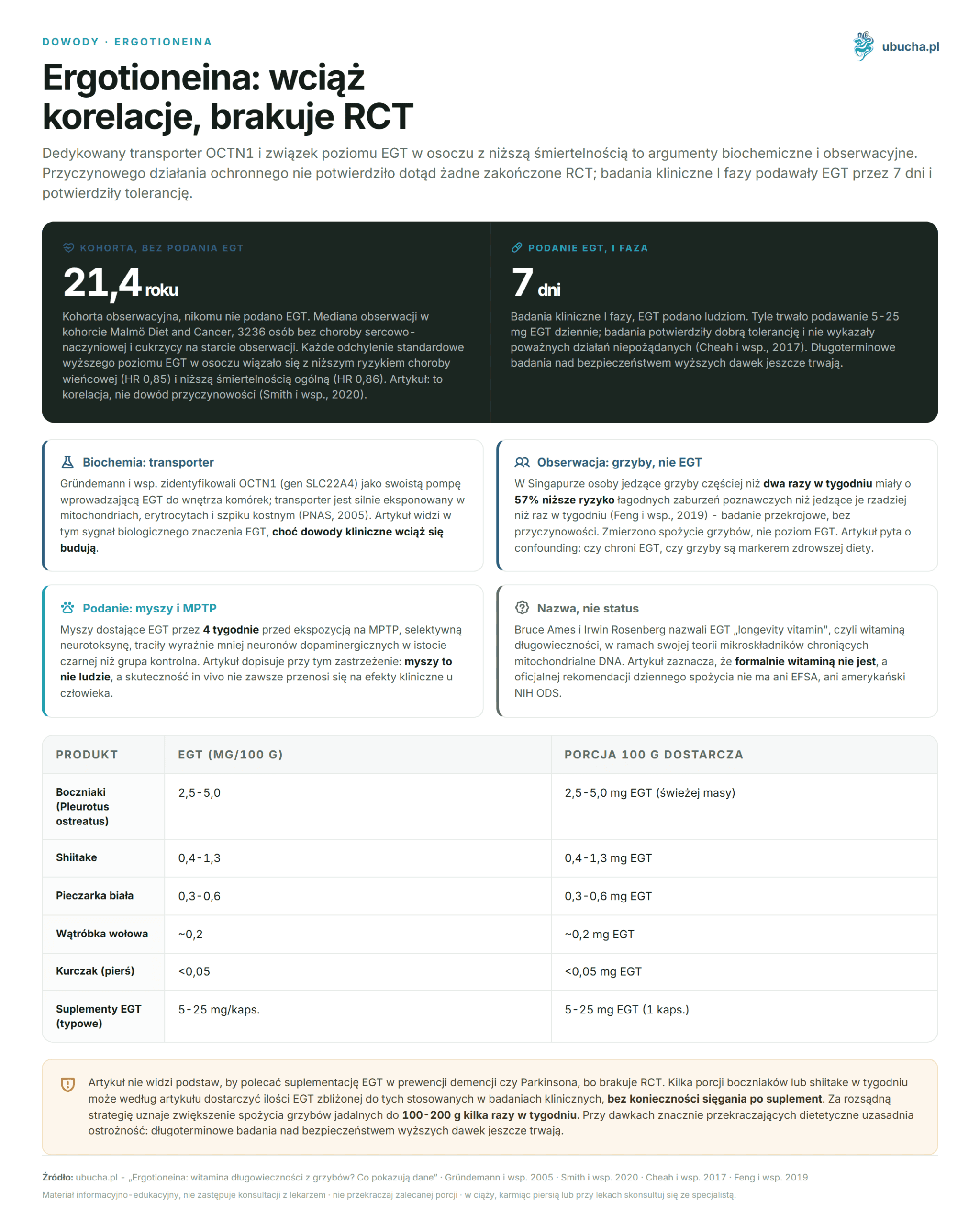
• The Malmö Diet and Cancer cohort (n=3236) links higher EGT levels in plasma with a lower risk of coronary heart disease and lower mortality (Smith et al., 2020).
• Phase I clinical studies confirm good tolerance of doses of 5-25 mg daily for 7 days (Cheah et al., 2017).
• There are no completed RCTs confirming causal protective effects: correlations are strong, but they are still correlations.
What is ergotioneine and where does it come from?
Ergotioneine is a betaine derivative of histidine with a thiol group. It is an amino acid synthesized exclusively by fungi and some soil bacteria, for example from the order Actinomycetales. Neither humans, plants, nor animals can synthesize it de novo, so the only way to obtain it is through diet. The ingested EGT accumulates in tissues very slowly, as its half-life in blood is several weeks, but it does so effectively: in erythrocytes, liver, kidneys, as well as in the brain and mitochondria.
A key discovery was made in 2005 when Gründemann and colleagues identified the transporter OCTN1 (gene SLC22A4) as a specific \”pump\” that brings ergotioneine into cells (Gründemann et al., PNAS, 2005). This transporter is highly expressed in tissues exposed to oxidative damage: in mitochondria, red blood cells, and bone marrow. If EGT were a common dietary metabolite without significance, evolution would not have preserved such a specific transporter for millions of years. This is a biochemical argument, but a strong one.
Professor Bruce Ames from the University of California, Berkeley, and Irwin Rosenberg from Tufts University named EGT the \”longevity vitamin\”. They did this as part of a broader theory that deficiencies of certain micronutrients necessary to protect mitochondrial DNA may accelerate aging. Ergotioneine made it onto this list along with selenium and coenzyme Q10.
Where to get ergotioneine from the diet?
Mushrooms are an unparalleled source of EGT. The concentration depends on the species and growing conditions: mushrooms growing in soils richer in manganese, which is a cofactor for the enzyme synthesizing EGT in fungi, have higher concentrations. Oyster mushrooms (Pleurotus ostreatus) are among the richest sources, providing up to 5 mg EGT per 100 g of fresh mass. This same species of mushroom is also described in the article on Polish medicinal mushrooms, where you can find its other health properties. White button mushrooms (Agaricus bisporus) contain about 0.4 mg/100 g, and shiitake provides 0.4-1.3 mg/100 g.
In comparison, meat contains trace amounts of EGT, as mushrooms in the diets of animals accumulate it in muscle tissues only in very low concentrations. Beef liver contains about 0.2 mg/100 g, which is significantly less than in oyster mushrooms. The Western European diet provides an estimated 1-5 mg EGT daily, while Asian societies that regularly consume shiitake and other mushrooms may intake 5-10 mg daily.
We have noticed that many epidemiological studies on EGT come from Singapore and Japan, countries with high mushroom consumption. This raises the question of a confounding effect: does EGT protect, or is mushroom consumption merely a marker of an overall healthier diet, rich in fiber, polyphenols, and other protective components? Only well-conducted RCTs with isolated EGT can answer this question.
What do the data say about the protective effects of ergotioneine?
Epidemiological data regarding the cardiovascular system are consistent, although they mainly come from Europe, not Asia. The Malmö Diet and Cancer study, involving 3236 individuals without cardiovascular disease and diabetes at the start of observation, linked higher EGT levels in plasma with a lower risk of coronary heart disease (HR 0.85 for each standard deviation increase in EGT) and lower cardiovascular mortality (HR 0.79) and overall mortality (HR 0.86) over a median of 21.4 years of observation (Smith et al., 2020). This is still a correlation, not proof of causation: EGT could merely be a marker of an overall healthier diet. Earlier studies have also shown correlations with a lower risk of dementia and a milder course of Parkinson’s disease.
Mechanistic data are more unequivocal. EGT is unique among thiol antioxidants because its sulfur radical is relatively stable and does not convert into reactive forms after neutralizing free radicals. This means that \”used\” EGT does not become a pro-oxidant, which distinguishes it from N-acetylcysteine and glutathione under certain oxidative conditions. In mitochondria, the site of the highest production of free radicals, EGT appears to act as an oxidative buffer.
Studies on mouse models of neurodegeneration show protection of dopaminergic neurons from oxidative stress with EGT supplementation. The target tissues are those that contain the most OCTN1 transporter, namely the brain, erythrocytes, and bone marrow. However, it is important to remember a significant caveat: mice are not humans, and pharmacological efficacy in vivo does not always translate to clinical effects in humans.
Table of EGT sources and estimated intake
The table below compares the most important food sources of ergotioneine along with the estimated contribution of a 100 g serving. Oyster mushrooms and shiitake clearly surpass meat and most other food products, making them the most practical source of EGT in the daily diet. For comparison, the table also includes the typical EGT content in a supplement capsule, to more easily assess how many servings of mushrooms correspond to one clinically studied dose.
| Product | EGT (mg/100 g) | 100 g serving provides |
|---|---|---|
| Oyster mushrooms (Pleurotus ostreatus) | 2.5-5.0 | 2.5-5.0 mg EGT |
| Shiitake (Lentinula edodes) | 0.4-1.3 | 0.4-1.3 mg EGT |
| White button mushroom (Agaricus bisporus) | 0.3-0.6 | 0.3-0.6 mg EGT |
| Beef liver | ~0.2 | ~0.2 mg EGT |
| Chicken (breast) | <0.05 | <0.05 mg EGT |
| EGT supplements (typical) | 5-25 mg/caps. | 5-25 mg EGT (1 cap.) |
The comparison shows that the difference between the richest and the poorest source reaches a hundredfold. A few servings of oyster mushrooms or shiitake per week can therefore provide amounts of EGT similar to those used in clinical studies, without the need to resort to supplements. People who do not regularly eat mushrooms may consider a ready extract as a simpler source of a repeatable dose.
Does ergotioneine protect the brain from cognitive aging?
Data suggest that it does, although the evidence is still epidemiological and preclinical. The brain is among the tissues most exposed to oxidative stress: it consumes about 20% of the total oxygen while constituting only 2% of body mass, generating huge amounts of reactive oxygen species. Dopaminergic neurons in the striatum and prefrontal cortex are particularly susceptible to oxidative damage, and these areas degenerate in Parkinson’s disease and cognitive aging of the brain.
Epidemiological studies from Singapore have shown that individuals consuming mushrooms more than twice a week had a 57% lower risk of mild cognitive impairment (MCI) compared to those eating mushrooms less than once a week (Feng et al., J Alzheimers Dis, 2019). The authors pointed to ergotioneine as one of the potential protective mechanisms, although the study was cross-sectional and did not establish causality.
Animal model studies have shown that EGT supplementation protects dopaminergic neurons from neurotoxins used to induce Parkinson’s models. In mice supplemented with EGT for 4 weeks before exposure to MPTP, a selective neurotoxin, significantly less loss of dopaminergic neurons in the substantia nigra was observed compared to the control group. These are mechanistic data, not clinical, but they indicate the direction researchers are heading.
How does this translate into practical recommendations? For now, there is no basis to recommend EGT supplementation in the prevention of dementia or Parkinson’s disease, as there are no RCTs. Increasing the intake of edible mushrooms, such as oyster mushrooms, shiitake, or button mushrooms, to 100-200 g several times a week is a reasonable strategy based on a healthy diet. It simultaneously provides EGT, fiber, and beta-glucans, and the whole has solid epidemiological justification without the need to wait for RCTs with the supplement alone.
Frequently asked questions
What is ergotioneine and why is it called the longevity vitamin?
Ergotioneine is an amino acid synthesized by fungi and bacteria, which humans cannot produce themselves. The body has a dedicated transporter OCTN1 for it, actively accumulating it in tissues exposed to oxidative stress. The name \”longevity vitamin\” was given to it by researchers Ames and Rosenberg, classifying it among micronutrients that slow aging, although it is not formally a vitamin (Gründemann et al., 2005).
Which mushrooms contain the most ergotioneine?
Oyster mushrooms (Pleurotus ostreatus), containing about 2.5-5 mg EGT per 100 g of fresh mass, are one of the richest available sources. Shiitake provides 0.4-1.3 mg/100 g, and white button mushrooms about 0.3-0.6 mg/100 g. Regular consumption of 100-150 g of oyster mushrooms several times a week can provide doses similar to those studied in supplements.
Does ergotioneine protect the heart according to research?
Epidemiological data suggest an inverse relationship between EGT levels and cardiovascular risk. The Malmö Diet and Cancer cohort (n=3236) showed that higher EGT levels in plasma were associated with a lower risk of coronary heart disease and lower cardiovascular mortality over more than 21 years of observation (Smith et al., 2020). This is a correlation, not proof of causation.
How to dose ergotioneine as a supplement?
Phase I clinical studies (Cheah et al., 2017) used 5-25 mg daily for 7 days and did not show serious adverse effects. Available supplements usually contain 5-25 mg EGT per capsule, similar to the doses studied clinically. There is no official daily intake recommendation from EFSA or the US NIH ODS.
Is ergotioneine safe as a supplement?
Available data suggest a good safety profile at doses of 5-25 mg daily, studied in clinical settings. EGT has been present in the human diet for millennia, and the body has a dedicated transporter for it, suggesting a biologically \”expected\” substance. Long-term studies on the safety of higher doses are still ongoing, so caution is warranted with doses significantly exceeding dietary levels.
You can find ergotioneine not only in the diet but also in ready extracts from functional mushrooms in the adaptogens category at the Bucha store.
This article is for informational and educational purposes and does not replace consultation with a doctor. If you are pregnant, breastfeeding, taking medications, or have chronic conditions, consult the use of supplements or herbs with a specialist.
Author: Michał Waluk · Published: 2026-08-09 · Updated: 2026-08-10