
Cleaning a Bong and Accessories: Step by Step Guide (FAQ)
Cleaning a bong step by step: isopropanol with salt, removing limescale, cleaning nozzles and bowls, and what studies on water bacteria say about water pipes.
A dirty bong is not just an aesthetic issue. Standing water in the chamber for several days is an environment where bacteria multiply unchecked, and smoke deposits narrow the channels and spoil the taste. The scale of this phenomenon has been measured in water pipes used communally in establishments, and the results are clear. Below you will find one proven cleaning method described step by step, separate procedures for limescale, and a few habits that make general cleaning necessary less often. Everything can be done with products from the pharmacy and kitchen, without buying specialized chemicals. We also separate two types of deposits that require completely different agents and are often confused: smoke resin and white limescale from hard water. Confusing them is the most common reason why scrubbing does not yield results.
KEY INFORMATION
• In a study of 285 samples taken from water pipes in 15 establishments, 82.8% showed an increase in bacteria, and in the water from the chamber, the percentage reached 96% (Safizadeh et al., Int J Tuberc Lung Dis, 2014).
• Change the water after each session, as that is where most accumulates.
• Isopropanol with coarse salt removes resins: the salt mechanically scrapes, the alcohol dissolves.
• Limescale from water is a mineral deposit and alcohol does not affect it. Vinegar or citric acid is used for it.
• After cleaning, rinse the bong thoroughly and dry it before use: isopropanol is flammable and irritating.
Why is it necessary to clean a bong?
The first reason is hygienic and is measured. Safizadeh’s team collected 285 samples from various parts of water pipes in 15 randomly selected establishments and cultured them on growth media. Bacterial growth was found in 236 samples, or 82.8% of them, with the percentage ranging from 69% for fixed mouthpieces to 96% for water from the chamber. Coagulase-negative staphylococci, streptococci, and Escherichia coli were most frequently found, and the authors concluded that water pipes are often contaminated with microorganisms (Safizadeh et al., Int J Tuberc Lung Dis, 2014).
A similar picture was given by metagenomic analysis of three pipes taken from rental points: over forty types of bacteria were found in the water from the chamber, in the stem, and in the hose, some commensal, some pathogenic, and the authors linked the presence of intestinal microorganisms to the conditions of equipment preparation (Hani et al., BMC Res Notes, 2018). Both studies concern water pipes used communally in establishments, not a home bong of one person, so the numbers cannot be directly transferred. However, they indicate where the most accumulates: in the water and in the mouthpiece.
The second reason is practical. Resins deposited on the walls and in the nozzle narrow the channel’s cross-section, making the draw heavier. The third concerns taste: deposits from previous sessions overlay the aroma of fresh material and blur the differences between strains of the herb.
What do you need and how to clean a bong step by step?
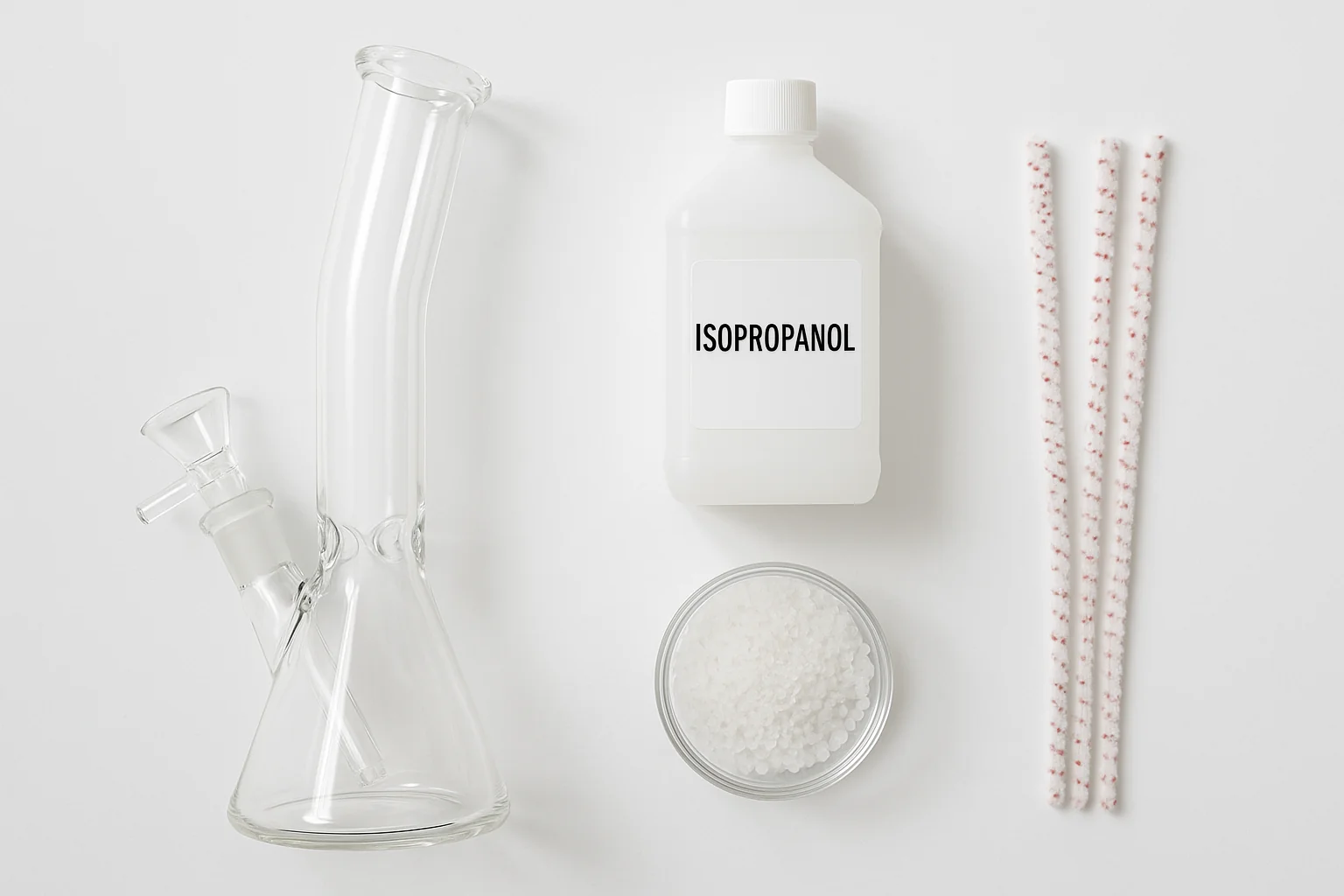
The set is short and cheap: high concentration isopropanol, coarse kitchen or sea salt, pipe cleaners, ziplock bags for soaking small parts, and something to block the openings, such as a piece of glove. Fine salt works worse because it scrapes less effectively. Low concentration alcohol also works slower because it contains more water, and water slows down the dissolution of resins.
- Disassemble and pour out the water. Remove the nozzle, bowl, and adapters. Clean each part separately, as they will bump against each other in the chamber.
- Add salt and pour in alcohol. Just enough to moisten the salt well, and the liquid reaches about half the chamber. Filling to the brim does not speed anything up.
- Block the openings and shake. Cover the mouthpiece and the nozzle opening, then shake vigorously for a few minutes. For old, hard deposits, leave the solution for half an hour to an hour before shaking.
- Pour out and rinse. Rinse several times with hot water until the dark liquid stops flowing. If the walls are still sticky, repeat the cycle instead of scrubbing hard.
- Inspect in the light and dry. The glass should be transparent. Leave the bong mouthpiece down to dry and do not use it with alcohol residues inside.
The last point is not a formality. Isopropanol is a flammable liquid, and its vapors irritate the respiratory tract, so thorough rinsing and drying is a safety element, not an aesthetic one.
What else can be used to clean a bong?
Alcohol with salt handles resins, but not every type of deposit. The white residue on the walls of the chamber is limescale, i.e., a mineral deposit from hard water, and alcohol does not affect it. Here, acid is needed: spirit vinegar or citric acid dissolved in warm water. Citric acid works just as well and does not leave a smell, which can linger for several sessions after vinegar.
Baking soda is sometimes recommended as a universal cleaner, but it disappoints with resins because it is a base, and resins dissolve in alcohol. Combining baking soda with vinegar creates a fizzing effect that helps mechanically detach light residue, but it does not replace alcohol for proper smoke deposits.
Ready-made cleaning solutions for pipes and bongs are also sold in accessory stores, designed to be poured in, shaken, and rinsed. They can be more convenient than homemade solutions because you do not need to add salt, but they cost many times more than pharmacy isopropanol. The composition cannot be compared from the outside, so read the label before use: check if the manufacturer allows the solution for equipment from which smoke is then inhaled, and whether rinsing is required.
| Type of contamination | What to use | How long it usually takes |
|---|---|---|
| Fresh smoke resin | Isopropanol with coarse salt | A few minutes of shaking |
| Old, hardened resin | The same, but with prior soaking | From half an hour to an hour |
| Limescale from water | Spirit vinegar or citric acid | From fifteen minutes to an hour, for hard deposits overnight |
| Mixed deposits | First alcohol with salt, after rinsing acid | Two cycles, each half an hour |
How to clean nozzles, bowls, and adapters?
Small parts are cleaned separately because they have narrow channels that shaking does not reach. Place the glass nozzle and adapters in a ziplock bag or small container with alcohol and salt, leave for half an hour, then scrub with a pipe cleaner and rinse with hot water. Metal parts can withstand boiling in salt water, and a few minutes of boiling softens the deposits enough that the rest comes off with a pipe cleaner.
The bowl requires attention in one place: at the opening in the bottom, where remnants of burnt material accumulate. It can be cleared with a thin pipe cleaner or an extraction tool, avoiding hard metal objects that scratch the glass. A scratch collects deposits faster than a smooth surface, so once made, it works against you with every subsequent cleaning.
Remove and wash seals and silicone parts with warm water and dish soap. Long soaking of silicone in concentrated alcohol is not a good idea, as the elastomer can become cloudy and lose its tightness. A fully silicone bong is cleaned with the same principle: short contact with alcohol, and the rest of the work is done mechanically by salt and warm water. A comprehensive overview of methods can be found in the guide how to clean and maintain a bong, pipe, and glass accessories.
How to make a bong get dirty slower?
The biggest difference is made by changing the water after each session. That is where most accumulates, it is responsible for the smell, and it is from there that the highest percentage of positive cultures comes in the aforementioned study of water pipes. Pouring it out takes a few seconds and pushes the date of general cleaning by a few sessions.
The second habit is a mesh screen in the bowl. It catches particles that would otherwise fall into the nozzle and start to accumulate there. The third is cleaning shortly after the session, while the resin is still soft: after a few hours, it hardens, and the same deposit requires soaking instead of a few minutes of shaking.
It is also worth paying attention to the water itself. Filtered or distilled water leaves less limescale than tap water, so if you see a white residue in the kettle, the same is happening in the bong’s chamber. It also helps not to overload the bowl: material that spills into the channel settles there faster than you can remove it. The same logic applies to other devices: we write more extensively about deposits and ways to remove them in the post about cleaning a vaporizer.
Frequently Asked Questions
What is the best way to clean a bong?
High concentration isopropanol with coarse kitchen salt. The salt acts as an abrasive, the alcohol dissolves the resin from the smoke. Block the openings, pour in the solution, shake for a few minutes, then rinse with hot water. For old, hard deposits, leave the solution for half an hour to an hour before shaking.
How often should I clean my bong?
Change the water after each session, as that is where most accumulates. A quick rinse with alcohol every few sessions prevents resin buildup. A thorough wash with soaking once a week is sufficient for daily use, and less often for occasional use. Regularity is easier than catching up on backlogs.
Can I clean my bong with vinegar instead of isopropanol?
Not instead, but alongside. Vinegar removes mineral deposits from the water, i.e., limescale, but it does poorly with smoke resins. Alcohol is needed for resins. It is best to divide the work: first isopropanol with salt for smoke deposits, then vinegar or citric acid for the white residue.
How to clean the nozzle and adapter of the bong?
Place them in a ziplock bag or small container with isopropanol and salt, leave for half an hour, then scrub with a pipe cleaner and rinse with hot water. Metal parts can be boiled for a few minutes in salt water, which softens the deposits in the narrow channel and makes mechanical cleaning easier.
How to remove limescale from a bong?
Limescale is a mineral deposit, so it is dissolved by acid, not alcohol. Pour warm water with spirit vinegar or citric acid into the chamber, wait fifteen minutes to an hour, shake, and rinse. For hard deposits, leave the solution overnight. Citric acid does not leave a smell, which can be bothersome after vinegar.
How to clean a bong made of dark glass or with patterns?
The interior is cleaned the same way as in clear glass, as the method does not depend on color. The difference concerns external decorations: paints, prints, and stickers do not withstand long contact with concentrated alcohol. Wipe the outside with a damp cloth, and keep the alcohol inside the vessel.
You can find bongs in the bong category.
This article is for informational and educational purposes. It contains internal links to product categories available in the u Bucha store. Prices and specifications may change: check the current data on the product page before purchasing.
Author: Michał Waluk · Published: 2026-08-09 · Updated: 2026-08-16