
Why the FDA Refused to Register MDMA Therapy in 2024: And What It Means for Research
In August 2024, the FDA refused to register MDMA therapy for PTSD. We explain what the advisory committee ruled, what the objections were, and what happens next.
In August 2024, the U.S. Food and Drug Administration refused to register MDMA-assisted therapy for treating post-traumatic stress disorder. The decision closed a decade-long effort by MAPS and Lykos Therapeutics, preceded by a critical position from the advisory committee in June of the same year. It is important to clarify what this decision was about, as a shorthand like “FDA rejected MDMA” misrepresents its content. The refusal pertained to a specific application from a specific company and concluded with a request for additional research, rather than a ruling that the substance does not work. Below, we explain what exactly was questioned, where the most challenging methodological problem in this field lies, and what has happened since then.
KEY INFORMATION
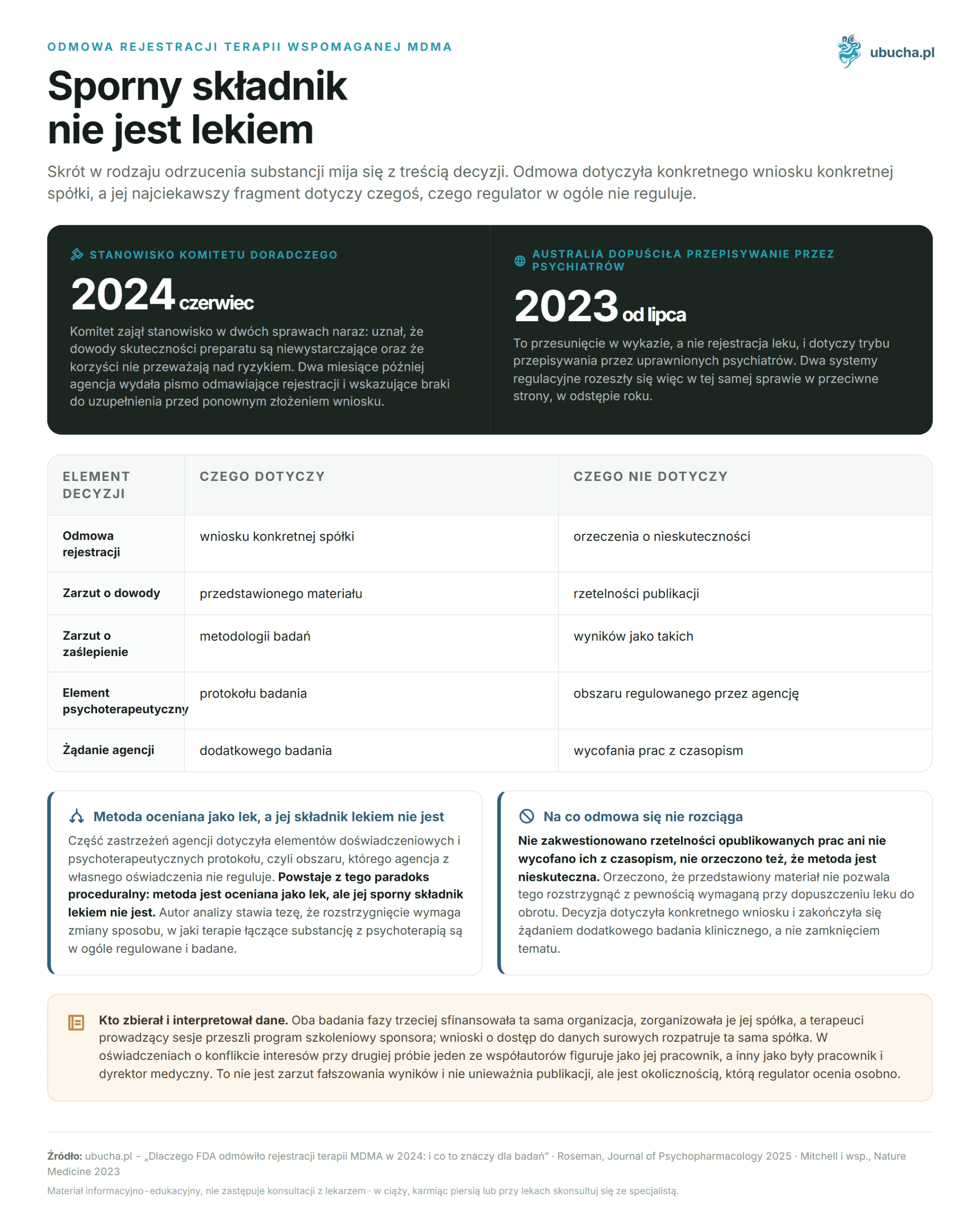
• On June 4, 2024, the FDA advisory committee found that the evidence of efficacy was insufficient and that the benefits did not outweigh the risks.
• In August 2024, the agency refused to register the product from Lykos Therapeutics and requested additional clinical research.
• The main objection was the inability to maintain blinding and that some disputed elements pertained to psychotherapy, which the agency does not regulate.
• Australia has allowed MDMA to be prescribed by authorized psychiatrists since July 1, 2023. This is a shift in classification, not drug registration.
Who submitted the application and what is Lykos Therapeutics?
MAPS, or the Multidisciplinary Association for Psychedelic Studies, is a U.S. nonprofit organization founded in 1986 that has funded research on the use of MDMA in treating PTSD for decades. To conduct the commercial part, MAPS Public Benefit Corporation was established, later renamed Lykos Therapeutics. This company submitted the registration application.
The separation of the foundation and the company was intended to separate the research mission from market activities, but it did not eliminate the tension that later resurfaced in the regulator’s assessment. Both phase 3 studies were funded by MAPS, organized by MAPS PBC, and the therapists conducting the sessions underwent the sponsor’s training program. Requests for access to raw data are handled by MAPS PBC. In conflict of interest statements for the second trial, one co-author is listed as an employee of MAPS PBC, and another as a former employee and medical director (Mitchell et al., Nature Medicine, 2023).
This is not an accusation of data falsification and does not invalidate publications that have undergone peer review and describe safeguards against bias. However, it is a circumstance that the regulator evaluates separately, as it pertains to who collected and interpreted the data subsequently presented as the basis for registration.
What did the FDA advisory committee rule in June 2024?
On June 4, 2024, the agency’s advisory committee took a position on two issues at once: it found that the evidence of the product’s efficacy was insufficient and that the benefits did not outweigh the risks. Two months later, the agency issued a letter refusing registration and indicating deficiencies to be addressed before resubmitting the application (Roseman, Journal of Psychopharmacology, 2025).
An analysis published after this decision points out an issue that goes beyond Lykos’s application itself. Some of the agency’s objections pertained to experiential and psychotherapeutic elements of the protocol, an area that the agency does not regulate according to its own statement. This creates a procedural paradox: the method is evaluated as a drug, but its disputed component is not a drug. The author of this analysis posits that a resolution requires a change in how therapies combining substances with psychotherapy are regulated and studied.
It is also worth noting what the refusal does not extend to. The reliability of published works was not questioned, nor were they retracted from journals. It was also not ruled that the method is ineffective. It was ruled that the submitted material does not allow for a determination with the certainty required for drug approval.
What is the problem with blinding?
This is the crux of the dispute and the difficulty that no research team in this field has yet resolved. In a classic double-blind trial, neither the patient nor the researcher knows who received the drug. However, MDMA produces clear sensations, so participants usually guess which group they belong to. From that moment, their assessment of their own symptoms ceases to be independent of expectations.
The authors of the phase 3 studies introduced a counterbalance: primary measurements were conducted by independent assessors who were unaware of the assignment, and the results were entered into a database separate from clinical data, to which the sponsor’s staff had no access (Mitchell et al., Nature Medicine, 2021). This safeguard limits one channel of bias but does not eliminate another: the patient still knows more than they should, and their report is input for assessment.
Additionally, there is an area that numbers do not describe. A systematic review of the literature on the ethics of psychedelic therapy identifies seven groups of issues that need to be organized before these methods are introduced into practice, including the therapeutic relationship, informed consent, and research ethics (Caporuscio et al., Psychological Medicine, 2025). The substance lowers vigilance and increases susceptibility to suggestion, and the session lasts eight hours in the presence of two people. Oversight of this relationship is a separate issue from efficacy, and the regulator treated it separately.
What did the phase 3 studies show?
The refusal did not invalidate the published results, so it is worth citing them as they appear in the source works. In the MAPP1 study involving 90 participants with severe PTSD, the average decrease in CAPS-5 score was 24.4 points compared to 13.9 points in the placebo group with the same psychotherapy. In the MAPP2 study involving 104 people, it was 23.7 points compared to 14.8 points.
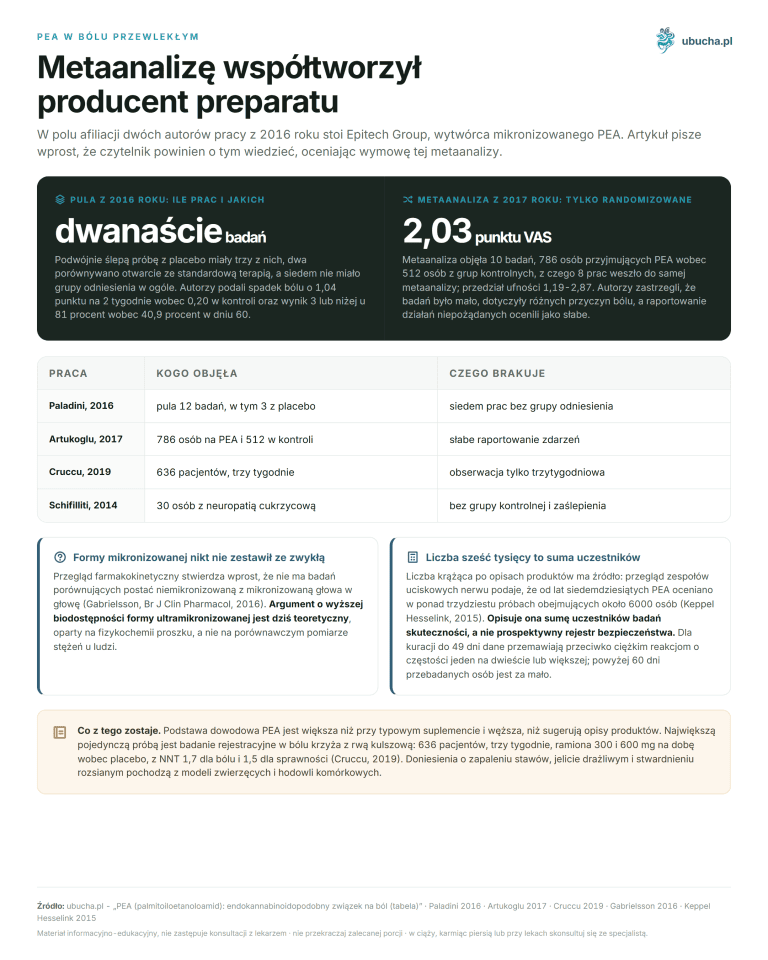
The most frequently repeated number from these works requires clarification. The statement about 67 percent remission after MDMA compared to 32 percent on placebo actually describes loss of diagnosis, meaning a situation where the patient no longer meets the diagnostic criteria for PTSD. Remission is a stricter threshold and additionally requires a CAPS-5 score not higher than 11 points. In MAPP2, remission was achieved by 24 out of 52 people in the MDMA group, or 46.2 percent, compared to 9 out of 42 people on placebo, or 21.4 percent. The denominators here are smaller than the number of randomly assigned individuals, as the analyses concern participants who completed treatment. Thus, the common version inflates the scale of the phenomenon, while the gap from the placebo group remains similar in both measurements. We detail these measurements in the text about phase 3 studies on MDMA in PTSD.
| Date | Event |
|---|---|
| 2021 | Publication of MAPP1 in Nature Medicine, 90 participants with severe PTSD |
| July 1, 2023 | In Australia, the shift of MDMA and psilocybin in the list of substances comes into effect |
| 2023 | Publication of MAPP2 in Nature Medicine, 104 participants |
| June 4, 2024 | FDA advisory committee rules on insufficient evidence of efficacy |
| August 2024 | FDA refuses registration and requests additional study |
Has Australia really approved MDMA therapy?
No in the sense that drug registration is understood. Until 2023, MDMA and psilocybin were listed in Australia as prohibited substances, available only for research and training purposes. The change that came into effect on July 1, 2023, moved them to the category of controlled substances and opened the path for prescription by psychiatrists with Authorised Prescriber status, after obtaining approval from the ethics committee and then the regulator (Hatfield et al., Aust N Z J Psychiatry, 2024).
The Australian psychiatric community has critically received this change. An editorial comment in the local psychiatric journal has a title stating directly that the shift occurred too quickly and too early (Kisely, Aust N Z J Psychiatry, 2023). A separate voice from the same volume raises a procedural objection: the regulator did not consult the decision with Australian researchers and clinicians experienced in psilocybin-assisted psychotherapy (Rossell et al., Aust N Z J Psychiatry, 2023).
The Australian path is therefore not evidence that the rest of the world is wrong. It is a second regulatory model, against which the same objections are formulated as against Lykos’s application, only from the other side: there, the problem is allowing the method before resolving the dispute over evidence.
What happens next with the registration?
The refusal letter is not a verdict, but a list of requirements to be met before resubmitting the application. The path leads through a new clinical study designed to limit the impact of participant expectations on measurement, and through resolving the issue of oversight during sessions. The timeline for this process cannot be responsibly provided today. The circulating time frames in the media should be treated as estimates from commentators, not as an announced schedule.
The MDMA case does not determine the fate of other substances, as each follows a separate registration path. Psilocybin for treatment-resistant depression has completed a phase 3 study involving 258 people, conducted by COMPASS Pathways, which finished collecting primary data on May 28, 2025. As of August 16, 2026, the results of this study have not been placed in the clinical trial registry nor published in a peer-reviewed journal. A second phase 3 study, involving 572 people, is still ongoing and is not recruiting new participants. We break down this thread in the text about psilocybin research in depression.
The practical takeaway for the reader is cautious. MDMA-assisted therapy remains an experimental method, not legally available in Poland in any form. The context of this decision and its implications for patients are described in more detail in the text about the consequences of the FDA decision, and the state of research on the entire group of substances in the review of therapies using psychedelics.
Frequently Asked Questions
When did the FDA refuse to register MDMA therapy?
In August 2024, in response to a request from Lykos Therapeutics. The decision was preceded by the advisory committee’s position from June 4, 2024, which found that the evidence of efficacy was insufficient and that the benefits did not outweigh the risks of the therapy.
Does this mean that MDMA therapy does not work?
No. The agency did not rule out the ineffectiveness of the method nor did it question the reliability of the published studies. It found that the submitted material did not allow for a determination of efficacy with the certainty required for drug approval, and requested additional clinical research.
What exactly were the agency’s objections?
Primarily the inability to maintain blinding: the participant feels the effects of MDMA, so they guess their assignment to a group, which affects their assessment of their own symptoms. A separate issue was that some disputed elements of the protocol pertained to psychotherapy, which the agency does not regulate.
Has Australia registered MDMA therapy?
Not in the sense of drug registration. Since July 1, 2023, MDMA and psilocybin have ceased to be prohibited substances and can be prescribed by psychiatrists with Authorised Prescriber status, after approval from the ethics committee and the regulator. Australian psychiatrists have critically assessed this change.
Does the refusal also apply to psilocybin?
No. Each substance follows a separate registration path. Psilocybin for treatment-resistant depression has completed a phase 3 study involving 258 people, which ended in May 2025, the results of which have not yet been published. A second phase 3 study, involving 572 people, is still ongoing.
What is a Complete Response Letter?
It is a formal document by which the agency informs the applicant that the registration application cannot be accepted in its current form. The letter indicates specific deficiencies and requirements to be met. It is not a final rejection: the applicant can supplement the material and reapply.
This article is for informational and educational purposes. It describes clinical trials in which the substance is administered under medical supervision after participant qualification; using it on one’s own does not replicate these conditions. These substances are controlled in Poland under the Act on Counteracting Drug Addiction. If you have suicidal thoughts, call the free, 24-hour numbers 116 123 or 800 70 2222. In case of life-threatening situations: 112.
Author: Michał Waluk · Published: 2026-08-09 · Updated: 2026-08-16