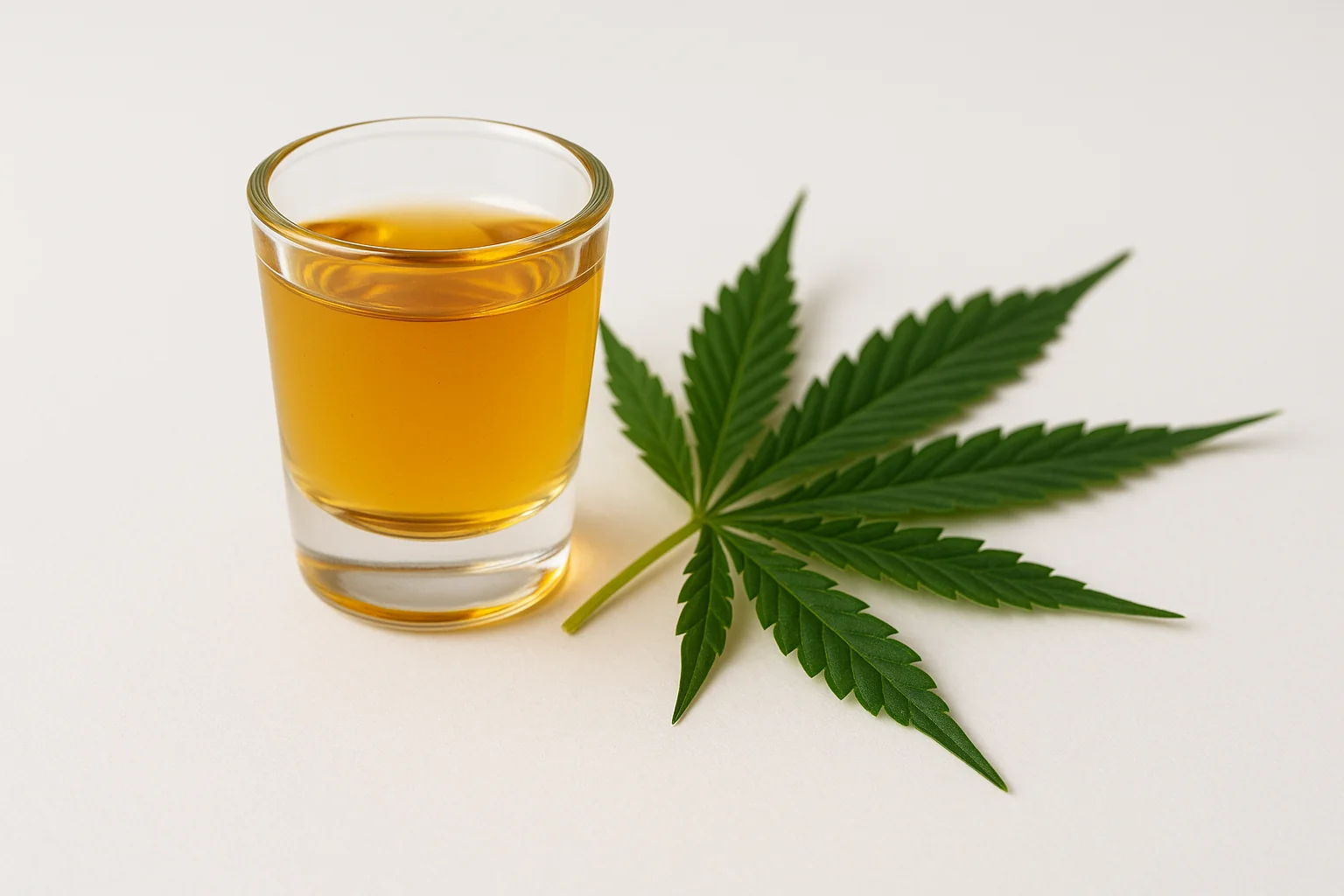

Hemp Water and CBD Shot: What It Is, How It Tastes, and How It Works 2026
Hemp water and CBD shots: what they are, how they taste, and what is really known about their absorption. EFSA's position on nanoparticles and the legal status in Poland.
Hemp drinks are the youngest category in hemp wellness and also the one surrounded by the most unsupported numbers. Labels promise bioavailability stated to the decimal point, time of action in minutes, and technology that supposedly bypasses the liver. When one reaches for the publications from which these numbers are supposed to come, it turns out that no one has measured them. A systematic review of the pharmacokinetics of cannabidiol in humans states outright that absolute bioavailability has been established only for one route of administration, and it is none of the oral routes. Separately, the EU regulator excluded nanoparticle forms from its safety assessment, which specifically concerns these drinks. This article describes what hemp water and CBD shots really are, how they taste, what is known about their absorption, and what their legal status is in Poland.
KEY INFORMATION
• The bioavailability of CBD in humans has been measured only for the inhalation route and was 31%; no study has yet done this for any oral route (Millar et al., Frontiers in Pharmacology, 2018).
• The provisional safe dose of CBD according to EFSA from 2026 applies only to preparations with a purity of at least 98% and without nanoparticles, meaning it does not include drinks with nanoemulsion.
• Sanitary notification of product introduction to the market is not authorization of new food and does not change the status of the ingredient.
• The time to first effects declared on labels, stated in minutes, has no basis in published pharmacokinetic studies.
What is hemp water and a CBD shot?
These are two forms of the same idea: to provide cannabidiol in a drinkable liquid instead of in sublingual oil. Hemp water is a large-volume drink with a low content of extract, while a shot is a concentrated portion in a small bottle. They differ in volume and concentration, and thus also in the situation in which they are chosen.
Producers of hemp water usually declare several to several dozen milligrams of CBD per bottle of a quarter or half a liter. A shot contains a similar or higher amount in a portion of 25-60 ml, so it is consumed in one gulp. The idea itself came from the sports supplement shelf, where a small bottle with a measured portion has been functioning for years.
The composition can vary. The simplest drinks contain water, extract, and natural flavor. Functional versions add adaptogens or vitamins, making them complex products with their own limitations. A drink with ashwagandha is no longer just a drink with CBD and must be evaluated as a mixture.
One note about naming, as it can be misleading. Some products described as hemp contain hemp seed oil, which practically does not contain cannabidiol, and not extract from flowers. This is a raw material difference, not a marketing one. We elaborated on it in the post Hemp Oil vs CBD Oil: What Are the Differences and What to Choose.
Does CBD dissolve in water at all?
No, it does not dissolve. Cannabidiol is lipophilic, meaning it mixes with fats, not with water. A drink that contains only CBD thrown into water separates or settles on the walls of the bottle. The entire hemp beverage industry stands on the attempt to circumvent this one physicochemical problem.
Hence, two technologies mentioned on labels. Nanoemulsion is a suspension of fat droplets with CBD enclosed in them, with a diameter of less than one hundred nanometers, stabilized by an emulsifier; such small droplets scatter light less, so the liquid can be almost transparent. A liposomal preparation encloses CBD in phospholipid vesicles, resembling a cell membrane in structure. Both have the same goal: to keep cannabidiol suspended stably enough so that the portion on the label corresponds to what actually reaches the mouth.
It is worth separating two questions that merge in advertisements. The first is: does the technology keep CBD in the drink instead of allowing it to settle? To this, nanoemulsion answers well, and it is a purely technological problem that can be solved. The second is: how much more CBD reaches the blood because of this? There is simply no answer to that, as discussed below.
The practical conclusion for the buyer is that a separated drink or a greasy film on the surface is a signal of poor formulation. Transparency, however, does not prove effectiveness; it only proves that the emulsion holds.
Do CBD drinks work faster than oil?
It is unknown, as no one has measured it. This is an unsatisfactory answer, but the only one consistent with the state of research. Circulating claims of first effects after 15-30 minutes or bioavailability of 20-25% for nano-CBD have no counterpart in published pharmacokinetic studies in humans.
Millar et al. (Frontiers in Pharmacology, 2018) searched PubMed and EMBASE, collected 792 articles, and selected 24 that provided pharmacokinetic parameters for CBD in humans. Their finding is unequivocal: absolute bioavailability was measured only after smoking and was 31%, and no other study has attempted to establish it for other routes of administration, even though intravenous preparations were available. The authors conclude the review with a statement about the lack of data and discrepancies in the pharmacokinetics of cannabidiol.
This means that any table comparing the bioavailability of a drink with oil or a capsule is built from numbers whose origin cannot be pointed out, regardless of where you encounter such a table. This is also confirmed by the EFSA panel in 2026, stating that the bioavailability of CBD is variable and depends on the carrier matrix and the food consumed, without providing values for specific forms.
What is known for sure: the time to reach maximum concentration is, according to Millar, in the range of zero to four hours, depending on the form and study, and the maximum concentration itself increases after a meal and with a fatty carrier. A drink consumed on an empty stomach and the same drink consumed after a meal are thus two different exposures, and this dependence is well documented.
What does hemp water and CBD shot taste like?
Hemp water tastes gentle, while a shot tastes pronounced. The difference comes directly from the concentration of the extract: the more of it in the liquid, the stronger the herbal-resinous hemp note comes out, which some people like from the first sip, while others need to get used to it.
Drinks based on isolate are the most neutral, as pure cannabidiol has practically no taste. The entire flavor profile of such a product then comes from added flavors. Drinks with full-spectrum extract carry terpenes, and they give the characteristic aftertaste, similar to a strongly brewed infusion from the herb.
Shots go a step further towards a supplement. Bitterness is the rule here, not a flaw in execution, and that is why producers mask it with citrus or mint. Sports versions usually focus on a fruity profile, under which the hemp base remains detectable.
We have noticed that people trying a shot for the first time rate the taste much milder when starting with a flavored version rather than a full-spectrum one without additives. If someone’s sensitivity to the hemp aftertaste is high, it is wiser to start with hemp water and only then reach for the concentrated portion.
What does EFSA say about nanoparticles in CBD products?
This is the most important thing in the entire text and also the one you will not find on labels. The EFSA panel on nutrition and new food derived a provisional safe dose of CBD in 2026 and in one sentence excluded nanoparticle forms from it.
The value is 0.0275 mg per kilogram of body weight per day, or about 2 mg daily for a person weighing 70 kg. It was derived using the benchmark dose method with an uncertainty factor of 400. The caveat is this: this dose applies only to dietary supplements with a purity of CBD of at least 98%, without nanoparticles, with a recognized safe production process and excluded genotoxicity.
A drink with nanoemulsion does not meet this condition by definition. This does not mean it is harmful, and no one has stated that. It means something else and narrower: the safety of this form has simply not been evaluated, so the claim of its testing and recognition as safe by EU authorities is a reversal of the factual state. The lack of evaluation is not a positive assessment.
The panel also lists gaps that have not been closed since 2022. In animal studies, liver toxicity recurs, and liver mass and histopathological changes have proven to be sensitive endpoints. In humans, hepatotoxic potential has been noted, especially with concurrent use of medications. No study has addressed immunotoxicity.
The panel’s final conclusion concerns groups, not numbers: the safety of CBD cannot be established in people under 25 years of age, in pregnant and breastfeeding women, and in those taking medications simultaneously. This statement has more practical significance than any bioavailability declaration from a label.
Are hemp drinks legal in Poland?
The answer breaks down into two separate issues, which are usually merged in texts about CBD: the status of cannabidiol as a substance and the status of CBD as a food ingredient. The first is simple, the second is not.
Cannabidiol is not listed in any controlled substance lists and is not banned in Poland. However, the raw material must come from industrial hemp, meaning those in which the total content of delta-9-THC and tetrahydrocannabinolic acid does not exceed 0.3% when calculated on dry mass, rounded to one decimal place. The basis is Article 4 point 5 of the Act of July 29, 2005 on Counteracting Drug Addiction (Journal of Laws 2023, item 1939), as amended by the Act of March 24, 2022 (Journal of Laws 2022, item 763). The threshold is calculated as the sum of both compounds, not just delta-9-THC itself, and this difference determines the outcome of the laboratory test.
The second issue is less convenient for the entire industry. CBD as a food ingredient is subject to new food regulations in the EU, and its assessment is still ongoing. The EFSA position from 2026 is a safety assessment bound by conditions, not an authorization for marketing or approval. Sanitary notification of product introduction to the market also does not determine anything here, as it is not authorization of new food and does not change the status of the ingredient. CBD drinks are therefore available for sale, but in a regulatory environment that may change.
What to check on the label before purchase?
Since claims about the speed of action cannot be verified, it is worth shifting attention to those pieces of information that can be checked. All of the following can be read from the packaging or the manufacturer’s website, without trusting marketing slogans.
- CBD content stated per serving, not per 100 ml - this is the first thing that labels confuse, and the only number allowing comparison of two products;
- certificate of analysis from an independent laboratory confirming the declared content and THC threshold;
- type of extract: isolate, broad spectrum, or full spectrum - this determines the taste and what else is in the liquid;
- composition without excess sugar and colorants, as a wellness drink can easily turn into a sweetened drink with added CBD;
- storage conditions, especially for emulsions, which can be sensitive to temperature.
What not to treat as an argument: percentages of bioavailability, declared time of action in minutes, and assurances of bypassing the liver. None of these three promises currently has a basis in published studies on humans, and all three appear on labels most often. If a producer provides them without citing a publication, treat it as a commercial declaration, because that is exactly what it is.
For whom do hemp drinks make sense, and for whom do they not?
Hemp drinks solve the problem of convenience, not effectiveness. They make sense where oil is impractical: at work, while traveling, at the gym, everywhere where holding a dropper under the tongue for a minute is awkward or simply impossible.
They also work well as a first contact with the category. A ready portion in a bottle removes the need for the user to count drops and is psychologically simpler than measuring. For those who already regularly use oil, the drink offers more variety than an advantage, as one pays significantly more for a milligram of cannabidiol in this form.
However, there are situations where it is better to skip. CBD drinks should not be consumed by people under 25 years of age, pregnant and breastfeeding women, or those taking medications regularly, as for these three groups, EFSA could not establish safety. The last group also relates to a note from the World Health Organization from a review in 2018: cannabidiol is usually well tolerated, and reported adverse effects may result from interactions with medications taken by the patient.
A full shelf of ready portions can be found in the hemp shots category. If you are considering a choice between a portion in a bottle and oil, we described the comparison of both forms in the post Hemp Shot or CBD Oil: What to Choose.
Frequently Asked Questions
What is the difference between hemp water and a CBD shot?
By volume and concentration. Hemp water is a large-volume drink with a small amount of extract, consumed like regular water. A shot is a concentrated portion of 25-60 ml, taken in one gulp. Both require nanoemulsion or a liposomal preparation because CBD does not dissolve in water.
Does a CBD shot work faster than sublingual oil?
It is unknown. Millar et al. (Frontiers in Pharmacology, 2018) found that the absolute bioavailability of CBD was measured in humans only after smoking, where it was 31%. No study has yet measured it for any oral or sublingual route, so percentage comparisons have no source.
Is CBD nanoemulsion safe?
It has not been evaluated. The provisional safe dose by EFSA from 2026 applies only to preparations with a purity of at least 98% and without nanoparticles, so nanoparticle forms were explicitly excluded from this assessment. However, the lack of evaluation is neither a statement of harm nor a confirmation of safety.
What does hemp water taste like?
Gently and herbally, and in drinks based on isolate, almost neutrally, because pure cannabidiol has practically no taste. Versions with full-spectrum extract carry terpenes and a more pronounced hemp note. Shots taste much more intense, usually with bitterness masked by citrus or mint.
Are CBD drinks legal in Poland?
Cannabidiol is not listed in controlled substances, and the raw material must come from hemp with a total delta-9-THC and THCA content not exceeding 0.3%. As a food ingredient, CBD is subject to new food regulations, and sanitary notification is not authorization and does not change the status of the ingredient.
Who should not drink CBD beverages?
People under 25 years of age, pregnant and breastfeeding women, and those taking medications regularly. For these three groups, the EFSA panel in 2026 stated that the safety of cannabidiol cannot be established. For ongoing treatment, it is advisable to discuss the decision with a doctor or pharmacist.
This article is for informational and educational purposes and does not replace consultation with a doctor. If you are pregnant, breastfeeding, taking medications, or have chronic conditions, consult the use of supplements or herbs with a specialist.
Author: Michał Waluk · Published: 2026-06-22 · Updated: 2026-08-11