
Polish Medicinal Mushrooms (Oyster, Butter): Do They Match Reishi (FAQ)
Oyster mushroom, butter mushroom, and Trametes versicolor from the Polish forest alongside reishi. We check which claims about Polish mushrooms have research backing and which are repeated legends.
Reishi, chaga, and lion’s mane have dominated the supplement shelf, while oyster mushrooms lie next to champignons in the vegetable section, and no one makes a fuss about them. The market suggests a gap that the chemical composition does not confirm: Trametes versicolor grows in Polish forests, from which one of the best clinically studied mushroom preparations in the world comes. This text compares what has really been measured about Polish and European species and what has been added by advertising. For each claim, we write on whom it was tested: on humans, on rodents, or in vitro, because this distinction is often lost in this topic and changes the weight of the statement more than the name of the species itself. Several claims that were here earlier had to be removed because they had no support in the works that backed them up.
KEY INFORMATION
• Oyster mushroom contains lovastatin, a natural HMG-CoA reductase inhibitor (Gunde-Cimerman and Cimerman, Experimental Mycology, 1995). In a comparative measurement, common champignon had a similar content (Chen et al., 2012).
• The effect on cholesterol was shown in rats, not in humans: a diet with a 5% addition of oyster mushroom reduced the LDL fraction in hypercholesterolemic rats by 59.6% (Alam et al., Mycobiology, 2011).
• PSK from Trametes versicolor has a meta-analysis of three clinical studies on 1094 patients after colorectal cancer resection (Sakamoto et al., 2006).
• The genus Pleurotus is among the richest sources of ergotioneine among edible mushrooms (Chen et al., 2012).
• Consumption of mushrooms was associated with a lower risk of death from any cause in a cohort of 15,546 adult Americans (Ba et al., 2021).
What does oyster mushroom really contain?
Three groups of compounds can be identified in the works: lovastatin, ergotioneine, and beta-glucans. Lovastatin is the same HMG-CoA reductase inhibitor that forms the basis of pharmacological cholesterol reduction. Its presence in the fruiting bodies of Pleurotus ostreatus was described by Gunde-Cimerman and Cimerman in Experimental Mycology in 1995.
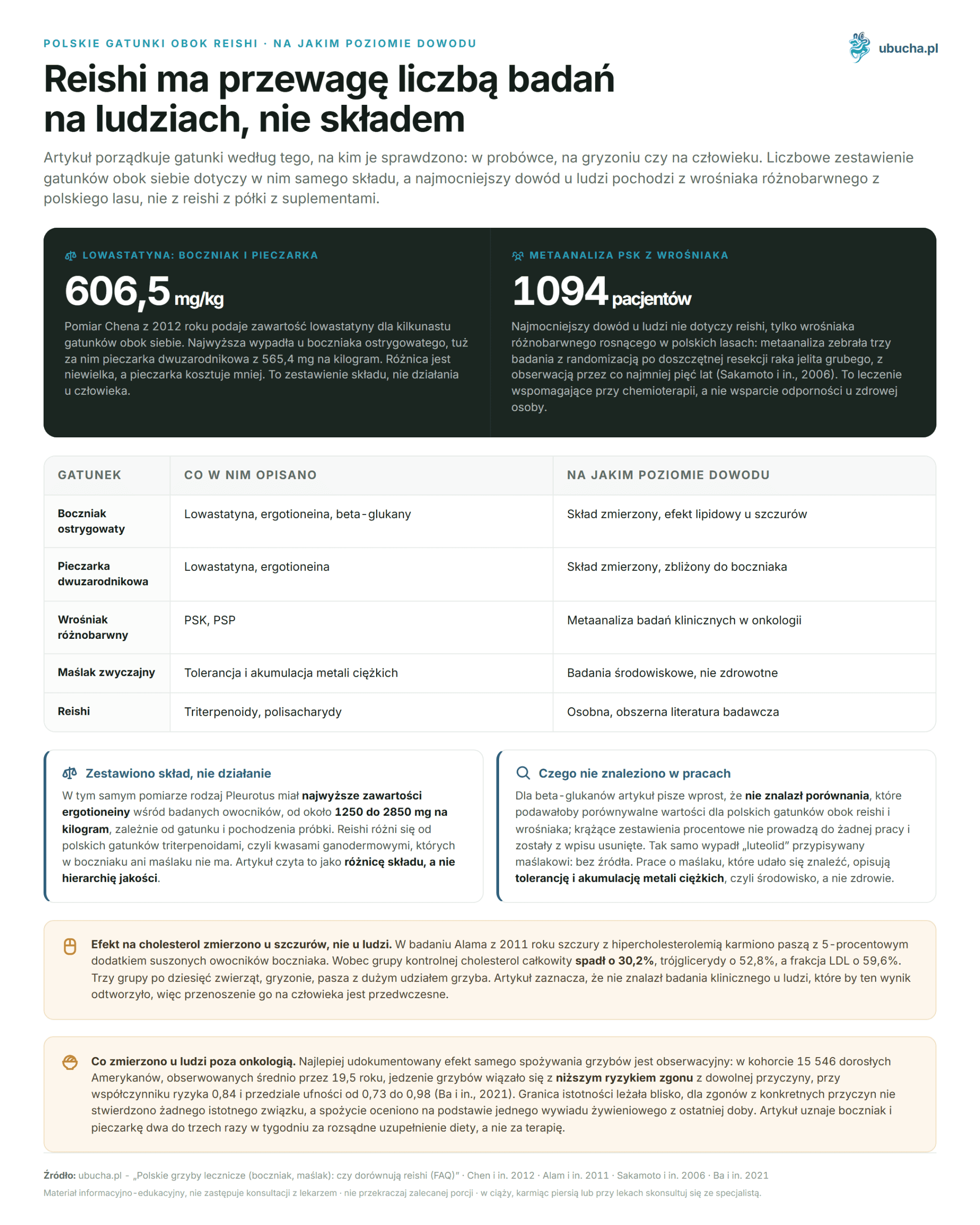
However, the quantitative comparison of species spoils the marketing story about the uniqueness of oyster mushrooms. The work of Chen and colleagues from 2012, which measured the content of lovastatin in the fruiting bodies of several species, reports the highest values for oyster mushrooms (606.5 mg per kilogram) and for the two-spored champignon (565.4 mg per kilogram). The difference is small, and the champignon costs less and is available in every store.
The most important caveat concerns what this lovastatin means for humans. The effect on the lipid profile was demonstrated in an animal model: in the study by Alam et al. from 2011, rats with hypercholesterolemia, fed a diet with a 5% addition of dried fruiting bodies, had total cholesterol lower by 30.2%, triglycerides by 52.8%, and LDL fraction by 59.6% than the control group. Three groups of ten animals, rodents, feed with a high mushroom content. We did not find a clinical study in humans that replicated this result, so the statement about lowering LDL by 10-15% in humans, which was here earlier, has been removed.
Do butter mushroom, chanterelle, and champignon have anything to boast about?
They do, but significantly less than popular compilations suggest. The common butter mushroom (Suillus luteus) is one of the most common pine mushrooms in Poland, and the works we found about it concern something other than health: they describe it as an organism that tolerates heavy metals and accumulates them in the fruiting body. This is a practical tip when foraging near roads.
The claim about “luteolid”, a compound allegedly characteristic of the genus Suillus and acting anti-inflammatory, stood in this entry without any source, and we did not find a work that described it. We removed it. Similarly with chanterelle: it is sometimes mentioned as a source of carotenoids and vitamin D, but we did not find a measurement that would allow us to provide a repeatable number, so we provide only the direction without values.
| Species | What is described in it | At what level of evidence |
|---|---|---|
| Oyster mushroom | Lovastatin, ergotioneine, beta-glucans | Measured composition, lipid effect in rats |
| Two-spored champignon | Lovastatin, ergotioneine | Measured composition, content similar to oyster mushroom |
| Trametes versicolor | PSK, PSP | Meta-analysis of clinical studies in oncology |
| Common butter mushroom | Tolerance and accumulation of heavy metals | Environmental studies, not health-related |
| Reishi | Triterpenoids, polysaccharides | Separate, extensive research literature |
Does reishi have a real advantage over Polish species?
It has an advantage in the number of studies on humans, not in the composition itself. The strongest evidence in this entire area does not actually concern reishi, but Trametes versicolor, which also grows in Polish forests. It concerns PSK, a polysaccharide isolated from this species and used in Japan as an adjunct to chemotherapy.
The meta-analysis by Sakamoto et al. from 2006 (Cancer Immunology, Immunotherapy) gathered three randomized studies, totaling 1094 patients after complete resection of colorectal cancer, observed for at least five years. Adding PSK to standard chemotherapy was associated with a hazard ratio of 0.71 for overall survival and 0.72 for disease-free survival. Read this result carefully: it is supportive treatment for cancer patients, not “immune support” for a healthy person, and it does not transfer to an infusion from a piece of fruiting body.
Reishi (Ganoderma lucidum) differs from Polish species primarily in triterpenoids, i.e., ganoderic acids, which are absent in oyster and butter mushrooms. They are responsible for the bitter taste and are studied as a separate group of compounds. This is a difference in composition, not a hierarchy of quality, and we advise reading it that way. The comparison of Asian species alone is discussed in our entry on adaptogenic mushrooms.
Why is ergotioneine the most interesting in this story?
Because it is a component that humans cannot produce on their own, yet it has a specialized transporter. Ergotioneine is a sulfur-containing compound synthesized exclusively by some fungi and bacteria. The body absorbs it from the diet through the OCTN1 protein and stores it in selected tissues to high concentrations.
A review by Halliwella, Cheah, and Tang published in FEBS Letters in 2018 describes another peculiarity: the body can raise the level of OCTN1 in areas of tissue damage, i.e., concentrate ergotioneine where oxidative stress is ongoing. Lower concentrations in the blood have been observed in some diseases, which the authors treat as a premise, not as causal evidence. The term “longevity vitamin” is not a marketing invention: Bruce Ames proposed in 2018 in PNAS a class of “longevity vitamins” and listed ergotioneine alongside nine other compounds. This is a theoretical proposal, not an established nutritional category.
The oyster mushroom performs exceptionally well here. In the aforementioned measurement by Chen, the genus Pleurotus had significantly the highest contents of ergotioneine among the studied fruiting bodies, with values ranging from about 1250 to 2850 mg per kilogram depending on the species and sample origin. The compound itself and its epidemiological data are discussed separately in our entry on ergotioneine.
How to include mushrooms in your diet and what to expect?
Simply and without great expectations. The best-documented effect of mushroom consumption in humans is observational: in the cohort of Ba et al. from 2021, which included 15,546 adult Americans observed for an average of 19.5 years, those who ate mushrooms had a lower risk of death from any cause.
It is worth providing the numbers along with caveats, because without them they sound stronger than they should. The hazard ratio was 0.84 with a confidence interval from 0.73 to 0.98, meaning the significance threshold was close. No significant relationship was found for deaths from specific causes. Consumption was assessed based on one dietary interview from the last day, which is a poor approximation of a long-term habit. The authors observed a dose-dependent relationship and a lower risk when replacing portions of processed or red meat with portions of mushrooms.
The practical conclusion is modest: consuming oyster and champignon mushrooms two to three times a week, prepared as usual, is a reasonable dietary supplement, not a therapy. Trametes versicolor is used in the form of a long-brewed infusion from dried slices, as the fruiting body is tough and inedible in the kitchen. Gummies with lion’s mane, chaga, reishi, and shiitake have been collected in the adaptogens category. Look for oyster mushrooms in the vegetable section, and Trametes versicolor in the forest, as neither is available on the supplement shelf.
Frequently Asked Questions
Do Polish forest mushrooms have medicinal properties?
They have a documented composition, but evidence of their effects in humans is uneven. The strongest relates to PSK from Trametes versicolor, studied as an adjunct to chemotherapy. For oyster mushrooms, lovastatin, ergotioneine, and beta-glucans have been described, while the effect on cholesterol has so far been shown in rats, not in clinical studies.
Does oyster mushroom lower cholesterol in humans?
This has not been demonstrated. The study by Alam et al. (Mycobiology, 2011) was conducted on rats with hypercholesterolemia, fed a diet with a 5% addition of oyster mushroom; the LDL fraction decreased by 59.6%. We did not find a clinical study in humans that confirmed this result, so transferring it to humans is premature.
Can oyster or butter mushroom replace reishi?
They are not substitutes, but different species with different compositions. Reishi contains triterpenoids, i.e., ganoderic acids, which are absent in oyster and butter mushrooms. Oyster mushrooms, on the other hand, are among the richest sources of ergotioneine among edible mushrooms. The choice depends on what you are looking for, not on a quality ranking.
Which Polish species has the strongest clinical evidence?
Trametes versicolor, which grows wild in Polish forests. The meta-analysis by Sakamoto et al. (2006) included three randomized studies on 1094 patients after colorectal cancer resection and showed a benefit from adding PSK to chemotherapy. This is an oncological application under medical supervision, not home immune support.
Does cooking destroy the nutritional value of mushrooms?
For vitamin D, this was measured directly: after five minutes of frying in a hot pan, losses were below 10 percent, so ordinary cooking does not remove it (Mattila et al., 1999). For beta-glucans, we did not find a comparable measurement, so we do not provide any numbers here.
How much beta-glucans do Polish mushrooms contain?
We did not find a comparison that provided comparable values for Polish species alongside reishi and Trametes versicolor. Circulating percentage lists do not lead to any work, and therefore we removed them from this entry. Standardized extracts have declared content on the packaging, while fresh mushrooms from the forest have none at all.
This article is for informational and educational purposes and does not replace consultation with a doctor. If you are pregnant, breastfeeding, taking medications, or have chronic conditions, consult the use of supplements or herbs with a specialist.
Author: Michał Waluk · Published: 2026-08-09 · Updated: 2026-08-15