
Dr Dustin Sulak on CBD Dosing: Your Optimal Dose and Why More Means Worse
The inverted U curve in Zuardi's study, the published protocol for slow titration involving Dr. Sulak, and the provisional safe dose EFSA 2026.
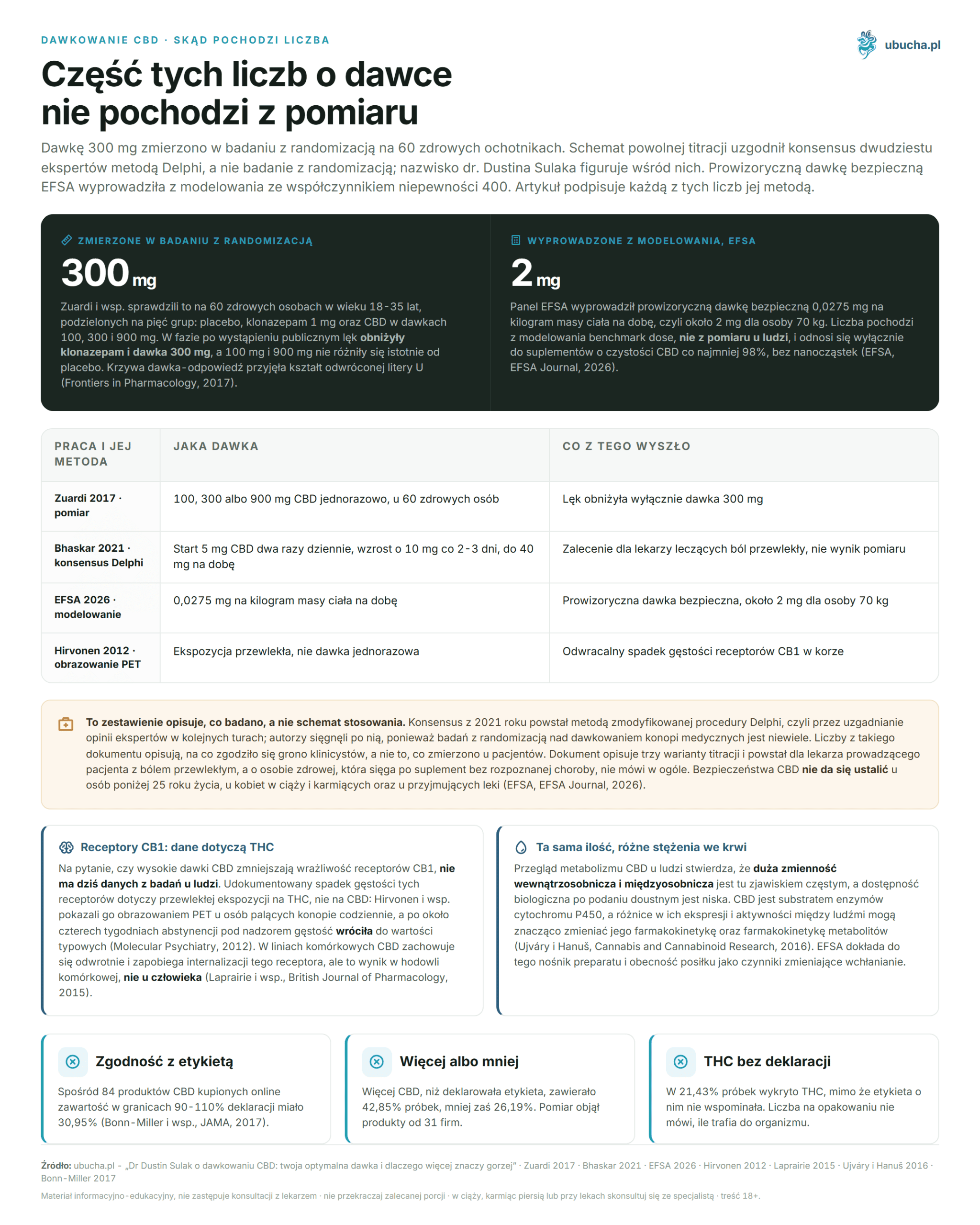
A typical path looks like this: the first dose has no effect, so after a week it is doubled, then again, and after a month someone is taking multiple times the starting dose and still asks why they feel nothing. Studies say this reflex can be erroneous. In a randomized study of 60 healthy volunteers, anxiety before public speaking was reduced by a dose of 300 mg of CBD, while doses of 100 mg and 900 mg did not differ significantly from placebo (Zuardi et al., Frontiers in Pharmacology, 2017). The dose-response curve took the shape of an inverted U. This article explains where this shape comes from, what the published protocol for slow dose escalation looks like, co-authored by Dr Dustin Sulak, and what cannot be said today about a safe dose.
KEY INFORMATION
• In a study of 60 healthy volunteers, anxiety was reduced by a dose of 300 mg of CBD, while 100 mg and 900 mg did not differ significantly from placebo (Zuardi et al., Frontiers in Pharmacology, 2017).
• The Delphi consensus of 20 experts from 9 countries, including Dr. Sulak, describes starting at 5 mg of CBD and increasing by 10 mg every 2-3 days (Bhaskar et al., Journal of Cannabis Research, 2021).
• EFSA derived a provisional safe dose of 0.0275 mg per kilogram of body weight per day, which is about 2 mg for a person weighing 70 kg (EFSA, 2026).
• The safety of CBD cannot be established in individuals under 25 years of age, pregnant or breastfeeding women, and those taking medications (EFSA, 2026).
• Of 84 CBD products purchased online, 30.95% had content consistent with the label (Bonn-Miller et al., JAMA, 2017).
Who is Dr Dustin Sulak and where does his dosing approach come from?
Dustin Sulak is an American physician publishing on the clinical use of cannabinoids. In 2017, he described in the journal Epilepsy & Behavior the state of artisanal cannabis preparations used in epilepsy in the United States (Sulak, Epilepsy & Behavior, 2017). His name is also among the twenty experts who developed a consensus on the dosing of medical cannabis in chronic pain.
It is worth immediately naming the rank of this material. The consensus was created using a modified Delphi procedure, meaning through the agreement of expert opinions in successive rounds, rather than through randomized studies. The authors state directly that they resorted to this method because there are few randomized studies on the dosing of medical cannabis, and doctors need any guidance (Bhaskar et al., Journal of Cannabis Research, 2021).
This distinction changes the way the rest is read. The numbers from such a document describe what a group of clinicians agreed upon, not what was measured in patients. They are a reference point for the attending physician, not a self-application instruction. There is also no reason to transfer them to a healthy person reaching for a supplement without a diagnosed disease, as the document does not address them at all.
What is the inverted U curve in the action of CBD?
The inverted U curve means that the effect increases to a certain dose, and above it, it diminishes. Zuardi and colleagues checked this on 60 healthy individuals aged 18-35, divided into five groups: placebo, clonazepam 1 mg, and CBD at doses of 100, 300, and 900 mg. Participants spoke before the remaining subjects, and anxiety was measured using a visual analog scale.
The result was unequivocal. In the post-speech phase, anxiety was significantly reduced by clonazepam and 300 mg of CBD. Doses of 100 mg and 900 mg did not produce such an effect. The authors also state that clonazepam acted more sedatively than CBD at doses of 300 and 900 mg (Zuardi et al., Frontiers in Pharmacology, 2017).
The following table shows what doses and in what context were mentioned in the works cited in this article. It is not a dosing table for use, but a description of what was studied.
| Source | Who and how many people | What dose | What came out of it |
|---|---|---|---|
| Zuardi et al., 2017 | 60 healthy individuals, 18-35 years old | 100, 300, or 900 mg of CBD at once | Anxiety was reduced only by the 300 mg dose |
| Bhaskar et al., 2021 | Consensus of 20 experts from 9 countries | Start 5 mg of CBD twice daily, increase by 10 mg every 2-3 days, up to 40 mg per day | Recommendation for doctors treating chronic pain, not a measurement result |
| EFSA, 2026 | Benchmark dose modeling with an uncertainty factor of 400 | 0.0275 mg per kilogram of body weight per day | Provisional safe dose, about 2 mg for a 70 kg person |
| Hirvonen et al., 2012 | Daily cannabis smokers, PET imaging | Chronic exposure, not a single dose | Reversible decrease in CB1 receptor density in the cortex |
What does the published protocol for slow dose escalation look like?
The 2021 consensus describes three titration variants. In the basic variant, the physician starts with a CBD-dominant strain at a dose of 5 mg twice daily and increases it by 10 mg every 2-3 days until the patient reaches their goals or up to 40 mg per day. The cautious variant starts at 5 mg once daily with the same rate of increase.
Only after reaching 40 mg of CBD per day does the document allow the addition of THC: in the basic variant from 2.5 mg with an increase of 2.5 mg every 2-7 days, in the cautious variant from 1 mg with an increase of 1 mg weekly. The rapid variant starts with a balanced strain, 2.5-5 mg of each cannabinoid once or twice daily (Bhaskar et al., Journal of Cannabis Research, 2021).
Three things stand out when comparing these numbers with the common way of using CBD. The step increase is small and steady. The interval between steps is counted in days, not hours. The upper limit is predetermined, not determined by feeling. However, this entire scheme was created for a physician treating a patient with chronic pain and should be read as such. The mechanics of the dose escalation itself is detailed separately in the entry on step-by-step titration.
Do high doses of CBD reduce the sensitivity of CB1 receptors?
There is currently no data from studies in humans on this question, and the popular explanation mixes two different substances. The documented decrease in CB1 receptor density pertains to chronic exposure to THC, not CBD. Hirvonen and colleagues demonstrated it using PET imaging in daily cannabis smokers: the decrease was selective for cortical areas and greater the longer the smoking duration.
More importantly, what happened afterward. After about four weeks of supervised abstinence, the density of CB1 receptors returned to typical values (Hirvonen et al., Molecular Psychiatry, 2012). Four weeks is a completely different scale than the popular two-day break found online. The relationship between the speed of receptor hiding and the development of tolerance is described separately in the entry on CB1 receptor kinetics, and the practical aspect of the break in use is covered in the entry on tolerance reset.
CBD itself acts on CB1 in a way that is difficult to reconcile with the thesis of desensitization. In cell lines, it behaves as a non-competitive negative allosteric modulator of this receptor and, by limiting the recruitment of arrestin 2, prevents its internalization (Laprairie et al., British Journal of Pharmacology, 2015). This is a result in cell culture, not in humans, and should not be read as evidence of anything in the body.
Why is someone else’s dose not your dose?
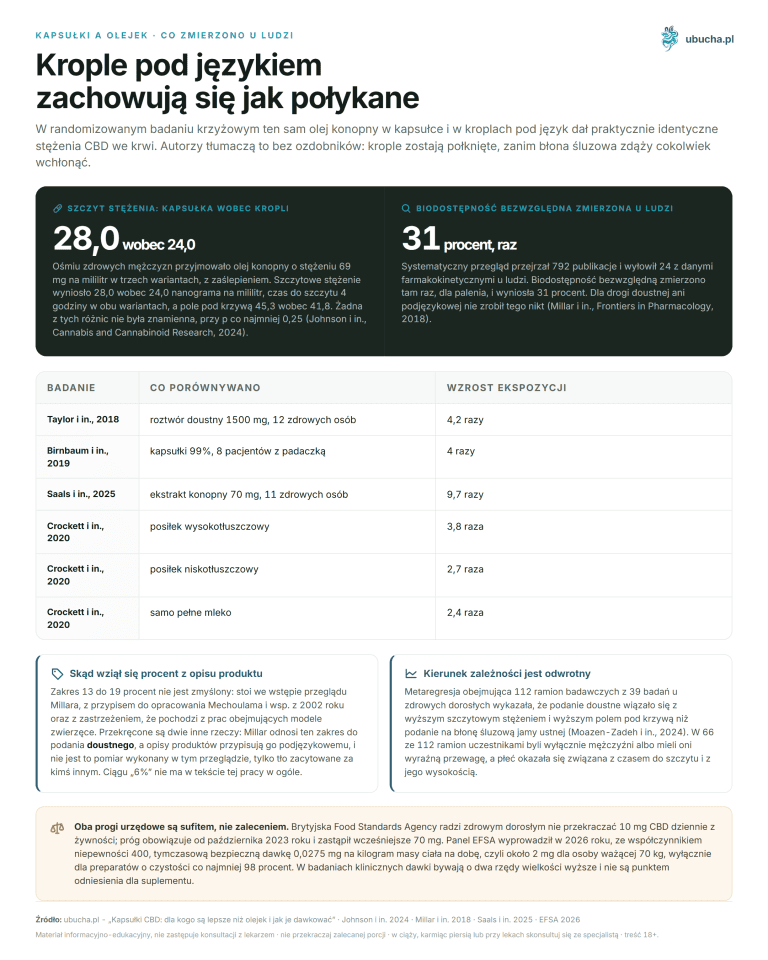
Because the same amount of CBD results in different blood concentrations in two people. A review of CBD metabolism in humans states that significant intra- and interindividual variability is common in this case, and the bioavailability after oral administration is low.
The authors also point out the mechanism. CBD is a substrate for cytochrome P450 enzymes, and differences in their expression and activity among individuals can significantly alter its pharmacokinetics and the pharmacokinetics of its metabolites (Ujváry and Hanuš, Cannabis and Cannabinoid Research, 2016). Additionally, the route of administration itself changes the absorption process.
EFSA’s assessment from 2026 adds two factors: the bioavailability of CBD is variable and depends on the carrier and whether the product was taken with food. The panel derived a provisional safe dose of 0.0275 mg per kilogram of body weight per day, about 2 mg for a 70 kg person, and noted that it applies only to supplements with at least 98% CBD purity, without nanoparticles. The safety of CBD cannot be established in individuals under 25 years of age, pregnant or breastfeeding women, and those taking medications (EFSA, EFSA Journal, 2026).
What to check before increasing the dose?
Before you conclude that the dose is too low, check if you even know how much you are taking. Bonn-Miller and colleagues examined 84 CBD products purchased online from 31 companies. Only 30.95% of them had content within the range of 90-110% of the label. 42.85% of samples contained more CBD than the label stated, while 26.19% contained less.
This same measurement brought a second surprise: THC was detected in 21.43% of samples, even though the label did not mention it (Bonn-Miller et al., JAMA, 2017). With a product lacking current laboratory testing, the number on the package does not indicate how much substance enters the body, and determining the effectiveness of the dose then loses its meaning.
The second thing to check is the repeatability of conditions. Since bioavailability depends on the carrier and food, comparing days when the product was taken once on an empty stomach and once after a fatty meal mixes two variables at once. The third thing is the hardest to accept: some expectations directed at CBD concern conditions that require diagnosis and treatment, not a supplement.
Frequently Asked Questions
Who is Dr Dustin Sulak?
He is an American physician publishing on the clinical use of cannabinoids. In 2017, he described in the journal Epilepsy and Behavior the state of artisanal cannabis preparations used in epilepsy in the United States. He is also one of twenty experts who developed a consensus on the dosing of medical cannabis in chronic pain, published in 2021.
What did the study on the inverted U curve show?
Zuardi and colleagues administered 60 healthy individuals a placebo, clonazepam 1 mg, or CBD at doses of 100, 300, or 900 mg before a public speaking event. In the post-speech phase, anxiety was reduced by clonazepam and 300 mg of CBD. Doses of 100 mg and 900 mg did not differ significantly from placebo, resulting in an inverted U-shaped curve.
What dose of CBD is considered safe today?
EFSA derived a provisional safe dose of 0.0275 mg per kilogram of body weight per day in 2026, which is about 2 mg for a person weighing 70 kg, applicable only to supplements with at least 98% CBD purity. The safety of CBD cannot be established in individuals under 25 years of age, pregnant or breastfeeding women, and those taking medications.
Do high doses of CBD damage CB1 receptors?
There is no data in humans. A reversible decrease in CB1 receptor density has been documented for chronic cannabis smoking, i.e., exposure to THC, and values returned to normal after about four weeks of abstinence. In cell culture, CBD behaves oppositely: it prevents the internalization of the CB1 receptor.
Why do two people need different doses?
Because the same amount of CBD results in different blood concentrations in them. A review of CBD metabolism describes significant intra- and interindividual variability and low bioavailability after oral administration. Differences in cytochrome P450 enzyme activity, route of administration, and the presence of food alter the absorption process.
The products mentioned in this article can be found in the oils category.
This article is for informational and educational purposes and does not constitute medical advice. Before starting to use cannabis or CBD for therapeutic purposes, consult a physician, especially if you are taking other medications, are pregnant, or breastfeeding.
Author: Michał Waluk · Published: 2026-08-09 · Updated: 2026-08-11