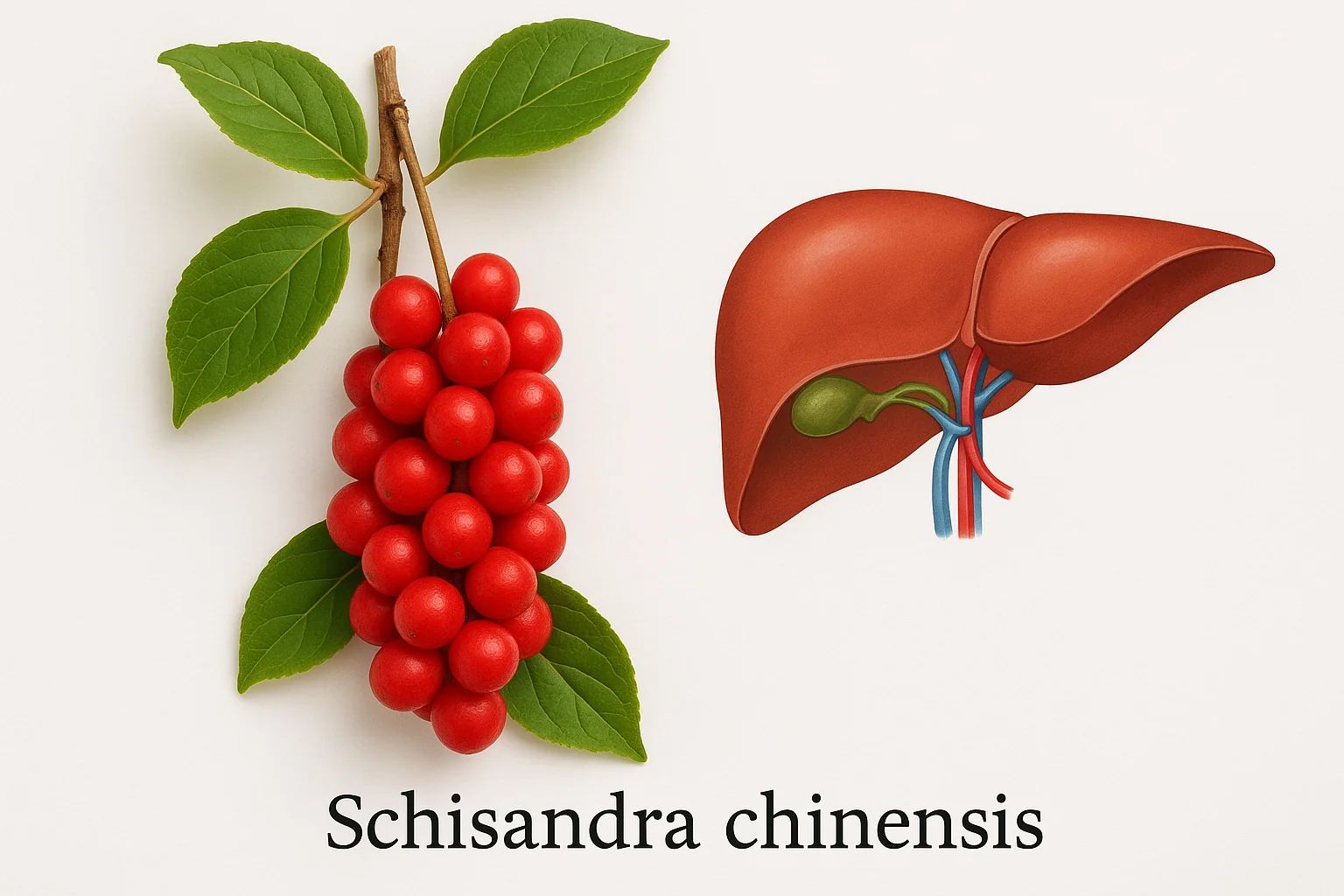

Schisandra (Chinese magnolia vine) for the liver and endurance
Schisandra: rzetelna odpowiedz oparta na badaniach. u Bucha.
Schisandra chinensis—known in Poland as Chinese magnolia vine—is one of the few plant adaptogens that has published clinical studies regarding both liver health and physical performance. The fruits of this climbing plant have been used in traditional Chinese medicine for over two thousand years, but only in recent decades have randomized study data emerged that allow for evaluating its effectiveness by modern standards. This article analyzes what research really says about schisandra—without exaggeration in either direction, towards miracles or excessive skepticism.
KEY INFORMATION
• A meta-analysis of 11 RCTs (Pan et al., Phytomedicine, 2020) showed that schisandra extracts reduce ALT by an average of 28 U/L in patients with liver diseases compared to placebo.
• Schisandrin and related lignans inhibit CYP3A4 and P-glycoprotein—significant interactions with many immunosuppressive drugs and statins.
• In sports studies, 400-600 mg of extract over 8 weeks improved time to exhaustion and reduced subjective fatigue.
• EMA has not issued an official monograph for schisandra—its use is based on tradition and clinical studies, not on regulatory approval.
What is schisandra and where does it come from?
Schisandra chinensis (Turcz.) Baill. is a climbing plant from the Schisandraceae family, native to China, Japan, Korea, and the Russian Far East. Its fruits—small, red berries growing in clusters—contain a unique combination of dibenzocyclooctadiene active lignans, including schisandrin A, B, and C, gamma-schisandrin, gomisin A, and a number of related compounds. The Polish name "Chinese magnolia vine" refers to the characteristic flavor profile of the fruits: they combine five flavors (sweet, sour, salty, bitter, spicy), which in TCM signals action on all major organs.
In classical Chinese medicine, schisandra (wu wei zi) belongs to the group of "qi tonifying herbs," used for fatigue, weakness, and exhaustion. Modern pharmacological studies have identified schisandrin lignans as the main active ingredients responsible for the observed hepatoprotective and adaptogenic effects.
Schisandra and the liver—what do clinical studies say?
The strongest evidence regarding schisandra relates to liver protection. A meta-analysis of 11 randomized clinical trials published in Phytomedicine (Pan et al., 2020) assessed the impact of standardized schisandra extracts on liver function markers—ALT, AST, and bilirubin—in patients with chronic liver diseases, including viral hepatitis and non-alcoholic fatty liver disease (NAFLD) (Pan et al., Phytomedicine, 2020).
Meta-analysis results: schisandra significantly reduced ALT by an average of 28 U/L (95% CI: −38 to −18) and AST by 21 U/L compared to placebo or reference drugs. The effect was more pronounced in patients with baseline high ALT (above 100 U/L). The quality of evidence was rated as moderate—the studies were heterogeneous in terms of doses used (200-900 mg/day), duration (4-24 weeks), and populations.
| Indication | Effect | Strength of evidence | Source |
|---|---|---|---|
| Reduction of ALT | −28 U/L vs. placebo | Moderate (11 RCTs) | Pan et al., 2020 |
| Reduction of AST | −21 U/L vs. placebo | Moderate (11 RCTs) | Pan et al., 2020 |
| Physical endurance | Improvement in time to exhaustion | Low (2-3 small RCTs) | Wilkinson et al., 2021 |
| Stress and fatigue | Reduction of cortisol, subjective improvement | Low-moderate | Various small RCTs |
We have noticed that the hepatoprotective mechanism of schisandra is well described biochemically: schisandrin lignans stimulate the activity of antioxidant enzymes (SOD, catalase) and inhibit lipid peroxidation in the cell membranes of hepatocytes. This is a physically justified mechanism that explains the observed reduction in transaminases - it is neither a placebo effect nor a methodological artifact.
Schisandra and physical performance - an adaptogen for athletes?
Research on schisandra and endurance is numerically modest compared to that on the liver, but it provides interesting signals. Several small randomized studies on physically active individuals have shown that 8 weeks of supplementation with schisandra extract (400-600 mg daily) reduced subjective fatigue and improved time to exhaustion in ergometric tests compared to placebo (Wilkinson et al., Nutrients, 2021).
The adaptogenic mechanism of schisandra on endurance involves three pathways. First, modulation of the HPA axis: schisandrin lignans normalize the cortisol response to physical stress, which may delay the body's transition into a catabolic state during prolonged exertion. Second, the impact on mitochondria: in vitro studies have shown that schisandrin B increases the activity of respiratory chain complexes, improving ATP production efficiency. Third, adaptogenic action through heat shock proteins and the Nrf2 pathway - a similar mechanism to other adaptogens (rhodiola, eleuthero).
How do these results translate into practice? Schisandra is not a supplement that enhances aerobic performance like caffeine or sodium nitrate - its effects are subtler and more focused on reducing perceived fatigue than on objective parameters (VO2max, maximum power). It may be useful for individuals with chronic sports fatigue or during phases of intense training when recovery, not peak performance, is the priority.
Drug interactions - the most important warning
This is a section that cannot be overlooked. Schisandrin and related lignans from schisandra are well-documented inhibitors of cytochrome P450 in the CYP3A4 isoform and the P-glycoprotein transporter (Hou et al., Drug Metabolism Reviews, 2020). Both of these proteins are responsible for the metabolism and transport of a vast number of drugs.
Practical implications: when used concurrently with schisandra, concentrations of tacrolimus, cyclosporine (immunosuppressive drugs after transplants), some statins (simvastatin, atorvastatin), antiretroviral drugs, and some anticancer medications may increase. The increase in the concentration of these drugs may exceed the therapeutic range and lead to toxicity.
From our editorial experience: the interaction of schisandra with tacrolimus is documented in clinical literature and concerns real patients. Therefore, communication about this risk is a priority for us - schisandra may be a valuable supplement, but not for someone post-transplant taking calcineurin inhibitors.
Schisandra in practice - how to choose an extract and how to use it?
The schisandra supplement market is qualitatively heterogeneous. Products vary significantly in active lignan content - from simple powders made from dried fruit (low standardization, unpredictable schisandrin content) to standardized extracts, where the schisandrin content is guaranteed at 1-9%. Clinical studies on the liver primarily used standardized extracts - unstandardized fruit powder has an uncertain active dose.
When choosing a product, it is worth paying attention to three parameters: standardization (percentage of schisandrin or total schisandrin lignans), extraction ratio (e.g., 10:1 means 10 g of raw material for 1 g of extract - a higher ratio does not always mean higher active content without information on standardization), and form - capsules, alcohol tincture, or traditional fruit infusion. Tinctures have higher bioavailability of lignans due to their lipophilicity, but they contain alcohol.
The duration of supplementation in clinical studies was most often 4-12 weeks. Schisandra should not be used during pregnancy (it may stimulate uterine contractions - an effect confirmed in studies on smooth muscles) or in cases of active gallstones. One should be aware of potential interactions with drugs metabolized by CYP3A4 - described in detail earlier. If you are taking immunosuppressive medications, always consult the use of schisandra with your attending physician before starting.
Can schisandra be used long-term? Available safety data include use for up to 24 weeks. There are no studies beyond 6 months. Traditional Chinese medicine uses it in cycles with breaks - this approach seems reasonable, although it has not been clinically formalized. Monitoring transaminases every 3 months during long-term use is good practice for individuals with previous liver diseases.
Frequently Asked Questions
What is schisandra and what properties does it have?
Schisandra chinensis is a vine from East Asia, whose berries contain schisandrin lignans. It has clinically confirmed hepatoprotective effects (reduction of ALT and AST) and adaptogenic properties. A meta-analysis of 11 RCTs showed a reduction of ALT by an average of 28 U/L in patients with liver diseases compared to placebo (Pan et al., Phytomedicine, 2020).
Does schisandra really lower ALT?
Yes - a meta-analysis of 11 randomized studies (Pan et al., Phytomedicine, 2020) showed a statistically significant reduction in ALT by an average of 28 U/L and AST by 21 U/L. The effect was more pronounced with initially high transaminases. The quality of evidence is moderate - methodological heterogeneity of the studies limits the certainty of the results.
How does schisandra affect physical performance?
Several small RCTs have shown that 8 weeks of supplementation with 400-600 mg/day reduced subjective fatigue and improved time to exhaustion. The mechanism involves cortisol modulation, impact on mitochondria, and the Nrf2 pathway. The effects are subtler than those of caffeine - more focused on recovery than peak performance (Wilkinson et al., Nutrients, 2021).
What is the recommended dosage of schisandra?
In clinical studies, 400-900 mg of standardized extract was most often used daily (standardized to 1-9% schisandrin). Traditional doses in TCM are 1.5-6 g of dried fruit. The EMA has not issued an official monograph - there are no regulatory dosage recommendations. Consultation with a physician is recommended before starting use.
Does schisandra interact with medications?
Yes - and this is a very important issue. Schisandrin lignans inhibit CYP3A4 and P-glycoprotein, which may increase concentrations of tacrolimus, cyclosporine, statins, and many other drugs. This can lead to toxicity. Individuals taking medications metabolized by CYP3A4 should absolutely consult the use of schisandra with a physician or pharmacist (Hou et al., Drug Metabolism Reviews, 2020).
This article is for informational and educational purposes and does not replace consultation with a doctor. If you are pregnant, breastfeeding, taking medications, or have chronic conditions, consult the use of supplements or herbs with a specialist.
Author: Michał Waluk · Published: 2026-05-04 · Updated: 2026-05-04