
How to Clean and Maintain a Bong, Pipe, and Glass Accessories
A bong and pipe are cleaned with 90-99% isopropyl alcohol and coarse salt. Check how often to clean the equipment, what to never use, and when to replace it.
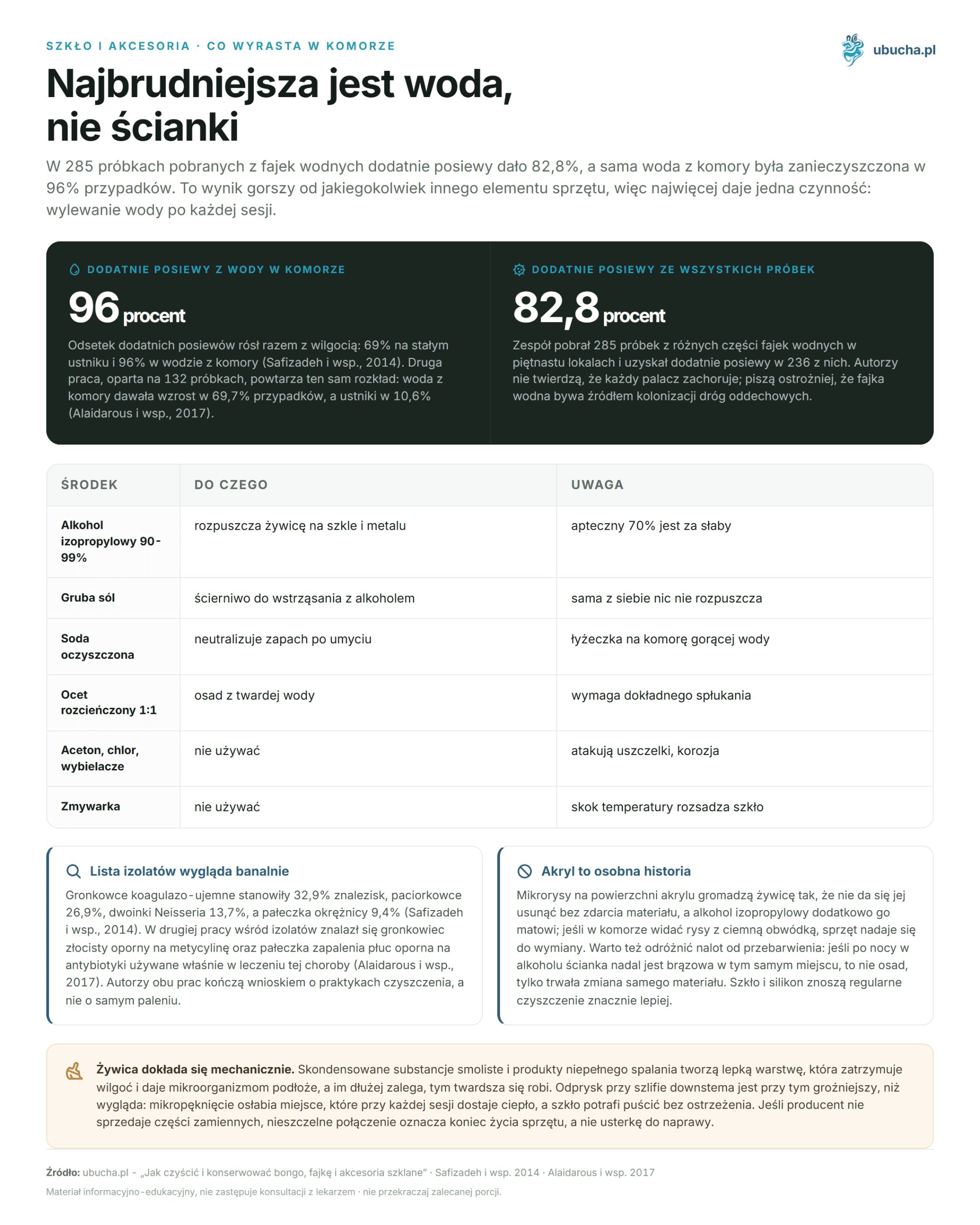
The water in the chamber is the dirtiest element of the entire equipment, and it’s not about appearance. In a study of 285 samples taken from water pipes in fifteen locations, 236 of them yielded positive cultures, which is 82.8%, and the water from the chamber was contaminated in 96% of cases. Among the most common isolates were staphylococci, streptococci, and Escherichia coli, which are bacteria that colonize the respiratory tract. A bong differs from a water pipe in its hose and size, not in its principle of operation: it is the same warm, humid chamber with organic residues that sits open on a shelf. Below you will find what to clean the glass with, how often to do it, what to do with resin that alcohol no longer affects, and how to recognize equipment that is only fit for replacement.
KEY INFORMATION
• In 285 samples from water pipes, 82.8% of cultures were positive, and the water from the chamber showed bacterial growth in 96% of cases (Safizadeh et al., 2014).
• Pour out the water after each session, clean the glass with alcohol once a week with daily use.
• 90-99% isopropyl alcohol with coarse salt dissolves and scrapes off resin without damaging the glass.
• A dishwasher and acetone are the two quickest ways to destroy equipment.
Why is a dirty bong a health problem, not an aesthetic one?
Because what grows in the water chamber is what you inhale later. The Safizadeh team collected 285 samples from various parts of water pipes in fifteen locations and obtained positive cultures in 236 of them, which is 82.8% (Safizadeh et al., 2014). The percentage increased with humidity: 69% on a solid mouthpiece, 96% in the water from the chamber.
The list of isolates looks banal, and that is the worst part. Coagulase-negative staphylococci accounted for 32.9% of findings, streptococci 26.9%, Neisseria diplococci 13.7%, and Escherichia coli 9.4%. The authors do not claim that every smoker will get sick. They write more cautiously: a water pipe can be a source of respiratory tract colonization.
The second study, based on 132 samples from Saudi Arabia, repeats the same distribution. The water from the chamber showed growth in 69.7% of cases, mouthpieces in 10.6% (Alaidarous et al., 2017). Among the isolates was methicillin-resistant Staphylococcus aureus and antibiotic-resistant pneumonia bacteria used in the treatment of this disease. The authors conclude with a recommendation for cleaning practices, not about smoking itself.
Resin adds to this mechanically. Condensed tar substances and products of incomplete combustion create a sticky layer that retains moisture and provides a substrate for microorganisms. The longer it sits, the harder it becomes. Weekly cleaning takes five minutes, while a month of delay ends with overnight soaking of the elements.
What to clean glass accessories with, and what should not be used?
With 90-99% isopropyl alcohol and coarse salt. Alcohol dissolves resin and evaporates without residue, while salt acts as an abrasive that scrapes the rest from the walls. Baking soda tackles the smell. All other home remedies either do not work or eat away at seals.
Pharmaceutical isopropanol usually has 70% and is too weak for resin. Look for a concentration of 90% or higher, usually sold as an electronic cleaning agent. Use coarse salt. Fine crystals dissolve immediately and do not scrape anything, so the size of the grain matters, not the origin of the salt.
| Agent | For what | Note |
|---|---|---|
| 90-99% isopropyl alcohol | Dissolves resin on glass and metal | Evaporates without residue, rinse with water after cleaning |
| Coarse salt | Abrasive for shaking with alcohol | Does not dissolve anything by itself |
| Baking soda | Neutralizes smell after washing | Teaspoon for the hot water chamber |
| Diluted vinegar 1:1 | Residue from hard water | Requires thorough rinsing |
| Acetone | Do not use | Attacks seals and plastic parts |
| Chlorine and bleach | Do not use | Irritating fumes, seal corrosion |
| Dishwasher | Do not use | Temperature shock can shatter even borosilicate glass |
A vaporizer operates under different principles, as it heats the herb instead of burning it, and the residue has a different composition. We have outlined the procedure for it separately in the text about cleaning a vaporizer.
How to clean a bong step by step?
The entire procedure takes fifteen minutes and consists of four movements: disassemble, fill with alcohol and salt, shake, rinse. Detachable elements should be cleaned separately, as shaking in a narrow downstem will not help. For heavily neglected equipment, repeat the cycle with a new portion of alcohol.
- Pour out the water, remove the downstem and bowl, rinse the chamber with cold water to collect loose residue.
- Add two or three tablespoons of coarse salt to the chamber and pour in 100-150 ml of isopropyl alcohol.
- Seal the mouthpiece and the hole for the downstem with silicone plugs or your hands, then shake for 2-3 minutes.
- Pour out the contents, rinse with hot water several times, and check under light to see if the walls are clear.
- Repeat with a new portion of alcohol if residue remains; finally, rinse with water and a teaspoon of baking soda.
The downstem and bowl get dirty faster than the chamber itself because condensate passes through them. Place them in a jar with alcohol for 20-30 minutes, then pull through the narrow openings with a pipe cleaner. Also, check the seals: a cracked rubber gives resistance when pulling and an aftertaste that can easily be mistaken for old resin. If you prefer the same procedure outlined in a Q&A format, you can find it in the bong cleaning guide step by step.
How to store equipment to slow down dirt accumulation?
The most significant factor is one thing: pouring out the water after each session. It is the standing water that yielded 96% positive cultures in the cited studies, which is a worse result than any other element of the equipment. The rest of the habits only slow down the accumulation of residue, but the difference between equipment emptied daily and one where water stands for a week is visibly noticeable after a month.
Keep the bong upright, in a place where it cannot be knocked over by an elbow. A tipped bong means spilled residual water with resin on the countertop, and such a stain is harder to clean than the contents of an ashtray. Store the pipe bowl up, in a closed case: this protects it from dust and from spilling leftover material. Keep glass elements away from hard surfaces, as most cracks come from one unfortunate placement, not from wear.
Once a week, rinse the chamber with alcohol even when the glass looks clean. The layer that is not yet visible comes off in thirty seconds. The type of herb also matters: moist material leaves more sticky residue in the bowl than well-dried herb, and we described the principles of moisture selection in the text about storing marijuana and CBD herb.
When to replace a bong or pipe with a new one?
When the damage is structural or the material can no longer be cleaned. Borosilicate glass can last for years with regular cleaning, so replacement usually comes from a crack, a chip at the grind, or a permanent residue that does not come off after several cycles with alcohol.
A chip at the grind of the downstem is more dangerous than it looks. A micro-crack weakens the area that receives heat with each session, and the glass can break without warning. The same goes for seals: if the manufacturer does not sell spare parts, a leaky connection means the end of the equipment’s life, not a repairable defect.
Acrylic is a separate story. Micro-scratches on its surface accumulate resin to the point that it cannot be removed without wearing down the material, and isopropyl alcohol additionally clouds it. If there are scratches with a dark border visible in the chamber, the equipment is due for replacement. Glass and silicone withstand regular cleaning much better, and they win in the long run. It is also worth distinguishing residue from discoloration: if after a night in alcohol the wall is still brown in the same spot, it is not residue, but a permanent change in the material itself.
Frequently Asked Questions
How often should I clean my bong and pipe?
Change the water after each session, as this is where the most bacteria grow: water from the chamber yielded positive cultures in 96% of samples (Safizadeh et al., 2014). Clean the glass with alcohol once a week with daily use, and the pipe every five to seven sessions.
Can I wash my bong in the dishwasher?
No. The dishwasher cycle involves a rapid temperature change, and borosilicate glass can withstand high temperatures, but not their fluctuations. The detergent also leaves a scent that penetrates the glass and returns with each session. Clean by hand with warm water and isopropyl alcohol.
What to do with resin that alcohol won’t remove?
Leave the element submerged in 90-99% isopropyl alcohol overnight, for eight to twelve hours. In the morning, add coarse salt and shake. Scrape the hard residue on the outer surfaces with a bamboo or wooden spatula, never metal: a thin wall can crack from point pressure.
Does isopropyl alcohol damage borosilicate glass?
No. Isopropanol is neutral to glass, metal, and silicone, leaves no toxic residues, and evaporates after rinsing with water. Caution applies to acetone, not alcohol: acetone attacks silicone seals and plastic parts and can cloud acrylic in minutes.
How to remove the smell from a bong?
After cleaning with alcohol, rinse the glass with hot water and a teaspoon of baking soda, which neutralizes the compounds responsible for the smell. A persistent odor usually means that organic residue remains inside, so instead of rinsing again, repeat the cleaning with alcohol and salt.
What should not be used to clean glass?
Avoid acetone, chlorine, and bleach, as they corrode seals and produce irritating fumes. Dish soap rinses poorly and leaves an aftertaste, and vinegar used without rinsing acts acidically on metal parts. The safe list is short: isopropanol, coarse salt, baking soda.
Equipment that withstands weekly cleaning with alcohol is primarily glass and silicone. We have gathered the current models in the bong category.
This article is for informational and educational purposes. It contains internal links to product categories available in the u Bucha store. Prices and specifications may change: check the current data on the product page before purchasing.
Author: Michał Waluk · Published: 2026-08-09 · Updated: 2026-08-10