
What is a one-hitter and how to use it (discreet, economical)
A one-hitter is one of the smallest pipes in use. How much does one portion hold, what is it made of, how to clean it, and does it really save material.
A one-hitter is one of the smallest pipes in common use: a narrow tube with a bowl small enough to hold a portion for one puff. It has two reputations, discreet and economical. The first defends itself, as the entire set fits in your hand and leaves no ash behind. The second requires verification, as studies on self-dosing cannabis say something less convenient than guides on microdosing repeat. Below you will find a definition, the calculated weight of a portion instead of circulating estimates, an overview of materials along with what is actually on the store shelf, the practice of packing and cleaning, an answer to whether it is still smoking or already vaporizing, and the legal status of the material that can be legally burned in such a pipe in Poland.
KEY INFORMATION
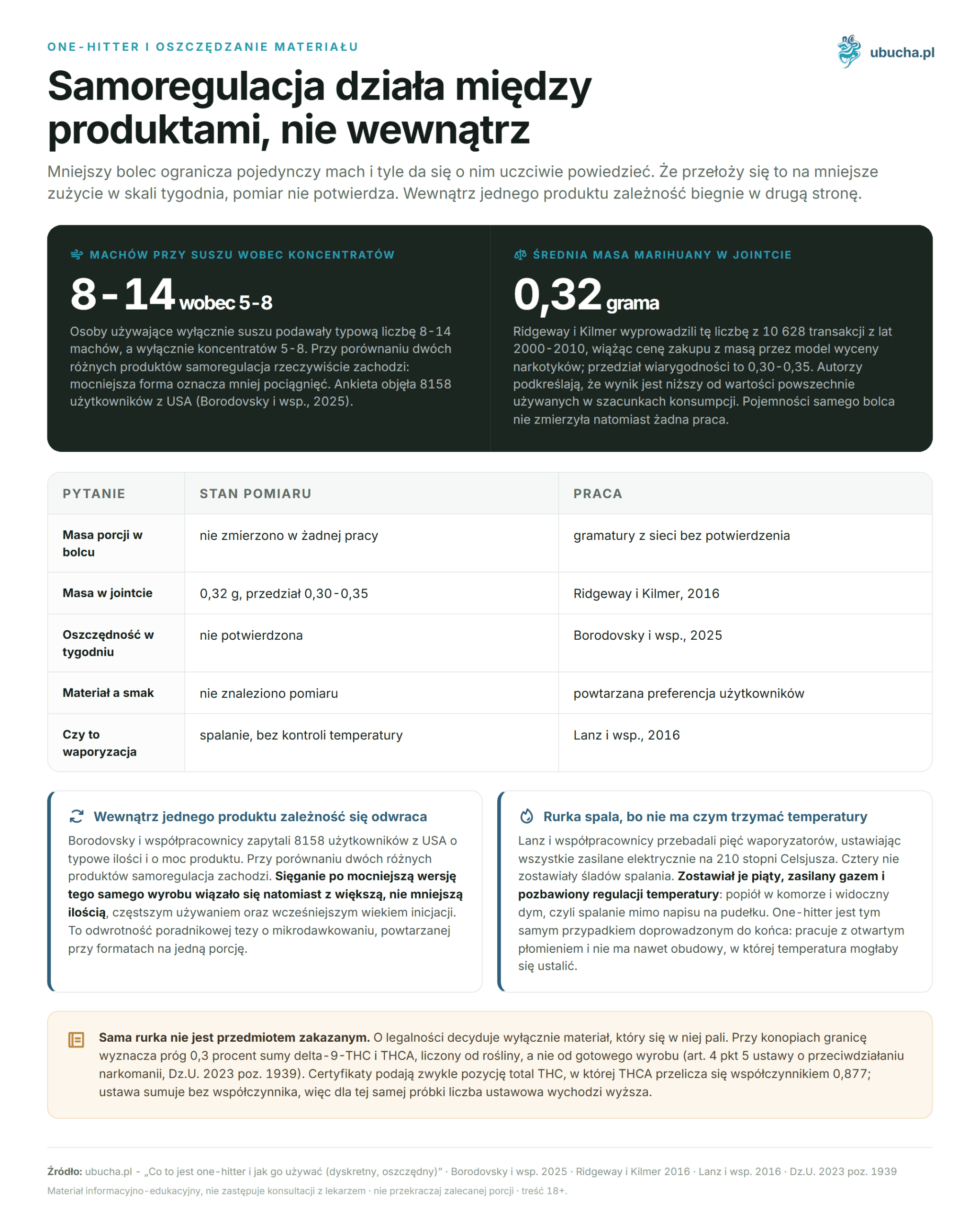
• The average weight of marijuana in one joint is 0.32 g (range 0.30-0.35), calculated from 10,628 transactions (Ridgeway and Kilmer, Drug and Alcohol Dependence 2016).
• In a survey of 8158 users, those using only flower reported a typical number of 8-14 puffs, and those using only concentrates 5-8 (Borodovsky et al., 2025).
• The same work debunks the guide’s thesis on microdosing: within one product, higher THC content was associated with greater, not lesser amounts.
• A one-hitter burns material. Four electric vaporizers set to 210 degrees Celsius showed no signs of burning; the fifth, gas-powered model without temperature regulation did (Lanz et al., PLOS One 2016).
• In the pipe category, the store has three glass pipes priced at 7.99-45 PLN (as of August 16, 2026); it does not offer metal one-hitters or dugouts.
What is a one-hitter and how does it differ from a regular pipe?
A one-hitter is a simple tube with a narrow bowl on one end and a mouthpiece on the other. The bowl holds a portion for one, at most two puffs, so it is repacked each time it is used. A regular pipe has a larger bowl and usually a carb, which is a side hole regulating airflow.
The absence of a carb is a design decision, not a simplification. Since the entire portion burns in one pull, there is nothing to regulate. This narrows control over the session but also removes the problem of material smoldering aimlessly between puffs in a larger bowl.
The format is sometimes derived from the chillum, a simple tube known from India, and from the American trend of the dugout, which is a small box with a chamber for a reserve and a socket for the pipe. Both origins have circulated in the community for years, and we present both as stories, not as facts: we have not found a source for either that could be verified. The structural difference is, however, visible to the naked eye, as a chillum is packed from the top and held vertically, while a one-hitter is pushed down with the bowl. A broader overview of formats is collected in the text about pipes and tubes.
How much material does one portion hold and does it really save?
The capacity of the bowl has not been found in any study, so the weights circulating online remain unverified. However, a reference point has been calculated on the other side: the average weight of marijuana in one joint is 0.32 grams, with a credibility range of 0.30-0.35.
Ridgeway and Kilmer derived this number from 10,628 transactions recorded between 2000-2010, linking the purchase price to weight through a drug pricing model (Drug and Alcohol Dependence, 2016). The authors emphasize that their result is lower than the values commonly used in consumption estimates. So if you read somewhere that a joint is a gram, you are dealing with a number that this measurement undermines.
Now for the uncomfortable part. Borodovsky and colleagues asked 8158 users in the USA about typical amounts and product potency (Journal of Psychiatric Research, 2025). When comparing two different products, self-regulation does indeed occur: those using only flower reported a typical number of 8-14 puffs, and those using only concentrates 5-8. But within one product, the relationship reverses. Reaching for a stronger version of the same product was associated with greater amounts, more frequent use, and an earlier age of initiation. A smaller bowl limits a single puff, and that is all that can be honestly said about it; that it will translate into less consumption on a weekly scale, this measurement does not confirm.
What materials are one-hitters made of?
Most commonly made of borosilicate glass, metal, or ceramic. The differences come down to what happens when dropped and how easily the residue can be removed from the narrow channel. The store at Bucha only offers glass variants in the pipe category.
| Material | Behavior when dropped | In the pipe category, as of August 16, 2026 |
|---|---|---|
| borosilicate glass | breaks | two pipes with a filter, 7.99 and 8.99 PLN |
| glass in a silicone sleeve | protected by a sleeve | one piece, 45 PLN |
| metal | does not break | not available |
| ceramic | crumbles on strong impact | not available |
Additionally, there is an argument that recurs in every discussion about materials: glass should not change the taste, metal does, especially when coated with residue. We did not find a measurement that would resolve this, so we treat it as a repeated user preference rather than a determination. The transparency of glass has a verifiable advantage: you can see when the channel is clogging.
The choice of material does not change what happens to the herb inside. It changes the durability of the pipe, the ease of cleaning, and the price you pay for one drop on tiles.
How to use and clean a one-hitter?
Grind the material evenly, press the bowl into the ground herb a few times with a slight twist, light the edge of the portion, and take a puff calmly. After burning, tap out the ash or blow through the pipe from the mouthpiece side. The whole technique comes down to two mistakes to avoid.
The first is grinding too finely. Dust passes through the bowl to the channel, clogs it, and ends up in your mouth. The second is packing the portion too tightly. Compressed material does not allow air to pass, so the pipe stops pulling, and you still won’t burn it. A two-piece grinder is sufficient here, as we describe in the guide on choosing a grinder for herb.
Cleaning is based on one property: isopropyl alcohol dissolves resin, and coarse salt acts as an abrasive that removes hard residue from the walls. Just fill the pipe with alcohol in a closed container, wait, shake with salt, push the channel with a cleaner, and rinse with water. Drying before the next use is mandatory.
We do not provide a number of days between cleanings because we did not find a measurement that would justify it. The signal is different and better: increasing resistance when pulling and a change in taste. With a glass pipe, you will see this earlier than you feel it. The full procedure for glass is described in the accessories cleaning guide.
Does a one-hitter vaporize or burn material?
It burns. The pipe works with an open flame and has no temperature control, so the material undergoes pyrolysis, not evaporation. The difference is not merely terminological but measurable, and it has been measured on devices that maintain temperature.
Lanz and colleagues tested five vaporizers, setting all electric ones to 210 degrees Celsius (PLOS One, 2016). The total THC recovery in vapor ranged from 54.6 to 82.7 percent depending on the model, and the decarboxylation of cannabinoid acids exceeded 97 percent for THC. The authors state directly that evaporation without pyrolysis allows avoiding tar, carbon monoxide, and other combustion products.
The most interesting result in this work is the outlier. The only gas-powered device, in which temperatures could not be controlled or measured, left ash in the chamber and visible smoke, meaning it burned the material despite the label on the box. A one-hitter is the same case taken to the extreme: there is not even a casing where the temperature could stabilize. We collected a comparison of the scale of damage between formats in the table bong vs vaporizer vs joint.
What can be legally put in a one-hitter in Poland?
The pipe itself is not a prohibited item. Legality is determined solely by the material that is burned in it. For cannabis, the threshold is set at 0.3 percent of the sum of delta-9-THC and THCA, calculated from the plant, not from the finished product.
The basis is Article 4 point 5 of the Act of July 29, 2005 on Counteracting Drug Addiction, in the consolidated text Journal of Laws 2023 item 1939, as amended by the Act of March 24, 2022 (Journal of Laws 2022 item 763), effective from May 7, 2022. The sum is calculated in flowering or fruiting tops from which resin has not been removed, converted to dry weight, and rounded to one decimal place.
Two distinctions determine the outcome of the laboratory test. The threshold includes the sum of delta-9-THC and THCA, not just delta-9-THC. Certificates usually state “total THC,” in which THCA is converted using a factor of 0.877; the law sums without a factor, so for the same sample, the statutory number comes out higher.
Plant material above the threshold is referred to by the law as cannabis other than fiber (Article 4 point 37), and its possession is a crime under Article 62 of the same law. The pipe does not change anything in either direction.
Frequently Asked Questions
How does a one-hitter differ from a regular pipe?
By the size of the bowl and the absence of a carb. The bowl holds a portion for one or two puffs, so you pack it each time. A regular pipe has a larger bowl and usually a side hole to regulate airflow, allowing for several puffs without repacking.
How much material does one portion hold?
We did not find a study measuring the capacity of the bowl, so the weights circulating online remain unverified. However, a reference point has been calculated: the average weight of marijuana in one joint is 0.32 grams, with a range of 0.30-0.35 (Ridgeway and Kilmer, Drug and Alcohol Dependence 2016).
Does a one-hitter really save material?
It limits a single puff, and that is where the certainty ends. In a survey of 8158 users, reaching for a stronger version of the same product was associated with a greater, not lesser amount, and with more frequent use (Borodovsky et al., 2025). Savings on a weekly scale are not confirmed.
What are one-hitters made of?
Made of borosilicate glass, metal, or ceramic. Glass breaks upon falling but allows you to see the clogging channel; metal does not break and forgives dropping. The store at Bucha offers three glass variants in the price range of 7.99-45 PLN, as of August 16, 2026.
How to clean a one-hitter?
With isopropyl alcohol, which dissolves resin, if necessary with coarse salt as an abrasive. Fill the pipe in a closed container, shake, push the channel with a cleaner, rinse, and dry. We do not provide a number of days because we did not find a source for it; the signal is resistance when pulling.
Is a one-hitter a vaporizer?
No. It works with an open flame and without temperature control, so the material burns. Four electric vaporizers set to 210 degrees Celsius left no signs of burning; the fifth model, powered by gas and lacking temperature regulation, did (Lanz et al., PLOS One 2016).
Glass pipes in the one-portion format can be found in the pipe category.
This article is for informational and educational purposes only and does not constitute legal advice. The legal status described in the article is valid as of the publication date: regulations regarding cannabis may change. Before making a decision, consult a lawyer or current legal acts.
Author: Michał Waluk · Published: 2026-08-09 · Updated: 2026-08-16