
MDMA in PTSD Therapy: What Phase 3 Studies Really Showed
Phase 3 studies MAPP1 and MAPP2 measured the effect of MDMA-assisted therapy in PTSD. We check what their numbers mean and why the FDA refused registration.
For decades, MDMA has been primarily associated with club music. In 2021 and 2023, the same substance made headlines in Nature Medicine as part of experimental treatment for post-traumatic stress disorder. Two phase 3 studies conducted by MAPS measured the effect of MDMA-assisted therapy in individuals with moderate to severe PTSD. The results were so clear that some commentators declared a breakthrough in psychiatry. However, in August 2024, the American regulator denied registration of the drug and requested another study. Both of these statements are true at the same time, which is why the topic is so easily misrepresented. This text shows exactly what was measured in both studies, which number is repeated in public circulation under a name it does not deserve, who funded these studies, and what the legal status of MDMA is in Poland.
KEY INFORMATION
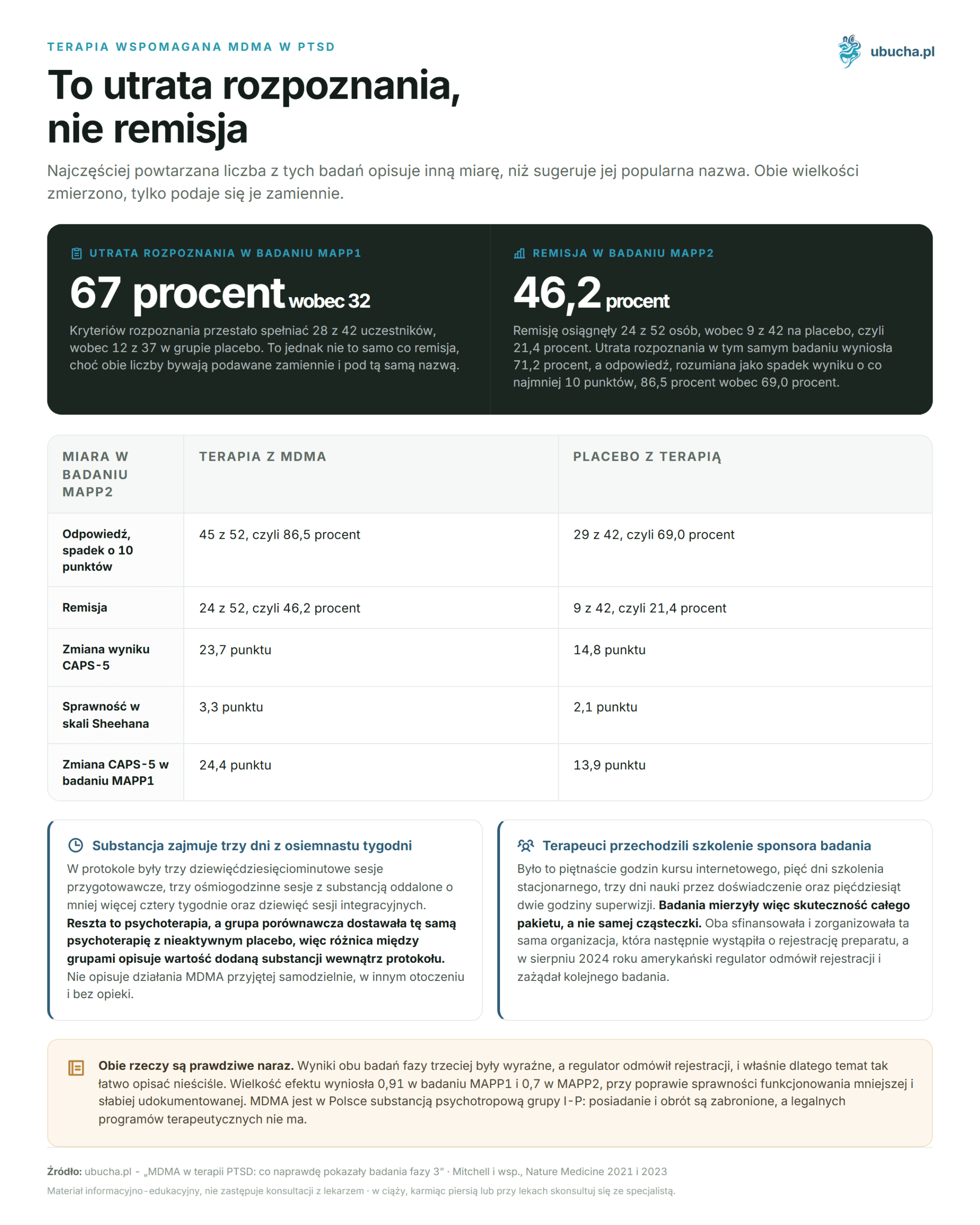
• In the MAPP1 study, after MDMA-assisted therapy, 28 out of 42 participants (67 percent) no longer met the criteria for PTSD diagnosis, compared to 12 out of 37 (32 percent) in the placebo group.
• The numbers 67 and 71 percent describe the loss of diagnosis, not remission. Remission in MAPP2 was achieved by 24 out of 52 individuals (46.2 percent) compared to 9 out of 42 (21.4 percent) on placebo.
• Both studies were funded and organized by MAPS, the entity that subsequently applied for registration of the drug.
• MDMA is a psychotropic substance of group I-P in Poland. Possession and trade are prohibited, and there are no legal therapeutic programs.
What is MDMA-assisted therapy and how does it differ from recreational use?
MDMA-assisted therapy is a clinical protocol in which the substance is administered several times over a few weeks, always in the presence of a two-person therapist team. In the MAPP1 study, participants underwent three ninety-minute preparatory sessions, followed by three eight-hour sessions with the substance, spaced approximately four weeks apart, and nine integration sessions. The entire process, along with four measurement points, took eighteen weeks (Mitchell et al., Nature Medicine, 2021).
The very distribution of time explains why the results of these studies cannot be transferred to use outside the clinic. The substance occupies three days out of eighteen weeks in this protocol. The rest is psychotherapy. The therapists conducting the sessions had to complete training from the study sponsor: fifteen hours of online course, five days of in-person training, three days of experiential learning, and fifty-two hours of supervision.
The consequence is that the MAPS studies measured the effectiveness of the entire package, not just the molecule itself. The comparison group received the same psychotherapy with an inactive placebo, so the difference between the groups describes the added value of the substance within the protocol. It does not describe the action of MDMA taken alone, in a different environment, and without supervision. This distinction disappears in most popular discussions and is the reason why the numbers from these studies so easily wander outside their context.
What exactly did the phase 3 studies MAPP1 and MAPP2 measure?
Both studies were multicenter, randomized, and blinded, and the results were assessed by independent evaluators who did not know which group participants were assigned to. The primary endpoint was the change in the CAPS-5 scale, a standard tool for measuring the severity of PTSD. MAPP1 included 90 individuals with severe PTSD, while MAPP2 included 104 individuals with moderate or severe PTSD, including 76 individuals with severe form (Mitchell et al., Nature Medicine, 2023).
In MAPP1, the average change in the CAPS-5 score was 24.4 points in the MDMA group compared to 13.9 points in the placebo group, with p below 0.0001 and an effect size d equal to 0.91. In MAPP2, the change was 23.7 points compared to 14.8 points, with p below 0.001 and d equal to 0.7. Improvement in functioning measured by the Sheehan scale was smaller and less well documented: 3.3 points compared to 2.1 points, with p equal to 0.03.
| Measure in the MAPP2 study | MDMA therapy | Placebo therapy |
|---|---|---|
| Response, i.e., decrease in CAPS-5 by at least 10 points | 45 out of 52 (86.5 percent) | 29 out of 42 (69.0 percent) |
| Loss of PTSD diagnosis | 37 out of 52 (71.2 percent) | 20 out of 42 (47.6 percent) |
| Remission, i.e., loss of diagnosis and CAPS-5 no higher than 11 | 24 out of 52 (46.2 percent) | 9 out of 42 (21.4 percent) |
| Severe adverse events | 5 individuals (9.4 percent) | 2 individuals (3.9 percent) |
The denominators in the table are smaller than the number of individuals randomly assigned to groups because these analyses include participants who completed treatment. The distinction in the last row is significant for another reason. Seven participants in MAPP2 experienced a severe adverse event, but in the regulatory category of “serious adverse event,” which includes death and hospitalization, not a single case was reported in this study. There were also no deaths. Both studies report results after eighteen weeks from the baseline and that is where they end.
Why is the number 67 percent sometimes reported as remission?
This is the most common mistake in discussions of these studies and is worth separate explanation, as it substitutes the name of the measurement, not the number itself. The MAPP2 study tracked three different thresholds of improvement and named them differently. Response is a decrease in the CAPS-5 score by at least ten points. Loss of diagnosis is the same decrease combined with the patient no longer meeting the diagnostic criteria for PTSD. Remission is the strictest threshold: it requires loss of diagnosis and a CAPS-5 score no higher than 11 points.
The figures of 67 percent in MAPP1 and 71.2 percent in MAPP2 describe the loss of diagnosis. Remission in MAPP2 included 24 out of 52 participants, or 46.2 percent, compared to 9 out of 42 individuals on placebo, or 21.4 percent. So when a text states seventy percent remission, it assigns a measurement to the study that it did not conduct under that name. It is also worth noting a point that is often lost in the correction: the absolute percentage drops by twenty-five percentage points, but the difference from placebo remains almost the same, as the loss of diagnosis is 23.6 percentage points, and remission is 24.8. The scale of the phenomenon is inflated, not the advantage over the comparison group.
The second misunderstanding concerns durability. There is a statement in circulation about the effect lasting for twelve months. Neither of the two phase 3 studies contains a twelve-month follow-up. The most frequently cited work on the long-term outcomes of MDMA therapy, Jerome et al. from 2020, was retracted by the journal, and a note about the retraction appeared in Psychopharmacology in 2024. It should not be referenced. Nothing is currently known from phase 3 studies about the durability of the effect of MDMA-assisted therapy after a year.
Who funded these studies and why does it matter?
Both phase 3 studies were funded by MAPS, a public benefit organization, and organized by MAPS Public Benefit Corporation, the same entity that subsequently applied for registration of the drug. MAPP2 was additionally created with the support of the Steven and Alexandra Cohen Foundation. Data from both trials remain under the sponsor’s control: requests for access to raw data are handled by MAPS PBC.
In the conflict of interest statements for MAPP2, one of the co-authors is an employee of MAPS PBC, another was previously and served as medical director, and others received honoraria from the company for training and reimbursement for travel expenses. The therapists conducting the sessions underwent the sponsor’s training program.
This does not invalidate the results and is not an accusation of scientific fraud. Both studies underwent peer review and describe safeguards: an independent team of evaluators, a separate database with results, sponsor personnel cut off from measurements. However, the reader has the right to know that the strongest numbers in this field come from trials designed, funded, and trained by the party interested in registration. This same circumstance later returned in the regulator’s assessment.
Why did the FDA refuse registration in 2024?
On June 4, 2024, the advisory committee of the American agency concluded that the evidence of efficacy was insufficient and that the benefits did not outweigh the risks. In August 2024, the agency denied registration of the drug, which was applied for by Lykos Therapeutics, a spin-off from MAPS, and requested an additional study. This was not a ruling that MDMA does not work, but that the material presented does not allow for a resolution (Roseman, Journal of Psychopharmacology, 2025).
The crux of the dispute is blinding. A person who received MDMA usually knows it, as the substance produces clear sensations. Therefore, the assessment of one’s own symptoms ceases to be independent of knowledge about group assignment. Additionally, there is the issue described above: some elements that the regulator deemed unresolved pertain to psychotherapy and the relationship with the therapist, not pharmacology. A review of the literature on the ethics of psychedelic therapy indicates the therapeutic relationship and research ethics as two of seven areas requiring organization before introducing these methods into practice (Caporuscio et al., Psychological Medicine, 2025). We describe this decision in more detail in a separate text about the refusal of MDMA therapy registration.
Australia took a different path. As of July 1, 2023, MDMA and psilocybin are no longer prohibited substances there and can be prescribed by psychiatrists with Authorised Prescriber status, after approval from the ethics committee and the regulator. This is not drug registration, but a reclassification combined with a pathway to access (Hatfield et al., Aust N Z J Psychiatry, 2024). The decision has been criticized by Australian psychiatrists as premature.
What is the legal status of MDMA in Poland?
MDMA is listed as item 65 in the list of psychotropic substances of group I-P, which is an annex to the regulation of the Minister of Health regarding the list of psychotropic substances, narcotic drugs, and new psychoactive substances (consolidated text Journal of Laws 2024 item 1139). The list is an annex to a regulation, not a law, and was issued based on Article 32 of the Act on Counteracting Drug Addiction (consolidated text Journal of Laws 2023 item 1939). MDMA is not a narcotic drug under these regulations, but a psychotropic substance.
The practical consequences are clear. Possession, production, and trade are prohibited. There are no legal therapeutic programs with MDMA in Poland, and access to the substance is only possible in scientific research conducted with permission. Importing the substance on one’s own or using non-medical offers remains illegal regardless of the state of research in other countries.
For individuals whose previous PTSD treatment has not improved their condition, available methods in the country remain: EMDR therapy, prolonged exposure, trauma-focused cognitive-behavioral therapy, and psychiatric treatment conducted by centers specializing in trauma disorders. A registry of ongoing clinical trials is maintained at ClinicalTrials.gov. Separately, we describe the state of research on psychedelic therapies and research on psilocybin in depression.
Frequently Asked Questions
What is MDMA-assisted therapy?
It is a clinical protocol in which MDMA is administered multiple times in the presence of a two-person therapist team. In the MAPP1 study, it consisted of three preparatory sessions, three eight-hour sessions with the substance spaced about four weeks apart, and nine integration sessions, totaling eighteen weeks.
How many participants were included in the phase 3 studies?
MAPP1 included 90 individuals with severe PTSD, while MAPP2 included 104 individuals with moderate or severe PTSD. In MAPP2, 53 individuals were assigned to the MDMA group, and 51 to the placebo therapy group. Both trials were multicenter, and the results were assessed by independent evaluators who were unaware of the assignment.
Did 67 percent of participants achieve remission?
No. The figure of 67 percent from the MAPP1 study describes the loss of PTSD diagnosis, meaning 28 out of 42 individuals compared to 12 out of 37 on placebo. Remission is a stricter threshold, and in MAPP2, it included 24 out of 52 participants, or 46.2 percent, compared to 9 out of 42 individuals, or 21.4 percent.
Does the effect of therapy last for a year?
It is unknown. Neither of the two phase 3 studies conducted a twelve-month follow-up, and the most frequently cited work on the long-term outcomes of MDMA therapy was retracted by the journal in 2024. The claim of a year-long durability of the effect is not supported by current registration studies.
Why did the FDA refuse registration in 2024?
The advisory committee concluded on June 4, 2024, that the evidence of efficacy was insufficient and that the benefits did not outweigh the risks. In August 2024, the agency denied registration and requested an additional study. The main criticism concerned the inability to maintain blinding and the assessment of the psychotherapeutic elements of the protocol.
Is MDMA legal in Poland for therapy?
No. MDMA is listed as item 65 in the list of psychotropic substances of group I-P. Possession, production, and trade are prohibited, and there are no legal therapeutic programs with MDMA in Poland. The substance is only available in scientific research conducted with permission.
This article is for informational and educational purposes. It describes clinical studies in which the substance is administered under medical supervision after participant qualification; using it on one’s own does not replicate these conditions. These substances are controlled in Poland under the Act on Counteracting Drug Addiction. If you have suicidal thoughts, call the free, 24-hour numbers 116 123 or 800 70 2222. In case of life-threatening situations: 112.
Author: Michał Waluk · Published: 2026-08-09 · Updated: 2026-08-16