
CBDV (cannabidivarin): cannabinoid studied in epilepsy and autism
CBDV, or cannabidivarin: TRPV1 mechanism, results of a phase two study in 162 people with focal epilepsy, glutamate measurement in autism, and legal status.
Cannabidivarin, or CBDV for short, has been returning in neurological publications for over a decade, most often in relation to epilepsy and autism spectrum disorders. It has shown promise in animal models. In the only large clinical study conducted so far in humans with epilepsy, it did not outperform placebo. No drug containing this compound is currently registered, although the name CBDV appears in product descriptions as if it were. Below you will find what can actually be verified in published works: how the molecule acts on ion channels in neurons, what a phase two study showed in adults with focal seizures, what was measured in the brain after a single dose, and what the current status of cannabidivarin is in Polish regulations.
KEY INFORMATION
• CBDV is a homolog of CBD with a shorter, three-carbon side chain. It does not cause intoxication and is not listed in the Polish register of controlled substances.
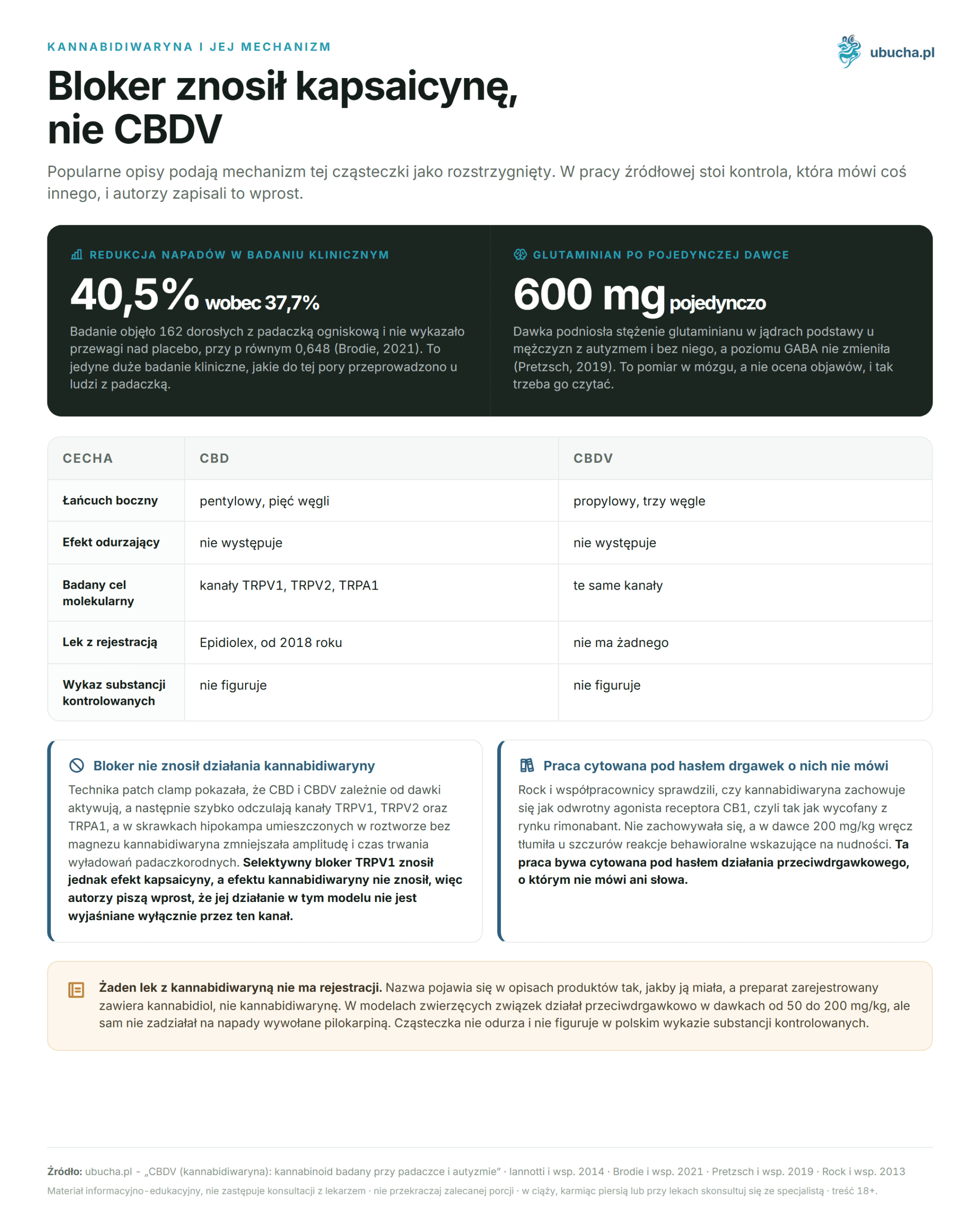
• In animal models, it acted anticonvulsively at doses from 50 to 200 mg/kg, but did not act on seizures induced by pilocarpine (Hill 2012).
• A phase two study in 162 adults with focal epilepsy showed no advantage over placebo: 40.5% versus 37.7% reduction in seizures, p=0.648 (Brodie 2021).
• A single dose of 600 mg raised glutamate levels in the basal ganglia in men with and without autism, while it did not change GABA levels (Pretzsch 2019).
• No drug with cannabidivarin is registered. Epidiolex contains CBD, not CBDV.
What is CBDV and how does it differ from CBD?
CBDV is a phytocannabinoid from the Cannabis sativa L. plant, built almost identically to CBD. The only difference lies in the carbon side chain: CBD has five carbon atoms, while cannabidivarin has three. This one change is enough for the molecule to bind differently to certain membrane proteins and be studied from a different angle than CBD.
Neither CBD nor CBDV causes intoxication. Rock and colleagues checked in 2013 whether cannabidivarin behaves like a reverse agonist of the CB1 receptor, similar to the withdrawn rimonabant. It did not behave that way. At a dose of 200 mg/kg, CBDV even suppressed behavioral responses indicating nausea in rats (Rock et al., British Journal of Pharmacology, 2013). It is worth remembering this, as this work is often cited under the heading of anticonvulsant action, which it does not mention at all. If you want to see where CBDV stands in relation to the entire family of plant compounds and those produced by the body, a comparison of phytocannabinoids, endocannabinoids, and synthetic compounds helps with that.
| Feature | CBD | CBDV |
|---|---|---|
| Side chain | pentyl, five carbons | propyl, three carbons |
| Intoxicating effect | none | none |
| Studied molecular target | including TRPV1, TRPV2, TRPA1 | the same TRP channels, activation and desensitization |
| Registered drug | Epidiolex, since 2018 | none |
| Controlled substances list | not listed | not listed |
How does CBDV affect the nervous system?
CBDV does not block TRPV1 channels, it opens them, and then quickly desensitizes their sensitivity. This distinction is important because in excited hippocampal tissue, TRPV1 receptors are excessively phosphorylated, meaning they are sensitized, and desensitizing this state is precisely what one wants to achieve.
Iannotti and colleagues showed using the patch clamp technique that CBD and CBDV activate and then quickly desensitize TRPV1, TRPV2, and TRPA1 channels depending on the dose. In hippocampal slices placed in a magnesium-free solution, cannabidivarin reduced both the amplitude and duration of epileptiform discharges (Iannotti et al., ACS Chemical Neuroscience, 2014). This same work contains a caveat that usually disappears in popular descriptions: a selective TRPV1 blocker negated the effect of capsaicin but did not negate the effect of CBDV. The authors explicitly state that the anticonvulsant action of cannabidivarin in this model is not explained solely by TRPV1.
- Activation and rapid desensitization of TRPV1 and TRPV2 channels and related TRPA1, confirmed by measuring currents in HEK293 cells.
- Dephosphorylation of TRPV1 in magnesium-depleted hippocampal tissue, consistent with receptor desensitization.
- Lack of behavioral profile of a reverse agonist of the CB1 receptor, indicating a different mechanism than rimonabant.
Does CBDV help with epilepsy?
In rodents, yes, in humans this has not been demonstrated so far. Cannabidivarin suppressed seizures in several animal models, but the only large clinical study conducted in 162 adults with focal epilepsy ended with a result indistinguishable from placebo.
Hill and colleagues studied CBDV in four seizure models. The compound acted at a maximum electric shock from 100 mg/kg, in audiogenic seizures from 50 mg/kg, and in seizures induced by pentylenetetrazole from 100 mg/kg, without impairing motor performance. In seizures induced by pilocarpine, CBDV administered alone, even at a dose of 200 mg/kg, did not work at all; the effect appeared only in combination with valproate or phenobarbital (Hill et al., British Journal of Pharmacology, 2012).
The human study was conducted by GW Pharmaceuticals under the designation GWP42006. Eighty-one people received cannabidivarin, eighty-one received placebo, and the dose was increased to 800 mg twice daily. Seizures decreased by 40.5% in the treated group and by 37.7% in the placebo group, with p=0.648, and none of the secondary endpoints differed (Brodie et al., Cannabis and Cannabinoid Research, 2021). Currently, only a CBD-based preparation has registration, which we discuss further in the text about CBD in epilepsy and seizures.
What do studies say about CBDV in autism?
So far, it has been studied what a single dose does to brain chemistry, not whether it changes behavior. No study has examined the effect of cannabidivarin on autism symptoms in humans, so claims of effectiveness have no basis.
Pretzsch and colleagues administered 600 mg of CBDV or placebo to thirty-four men, seventeen of whom had a diagnosis of autism. Glutamate and GABA levels were measured using magnetic resonance spectroscopy. CBDV significantly raised glutamate levels in the basal ganglia in both groups, while it did not change it at all in the medial prefrontal cortex, and did not affect GABA levels in any of the studied areas (Pretzsch et al., Translational Psychiatry, 2019). In the autism group, the magnitude of change depended on the baseline level: the higher it was at the start, the smaller the increase turned out to be.
The reason these two topics are even connected is epidemiological. Besag estimates that epilepsy occurs in about 20% of people with autism, and immediately cautions that after expanding the criteria for diagnosing the spectrum, this number is likely inflated (Besag, Neuropsychiatric Disease and Treatment, 2018). Co-occurrence does not mean that a drug acting on one will act on the other.
Is CBDV legal and available in Poland?
Cannabidivarin is not a controlled substance in Poland. The name does not appear even once in the regulation of the Minister of Health regarding the list of psychotropic substances, narcotics, and new psychoactive substances (consolidated text Dz.U. 2024 poz. 1139). Controlled positions from the cannabis family include tetrahydrocannabinols, delta-9-THC, and HHC and HHC-O.
Sales is a separate matter, and here descriptions online can be misleading. Hemp extracts containing cannabinoids are listed in the EU catalog of novel food, which means that before being placed on the market, they require authorization issued under Regulation (EU) 2015/2283. To date, no application regarding cannabinoids has received such authorization. The statement that a product with CBDV only needs to be reported to the sanitary inspection as a dietary supplement simplifies the legal situation in favor of the seller. Our text on regulations of cannabis products in Poland elaborates on this further.
What is known about safety is based on the results of the phase two study. Adverse events occurred in 72.8% of those taking cannabidivarin compared to 48.1% in the placebo group, most often diarrhea, nausea, and drowsiness. Serious events were rare: 3.7% versus 1.2%. In three participants, aminotransferase activity exceeded three times the upper limit of normal, and two of them discontinued participation in the study. These data come from eight weeks of treatment, so they say nothing about the effects of long-term use.
Frequently Asked Questions
How does CBDV differ from CBD?
By structure and state of knowledge. CBDV has a three-carbon side chain instead of a five-carbon one, which changes how it binds to certain membrane proteins. Neither of these compounds causes intoxication. CBD has an approved drug and hundreds of studies in humans, while cannabidivarin has one large clinical study that did not yield positive results.
Does CBDV have anticonvulsant effects?
In studies on rodents, yes, at doses from 50 to 200 mg/kg. In humans, this has not been confirmed even once: in a study of 162 adults with focal epilepsy, seizures decreased by 40.5% with cannabidivarin and by 37.7% with placebo, and the difference was not statistically significant (p=0.648).
Does CBDV help with autism?
There is no study that answers this. The only work in humans measured neurotransmitter levels after a single dose of 600 mg, not symptoms. It showed an increase in glutamate in the basal ganglia and no changes in GABA levels. No conclusions about treatment can be drawn from this.
How does CBDV affect neurons?
It activates TRPV1, TRPV2, and TRPA1 channels, and then quickly desensitizes their sensitivity. In hippocampal slices, it shortened epileptiform discharges and reduced their amplitude. However, the authors of this work caution that TRPV1 alone does not explain the entire effect, as a blocker of this channel did not negate it.
Is CBDV legal in Poland?
Yes, it is not listed in the register of controlled substances. A separate issue is the trade in food: hemp extracts with cannabinoids are treated as novel food in the EU and require authorization, which has not yet been issued for any cannabinoid. These are two different regulations and it is easy to confuse them.
Where to buy a product with CBDV?
Products explicitly described as cannabidivarin are rare. In full-spectrum extracts, CBDV may be present in trace amounts, but the quantity depends on the strain and batch of raw material. The only way to verify this is through laboratory testing of a specific batch, i.e., a certificate of analysis detailing the content of this compound.
If you are looking for products where the manufacturer provides a full cannabinoid profile, check the category of hemp oils and look for the certificate of analysis for a specific batch.
This article is for informational and educational purposes only and does not constitute medical advice. Before starting to use cannabis or CBD for therapeutic purposes, consult a doctor, especially if you are taking other medications, are pregnant, or breastfeeding.
Author: Michał Waluk · Published: 2026-08-09 · Updated: 2026-08-10