
Gotu kola (Centella asiatica): properties for memory, varicose veins and wound healing 2026
Gotu kola has the strongest evidence for venous insufficiency, weaker for memory. Check what studies have shown and why liver damage has been reported.
Gotu kola has reached Western scrutiny from Ayurveda through three independent paths: through varicose veins, through wound healing, and through memory. Each has a different quality of evidence, and the difference between them is greater than the descriptions of supplements suggest. For chronic venous insufficiency, there are randomized trials from decades ago, while for memory, there is a single pilot study on twenty-eight individuals. Separately, there is the issue that commercial descriptions usually remain silent about: cases of severe liver damage have been reported after several weeks of use, and in one patient, symptoms returned after resuming the herb. Additionally, there is confusing nomenclature, as gotu kola has nothing to do with kola nut or bacopa, even though all three are sometimes referred to as brahmi or kola. Below, we separate these threads and show where the evidence ends and tradition begins for each.
KEY INFORMATION
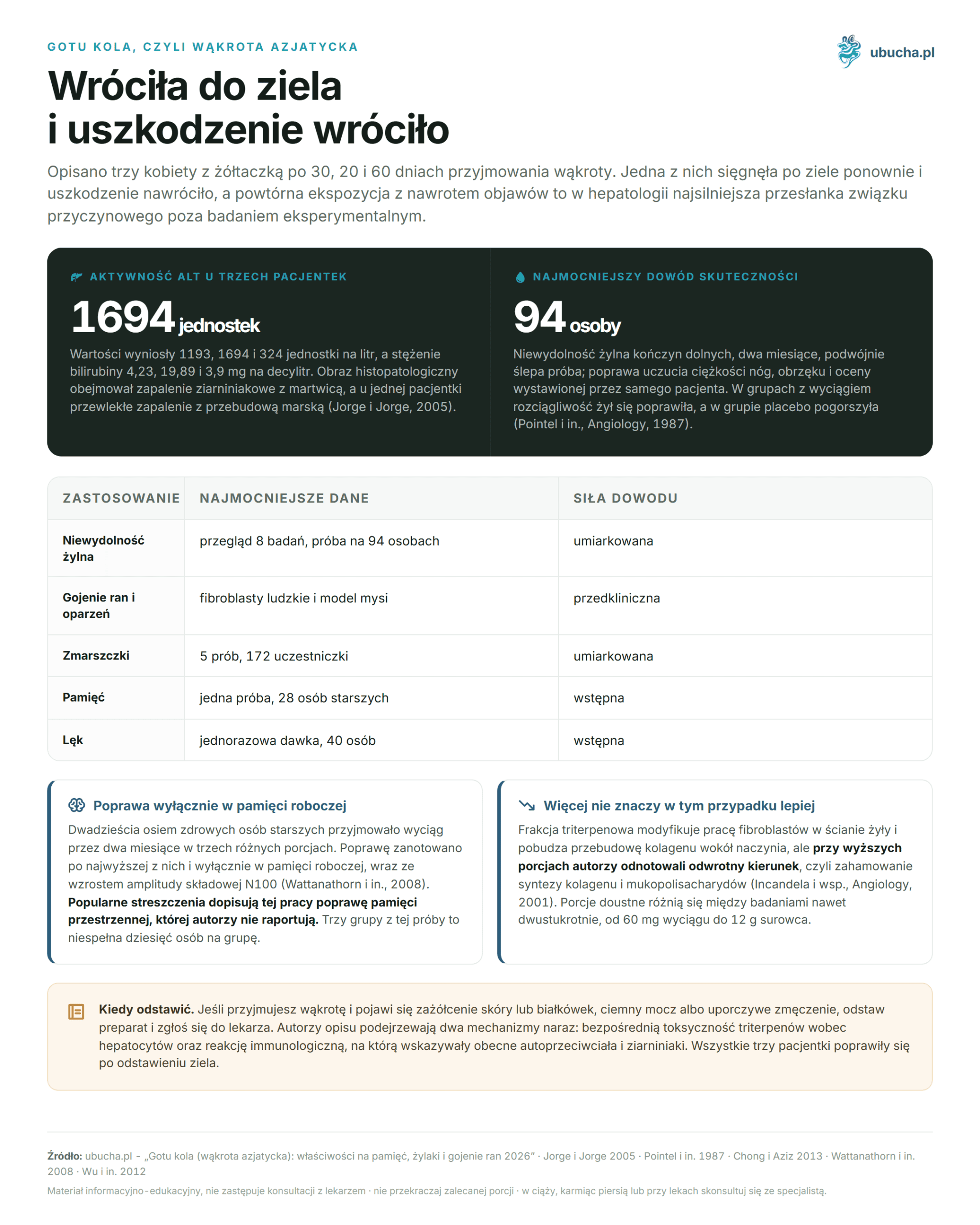
• Strongest evidence: 94 individuals with venous insufficiency, two months, improvement in swelling (Pointel et al., Angiology, 1987).
• Wound healing is attributed to asiaticoside and madecassoside, not their metabolites (Wu et al., 2012).
• Memory: one study on 28 older individuals, improvement only in working memory.
• Three cases of jaundice reported after 20-60 days of use (Jorge and Jorge, 2005).
What is Centella asiatica and what works in it?
Gotu kola, in Polish known as wąkrota azjatycka, is a low herbaceous plant from the Apiaceae family, growing in moist areas of tropical Asia. In Ayurveda, it is known as brahmi or mandukaparni and belongs to the group of herbs considered to enhance the mind.
Its action is attributed to a group of pentacyclic triterpenes. Bylka et al. (Phytotherapy Research, 2014) list four main ones: asiaticoside and madecassoside, along with their corresponding aglycones, namely asiatic acid and madecassic acid. The same authors begin their review with the statement that the plant has been used as a panacea for three thousand years, reminding us that a long tradition of use is not evidence of efficacy.
Gotu kola differs from other nootropic herbs in one way: it acts on connective tissue. Bacopa monnieri, the second plant called brahmi, is mainly studied for neurotransmission, while ginkgo is studied for cerebral blood flow. Centella, on the other hand, stimulates fibroblasts to synthesize collagen, which ties its three applications into one mechanism: the vein wall, scar, and skin are made of the same material.
If you are looking for an herb with a stronger evidence base for memory alone, bacopa monnieri is described separately. These are two different plants, despite sharing a traditional name.
How does gotu kola work on varicose veins and what have studies shown?
The best-documented use of gotu kola is chronic venous insufficiency. Pointel et al. (Angiology, 1987) conducted a multicenter double-blind study involving 94 individuals with lower limb venous insufficiency and randomly assigned them for two months to three groups: TECA extract at a dose of 120 mg daily, the same extract at a dose of 60 mg daily, or placebo.
The results were statistically significant in favor of the extract at three points: the feeling of heaviness in the legs, swelling, and overall assessment by the patient themselves. The authors also measured the distensibility of the veins using a mercury plethysmograph at three occlusion pressures. In the groups receiving the extract, the parameter improved, while in the placebo group, it worsened.
This last sentence is more important than it appears. The worsening in the placebo group indicates that the study captured the natural course of the disease, which progresses on its own. Therefore, the difference between the groups does not solely result from improvement after treatment.
The study has obvious limitations: it dates back to 1987, lasted two months, and measured symptoms rather than distant endpoints like leg ulcers. It does not answer the question of what happens after a year or whether the extract changes the course of the disease or merely alleviates its perception.
How strong is the evidence for venous insufficiency?
Moderate, with a clear caveat regarding the quality of reporting. Chong and Aziz (Evidence-Based Complementary and Alternative Medicine, 2013) searched thirteen databases and included eight studies. After compiling the data, Centella asiatica significantly improved microcirculation parameters: transcutaneous partial pressure of oxygen and carbon dioxide, the rate of ankle swelling, and the venous-arteriolar reflex.
Three of the eight studies did not provide numerical data at all, although they reported improvements in heaviness of the legs, pain, and swelling. The authors of the review conclude with a warning: most studies were characterized by insufficient reporting and unclear risk of systematic bias, which undermines confidence in the conclusion. This is an honest description of the state of knowledge, not an invitation to abandon treatment.
The mechanism was described by Incandela et al. (Angiology, 2001). The triterpene fraction modifies the work of fibroblasts in the vein wall, improves collagen synthesis, and stimulates its remodeling around the vessel. However, there is a nuance that disappears from commercial summaries: the stimulating effect is moderate, and at higher doses, the authors noted the opposite direction, meaning inhibition of collagen and mucopolysaccharide synthesis. More does not mean better in this case.
| Application | Strongest available data | Strength of evidence |
|---|---|---|
| Venous insufficiency | Review of 8 studies (Chong and Aziz, 2013); trial on 94 individuals (Pointel, 1987) | moderate |
| Wound and burn healing | Human fibroblasts and mouse model (Wu et al., 2012) | preclinical |
| Wrinkles | 5 double-blind trials, 172 participants (Kongkaew et al., 2020) | moderate |
| Memory | One trial, 28 older individuals (Wattanathorn et al., 2008) | preliminary |
| Anxiety | Single dose, 40 individuals (Bradwejn et al., 2000) | preliminary |
Does gotu kola accelerate wound and scar healing?
The data is convincing, but comes from laboratory and animal models, not from patient trials. Wu et al. (Evidence-Based Complementary and Alternative Medicine, 2012) compared four triterpenes from gotu kola on primary human skin fibroblasts and on mice after burns.
The result overturned previous assumptions. It was asiaticoside and madecassoside that turned out to be the main active substances, not their metabolites, asiatic acid and madecassic acid, which had previously been attributed this role. Madecassoside performed better than asiaticoside in type III procollagen synthesis, healing rate, and quality of healing.
The researchers also traced the pathway: cell proliferation, collagen synthesis, the balance between metalloproteinase MMP-1 and its inhibitor TIMP-1, and TGF-beta and Smad signaling. The latter explains why gotu kola affects not only the rate of healing but also the way tissue is rebuilt.
What does this not imply? That a cream with gotu kola will smooth out an existing keloid or replace treatment for a difficult-to-heal wound. Bylka et al.’s review summarizes laboratory and animal experiences, not results from treating patients with wounds. In the case of a wound that does not heal for several weeks, the decision is made by a surgeon, not an herbal product.
Does gotu kola improve memory and calm?
The data is preliminary in both cases and narrower than described. Wattanathorn et al. (Journal of Ethnopharmacology, 2008) administered an extract of Centella asiatica to 28 healthy older adults for two months, in three different doses. Improvement was noted only after the highest of them and only in working memory, along with an increase in the amplitude of the N100 component of the evoked potential. Participants also reported improved mood self-assessment.
It is worth pausing on the word “only.” Popular summaries add spatial memory improvement to this study, which the authors do not report. Twenty-eight individuals divided into three groups means less than ten individuals per group, so this is a signal for further research, not a conclusion.
In the case of anxiety, the situation is similar. Bradwejn et al. (Journal of Clinical Psychopharmacology, 2000) administered a single dose of 12 g of gotu kola to twenty individuals, and twenty placebo, and measured the startle reflex to an acoustic stimulus. The amplitude of the reflex significantly decreased after 30 and 60 minutes.
We noticed during this editing a discrepancy that usually disappears from descriptions: in the same study, gotu kola did not significantly affect mood self-assessment or heart rate and blood pressure. The reflex index decreased, not the well-being of the subjects. If you are looking for an adaptogenic herb with a longer series of studies on stress, holy basil is described separately.
What doses were used in studies on gotu kola?
The cited trials differ so much that they do not form any common pattern. Below is a summary of what was actually administered to participants, solely as a description of the studies. This is not a guideline on how much you should take.
- Pointel 1987, venous insufficiency: TECA extract at a dose of 120 mg or 60 mg daily for two months, in 94 individuals, against placebo.
- Wattanathorn 2008, memory in older individuals: extract in three doses, from 250 to 750 mg once daily for two months, in 28 individuals; effect only after the highest.
- Bradwejn 2000, startle reflex: single dose of 12 g of raw material in twenty individuals, measurement after 30 and 60 minutes.
- Kongkaew 2020, wrinkles: topical preparations for 12 weeks around the eyes and asiaticoside in a balm for 8 weeks.
Three things from this summary deserve attention. Oral doses differ between studies by even two hundred times, from 60 mg of extract to 12 g of raw material. The preparations were not standardized in the same way, which the authors of the wrinkles review point out. Finally, venous insufficiency and memory were studied with different preparations, so results from one area cannot be transferred to another.
Decide to use gotu kola for venous disease, for a wound, or for memory disorders with your doctor. For venous insufficiency, there are methods with a stronger basis, from compression therapy to surgical treatment, and the herbal extract does not replace them.
Can gotu kola damage the liver?
Yes, such cases have been reported, and this is the most serious caveat regarding this plant. Jorge and Jorge (Revista Española de Enfermedades Digestivas, 2005) described three women aged 61, 52, and 49, who developed jaundice after 30, 20, and 60 days of taking Centella asiatica, respectively.
The deviations were significant: ALT activity was 1193, 1694, and 324 units per liter, and bilirubin levels were 4.23, 19.89, and 3.9 mg per deciliter. The histopathological picture included granulomatous inflammation with necrosis and, in one patient, chronic inflammation with cirrhotic remodeling. All three improved after discontinuing the herb and administering ursodeoxycholic acid.
The strongest element of this description is what happened to the first patient: she took gotu kola again, and the damage returned. Re-exposure with symptom recurrence is the strongest causal link that can be obtained outside of experimental study in hepatology. The authors suspect two mechanisms simultaneously: direct toxicity of triterpenes to hepatocytes and an immune response, indicated by present autoantibodies and granulomas.
The practical conclusion is simple. If you are taking gotu kola and experience yellowing of the skin or sclera, dark urine, or persistent fatigue, discontinue the product and consult a doctor. Do not use it together with other liver-burdening preparations.
Does gotu kola smooth out wrinkles?
There is data from clinical trials for topical use, although modest. Kongkaew et al. (Journal of Cosmetic Science, 2020) included five double-blind studies in their review, involving a total of 172 participants from Asia.
Two studies compared a gel or cream with gotu kola or with just asiaticoside to placebo, over twelve weeks, around the eye area. In two others, tretinoin or pueraria was used on the opposite side of the face. The network analysis showed that Centella performed better than pueraria and probably worse than tretinoin. Asiaticoside in a balm for eight weeks reduced lip wrinkles.
Another result stands out: skin hydration increased significantly after gotu kola, while it did not after tretinoin. Ten adverse events were reported after Centella compared to thirty-five after tretinoin. However, the authors caution that the lack of standardization of preparations prevents these results from being applied to any cosmetic with this ingredient.
Since we are talking about collagen, it is worth distinguishing two paths: gotu kola stimulates its own fibroblasts to produce it, while collagen supplements provide peptides from the outside. This second path is described in a separate entry.
Frequently asked questions
Is gotu kola the same as kola nut?
No, they are two unrelated plants with a misleading name. Gotu kola, or Centella asiatica, belongs to the Apiaceae family and does not contain caffeine. Kola nut comes from the Cola nitida tree of the Malvaceae family and contains caffeine. The similarity in names is coincidental.
What does gotu kola have the strongest evidence for?
For chronic venous insufficiency. Pointel and colleagues (Angiology, 1987) demonstrated improvement in swelling and heaviness in the legs in 94 individuals after two months, and a review of eight studies (Chong and Aziz, 2013) confirmed improvement in microcirculation parameters, noting unclear risk of bias in the original studies.
Does gotu kola really improve memory?
The data is preliminary. In the only clinical trial on humans (Wattanathorn et al., 2008), 28 healthy older adults took the extract for two months, and improvement was noted only after the highest of three doses and only in working memory. This is a signal for further research, not a conclusion.
How does gotu kola help with wounds and scars?
Asiaticoside and madecassoside stimulate fibroblasts to synthesize collagen via the TGF-beta and Smad pathways and alter the balance of MMP-1 and TIMP-1 (Wu et al., 2012). Madecassoside acted more strongly in this study. However, the data comes from cell cultures and mouse models, not from patient trials.
Is gotu kola safe for the liver?
Not always. Jorge and Jorge (2005) described three women with jaundice after 20-60 days of taking gotu kola, with ALT activity up to 1694 units per liter. One of them returned to the herb and the damage recurred. If you experience liver symptoms, discontinue the product and consult a doctor.
Can gotu kola be used during pregnancy?
There is no data to consider it safe, and the described cases of liver damage further advocate caution. Reviews on gotu kola do not include pregnant or breastfeeding women. In both situations, make any herbal product decision with your doctor.
Does gotu kola interact with medications?
The main risk concerns the liver, so combining gotu kola with medications that burden this organ requires caution. Due to observed sedative effects in studies, caution is also advised with sleeping and sedative medications. Check your list of medications with your doctor or pharmacist.
We do not currently have the extract of gotu kola for sale. Among herbs with studied effects on memory in the category of herbs, you will find bacopa monnieri.
This article is for informational and educational purposes and does not constitute medical advice. Before starting supplementation, consult your doctor, especially if you are taking medications regularly, are pregnant or breastfeeding, or have chronic illnesses.
Author: Michał Waluk · Published: 2026-06-22 · Updated: 2026-08-16