
Supplements for Sarcopenia in Seniors: Protein, Creatine, and Vitamin D
What studies have really shown about supplements for sarcopenia in older adults: creatine, vitamin D, omega-3, and HMB compiled with numbers from meta-analyses.
Sarcopenia, or the progressive loss of muscle mass and strength with age, is one of the main causes of falls, fractures, and loss of independence in older adults. The market for supplements aimed at this group is vast and largely based on results obtained from young athletes, which cannot be transferred to seniors. This compilation organizes something different: it shows which substances have studies conducted on individuals over sixty and what exactly those studies revealed. For each item, we provide the number of participants, duration, and results, because without these three things, a statement about effectiveness is just a promise. We also provide the boundaries of these studies, meaning the groups that were not included and the conditions under which the described effect did not occur.
KEY INFORMATION
• Sarcopenia is a muscle disease recognized according to the EWGSOP2 consensus from 2019, with low muscle strength as the starting point.
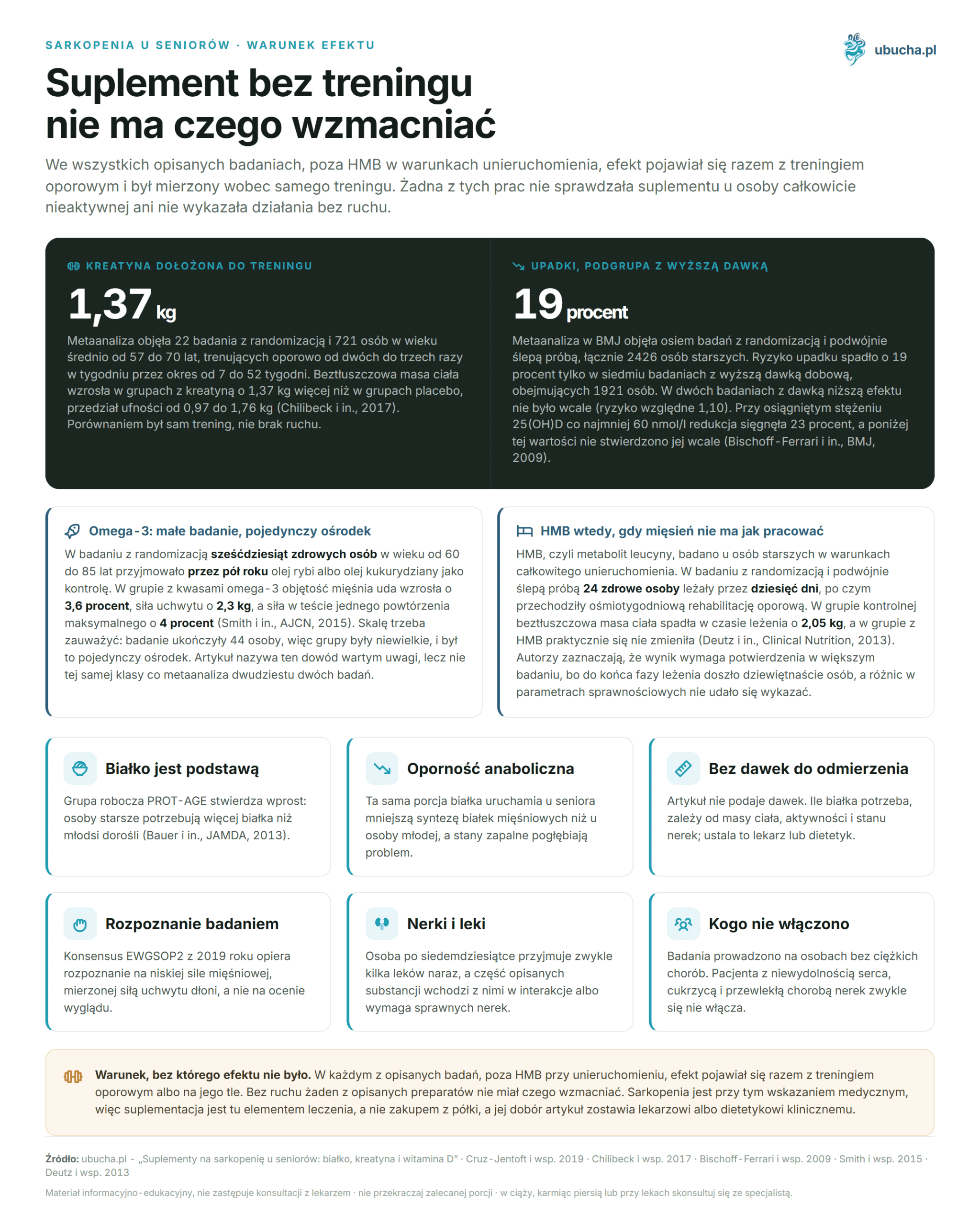
• Creatine combined with resistance training has the strongest data: a meta-analysis of 22 studies involving 721 individuals showed an increase in lean body mass of 1.37 kg.
• Vitamin D in fall studies reduced the risk by 19 percent, but only in the subgroup with a higher daily dose.
• HMB has narrow and specific evidence: it protects muscle mass during immobilization, but does not replace training.
• This text does not provide dosages to be measured. Sarcopenia is a medical indication, so supplementation should be determined by a doctor or clinical dietitian.
What is sarcopenia and how is it diagnosed?
Sarcopenia is a muscle disease, not a natural symptom of aging that must be accepted without objection. The European working group EWGSOP2 in the 2019 consensus defined it as muscle failure that accumulates throughout life, most often manifesting in older individuals, but can also occur earlier (Cruz-Jentoft et al., Age and Ageing, 2019).
The order of examination has changed. The starting point for diagnosis today is low muscle strength, most often measured by grip strength. Low quantity and quality of muscle tissue serve to confirm the diagnosis, and poor physical performance indicates a severe form. This is a reversal from the previous version from 2010, where muscle mass itself was the primary focus.
The practical significance of this change is substantial. A person with seemingly normal body mass may have sarcopenia if grip strength is low, while a slim person may not necessarily have it. Therefore, diagnosis is made through testing, not by assessing appearance, and any decision regarding supplementation should follow diagnosis, not precede it.
How do we assess the evidence for supplements for sarcopenia?
Each item is evaluated solely based on studies conducted on older individuals. Results obtained from twenty-year-olds at the gym are not evidence for this list, as older muscle responds differently to the same stimulus. The table below organizes substances according to what can be said about them from the abstracts of studies, not by popularity.
| Substance | What has been shown in older individuals | Basis |
|---|---|---|
| Dietary Protein | The basis of every intervention; a separate position of an international group of experts | Bauer et al., JAMDA, 2013 |
| Creatine Monohydrate | Increase in lean body mass and strength beyond the effect of training alone | Chilibeck et al., 2017; Devries and Phillips, 2014 |
| Vitamin D | Reduction in fall risk in the subgroup with a higher daily dose | Bischoff-Ferrari et al., BMJ, 2009 |
| Omega-3 (EPA and DHA) | Increase in thigh muscle volume and grip strength in a six-month study | Smith et al., AJCN, 2015 |
| HMB | Preservation of muscle mass during ten days of immobilization | Deutz et al., Clinical Nutrition, 2013 |
The principle of this scale has been described in more detail in the compilation supplements with the strongest scientific evidence. Substances without studies on older individuals were not included in the table at all, even if they have loud results in athletes.
Why is protein more important than any supplement?
Because without sufficient protein intake, the rest of the interventions have nothing to build on. The international working group PROT-AGE, established by the European Geriatric Medicine Society, published a position in 2013 stating that older adults need more protein than younger adults to maintain health and fitness (Bauer et al., Journal of the American Medical Directors Association, 2013).
The reason is physiological and well described in the same document. In older individuals, the uptake of amino acids in the visceral area increases, and the anabolic response to ingested protein weakens. This phenomenon is called anabolic resistance and means that the same portion of protein triggers less muscle protein synthesis in a senior than in a younger person. Chronic diseases and inflammatory states exacerbate the problem by increasing protein breakdown.
The practical consequence is that the size and distribution of protein meals throughout the day are more important for seniors than the choice of supplement. How much protein a specific person needs depends on body weight, activity, and kidney status, so this is a determination for a doctor or dietitian. The differences between amino acid preparations and complete protein have been outlined in the comparison BCAA and EAA: what to realistically choose.
Does creatine work for older adults?
Yes, and it is the best-documented item on this list. The meta-analysis included 22 randomized studies involving 721 individuals aged on average from 57 to 70, training with resistance two to three times a week for periods ranging from 7 to 52 weeks. In the creatine groups, lean body mass increased by 1.37 kg more than in the placebo groups, with a confidence interval of 0.97 to 1.76 kg; strength in bench press and leg press also improved (Chilibeck et al., Open Access Journal of Sports Medicine, 2017).
An earlier meta-analysis on the same topic, involving 357 individuals aged around 64 and an average of 12.6 weeks of training, provided a consistent picture: creatine added to training increased lean body mass and performance in bench press, as well as improved the sit-to-stand test in 30 seconds (Devries and Phillips, Medicine and Science in Sports and Exercise, 2014).
It is worth noting what was a condition in both studies. Creatine was used together with resistance training, not instead of it, and was compared to training alone. There is no data indicating that supplementation alone in an inactive person would change anything. The issues of its use are discussed in the text creatine: timing and loading.
What does vitamin D change in fall risk?
A meta-analysis published in BMJ included eight randomized and double-blind studies involving 2426 older individuals. The result depended on the size of the daily dose: in seven studies with a higher dose, involving 1921 individuals, the risk of falling decreased by 19 percent (relative risk 0.81; confidence interval from 0.71 to 0.92). In two studies with a lower dose, there was no effect at all (relative risk 1.10; range from 0.89 to 1.35) (Bischoff-Ferrari et al., BMJ, 2009).
The second differentiating factor was the achieved concentration of vitamin D in the blood. At a concentration of 25(OH)D of at least 60 nmol/l, the reduction in falls reached 23 percent, and below this value, no reduction was observed at all. This explains why supplementation conducted without measurement can be ineffective: the effect appears only after exceeding a certain threshold, not from the first tablet.
The muscle mechanism is separate from the bone one. The vitamin D receptor is present in muscle cells, and its insufficient stimulation weakens the function of fast fibers responsible for reflexively stopping a trip. Therefore, the impact on falls is not limited to bone density. The size of the dose and the timing of monitoring the concentration is determined by a doctor based on blood tests.
Do omega-3s affect muscle mass in seniors?
The data is narrower than for creatine, but specific. In a randomized study, sixty healthy individuals aged 60 to 85 took fish oil or corn oil as a control for six months. In the omega-3 group, thigh muscle volume increased by 3.6 percent, grip strength by 2.3 kg, and strength in the one-repetition maximum test by 4 percent (Smith et al., American Journal of Clinical Nutrition, 2015).
The authors conclude that omega-3 fatty acids slow the usual decline in muscle mass and function in older individuals. However, it should be noted the scale: 44 individuals completed the study, so the groups were small, and it was a single center. This is evidence worth noting, but not of the same class as the meta-analysis of twenty-two studies.
Mechanistically, this is explained by the inhibition of chronic low-grade inflammation, which exacerbates muscle anabolic resistance. The sensibility of such supplementation thus depends on whether a given individual actually has inflammation, which is assessed through testing, not by chronological age.
When does HMB actually help?
When the muscle has no way to work. HMB, or a metabolite of leucine, has been studied in older individuals under conditions of complete immobilization. In a randomized and double-blind study, 24 healthy individuals lay down for ten days, after which they underwent eight weeks of resistance rehabilitation. In the control group, lean body mass decreased by 2.05 kg during lying down, while in the HMB group, it practically did not change (Deutz et al., Clinical Nutrition, 2013).
The authors themselves note that the result requires confirmation in a larger study, as only nineteen individuals completed the lying phase. Differences in performance parameters could not be demonstrated, likely due to the small sample size.
The practical conclusion is quite clear and pertains to the situation where rapid muscle loss most often occurs in seniors, namely hospitalization or fracture. Outside of this scenario, with maintained activity and regular training, the evidence for HMB is weaker and less consistent than for creatine. Therefore, this substance should be treated as a tool for a specific situation, not as a permanent addition to daily supplementation. Whether it makes sense in a given case is usually determined by the rehabilitation staff after surgery, as they see both the nutritional status and the pace of return to movement.
What does this compilation not resolve?
It does not resolve what is appropriate for a specific individual, and this limitation is more serious in geriatrics than elsewhere. A person over seventy usually takes several medications simultaneously, and some of the described substances interact with them or require functioning kidneys. Sarcopenia is a medical indication, so supplementation is part of treatment, not a purchase off the shelf.
The second limitation concerns the evidence itself. All the studies described above were conducted on healthy individuals or those without severe comorbidities. It is unknown how these results translate to a patient with heart failure, diabetes, and chronic kidney disease simultaneously, as such individuals are usually not included in studies at all.
The third point is the simplest and most often overlooked. In each of these studies, except for HMB during immobilization, the effect appeared together with resistance training or against its background. Without movement, none of the described preparations had anything to strengthen. What else is worth knowing about safety in this age group, we have gathered in the post supplements for seniors, and you can find the preparations in the category supplements.
Frequently Asked Questions
What is the difference between sarcopenia and normal age-related weakness?
Sarcopenia is a recognized muscle disease, not just a feeling of weakness. The EWGSOP2 consensus from 2019 bases the diagnosis on low muscle strength, confirmed by measuring the quantity and quality of muscle, and treats poor physical performance as a severe form.
Does creatine work for people over 65?
A meta-analysis of 22 randomized studies involving 721 individuals aged 57 to 70 showed that creatine added to resistance training resulted in an increase in lean body mass of 1.37 kg greater than training alone, with a confidence interval of 0.97 to 1.76 kg.
Does vitamin D reduce the risk of falls in seniors?
In a meta-analysis of eight studies involving 2426 individuals, the effect was observed only in the subgroup with a higher daily dose: the risk of falling decreased by 19 percent. No reduction was observed at a lower dose and lower achieved concentration of 25(OH)D.
Is HMB effective for sarcopenia?
It has one narrow, well-documented scenario. In a study of 24 older individuals, HMB preserved muscle mass during ten days of immobilization, while the control group lost 2.05 kg. With maintained activity, the evidence is weaker than for creatine.
Is a supplement enough without exercise?
No. In all described studies, except for HMB in immobilization conditions, the effect appeared together with resistance training and was measured against training alone. None of these studies tested the supplement in a completely inactive person or demonstrated any effect without movement.
This article is for informational and educational purposes and does not replace consultation with a doctor. If you are pregnant, breastfeeding, taking medications, or have chronic conditions, consult the use of supplements or herbs with a specialist.
Author: Michał Waluk · Published: 2026-08-05 · Updated: 2026-08-11