
Creatine: what research says about timing (before or after) and loading
What exactly was compared in studies on creatine before and after training and on the loading phase, what were the results, and what the ISSN position does not resolve at all.
Two questions come up in discussions about creatine more often than all others: when to take it and whether to start with loading. Both concern scheduling, not the action of the preparation itself, and both have less clear answers in the literature than popular summaries suggest. This text shows exactly what was compared in these studies, in which groups, and with what results. You will not find a dosage table or a protocol for measuring here, as the question of scheduling requires different material: a description of what was given to whom and whether the difference between arms proved significant. Separately, we note what the cited position of the scientific society does not contain at all, and who funded it, as both of these things change the weight that should be assigned to it.
KEY INFORMATION
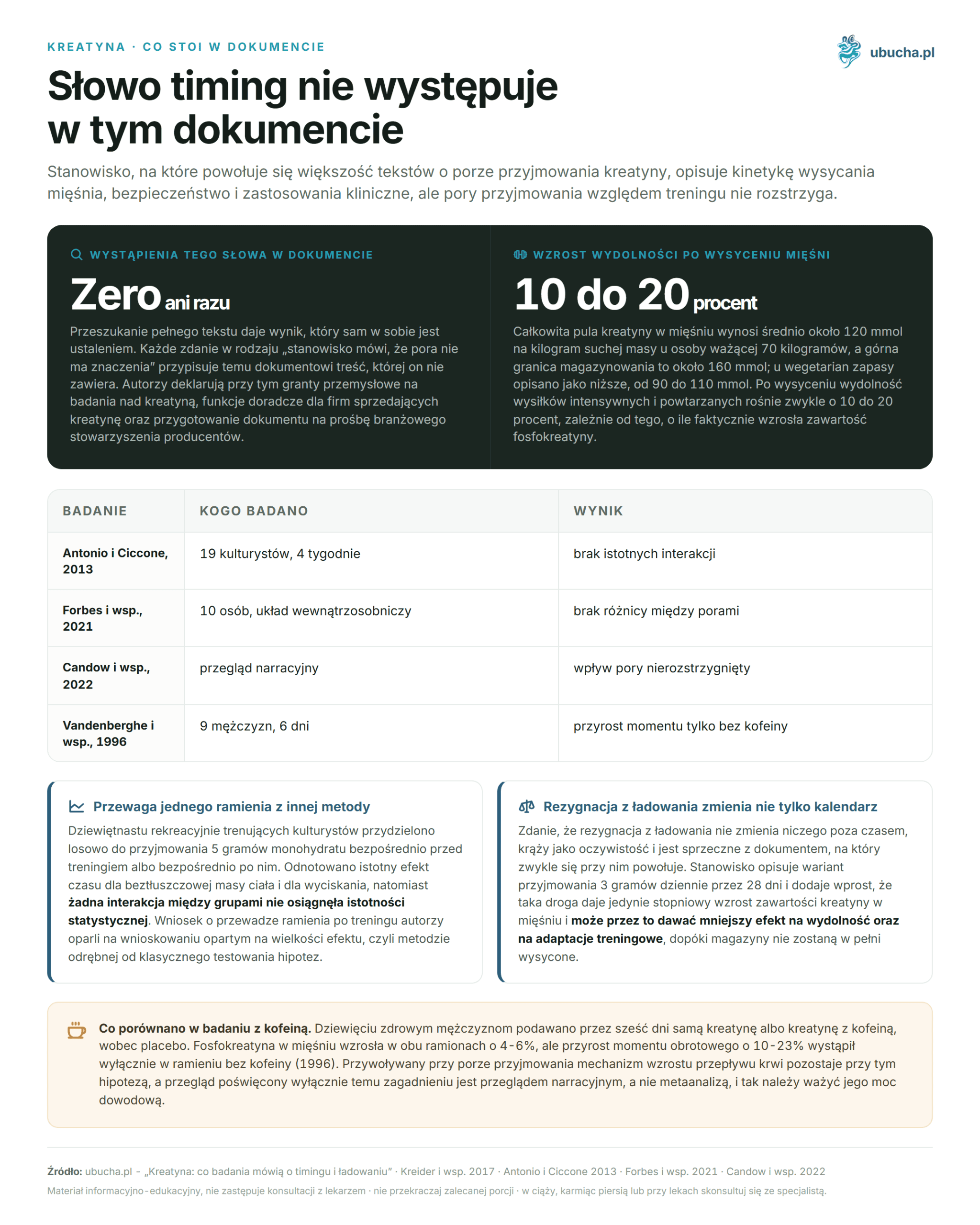
• The ISSN position from 2017, which most texts on creatine timing refer to, does not contain the word timing even once.
• A study comparing intake before and after training in 19 recreational bodybuilders did not show significant interactions; the advantage of the post-training arm is based solely on inference based on effect size.
• An intra-subject study in 10 individuals over 8 weeks showed no difference between intake before and after training.
• The popular statement that skipping loading changes nothing but the time is contrary to the content of the cited position.
• The authors of this position declare grants and consulting from companies selling creatine.
What does the ISSN position actually resolve, and what does it not?
The position of the International Society of Sports Nutrition from 2017 is the most frequently cited document on this topic (Kreider et al., Journal of the International Society of Sports Nutrition, 2017). It is worth checking what it states. A search of the full text yields a result that is in itself a determination: the word timing does not appear in this document even once. The position describes the kinetics of muscle saturation, safety, and clinical applications, but does not resolve the timing of intake relative to training. Any sentence like “ISSN says that timing does not matter” assigns content to this document that it does not contain.
The document does provide values describing muscle storage. The total pool of creatine in the muscle averages about 120 mmol per kilogram of dry mass in a person weighing 70 kilograms, and the upper limit of storage is about 160 mmol per kilogram. In vegetarians, stores are described as lower, ranging from 90 to 110 mmol per kilogram of dry mass. After saturating the muscles, performance in intense and repeated efforts usually increases by 10 to 20 percent, depending on how much the content of phosphocreatine actually increased.
There is also a layer that no citation-checking tool will show. In the conflict of interest section, the authors of this position declare, among other things, industrial grants for research on creatine, advisory roles for companies selling creatine, and preparation of the document at the request of the industry association of supplement manufacturers. This does not invalidate the content, but the reader has the right to know this before treating this text as a fully independent voice.
What exactly was compared in studies on timing of intake?
There are few studies directly comparing two timings, and they are small. In the first, nineteen recreationally training bodybuilders were randomly assigned to take 5 grams of monohydrate either directly before training or directly after. They trained an average of five days a week for four weeks, measuring body composition and maximum bench press. Result: a significant effect of time for lean body mass and for bench pressing, while no interaction between groups reached statistical significance. The conclusion of the advantage of the post-training arm was based on inference based on effect size, a method separate from classical hypothesis testing (Antonio and Ciccone, Journal of the International Society of Sports Nutrition, 2013).
The second study was designed to eliminate differences between individuals. Ten active participants took monohydrate before training on one side of the body and placebo after, while on the other side of the body the setup was reversed; the unilateral training involved forearm flexion and knee extension over eight weeks. Muscle thickness and maximum strength increased significantly over time, but there was no difference between the two intake strategies (Forbes et al., Journal of Sports Medicine and Physical Fitness, 2021).
A review dedicated solely to this issue cautiously summarizes the state of knowledge: it is unknown whether the timing of intake affects mass gain and performance, and the cited mechanism of increased blood flow remains a hypothesis (Candow et al., Frontiers in Sports and Active Living, 2022). This is a narrative review, not a meta-analysis, and its evidential strength should be weighed accordingly.
| Study | Who was studied | What was compared | Result |
|---|---|---|---|
| Antonio and Ciccone, 2013 | 19 recreational bodybuilders, 4 weeks | 5 g before training vs 5 g after training | No significant interactions; advantage of post-training arm only based on inference based on effect size |
| Forbes et al., 2021 | 10 active individuals, 8 weeks, intra-subject design | Before training vs after training, unilateral training | No difference in muscle thickness and maximum strength |
| Candow et al., 2022 | Narrative review | Collected studies on timing of intake | The effect of timing of intake remains unresolved |
| Vandenberghe et al., 1996 | 9 healthy men, 6 days | Creatine alone vs creatine with caffeine vs placebo | Phosphocreatine in muscle increased in both arms by 4-6%, but the increase in torque by 10-23% occurred only without caffeine |
Does skipping loading only change the time to saturation?
This statement circulates as an obvious truth and is contrary to the document usually cited with it. The ISSN position describes an alternative variant to loading, which is taking 3 grams daily for 28 days, and adds directly that this approach provides only a gradual increase in creatine content in the muscle compared to the faster loading method and may therefore yield a smaller effect on performance and training adaptations until stores are fully saturated. Elsewhere, the same document notes that with smaller doses, storage increases over three to four weeks, and the initial performance effects of such a method are less well documented.
The difference thus concerns not only the calendar. It also pertains to what happens during the transitional period before the storage is filled. The statement “the final effect is identical, only the time changes” oversimplifies this by one layer too much, and it is precisely this layer that someone planning to start in a few weeks is asking about.
On the other hand, there is a meta-analysis of 53 studies on upper limb strength, involving 563 individuals in the creatine arm and 575 individuals in control groups. It showed a moderate effect on strength, and meta-regression found no relationship between effectiveness and loading phase, total dose, or duration of supplementation (Lanhers et al., Sports Medicine, 2017). These two sources are not contradictory, as they measure different things: one describes the rate of muscle saturation, the other the cumulative strength effect at the end of the study.
What is known about combining creatine with other ingredients?
The best-described thread here is caffeine, and it looks the opposite of what the popular version of the myth claims. Nine healthy men received placebo, creatine alone, or creatine together with caffeine for six days. The concentration of phosphocreatine in the muscle increased by 4 to 6 percent in both arms with creatine, but the increase in torque by 10 to 23 percent occurred only without caffeine; the authors write that the ergogenic effect was completely negated by caffeine (Vandenberghe et al., Journal of Applied Physiology, 1996). No subsequent work has been identified that directly refutes this result. A fair summary is therefore: the observation comes from a single study and has not been repeated, and that is not the same as being refuted.
The ISSN position notes that taking creatine together with carbohydrates or with carbohydrates and protein more consistently promotes its retention in the muscle. This is a description of observations from retention studies, not a determination regarding the time of day.
Separately, the question about a plant-based diet returns. A systematic review of nine studies in vegetarians showed an increase in creatine and phosphocreatine concentrations in muscle, plasma, and red blood cells, often to values higher than in meat-eaters, as well as an increase in lean body mass, strength, and muscular endurance. However, the authors explicitly note that the results regarding whether the improvement in performance is greater in vegetarians than in meat-eaters are ambiguous (Kaviani et al., International Journal of Environmental Research and Public Health, 2020). The included studies were assessed as having moderate or high risk of bias.
Frequently Asked Questions
Does the ISSN position resolve the issue of when to take creatine?
No. A search of the full text of this document does not yield a single occurrence of the word timing. The position describes the kinetics of muscle saturation, safety, and clinical applications. Statements attributing it with resolving the timing dispute assign it content that it does not contain.
What did studies comparing intake before and after training show?
In a study of 19 recreational bodybuilders over four weeks, no interaction between groups reached statistical significance. In an intra-subject study of 10 individuals over eight weeks, no difference in muscle thickness or maximum strength was found between intake before and after training.
Does skipping the loading phase only change the time?
The cited position states otherwise. It describes a variant without loading as providing only a gradual increase in creatine content in the muscle, which may yield a smaller effect on performance until stores are fully saturated. The difference thus also includes the transitional period, not just the calendar.
How much creatine can muscle hold?
The cited position provides an average total pool of about 120 mmol per kilogram of dry muscle mass in a person weighing 70 kilograms and an upper limit of storage of about 160 mmol per kilogram. In vegetarians, lower stores were described, ranging from 90 to 110 mmol per kilogram of dry mass.
Does caffeine interact with creatine?
A 1996 study found that caffeine negates the performance benefit gained from muscle saturation with creatine. No subsequent work has been identified that directly refutes this result. A fair summary is therefore: the observation comes from a single study and has not been repeated.
Do people on a plant-based diet respond more strongly to creatine?
A review of nine studies in vegetarians showed an increase in creatine concentration in muscle and an increase in lean body mass and strength. As for whether the improvement in performance is greater than in meat-eaters, the authors describe the results as ambiguous. Baseline stores in vegetarians are lower.
How long does saturation last after discontinuation?
The cited position states that after increasing creatine stores in the muscle, return to baseline values usually takes four to six weeks. The document does not describe the need for planned breaks in supplementation for safety reasons.
Is monohydrate different from other forms of creatine?
Monohydrate has the broadest research base and it was used in the studies described in this text, including both studies on timing. Alternative forms, such as malate, hydrochloride, or buffered creatine, have a significantly narrower evidence base, which is a separate question from the scheduling question.
If you are interested in what creatine offers beyond the schedule itself, read the text about what creatine gives and whether it is only for strength athletes. Similarly structured data can be found in the review of studies on beta-alanine, and compliance issues are discussed in the text about supplements for athletes without doping.
This article is for informational and educational purposes only and does not constitute medical advice. Before starting supplementation, consult your doctor, especially if you are taking medications regularly, are pregnant or breastfeeding, or have a chronic illness.
Author: Michał Waluk · Published: 2026-08-09 · Updated: 2026-08-16