
Colostrum for Athletes: Does It Protect Against Respiratory Infections
What studies really showed about bovine colostrum in training individuals: fewer days with respiratory symptoms, but without confirmation of the mechanism through IgA in saliva.
A simple story has grown around bovine colostrum: intense training lowers antibody levels in saliva, colostrum replenishes them, so athletes get sick less often. The last link in this chain is supported by data, although weaker than usually stated. The middle link has no support, and the study that directly tested it did not confirm the mechanism. This article separates these three layers: what was measured in terms of the number of infections, what was measured on immune markers, and where the known information ends. It also shows why the numbers circulating in supplement descriptions can be higher than those in the publications they refer to. Distinguishing the endpoint is practically significant here, as the number of days with a runny nose, the concentration of antibodies in saliva, and the integrity of the intestinal barrier are three separate measurements, each measured in a different group of subjects and for a different duration.
KEY INFORMATION
• A systematic review of five studies involving 152 training individuals showed fewer days with respiratory symptoms in the colostrum group than in the control group (Jones et al., 2016).
• The best-designed study in this group showed no effect of colostrum on salivary secretory IgA, which is the mechanism usually cited (Jones et al., 2014).
• Four out of five studies in this review were rated as having moderate or high risk of systematic error.
• A study of rowers showed no effect of colostrum on plasma buffering capacity or hemoglobin.
• A separate line of research concerns the intestinal barrier, not the respiratory tract, and these are two different endpoints.
What is bovine colostrum and what does it contain?
Colostrum is the first secretion of the mammary gland after birth, produced during the first few hours. Bovine colostrum differs from regular cow’s milk primarily in its content of immunoglobulins, predominantly IgG, and the presence of lactoferrin and growth factors. It is these components that have led to the product’s entry into sports.
A review dedicated to the action of bovine immunoglobulins in humans describes that orally administered bovine IgG can be recovered from feces in amounts ranging from very small to half the ingested dose, with infants having a higher percentage than adults due to differences in stomach pH and intestinal conditions (Ulfman et al., Frontiers in Nutrition, 2018). The authors’ conclusion is cautious and worth remembering when reading commercial descriptions: the antibody retains activity in the lumen of the gastrointestinal tract, not in the bloodstream. The same review notes that studies differ in population, source of immunoglobulins, dosage, and measured endpoint to such an extent that it is difficult to draw a general conclusion about effectiveness.
For the reader, this means one practical thing. Statements about rebuilding the body’s immunity through colostrum describe something different than what was studied. The studies examined local action in the gastrointestinal tract and the number of reported symptoms, not the concentration of antibodies in the blood.
Does colostrum reduce the number of respiratory infections?
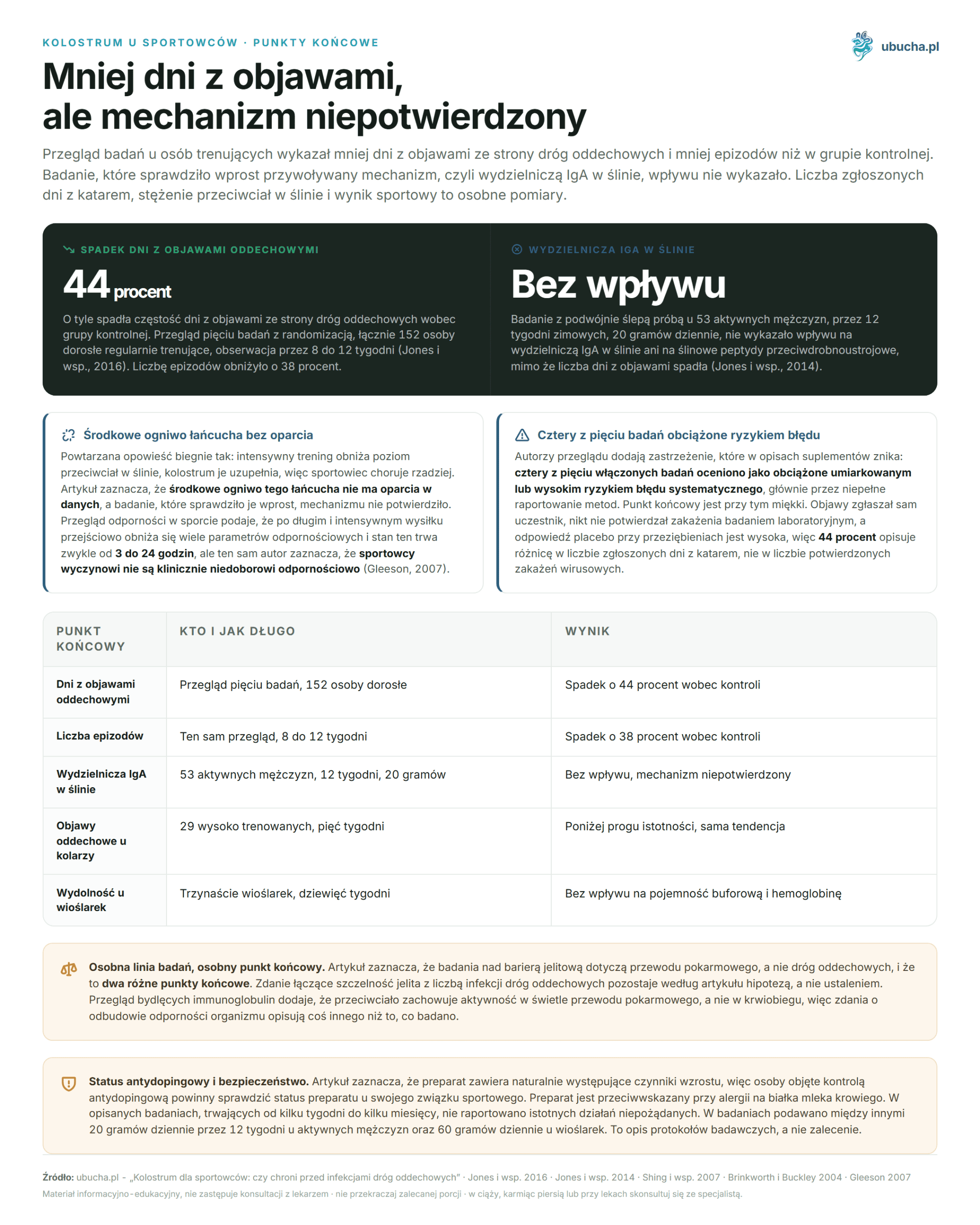
At the level of counted symptoms, the answer is: probably yes, with weak quality of evidence. A systematic review with meta-analysis included five randomized studies and a total of 152 adult individuals regularly training, observed for 8 to 12 weeks. Bovine colostrum reduced the frequency of days with respiratory symptoms by 44 percent and the number of episodes by 38 percent compared to the control group (Jones et al., BMC Sports Science, Medicine and Rehabilitation, 2016). The authors add a caveat that disappears in supplement descriptions: four out of five included studies were rated as having moderate to high risk of systematic error, mainly due to incomplete reporting of methods.
Individual studies align similarly. A paper published in the European Journal of Nutrition compared 93 individuals taking concentrated colostrum protein with 81 individuals taking whey protein over eight weeks. Infection symptoms were reported by 32 percent of individuals in the first group and 48 percent in the second, and the difference was statistically significant. The duration of symptoms did not differ between groups (Brinkworth and Buckley, European Journal of Nutrition, 2003). It is worth noting that this work was not a new randomized study but a re-analysis of symptom diaries from previous studies by this team.
The endpoint here is very soft. Symptoms were reported by the participant themselves, no one confirmed the infection with laboratory testing, and the placebo response in colds is high. Therefore, the number 44 percent describes the difference in the number of reported days with a runny nose, not in the number of confirmed viral infections.
Does it work through salivary secretory IgA?
This has not been confirmed, although it is the most frequently repeated explanation. It was directly tested in a double-blind study in which 53 active men received either 20 grams of colostrum or a placebo matched for energy and macronutrients over 12 winter weeks. The colostrum group had a significantly lower percentage of days with respiratory symptoms and fewer episodes. At the same time, no effect was found on salivary secretory IgA, neutrophil oxidative burst, or salivary antimicrobial peptides, which, as the authors write, does not confirm previously suggested mechanisms (Jones et al., Brain, Behavior, and Immunity, 2014). However, something else was observed: in the placebo group, the bacterial load in saliva increased over 12 weeks, while in the colostrum group, this increase was weaker.
The physiological background of the phenomenon itself is better described than the role of colostrum in it. A review dedicated to immunity in sports states that after prolonged and intense effort, many immune parameters temporarily decrease, and this state usually lasts from 3 to 24 hours and depends on the intensity and duration of the effort. However, the same author notes that elite athletes are not clinically immune-deficient (Gleeson, Journal of Applied Physiology, 2007). Values such as a drop in IgA by half, circulating in texts about supplements, do not come from this work.
What did the studies measure besides the number of infections?
Distinguishing endpoints is more important here than usual, as strength, buffering capacity, antibody levels, and the number of infections are four different things, and a study measuring one does not support a statement about the other. In a study of 29 highly trained road cyclists, 10 grams of colostrum protein concentrate was given daily for five weeks, after which participants underwent five days of high-intensity training. Supplementation increased the concentration of soluble receptor 1 for TNF, mitigated the post-exercise drop in cytotoxic and suppressor lymphocytes, and prevented the drop in IgG2 concentration in serum. The difference in the frequency of respiratory symptoms did not reach significance and remained at a trend level (Shing et al., Journal of Applied Physiology, 2007).
Separately, performance parameters were checked, and the result was negative. Thirteen elite female rowers received either bovine colostrum or whey protein for nine weeks of pre-competition training. Plasma buffering capacity increased in both groups, but the difference between them was not significant, and hemoglobin concentration did not change in either group (Brinkworth and Buckley, European Journal of Applied Physiology, 2004). This is a negative result and should be read as such.
Colostrum is also sold as a means to support strength and muscle mass. Data in this area come from small trials comparing colostrum with whey protein, which is an active comparator, not a placebo. The justification for colostrum is strongest where symptoms were counted, not where sports performance was measured.
Does colostrum protect the intestinal barrier during exercise?
This is a second, completely separate line of research and is confused with the first more often than it should be. Prolonged effort redirects blood from the intestines to the muscles, which increases intestinal permeability. In a study with an alternating design, twelve volunteers took colostrum or placebo for 14 days before standardized exercise. In the placebo arm, intestinal permeability increased two and a half times after exercise, while colostrum limited this increase by 80 percent (Marchbank et al., American Journal of Physiology, 2011).
Earlier work in the same vein studied not exercise but anti-inflammatory drugs. Seven healthy volunteers took indomethacin for five days along with colostrum or whey protein as a control. In the control arm, permeability increased threefold, while no significant increase was recorded with colostrum. The second part of the same work, involving 15 patients chronically taking anti-inflammatory drugs, showed no effect of the tested preparations (Playford et al., Clinical Science, 2001).
It is also worth being cautious about the shortcut thinking that connects the gut to the lungs. A study in which 29 athletes after a long-distance triathlon showed mild endotoxemia also found that its severity did not correlate with gastrointestinal complaints or interleukin 6 response (Jeukendrup et al., Clinical Science, 2000). Therefore, the statement linking gut integrity with the number of respiratory infections remains a hypothesis, not an establishment.
Frequently Asked Questions
Does colostrum reduce the number of respiratory infections in athletes?
A review of five randomized studies involving 152 individuals showed 44 percent fewer days with respiratory symptoms and 38 percent fewer episodes than in the control group. Four out of five studies had moderate to high risk of systematic error, and symptoms were reported by the participants themselves without laboratory confirmation.
Does colostrum increase IgA levels in saliva?
A double-blind study of 53 active men over 12 weeks showed no effect of colostrum on salivary secretory IgA, despite a decrease in the number of days with symptoms. The authors state that the result does not confirm previously suggested mechanisms. However, a smaller increase in bacterial load in saliva was observed.
What doses and durations were used in the studies?
Studies on respiratory symptoms lasted from 8 to 12 weeks. Among other things, 20 grams daily for 12 weeks was used in active men, 60 grams daily for eight weeks in adult men, and 10 grams daily for five weeks in cyclists. This is a description of research protocols, not a recommendation.
Does colostrum improve endurance or strength?
A study of thirteen elite female rowers taking 60 grams daily for nine weeks showed no effect on plasma buffering capacity or hemoglobin. Data on strength and muscle mass come from small trials with whey protein as a comparator. The best-documented endpoint remains the number of reported symptoms.
Is bovine colostrum safe?
In the described studies, lasting from several weeks to several months, no significant adverse effects were reported. The product is contraindicated in case of allergy to cow’s milk proteins. It contains naturally occurring growth factors, so individuals subject to anti-doping control should check the product’s status with their sports association.
If you are looking for a broader context, read the text about what colostrum is and whether it is worth supplementing beyond infancy, and the compilation of data on NAC in respiratory infections. Athletes may also find a review of studies on recovery after training useful. You can find colostrum products in the supplements category.
This article is for informational and educational purposes and does not replace consultation with a doctor. If you are pregnant, breastfeeding, taking medications, or have chronic conditions, consult the use of supplements or herbs with a specialist.
Author: Michał Waluk · Published: 2026-08-09 · Updated: 2026-08-16