
Coenzyme Q10 and Male Fertility: Improves Semen, But Does It Lead to Pregnancies
Coenzyme Q10 improves semen parameters, but the meta-analysis did not show an increase in pregnancy rates or live births. What exactly was studied and where the evidence ends.
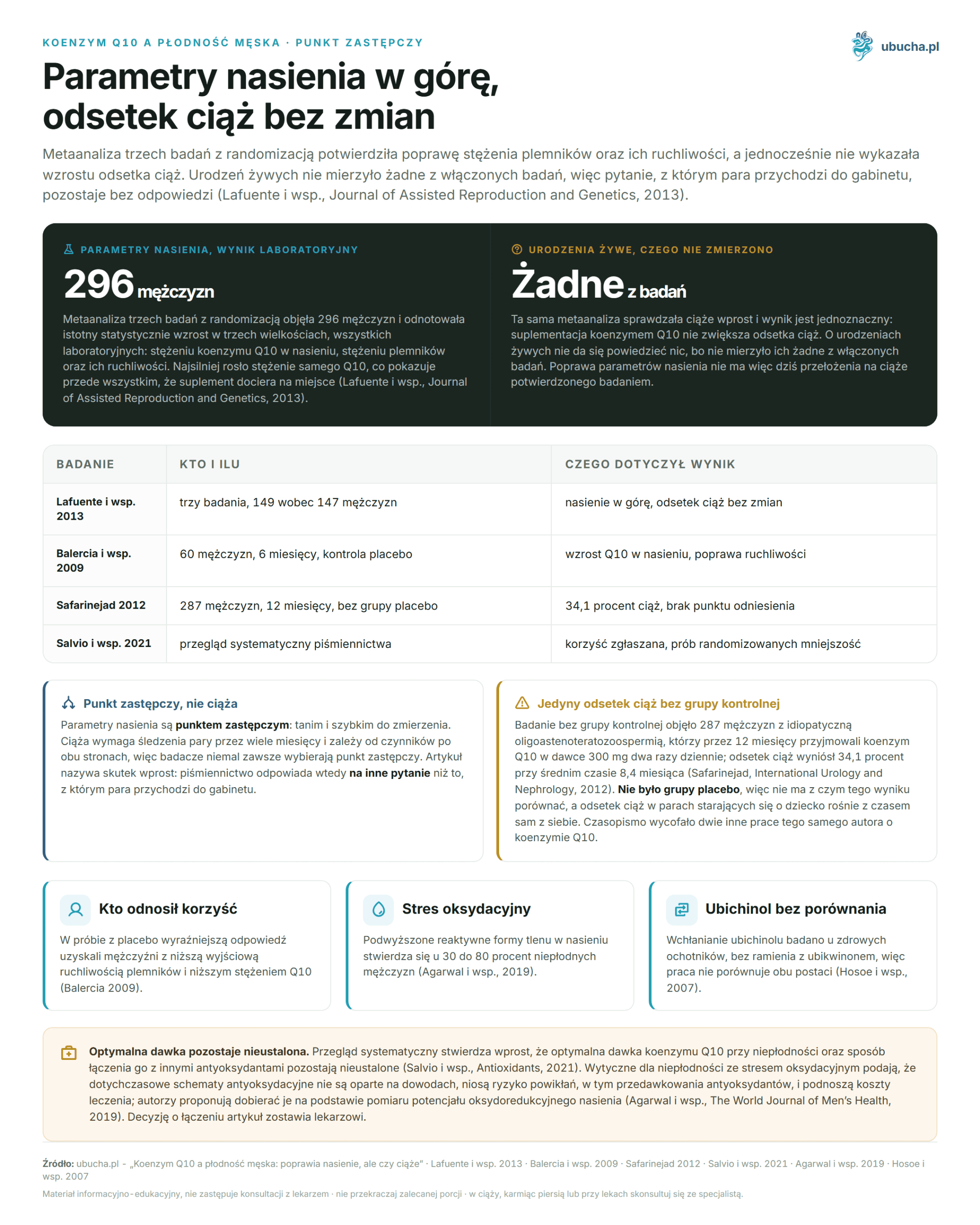
Coenzyme Q10 regularly comes up in discussions about male infertility, and there are good reasons for this: it improves measurable semen parameters. The problem arises with the question that really interests couples. A meta-analysis of three randomized studies, involving 296 men, states directly that coenzyme Q10 supplementation does not increase pregnancy rates, and no data on live births was provided by any of the included studies (Lafuente et al., Journal of Assisted Reproduction and Genetics, 2013). This divergence between the laboratory and real life is the main theme of this text. Below you will find what exactly was measured, how strong the individual studies are, and why the only positive result regarding pregnancies requires very careful reading.
KEY INFORMATION
• The meta-analysis of three randomized studies did not show an increase in pregnancy rates after coenzyme Q10, and no study measured live births (Lafuente et al., Journal of Assisted Reproduction and Genetics, 2013).
• The same meta-analysis confirmed an improvement in sperm concentration and motility.
• Elevated reactive oxygen species in semen is found in 30 to 80 percent of infertile men (Agarwal et al., The World Journal of Men’s Health, 2019).
• The optimal dose of Q10 for infertility and the way to combine it with other antioxidants remain undetermined (Salvio et al., Antioxidants, 2021).
Why coenzyme Q10 for male infertility?
Because it combines two functions needed by sperm simultaneously. It is a cofactor in the respiratory chain, meaning it participates in the production of ATP that powers the tail’s movement, and it acts as a fat-soluble antioxidant, protecting membranes from oxidation. Sperm have an exceptionally high amount of membranes and exceptionally low repair reserves.
The second reason is the scale of oxidative stress in this group. Elevated levels of reactive oxygen species in semen are found in 30 to 80 percent of infertile men, and the damage mechanism includes impaired capacitation and possible damage to the membrane and DNA of sperm (Agarwal et al., The World Journal of Men’s Health, 2019). The authors propose a separate diagnostic name for this group to distinguish it from idiopathic infertility understood as unexplained infertility.
It is worth noting the proportions right away. Infertility affects about 15 percent of couples, and the male factor is involved in half of the cases; antioxidant therapy falls into the category of empirical treatment, meaning it is used despite incomplete knowledge of the mechanism (Salvio et al., Antioxidants, 2021). If you are interested in the relationship itself outside the context of fertility, we have a separate general guide to coenzyme Q10.
What does the meta-analysis say about semen parameters?
That the improvement is real and measurable, but narrow. Three studies were included in the analysis: 149 men received coenzyme Q10, and 147 placebo. A statistically significant increase was noted in three parameters, all laboratory-based (Lafuente et al., Journal of Assisted Reproduction and Genetics, 2013).
The concentration of coenzyme Q10 in semen increased the most, which primarily shows that the supplement reaches its destination. The concentration of sperm in the ejaculate and their motility also increased. The authors summarize this as an overall improvement in semen parameters while also noting that appropriately large studies on individual antioxidants and their combinations are needed.
A newer systematic review collects the same picture more broadly and adds a methodological caveat: all studies report a beneficial effect of Q10 on semen parameters, but randomized studies constitute a minority among them (Salvio et al., Antioxidants, 2021). This means that the majority of the literature consists of studies without a control group, in which it is impossible to separate the effect of the preparation from the natural variability of semen test results.
Does the improvement in semen translate to pregnancies?
So far, there is no evidence for this. The meta-analysis examined this point directly, and the result is clear: coenzyme Q10 supplementation does not increase pregnancy rates, and nothing can be said about live births, as none of the included studies measured them (Lafuente et al., Journal of Assisted Reproduction and Genetics, 2013).
The reason for this state of affairs is practical. Semen parameters are a surrogate endpoint, cheap and quick to measure, while pregnancy requires tracking a couple for many months and depends on factors on both sides. We have noticed that researchers almost always choose a surrogate endpoint, which means the literature answers a different question than the one the couple brings to the office.
One study reports the pregnancy rate and is often cited as evidence, but it is important to know what it is. It involved 287 men with idiopathic oligoasthenoteratozoospermia who took coenzyme Q10 at a dose of 300 mg twice daily for 12 months. After a year, the pregnancy rate was 34.1 percent with an average time of 8.4 months (Safarinejad, International Urology and Nephrology, 2012). However, there was no placebo group, so there is nothing to compare this result to, and the pregnancy rate in couples trying to conceive increases over time on its own. Additional caution is warranted here: two other works by the same author regarding coenzyme Q10 have been retracted by the journal.
What does the strongest single study look like?
It is a randomized, placebo-controlled trial conducted using a double-blind method at an Italian andrology clinic. It involved 60 infertile men aged 27 to 39, of whom 55 completed the study. The scheme included a one-month preliminary phase, six months of treatment or placebo, and three months of observation after discontinuation (Balercia et al., Fertility and Sterility, 2009).
| Study | Who and how many | What the result concerned |
|---|---|---|
| Lafuente et al. 2013 | meta-analysis of three trials, 149 vs 147 men | semen parameters up, pregnancy rates unchanged |
| Balercia et al. 2009 | 60 men, 6 months, placebo control | increase in Q10 in semen, improvement in sperm motility |
| Safarinejad 2012 | 287 men, 12 months, no control group | pregnancy rate 34.1 percent, no reference point |
| Salvio et al. 2021 | systematic review of the literature | benefit commonly reported, randomized trials minority |
Two details from this study are worth knowing. First, both coenzyme Q10 and ubiquinol increased in both seminal plasma and in the sperm themselves, and motility improved simultaneously. Second, a more pronounced response was observed in men who started with lower sperm motility and lower baseline Q10 concentration. This suggests supplementation of a deficiency rather than a strengthening effect for everyone.
Is ubiquinol better than ubiquinone?
It is unknown, and that is a fair answer. Ubiquinol is the reduced form of coenzyme Q10, while ubiquinone is the oxidized form. The absorption of ubiquinol was studied in healthy volunteers after single doses of 150 and 300 mg, as well as after four weeks of taking 90, 150, or 300 mg daily; absorption was evident, and plasma concentration increased with the dose in a nonlinear manner (Hosoe et al., Regulatory Toxicology and Pharmacology, 2007).
What this study does not contain is more important than what it does contain. There was no arm with ubiquinone, so this work does not compare the two forms with each other and cannot be the basis for claiming that one is absorbed several times better. It also did not involve men being treated for infertility, but healthy volunteers.
In the literature on fertility, the situation is similar. A systematic review states directly that the optimal dose of coenzyme Q10 remains unknown (Salvio et al., Antioxidants, 2021), and the meta-analysis combined trials without separating the forms of the preparation (Lafuente et al., Journal of Assisted Reproduction and Genetics, 2013). Therefore, the choice between ubiquinol and ubiquinone does not currently have a basis in comparative studies on semen.
Should coenzyme Q10 be combined with other antioxidants?
Cautiously and not on your own. Guidelines for infertility with oxidative stress state directly that existing antioxidant regimens are not evidence-based, carry risks of complications, and increase treatment costs; the authors suggest selecting them based on measuring the oxidative-reduction potential of semen, among other things, to avoid antioxidant overdose (Agarwal et al., The World Journal of Men’s Health, 2019).
The direction of combining has a basis, as oxidative stress in semen has many sources. Folic acid is studied, for example, for its effect on sperm DNA stability: in an observational study of 251 men from couples treated with in vitro fertilization, low folate levels in seminal plasma were associated with a higher DNA fragmentation rate (Boxmeer et al., Fertility and Sterility, 2009). This is an observational relationship, not proof of supplement efficacy.
However, what determines practice is missing: the way to combine coenzyme Q10 with other antioxidants to enhance the effect remains undetermined (Salvio et al., Antioxidants, 2021). If you are looking for related topics based on randomized studies, we have separately described the role of zinc in semen quality and results regarding ashwagandha and semen parameters.
Frequently Asked Questions
Does coenzyme Q10 improve semen parameters?
Yes, in terms of laboratory parameters. A meta-analysis of three randomized studies involving 149 men receiving Q10 and 147 placebo showed a significant increase in coenzyme Q10 concentration in semen, sperm concentration, and their motility (Lafuente et al., Journal of Assisted Reproduction and Genetics, 2013).
Does coenzyme Q10 increase the chances of pregnancy?
There is no evidence for this. The meta-analysis examined this point directly and found no increase in pregnancy rates, and no included study measured live births (Lafuente et al., Journal of Assisted Reproduction and Genetics, 2013). A single study reporting a pregnancy rate of 34.1 percent had no control group (Safarinejad, International Urology and Nephrology, 2012).
How long did the studies on coenzyme Q10 and semen last?
From several months to a year. The placebo-controlled trial involved six months of treatment and three months of observation after discontinuation in 60 men (Balercia et al., Fertility and Sterility, 2009). The largest study without a control group lasted 12 months and included 287 men (Safarinejad, International Urology and Nephrology, 2012).
Who benefited the most from coenzyme Q10?
Men with poorer baseline parameters. In the placebo-controlled trial, those who started with lower sperm motility and lower baseline coenzyme Q10 concentration showed a more pronounced response (Balercia et al., Fertility and Sterility, 2009). This indicates supplementation of a deficiency rather than a strengthening effect for everyone.
Is it worth combining coenzyme Q10 with other antioxidants?
The decision should be left to the doctor. Guidelines for infertility with oxidative stress state that existing antioxidant regimens are not evidence-based and carry risks of complications, including antioxidant overdose (Agarwal et al., The World Journal of Men’s Health, 2019). The optimal way to combine remains undetermined (Salvio et al., Antioxidants, 2021).
Products containing coenzyme Q10 can be found in the supplements category.
This article is for informational and educational purposes only and does not constitute medical advice. Before starting supplementation, consult your doctor, especially if you are taking medications regularly, are pregnant or breastfeeding, or have a chronic illness.
Author: Michał Waluk · Published: 2026-08-09 · Updated: 2026-08-11