
CBD and the 5-HT2A Receptor: A Psychedelic Receptor Seen Differently Than with LSD
Psilocybin acts through 5-HT2A, which has been confirmed in humans. For CBD, this receptor has only been described in preliminary binding studies on rat receptors.
LSD, psilocybin, and mescaline induce psychedelic effects through the serotonin receptor 5-HT2A. There is evidence for this claim in humans: ketanserin, an antagonist of this receptor, dose-dependently abolished the psychotomimetic effects of psilocybin in healthy volunteers (Vollenweider et al., Neuroreport, 1998). There is a story circulating about CBD acting on the same receptor in the opposite way, that is, as an antagonist. We checked what actually lies behind this statement by referring to primary studies instead of subsequent summaries. The answer is much more modest than it sounds in popular texts and leads to another serotonin receptor. This article shows where the line between measurement and speculation lies, and provides the material on which each claim is based.
KEY INFORMATION
• The psychedelic effect of psilocybin in humans is abolished by ketanserin, an antagonist of 5-HT2A, making this receptor a confirmed target of classic psychedelics (Vollenweider et al., Neuroreport, 1998).
• For CBD on the 5-HT2A receptor, there are only preliminary data from binding studies on cloned rat receptors, weaker than for 5-HT1A (Russo et al., Neurochemical Research, 2005).
• The serotonin receptor on which CBD has been described as an agonist is 5-HT1A, not 5-HT2A.
• A systematic review of 65 described molecular targets of CBD warns that some of them only reveal themselves at supra-physiological concentrations in vitro.
What is the 5-HT2A receptor and where is it located?
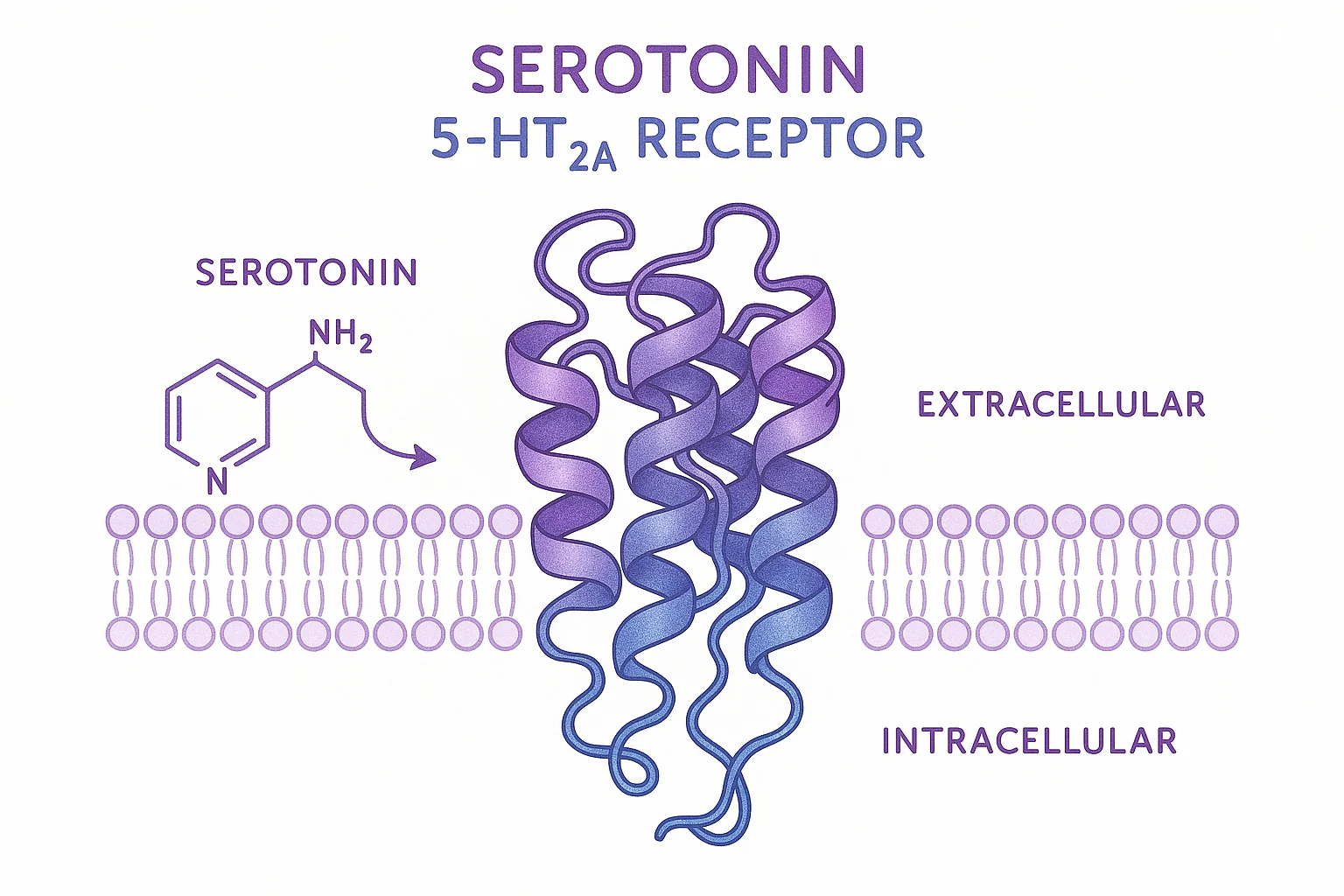
The 5-HT2A receptor belongs to the family of serotonin receptors coupled with Gq proteins. Upon activation, it triggers phospholipase C, which increases intracellular calcium levels and activates protein kinase C. The signal is not a simple opening of a channel, but a cascade spread over seconds and minutes. In the neocortex, the receptor is particularly dense in the fifth layer of pyramidal neurons, which are cells that gather information from many areas of the brain.
This distribution explains the profile of psychedelic actions. Its presence in the visual cortex is associated with visual hallucinations, while in the prefrontal cortex, it is linked to changes in the sense of self. The receptor is also found in the amygdala and hippocampus, which broadens the spectrum of effects beyond just the visual layer of the cortex.
Besides psychedelia, 5-HT2A is involved in regulating synaptic plasticity and glutamatergic transmission. Atypical antipsychotic drugs, such as clozapine and olanzapine, are strong antagonists of this receptor. Vollenweider himself noted that overactivity of this receptor may play a role in the pathophysiology of schizophrenia, and its blockade is involved in the action of drugs. More about the role of this receptor in brain plasticity is discussed in the text about psychedelics and plasticity.
What has actually been measured for CBD on the 5-HT2A receptor?
Less than most cannabis texts suggest. The only primary data we found come from a study by Russo and colleagues from 2005. This is a cell culture study primarily focused on the 5-HT1A receptor. The data on 5-HT2A are described by the authors as preliminary and comparative: they come from cloned rat receptors, are limited to binding analyses, and show that CBD is active there, but weaker than against human 5-HT1A (Russo et al., Neurochemical Research, 2005).
Such a measurement does not indicate the direction of action. A binding study indicates that a molecule occupies a place on the receptor. It does not say whether, after occupying this place, the receptor activates, deactivates, or drops below its resting activity. A functional test is needed to resolve this, and we did not find one for CBD on 5-HT2A. Therefore, statements about antagonism and inverse agonism describe two different directions, neither of which has been measured.
Caution is also suggested by a systematic review of CBD’s molecular targets. The authors counted over 65 described targets in the primary literature and assessed the reliability of each. Their conclusion is harsh: some effects only reveal themselves at concentrations difficult to achieve in the body, and many targets were assigned based solely on correlation (Ibeas Bih et al., Neurotherapeutics, 2015).
Which serotonin receptor does CBD actually activate?
The 5-HT1A receptor, and in the opposite direction than the popular version about blocking. In the same 2005 study, CBD displaced the agonist from the cloned human 5-HT1A receptor depending on the concentration, increased G protein binding, and decreased cyclic AMP levels, behaving like an agonist with moderate affinity. THC did not displace the agonist at all in the same concentration range.
This distinction matters because it reverses the meaning of the entire story. At the receptor where CBD’s action has been best documented, cannabidiol activates the receptor, not deactivates it. The anxiolytic mechanism leading this way is described separately in the entry about the 5-HT1A receptor, along with experiments in which an antagonist of this receptor weakened the action of cannabidiol.
We noticed that confusing these two receptors is surprisingly common in cannabis texts, and it is not a mere editorial detail. Swapping 5-HT1A for 5-HT2A changes both the receptor and the direction of action, as well as the expected effect. A statement built on such a swap sounds all the more credible the more details it has, because details mask the fact that there is no measurement underneath.
How do ligands acting on the same receptor differ?
Occupying a receptor and activating it are two different things. An agonist shifts the protein to an active state, an antagonist occupies the place and lets no one in, while an inverse agonist lowers activity below the resting level. The table below compares the discussed substances with the material on which they were studied, because without it, all look equally certain.
| Substance | Described action on 5-HT2A | Measured on |
|---|---|---|
| Serotonin | Natural agonist | Basic pharmacology of the receptor |
| Psilocybin | Agonist, psychotomimetic effects | Healthy volunteers, blockade by ketanserin abolished the effect |
| Clozapine, olanzapine | Strong antagonism | Pharmacology of antipsychotic drugs |
| CBD | Activity in binding study, direction undetermined | Cloned rat receptor, preliminary data |
| CBD against 5-HT1A | Agonist with moderate affinity | Cell culture, cloned human receptor |
The two bottom rows refer to the same substance and the same publication. They differ in receptor, species, type of test, and strength of conclusion. The row for 5-HT1A describes a functional measurement, while the row for 5-HT2A is solely binding.
Popular comparisons place CBD in the same row as clozapine, that is, with drugs with documented antagonism. There is no basis for this. Without the column for research material, all rows would appear to be equivalent, and the difference between evidence in humans and preliminary measurements on rodent receptors would vanish without a trace.
What did brain imaging studies show after CBD administration?
They showed real differences in brain activity, but did not measure any receptor. Bhattacharyya and colleagues examined 15 healthy men with minimal prior contact with cannabis using functional magnetic resonance imaging. Each was scanned three times after oral administration of THC, CBD, or placebo, during memory tasks, response inhibition, auditory stimulus processing, and viewing faces expressing fear (Bhattacharyya et al., Neuropsychopharmacology, 2010).
THC and CBD produced opposite directions of activity changes in the striatum, hippocampus, amygdala, and superior and occipital cortices. In a separate experiment, six volunteers were administered THC intravenously, once after CBD, once after placebo. Administering CBD before THC prevented acute psychotic symptoms.
It is worth noting what is not present in this work. There is no measurement of receptor occupancy, no labeled ligand, and no resolution of which of the more than sixty described targets of CBD corresponds to the observed image. Attributing these results to antagonism against 5-HT2A is adding a mechanism to a measurement that did not study any mechanism.
Another inconsistency concerns the conditions. Effects in the amygdala were noted when THC and CBD were administered in separate sessions, each after a different substance. The experiment with simultaneous administration of both compounds was separate and measured psychotic symptoms, not brain activity. A statement linking both results into one describes a study that was not conducted.
Does CBD alleviate psychosis and is it known through which receptor?
The clinical effect was measured, but the mechanism was not established. McGuire and colleagues studied 88 individuals with schizophrenia. Cannabidiol at a dose of 1000 mg per day or placebo was administered for six weeks as an adjunct to existing medications, not as a replacement. After six weeks, the group receiving CBD had fewer positive symptoms on the PANSS scale, with a difference of 1.4 points between groups (McGuire et al., American Journal of Psychiatry, 2018).
The authors did not indicate 5-HT2A. In conclusion, they wrote that the action of CBD does not seem to depend on blocking dopamine receptors, which distinguishes it from classic neuroleptics. Another clinical study indicated a different lead: treatment with cannabidiol increased serum anandamide levels, and this increase was associated with clinical improvement (Leweke et al., Translational Psychiatry, 2012). This lead is further developed in the text about CBD as an antipsychotic compound.
Another issue is the risk associated with cannabis itself. In a study involving 901 individuals with a first episode of psychosis and 1237 individuals from control groups in eleven centers in Europe and Brazil, daily use of cannabis containing at least 10 percent THC was associated with nearly five times higher odds of psychotic disorder (Di Forti et al., Lancet Psychiatry, 2019). The condition was daily use. The study did not divide the material by CBD content and did not determine a protective mechanism.
Would blocking 5-HT2A inhibit plasticity after psychedelics?
This reasoning circulates in texts about combining CBD with psychedelics, but it is based on an assumption that newer works challenge. LSD and psilocybin bind directly to the TrkB receptor, which is the receptor for the neurotrophic factor BDNF, with an affinity a thousand times higher than other antidepressants. In studies on mice, the impact of psychedelics on neurotrophic signaling, plasticity, and behavior depended on binding to TrkB and was independent of 5-HT2A receptor activation (Moliner et al., Nature Neuroscience, 2023).
However, the characteristic head twitch in mice, which is the behavioral equivalent of hallucinogenic action, depended on 5-HT2A. Separating these two pathways is important because the authors directly suggest the possibility of retaining the antidepressant effect without hallucinogenic action.
The conclusion for our topic is doubly negating. It has not been demonstrated that CBD blocks 5-HT2A, and even if it did, the plasticity induced by psychedelics does not run this way. Therefore, the statement about CBD inhibiting neuroplasticity stands on two unconfirmed premises at once.
The picture is not closed, however. Another work from the same year indicates that plasticity is triggered by 5-HT2A receptors located inside the cell, not on its surface. However, the conclusion of both works is common: the dependence of the kind “receptor blockade equals less plasticity” is not supported by measurements.
What is the status of CBD in food in the European Union?
Cannabidiol remains unauthorized as a novel food in the European Union, and the health notification submitted by the manufacturer is not an authorization and does not change the status of the ingredient. The clinical studies described above concerned a pharmaceutical preparation administered in hospital conditions, not a supplement, and do not transfer to products available for sale.
The EFSA panel on nutrition and novel foods updated its position on the safety of CBD in 2026. It derived a temporary safe dose of 0.0275 mg per kilogram of body weight per day, using an uncertainty factor of 400, and stipulated that this applies only to preparations with at least 98 percent purity. For individuals under 25 years of age, pregnant and breastfeeding women, and those taking medications simultaneously, safety cannot be established (EFSA NDA Panel, EFSA Journal, 2026).
The panel noted that data on neurological and psychiatric safety remain insufficient. For the text about the brain receptor, this caveat is one of the things that cannot be overlooked.
For the same reason, this article does not contain a reference to product categories. The text ends with the determination that the action of CBD on the described receptor has not been demonstrated, and a reference to the store shelf would suggest a benefit that the content does not support.
Frequently Asked Questions
Why is 5-HT2A called a psychedelic receptor?
Because its activation is responsible for the effects of classic psychedelics, and this has been confirmed in humans. Ketanserin, an antagonist of this receptor, dose-dependently abolished the psychotomimetic effects of psilocybin in healthy volunteers, while the dopamine antagonist haloperidol enhanced them (Vollenweider et al., Neuroreport, 1998).
Is CBD an antagonist of the 5-HT2A receptor?
This has not been demonstrated. The available primary data come from binding studies on cloned rat receptors, described by the authors as preliminary and weaker than for 5-HT1A (Russo et al., Neurochemical Research, 2005). Binding studies do not determine whether a substance activates or deactivates the receptor.
Which serotonin receptor does CBD actually act on?
On 5-HT1A, as an agonist with moderate affinity. In cell culture, CBD displaced the agonist from the cloned human receptor, increased G protein binding, and decreased cyclic AMP levels. THC did not exhibit such effects at the same concentration range.
Do imaging studies confirm the 5-HT2A mechanism?
No, because they did not study it. In a functional MRI study of 15 healthy men, THC and CBD produced opposite directions of brain activity changes, but no receptor occupancy was measured (Bhattacharyya et al., Neuropsychopharmacology, 2010). The activity image does not indicate which molecular target was involved.
Does CBD help with schizophrenia and how strong is this effect?
In a study of 88 individuals, CBD at a dose of 1000 mg per day for six weeks, added to existing medications, reduced positive symptoms on the PANSS scale by 1.4 points compared to placebo (McGuire et al., American Journal of Psychiatry, 2018). The authors concluded that the effect does not depend on blocking dopamine receptors.
This article is for informational and educational purposes only and does not constitute medical advice. Before starting to use cannabis or CBD for therapeutic purposes, consult a doctor, especially if you are taking other medications, are pregnant, or breastfeeding.
Author: Michał Waluk · Published: 2026-08-09 · Updated: 2026-08-16