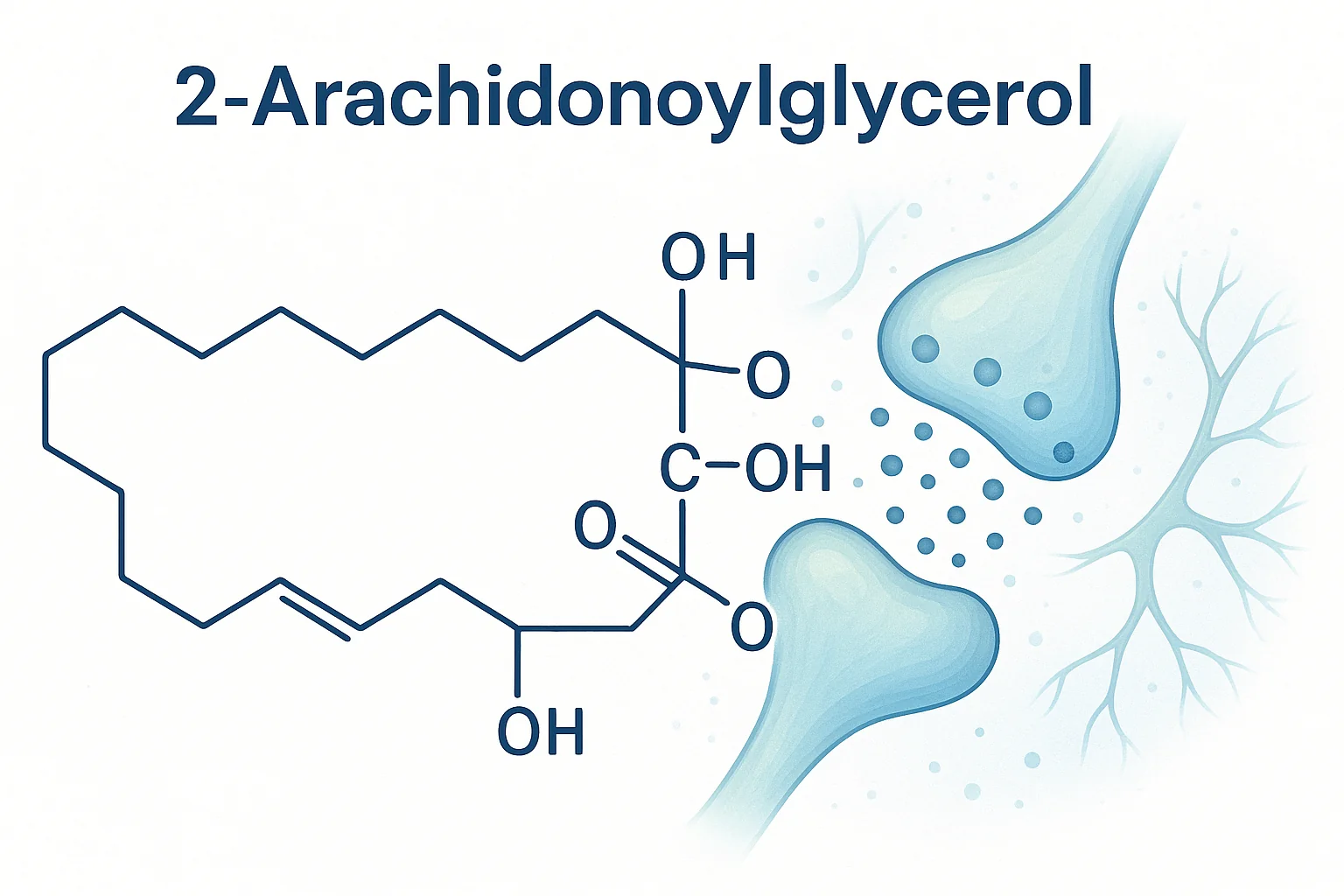

2-AG - the most abundant endocannabinoid (guide)
2-AG — co to, jak dziala i na co. Przewodnik u Bucha.
When it comes to endocannabinoids, anandamide gets most of the attention. Meanwhile, 2-arachidonoylglycerol - known as 2-AG - is present in the brain at concentrations up to 200 times higher and acts on cannabinoid receptors with full power. Discovered in 1995 by two independent research teams, 2-AG has proven to be a key synaptic mediator responsible for a wide range of processes: from pain regulation to modulation of inflammatory responses and appetite control (Sugiura et al., Biochemical and Biophysical Research Communications, 1995). This article explains what 2-AG really is, how you produce it, what it does, and why science is paying more and more attention to it.
KEY INFORMATION
• 2-AG (2-arachidonoylglycerol) is the most abundant endocannabinoid in the brain - its concentration is 200 times higher than that of anandamide (Sugiura et al., 1995).
• 2-AG is a full agonist of CB1 and CB2 receptors - activating them with maximum power, unlike anandamide, which is a partial agonist.
• The key enzyme that degrades 2-AG is MAGL (monoacylglycerol lipase) - different from FAAH which breaks down anandamide.
• 2-AG plays a central role in retrograde signaling at synapses - a mechanism called DSE/DSI.
What is 2-AG and where does it come from?
2-arachidonoylglycerol is an ester of arachidonic acid and glycerol. Like all endocannabinoids, it is not stored in cells - it is produced on demand when a neuron is activated. Synthesis occurs from membrane phospholipids in two enzymatic steps: phospholipase C hydrolyzes phosphatidylinositol to diacylglycerol (DAG), and then diacylglycerol lipase (DAGL) releases 2-AG from DAG. Two variants of the enzyme - DAGL-α and DAGL-β - have different distributions in the brain and perform somewhat different functions.
The discovery of 2-AG occurred almost simultaneously in 1995: Sugiura's team in Japan isolated it from rat intestines, while Mechoulam and colleagues isolated it from dog brains (Mechoulam et al., Biochemical Pharmacology, 1995). Both groups demonstrated that 2-AG binds to CB1 and CB2 receptors. This was an important discovery: previously, only anandamide was known, and science was just beginning to build a picture of the endocannabinoid system as a complete signaling system.
The concentration of 2-AG in the brain is surprisingly high - on the order of nmol/g of tissue, while anandamide is measured in pmol/g. Why? Some researchers point out that 2-AG serves two roles simultaneously: it is an endocannabinoid-signal, but also a substrate for the synthesis of eicosanoids (prostaglandins, leukotrienes) by COX and LOX enzymes. Not all 2-AG released in tissue reaches CB1 receptors - some is metabolized through inflammatory pathways. This complicates the interpretation of its concentrations in vivo.
How does 2-AG differ from anandamide - a comparative table
Both compounds are endocannabinoids, but they differ in several significant aspects: affinity for receptors, concentrations, degrading enzymes, and action profiles. Understanding these differences helps to better grasp why the ECS reacts differently to THC (which mimics 2-AG as a full agonist) than to CBD (which acts through anandamide).
| Feature | 2-AG | Anandamide (AEA) |
|---|---|---|
| Full name | 2-arachidonyloglicerol | Arachidonoylethanolamide |
| Year of discovery | 1995 | 1992 |
| Concentration in the brain | Very high (nmol/g) | Niskie (pmol/g) - ~200× mniej |
| Type of CB1/CB2 agonist | Full agonist | Partial agonist |
| Synthesis enzyme | DAGL-α/β | NAPE-PLD |
| Degradation enzyme | MAGL (mainly) | FAAH (mainly) |
| Main roles | Retrograde signaling, pain regulation, inflammatory response, appetite | Mood, euphoria, anxiety modulation, memory |
| The impact of CBD | Indirect (through lipid pathways) | Direct (inhibition of FAAH) |
Rola 2-AG w sygnalizacji synaptycznej - mechanizm DSE i DSI
The most fascinating role of 2-AG is mediating retrograde signaling at synapses - a mechanism that science has called "depolarization-induced suppression of excitation" (DSE) and "depolarization-induced suppression of inhibition" (DSI). When a neuron is strongly activated, it releases 2-AG, which travels backward and binds to CB1 on the axon of the presynaptic neuron. The effect: inhibition of neurotransmitter release from the presynapse, which "mutes" further excitation (Wilson & Nicoll, Nature, 2001).
This mechanism acts as a kind of biological safety valve. When the neuronal network becomes too active, 2-AG triggers a retrograde signal that suppresses excessive excitation. In practice, this means that 2-AG is involved in regulating synaptic plasticity - the brain's ability to change the strength of connections between neurons. Disruptions in the DAGL/2-AG/CB1 pathway are being studied in the context of epilepsy, where pathological excessive excitation of neuronal networks is a central problem.
It is worth noting a certain paradox: 2-AG is the endocannabinoid that quantitatively dominates the brain, yet for years it has lived in the shadow of anandamide in popular science discussions. This is partly due to measurement difficulties - 2-AG is degraded more quickly by MAGL and reacts more strongly with inflammatory pathways, complicating the interpretation of its concentrations in vivo. Modern analytical methods (LC-MS/MS) allow for more precise measurement of both compounds, driving an increasing number of publications on 2-AG in recent years.
2-AG and pain, inflammation, and the immune system
2-AG is one of the most important endogenous mediators of anti-inflammatory and analgesic effects. Through the CB2 receptor - which is densely located in immune system cells - 2-AG modulates the release of pro-inflammatory cytokines and the activity of microglial cells. Studies on animal models suggest that increasing the level of 2-AG by inhibiting MAGL produces analgesic and anti-inflammatory effects comparable to opioids, but without the risk of addiction (Blankman & Cravatt, Annual Review of Pharmacology and Toxicology, 2013).
This is why MAGL inhibitors - the enzyme that breaks down 2-AG - are actively being researched as potential analgesic drugs. Pharmaceutical companies have invested significant resources in developing selective MAGL inhibitors, as they hope for a class of drugs that works by increasing the patient's own 2-AG levels instead of administering external substances. Initial phase I clinical trials have been conducted since 2018.
In the intestines, 2-AG plays another role. CB1 and CB2 receptors are abundantly located in the enteric nervous system (ENS - the "second brain" of the intestines). 2-AG modulates gastrointestinal motility, the secretion of digestive juices, and the permeability of the intestinal barrier. Disruptions in ECS signaling by 2-AG in the intestines are associated with irritable bowel syndrome (IBS) and other gastrointestinal diseases.
2-AG and neuroprotection and brain injuries
One of the more promising lines of research on 2-AG is its role in the brain's response to injuries. After traumatic brain injury (TBI) or ischemia, the level of 2-AG in brain tissue increases dramatically - even tenfold within minutes of the injury. Mechoulam and colleagues interpreted this as an endogenous neuroprotective response: the brain floods itself with 2-AG to activate defense pathways through CB1 and CB2 (Panikashvili et al., Nature, 2001).
Experiments with exogenous administration of 2-AG to mice after closed head injury showed reduced brain swelling, less tissue necrosis, and better results in neurological tests compared to the control group. This is exciting, but an important caveat: the studies were conducted on animal models, and translation to clinical settings in humans remains a challenge. The human brain and that of mice differ in many significant aspects.
Questions about 2-AG mainly come from individuals who are exploring the ECS system in more depth - usually after reading something about anandamide and asking themselves: "if anandamide is not the only endocannabinoid, then what is this other one?". This curiosity shows that the popularization of science about the endocannabinoid system has real depth: there is a segment of the audience ready to delve into biochemistry, not just asking "does CBD work for sleep?".
Frequently Asked Questions
What is 2-AG and how does it differ from anandamide?
2-AG (2-arachidonoylglycerol) is an endocannabinoid produced by neurons on demand. Unlike anandamide (AEA), it is a full agonist of CB1 and CB2 receptors, and its concentration in the brain is several times higher. Both compounds are synthesized from membrane phospholipids, but by different enzymes (Sugiura et al., 1995).
What functions does 2-AG perform in the body?
2-AG regulates synaptic signaling as a retrograde neurotransmitter - it inhibits excessive neurotransmitter release. It participates in the regulation of pain, inflammation, appetite, sleep, and mood. Through the CB2 receptor, it modulates immune functions. In the intestines, it affects motility and microbiota regulation (Mechoulam et al., 1995).
How is 2-AG synthesized and degraded?
2-AG is synthesized from diacylglycerol (DAG) by the enzymes DAGL-α and DAGL-β. Degradation occurs mainly through MAGL (monoacylglycerol lipase), which breaks it down into arachidonic acid and glycerol. MAGL inhibitors are being studied as potential pain relief medications (Blankman & Cravatt, 2013).
Does CBD affect the level of 2-AG?
CBD does not inhibit MAGL (the enzyme that degrades 2-AG) as clearly as it inhibits FAAH (the enzyme that breaks down anandamide). The main effect of CBD on the endocannabinoid system is realized through raising AEA levels, not 2-AG. The indirect effects of CBD on 2-AG metabolism through lipid pathways are still being studied, and the data is incomplete.
What is DSI/DSE and what is the role of 2-AG?
DSI (depolarization-induced suppression of inhibition) is a mechanism in which strong neuronal activity triggers the release of 2-AG, which retrogradely inhibits neurotransmitter release from the presynapse. 2-AG is a key mediator of this process - it is one of the best-documented endogenous mechanisms of neuronal excitability regulation (Wilson & Nicoll, Nature, 2001).
This article is for informational and educational purposes and does not replace consultation with a doctor. If you are pregnant, breastfeeding, taking medications, or have chronic conditions, consult the use of supplements or herbs with a specialist.
Author: Michał Waluk · Published: 2026-05-04 · Updated: 2026-05-04