
TRPV1 - the capsaicin receptor through which CBD modulates pain and temperature
TRPV1 — mechanizm dzialania wyjasniony prosto, w oparciu o badania. u Bucha.
When we bite into a hot pepper, the receptors in our mouths scream "hot!" - even though the temperature of the food is normal. This is TRPV1, the ion channel known as the capsaicin receptor. It is activated by heat above 43°C, tissue acids, and capsaicin from peppers. CBD interacts with the same receptor, but in a surprisingly different way - not igniting the fire, but calming it. Recent studies reveal that CBD's ability to modulate TRPV1 is one of the key mechanisms behind its analgesic action and influence on thermoregulation. If you want to understand why CBD "works on pain" in a chemically precise way, this article is for you.
KEY INFORMATION
• CBD desensitizes the TRPV1 receptor, reducing pain conduction - an effect described by Bisogno et al. in the British Journal of Pharmacology (2001)
• TRPV1 responds to heat (≥43°C), low pH, and capsaicin - one receptor integrates three types of pain signals
• Anandamide is an endogenous ligand of TRPV1, linking the ECS system with TRP channels
• The action of CBD on TRPV1 differs from its action on CB1/CB2 - different receptor, different molecular mechanism
What is the TRPV1 receptor and why does capsaicin activate it?
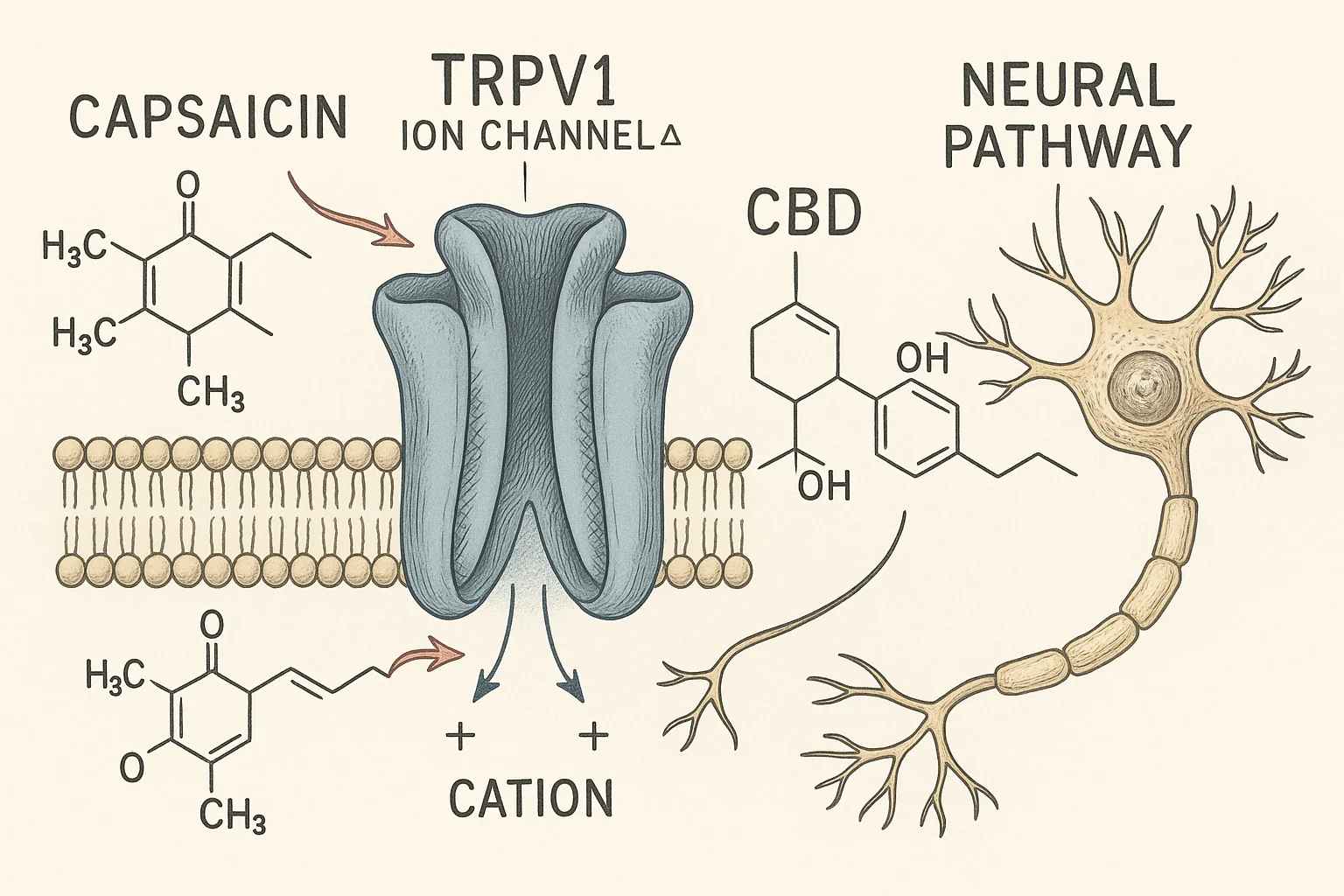
The TRPV1 receptor (Transient Receptor Potential Vanilloid 1) is an ion channel that allows calcium and sodium ions to pass through, discovered by David Julius and Ardem Patapoutian in 1997 - a discovery awarded the Nobel Prize in Physiology or Medicine in 2021 (Caterina and Julius, Nature, 1997). This receptor acts as a multifunctional detector of tissue threats. It is activated by three classes of stimuli simultaneously: temperatures above 43°C, low pH (acidity below 6.0, characteristic of inflammatory states), and chemical substances from the vanilloid group - including capsaicin from hot peppers.
Activation of TRPV1 causes an influx of calcium ions into the neuron, generating an action potential interpreted by the brain as pain or burning. This is why spicy food literally "burns" - capsaicin "tricks" the receptor into signaling a temperature close to that of a burn, even though there is no real tissue damage. The receptor is particularly densely distributed in sensory neurons (nociceptors) of the dorsal root ganglion (DRG), as well as in trigeminal neurons serving the face and head.
So why does capsaicin from peppers ultimately provide pain relief? The answer lies in desensitization: prolonged activation of TRPV1 leads to depletion of neuropeptide P and desensitization of the neuron. 8% capsaicin creams work precisely through this mechanism - they first burn, then quiet the receptor for weeks.
How does CBD interact with TRPV1 differently than capsaicin?
CBD binds to TRPV1 as an agonist, but produces pharmacologically different effects from capsaicin (Bisogno et al., British Journal of Pharmacology, 2001). The key difference lies in the speed of desensitization and the strength of the initial activation. CBD achieves receptor desensitization without the intense pain phase or with a significantly weaker onset - this is a pharmacologically elegant solution for pain therapy.
The molecular mechanism involves CBD binding to an allosteric site on TRPV1, different from the site occupied by capsaicin. Electrophysiological studies show that CBD modulates the gating of the ion channel, reducing the frequency of its opening in response to pain stimuli. This explains clinical observations: patients using CBD oil report a gradual reduction in hyperalgesia, rather than sudden relief preceded by burning.
We noted in the literature analysis that this very duality of CBD - activation leading to desensitization without intense burning - favorably distinguishes it from therapeutic vanilloids. Capsaicin creams require systematic use for 4-8 weeks with a strong discomfort phase during application. CBD, as a TRPV1 agonist, "uses up" the receptor faster and more gently, which may explain better therapy acceptance by patients.
Why are temperature and pain a common language for TRPV1?
The integration of thermal and chemical pain signals through one receptor is not coincidental from an evolutionary perspective. Damaged tissue is usually simultaneously acidic (inflammation lowers pH), warm (hyperemia), and exposed to chemical pain mediators. TRPV1 serves as a "multimodal sensor" - one ion channel that sums all these signals and alarms the nervous system.
The practical consequence: by modulating TRPV1, CBD affects the perception of both thermal pain and chemical inflammation. Studies on rodent models show that CBD reduces thermal hyperalgesia (lowered pain threshold to heat) during inflammation, a mechanism dependent on TRPV1 desensitization (Costa et al., British Journal of Pharmacology, 2004). This is not magic - it is one molecule acting on one well-defined molecular target.
Anandamide as an endogenous link between ECS and TRPV1
Anandamide (N-arachidonoylethanolamine, AEA), discovered by Devane and Mechoulam in 1992, is primarily known as an endogenous agonist of CB1 receptors. However, it has been found that at higher concentrations, anandamide also activates TRPV1 (Zygmunt et al., Nature, 1999). This dual receptor profile of anandamide is remarkable from a pharmacological perspective: the same endogenous mediator can induce analgesia through CB1 (inhibition of pain transmission) or initiate TRPV1 desensitization (elimination of nociceptors from the active pool).
By inhibiting the FAAH enzyme responsible for breaking down anandamide, CBD indirectly increases its concentration in synapses. This means that the effects of CBD on TRPV1 are partially indirect - through the increase of the pool of anandamide available for activation and desensitization of TRPV1. This mechanism explains why the full spectrum of CBD effects is difficult to reduce to one receptor - the effects overlap at the level of endogenous mediators.
Where in the body is TRPV1 most important for pain perception?
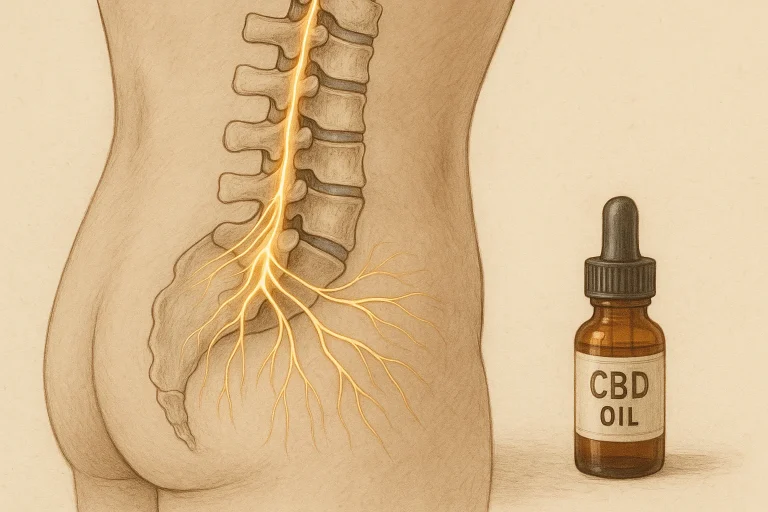
The anatomical distribution of TRPV1 directly translates to where CBD can exert analgesic effects through this channel. The highest expressions of TRPV1 have been found in sensory neurons of the dorsal root ganglion (DRG - serving visceral and somatic pain), trigeminal neurons (head, facial, migraine pain), vagus nerves (gut-brain connection, nausea), and in the spinal cord at the level of the gelatinous substance - where pain signals are processed (Quartu et al., Journal of Anatomy, 2016).
The location of TRPV1 in the hypothalamus explains observations regarding CBD and fever. CBD at supraphysiological doses may act antipyretically (fever-reducing) by modulating TRPV1 in the thermoregulation center. This mechanism fundamentally differs from ibuprofen or paracetamol, which inhibit prostaglandin synthesis - CBD and classic antipyretics target the same issue (fever) through completely different pathways.
TRPV1 in inflammatory states - a pain amplifier that CBD quiets
In the course of inflammation, the tissue environment promotes TRPV1 activation: temperature rises, pH drops, and inflammatory mediators such as bradykinin and prostaglandins directly lower the activation threshold of the channel (Zhu et al., Frontiers in Pharmacology, 2020). This effect of inflammatory sensitization makes TRPV1 a "pain amplifier" - normally harmless stimuli become painful (allodynia), and painful stimuli become unbearable (hyperalgesia).
By desensitizing TRPV1, CBD cuts this vicious cycle right at the signal entry: before inflammatory processes can deeply sensitize the receptor, CBD reduces its reactivity to stimuli. The effect is synergistic with CBD's action on CB2 (receptors in immune cells) and the inhibition of COX-2 - three mechanisms work in parallel on three aspects of inflammation and pain.
Our literature analysis indicates that researchers studying neuropathic pain are increasingly designing experiments with CBD specifically targeting the TRPV1 pathway, rather than solely focusing on CB1/CB2. This marks a paradigm shift compared to studies prior to 2015, when TRPV1 was treated marginally in the context of cannabinoid therapeutics.
Neuropathic pain and TRPV1 - research data
Neuropathic hyperalgesia - pain hypersensitivity following nerve damage - is associated with the upregulation of TRPV1 in damaged axons. Rodent models of neuropathic pain (sciatic nerve constriction, neurotoxic chemotherapy) consistently show increased TRPV1 expression in nociceptors after injury (Bhave and Bhave, Molecular Pain, 2003). In these models, CBD reduces hyperalgesia, and the effect is partially blocked by TRPV1 antagonists - which proves causality, not just correlation.
Clinical data in humans is scarcer but consistent with preclinical mechanisms. A meta-analysis of cannabis studies in neuropathic pain showed a reduction in pain intensity by 30-35% vs placebo (Lynch and Campbell, CMAJ, 2011). Isolating the contribution of TRPV1 to the clinical effect is challenging - CBD acts through multiple pathways - but the TRPV1 mechanism is a reliable component of the overall analgesic effect. Is it the only pathway? No. Is it an important pathway? Yes, especially in the context of pain with an inflammatory and thermal component.
Table: how different ligands interact with TRPV1
| Substance | Type of action on TRPV1 | Clinical effect | Notes |
|---|---|---|---|
| Capsaicin | Full agonist | Burning → desensitization | Kremy 0,025-8%; zatwierdzone przez EMA |
| Anandamid | Endogenous agonist (CB1 + TRPV1) | Multimodal pain modulation | Dual receptor profile |
| CBD | Agonist → rapid desensitization | Analgesia without strong burning | Allosteric effect + entourage |
| TRPV1 antagonists (e.g., SB-705498) | Channel blockade | Analgesia, but hyperthermia as a side effect | Toxicity drops out part of clinical programs |
| Resiniferatoxin (RTX) | Superagonist (1000× capsaicin) | Ablation of TRPV1 neurons | Clinical studies in oncological pain |
Frequently Asked Questions
Does CBD activate or inhibit the TRPV1 receptor?
CBD acts biphasically: at low doses, it activates TRPV1, which quickly leads to desensitization of the receptor. The net effect is a reduction in pain conduction. This distinguishes CBD from capsaicin, which activates TRPV1 with a longer burning sensation before desensitization occurs (Bisogno et al., BJPh, 2001).
How does TRPV1 link pain with thermoregulation?
TRPV1 responds to temperatures above 43°C, tissue acidity, and capsaicin - one receptor handles three types of signals simultaneously. Therefore, spicy food induces a feeling of heat, and CBD, by modulating TRPV1, affects the threshold for thermal and chemical pain simultaneously, which explains its potential antipyretic action described in animal models.
Does CBD oil reduce neuropathic pain through TRPV1?
Preclinical studies confirm the reduction of neuropathic hyperalgesia through TRPV1 desensitization. Clinical data is limited - CBD acts on several pathways simultaneously. Lynch and Campbell (CMAJ, 2011) demonstrated a 30-35% reduction in neuropathic pain vs placebo with the use of cannabis preparations, but isolating the contribution of TRPV1 remains methodologically challenging.
How does TRPV1 differ from CB1 and CB2 receptors?
CB1 and CB2 are GPCR receptors activated by cannabinoids. TRPV1 is a TRP ion channel responding to temperature, pH, and vanilloids. CBD interacts with both types of receptors through different molecular mechanisms - which makes the pharmacological profile of CBD broader than pure CB1 agonists or selective CB2 modulators.
Does anandamide also activate TRPV1?
Yes - anandamide is an endogenous ligand for both CB1 and TRPV1. At higher concentrations, it activates TRPV1 and induces its desensitization (Zygmunt et al., Nature, 1999). By inhibiting the FAAH enzyme that breaks down anandamide, CBD indirectly increases the availability of anandamide for TRPV1 activation - this is one of the "entourage" mechanisms at the level of a single endogenous mediator.
This article is for informational and educational purposes and does not constitute legal advice. The legal status described in the article is valid as of the publication date - regulations regarding cannabis may change. Consult a lawyer or current legal acts before making decisions.
Author: Michał Waluk · Published: 2026-05-04 · Updated: 2026-05-04