
CBC (cannabichromene): what it is, effects and properties (guide)
CBC (cannabichromene): what it is, how it acts on TRPA1 receptors, what studies have really shown about pain and mood, and what its legal status is in Poland.
Cannabis produces over a hundred cannabinoids, and two of them are well-known. CBC, or cannabichromene, is one of those overlooked, although it has its own receptor profile and its own experimental literature (Sepulveda et al., 2024). The problem is that popular descriptions of CBC replicate claims that the cited works do not contain, starting with the inhibition of the FAAH enzyme and comparisons to fluoxetine. This guide shows what individual studies actually measured, where animal data ends, and what is still unknown about CBC. Each numerical claim below comes from the linked work, and where the literature says something different from the popular version, we mark it directly. The distinction is practically significant, as the mechanism determines what can be expected from the compound in combination with others.
KEY INFORMATION
• CBC does not significantly bind to CB1 or CB2 receptors, so it does not have intoxicating effects. Its main confirmed molecular target is the TRPA1 channel.
• CBC does not inhibit FAAH. In a comparative study of eleven cannabinoids, the only inhibitor of this enzyme was CBD, and CBC acted at a different stage of anandamide turnover.
• Analgesic effects were confirmed in mice at doses of 10 and 20 mg/kg administered intraperitoneally. There are no clinical studies in humans.
• In the forced swimming test, CBC acted antidepressively from 20 mg/kg, but the study did not compare it with any antidepressant drug.
• Cannabichromene is not listed in the Polish register of psychotropic substances, narcotics, or new psychoactive substances.
Where does CBC come from in the cannabis plant?
From the same place as CBD and THC. All plant cannabinoids have a common starting point in cannabigerolic acid, and which one will be produced is determined by synthase enzymes. CBGA converts to cannabichromenic acid (CBCA), just as it does to tetrahydrocannabinolic acid or cannabidiolic acid.
Acidic forms dominate in the fresh plant. Heat and time cleave the carboxyl group, so only after decarboxylation does CBC form from CBCA, THC from THCA, and CBD from CBDA. The practical consequence is that cannabichromene appears in every extract that maintains the full profile of the plant, without any additional processing. How much there will be depends on the strain, the age of the plant, and the method of processing the raw material. Published compilations do not allow for a single number for all chemotypes, so every declaration of CBC content must be read from a specific certificate of analysis for the batch, not from the product category description.
The common precursor can be a source of misunderstanding. A review dedicated to cannabichromene notes that compounds arising from the same starting molecule differ in structure and pharmacology enough that each must be assigned a separate therapeutic potential. Conclusions regarding CBD cannot therefore be transferred to CBC by analogy, and vice versa.
How does CBC act at the receptor level?
Outside the cannabinoid receptor system. CBC does not show significant affinity for CB1 or CB2, which explains the lack of intoxicating effects, and its effects in animal models do not disappear after the administration of antagonists of these receptors. The best-documented target is the TRPA1 channel.
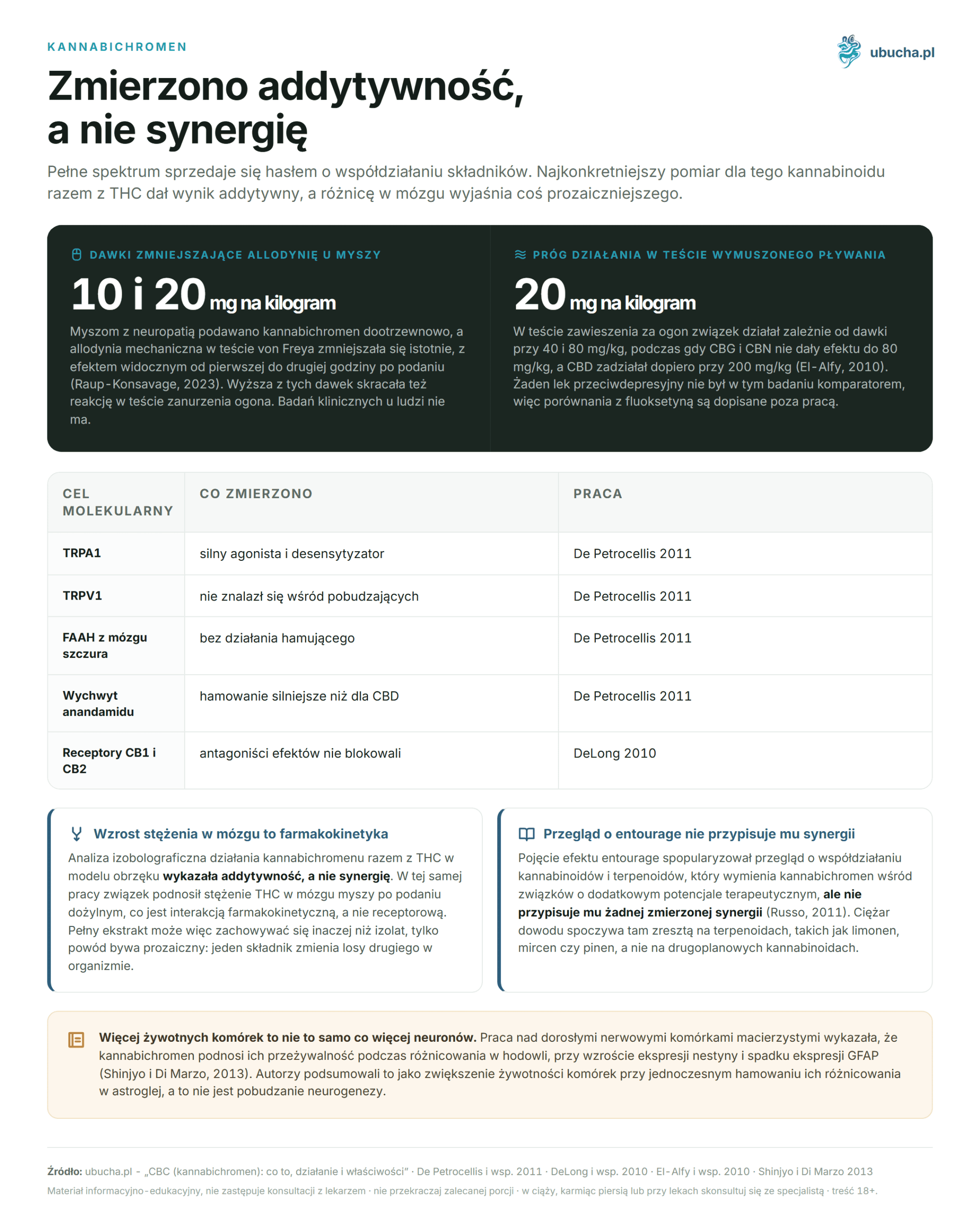
The most commonly repeated error concerns the FAAH enzyme. In a comparative study of eleven pure cannabinoids, the only compound that inhibited FAAH was CBD, while CBC acted at a different stage of anandamide metabolism, namely its cellular uptake, and more strongly than CBD (De Petrocellis et al., British Journal of Pharmacology, 2011). This measurement was performed on an enzyme from rat brain and does not transfer to humans: cannabidiol inhibits rodent FAAH, but does not inhibit human FAAH, so the increase in anandamide in humans cannot be explained by the inhibition of this enzyme. It is due to competition for intracellular transport proteins from the FABP family (Elmes, J Biol Chem, 2015). The direction of change may therefore be similar, but the mechanism is different, and this alters predictions regarding interactions.
| Molecular target | What was measured for CBC | Source |
|---|---|---|
| TRPA1 | Strong agonist and desensitizer, alongside CBD and CBN | De Petrocellis 2011 |
| TRPV1 | Not among cannabinoids stimulating this receptor | De Petrocellis 2011 |
| TRPV2 | One of two non-acidic cannabinoids without activity against this channel | De Petrocellis 2011 |
| FAAH from rat brain | No inhibitory action; the only inhibitor in the set was CBD | De Petrocellis 2011 |
| Cellular uptake of anandamide | Inhibition stronger than that of CBD | De Petrocellis 2011 |
| CB1 and CB2 | The effects of CBC were not blocked by antagonists of either receptor | DeLong 2010 |
Does CBC have analgesic and anti-inflammatory effects?
In animal models, yes, but this has not been tested in humans at all. The most detailed data comes from a study in which mice with neuropathy were administered CBC intraperitoneally. Doses of 10 and 20 mg/kg significantly reduced mechanical allodynia in the von Frey test, with an effect visible from the first to the second hour after administration, and 20 mg/kg shortened the response in the tail immersion test and limited pain behaviors in both phases of the formalin test (Raup-Konsavage et al., 2023).
The anti-inflammatory side looks similar. In a model of paw edema induced by lipopolysaccharide, CBC reduced edema in a dose-dependent manner, with a CB2 receptor antagonist blocking the effect of THC but not the effect of CBC (DeLong et al., 2010). In the intestine, CBC normalized accelerated motility caused by inflammation, also independently of cannabinoid receptors and TRPA1 itself. At the cellular level, a study on human macrophages indicated inhibition of the NLRP3 inflammasome via the PANX1/P2X7 axis and reduced IL-6/TYK-2/STAT-3 signaling. None of these results come from a clinical study, and the range of mechanisms suggests more of a multi-pathway approach than a single confirmed pathway. For comparison with therapies tested in humans, it is worth looking at the entry on treating neuropathic pain with cannabis.
What do studies say about CBC, mood, and nerve cells?
They say less than popular summaries suggest. In a study on mice, CBC shortened immobility time in the forced swimming test from a dose of 20 mg/kg, and in the tail suspension test, it acted dose-dependently at 40 and 80 mg/kg. In the same set, CBG and CBN did not produce effects up to 80 mg/kg, while CBD acted only at 200 mg/kg (El-Alfy et al., 2010). No antidepressant was a comparator in this study, so comparisons with fluoxetine are added outside the work.
The thread regarding nerve cells looks similar. A study on adult neural stem cells showed that CBC increases their survival during differentiation in vitro, with an increase in nestin expression and a decrease in GFAP expression. The authors summarized this as an increase in cell viability while simultaneously inhibiting their differentiation into astroglia, likely through adenosine signaling and ERK1/2 phosphorylation (Shinjyo and Di Marzo, Neurochemistry International, 2013). This is not the same as stimulating neurogenesis, and the difference is significant because inhibiting differentiation into glial cells does not necessarily mean more neurons. The clinical context is described in a separate entry on depression and cannabis.
Does CBC enhance the entourage effect?
The hypothesis is reasonable, but hard measurements for CBC yield a result more modest than what full-spectrum marketing claims. The concept of the entourage effect was popularized by a review on the interaction of cannabinoids and terpenoids, which lists cannabichromene among compounds with additional therapeutic potential but does not attribute any measured synergy to it (Russo, British Journal of Pharmacology, 2011). The burden of proof in that text rests, after all, on terpenoids such as limonene, myrcene, pinene, or linalool, not on secondary cannabinoids.
The most concrete result for a mixture comes from a study on edema: isobolographic analysis of the action of CBC together with THC showed additivity, not synergy. In the same work, CBC increased THC concentration in the brains of mice after intravenous administration, which is a pharmacokinetic interaction, not a receptor one. In other words, a full extract may indeed behave differently than an isolate, but the reason may be prosaic: one component changes the fate of another in the body. For the reader, this means one thing. The statement about the synergy of CBC with other cannabinoids is so far a hypothesis supported by molecular biology, not a conclusion from measurements in humans. The role of other components of the full profile is explained in the entry on terpenes in cannabis.
Is CBC legal in Poland and in which products is it found?
The compound itself is not controlled in Poland. Cannabichromene is not listed in the register of psychotropic substances, narcotics, or new psychoactive substances, in the consolidated text of the Minister of Health’s regulation (Journal of Laws 2024 item 1139) or in any of its later amendments, including the regulation effective from July 28, 2026 (Journal of Laws 2026 item 934). The status of the raw material, however, is determined by the threshold for plant material: industrial hemp is a plant in which the sum of delta-9-THC and tetrahydrocannabinolic acid does not exceed 0.3% when calculated on a dry mass basis, rounded to one decimal place (Article 4 point 5 of the Act on Counteracting Drug Addiction, consolidated text Journal of Laws 2023 item 1939, as amended by Journal of Laws 2022 item 763).
A separate issue is food law, which still leaves the status of cannabinoids in supplements unresolved. Cannabidiol, the best-studied compound in this group, has not been approved as a novel food in the EU, and the authors of a review dedicated to CBC note directly that products containing this compound are sold without evidence of safety and efficacy. In practice, you will most often encounter CBC as a natural component of full-spectrum extracts, rather than as a separate item on the label. How such extracts differ from purified forms is explained in the comparison of hemp distillate and isolate.
Frequently asked questions
What is CBC (cannabichromene)?
It is one of over a hundred cannabinoids produced by cannabis. It is derived from cannabichromenic acid, which plant enzymes create from cannabigerolic acid, a common precursor of all plant cannabinoids. The active form appears after decarboxylation, that is, under the influence of heat or the passage of time.
Is CBC psychoactive?
No. CBC does not show significant affinity for CB1 receptors, which are responsible for the intoxicating effects of THC. In animal studies, a CB1 receptor antagonist did not block the effects of CBC, confirming that its action follows a different pathway than that of THC.
How does CBC differ from CBD?
By molecular target profiles. CBD stimulates and desensitizes the human TRPV1 receptor and inhibits rodent FAAH, although it does not inhibit human FAAH (Elmes, J Biol Chem, 2015); CBC does neither. Instead, CBC is a strong agonist of the TRPA1 channel and inhibits cellular uptake of anandamide more than CBD does.
Does CBC raise anandamide levels like CBD?
By a different mechanism. The claim that CBC inhibits FAAH is widely circulated, but in a study comparing eleven cannabinoids, the only inhibitor of the rat enzyme was CBD, and it does not inhibit human FAAH (Elmes, J Biol Chem, 2015). CBC, however, limited cellular uptake of anandamide, and more effectively than CBD.
Is CBC legal in Poland?
Cannabichromene is not listed in the Polish register of psychotropic substances, narcotics, or new psychoactive substances. However, the legality of a specific product depends on the raw material, that is, whether the plant material falls within the threshold of 0.3% total delta-9-THC and tetrahydrocannabinolic acid.
In which products is CBC found?
Primarily in extracts that maintain the full profile of the plant, as it is present there along with other cannabinoids. Isolates and purified products do not contain it. The content varies between batches of raw material, so the only reliable source of the number is the certificate of analysis for a specific batch.
Hemp extract oils in the store at Bucha can be found in the oils category.
This article is for informational and educational purposes and does not constitute medical advice. Before starting to use cannabis or CBD for therapeutic purposes, consult a doctor, especially if you are taking other medications, are pregnant, or breastfeeding.
Author: Michał Waluk · Published: 2026-08-09 · Updated: 2026-08-17