
CBD Gum: Does It Work and Who Is It For (FAQ)
CBD gum. The only controlled study found no difference compared to placebo, and no one has measured the bioavailability of the buccal route in humans.
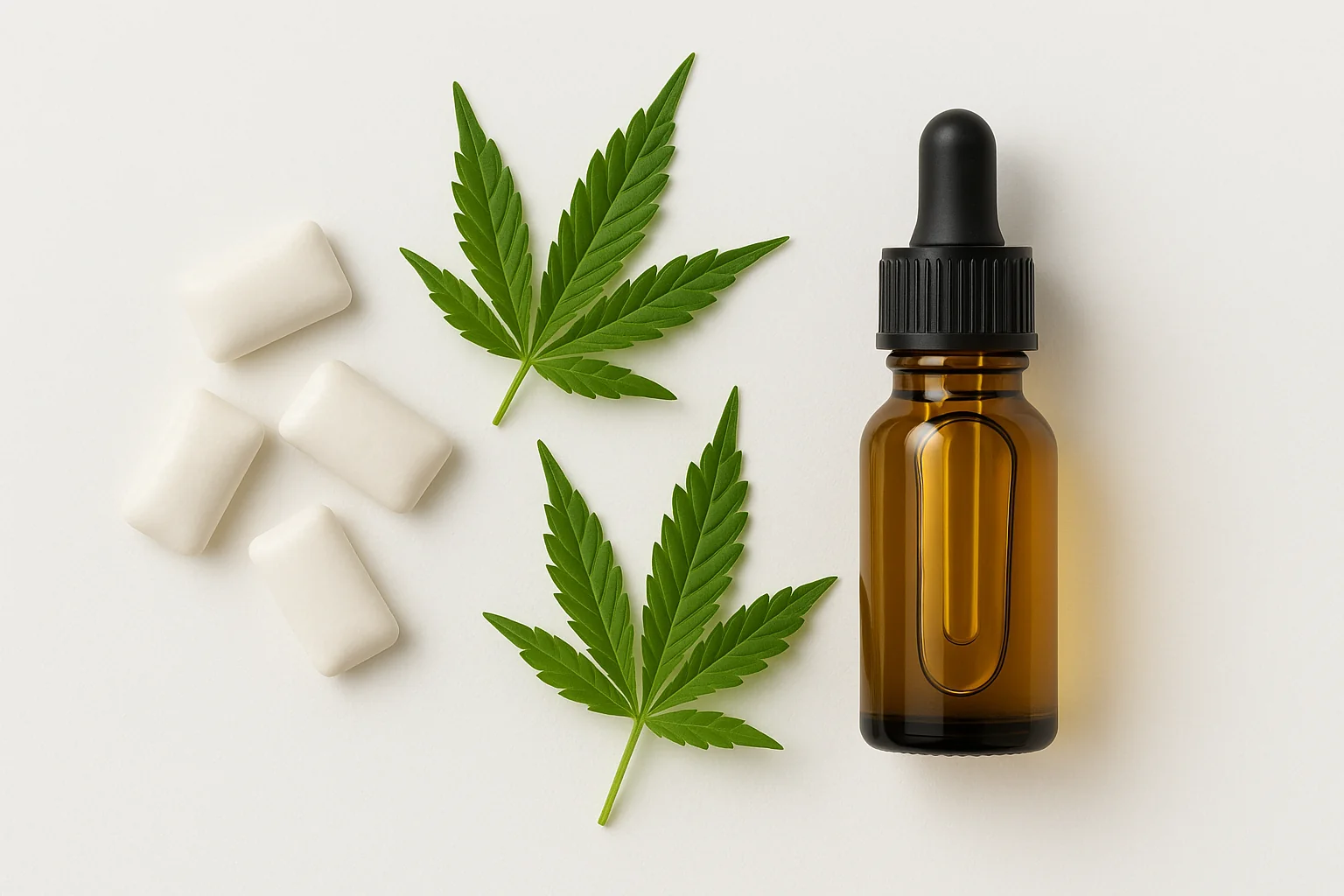
CBD gum is sold with the promise of convenience: instead of opening a bottle of oil at your desk, you simply chew. Under this promise lies a second, much stronger and much less documented claim: that absorption through the mucous membrane of the mouth bypasses the liver and provides better bioavailability than a capsule. It is worth breaking this down, as this is precisely where numbers without measurement circulate on Polish internet. This text shows what has actually been studied about CBD gum, what result the only controlled study of this form yielded, and why the oral bioavailability range should not be presented as a fact. You will also find what these findings imply when purchasing, as well as information about the availability of such products in the store.
KEY INFORMATION
• In the only controlled study of CBD gum, involving 32 women with irritable bowel syndrome, gum with 50 mg of substance did not differ from placebo in pain assessment.
• The absolute bioavailability of cannabidiol was measured in humans only after smoking and was 31%. For oral, sublingual, and buccal routes, no study has done this.
• The range “6-19%”, previously stated in this article as oral bioavailability, has no measurement. The number 6% comes from a WHO report as an estimate referring to a textbook chapter.
• A review comment from 2025 states that there are very few clinical studies on cannabinoid gums, and the absorption mechanism, dosing precision, and long-term safety remain unstudied.
• The store ubucha.pl does not sell CBD gum; catalog status as of August 16, 2026.
How would CBD absorb from chewing gum?
The reasoning behind this form is anatomical. The mucous membrane lining the cheeks, gums, and palate is thin and highly vascularized, so the substance dissolved in saliva can theoretically penetrate directly into the bloodstream, bypassing the digestive tract and liver. This route is called buccal and is a real administration pathway for many medicinal substances.
However, a crucial caveat exists. Some cannabidiol is swallowed with saliva and reaches the stomach, where it is absorbed through the classic digestive route. The ratio between what has passed through the mucous membrane and what has been swallowed depends on the composition of the gum, chewing time, and individual anatomy, and has not been established for cannabidiol. A review comment specifically addressing this form states that despite promising reports, research gaps remain open, particularly regarding the absorption mechanism, dosing precision, and safety with prolonged use (Pressman et al., Medical Cannabis and Cannabinoids, 2025).
In other words: the mechanism is credible as a hypothesis, not as a measured fact for this specific form. The difference is practically significant, as the entire advantage of gum over a capsule relies precisely on this unmeasured link.
What did the only controlled study of CBD gum show?
No difference compared to placebo. The study involved 32 women with irritable bowel syndrome and had a crossover, randomized, double-blind design with a placebo control. Participants chewed gum containing 50 mg of cannabidiol as needed in response to pain, up to six pieces daily. Pain was assessed using a visual analog scale, and quality of life was measured with the IBS-36 questionnaire (van Orten-Luiten et al., Cannabis and Cannabinoid Research, 2022).
At the group level, no statistically significant difference was found in pain ratings between cannabidiol gum and placebo gum. Subgroup analyses and individual results were very varied, and the number of gums consumed was lower than expected in both arms. The authors interpret this unequivocally: the benefit perceived by patients generally did not outweigh the practical inconvenience of prolonged chewing throughout the day.
It must be honestly added what this study does not answer. It concerned visceral pain in a specific disease and not stress or muscle tension, and it included only women. Therefore, it does not rule out this form for all indications. However, it is the only controlled measurement that exists for CBD gums, and it came out neutral.
How much cannabidiol from gum reaches the blood?
It is unknown and cannot be quantified today. A systematic review of the pharmacokinetics of cannabidiol in humans searched 792 publications and found 24 that provide pharmacokinetic parameters in humans. Absolute bioavailability was established only after smoking, where it was 31%; for no other route of administration has this been attempted, even though intravenous forms were available (Millar et al., Frontiers in Pharmacology, 2018).
The previous version of this article stated that the bioavailability of cannabidiol taken orally without fat is 6-19%, attributing this range to Millar’s work in the journal Pharmaceuticals from 2019. The identifier given under this sentence leads to a study of the pharmacokinetics of a cannabis product in healthy dogs and cats. The range itself does not appear in Millar’s review, and the number 6% functions in a WHO report from 2018 as an estimate for the oral route, referring to a textbook chapter. Stretching an estimate into a range and presenting it as a measurement is fabrication.
So what can be said comparatively? That exposure increases with dose, that the maximum concentration is higher after a meal and in products with a fat carrier, and that after inhalation, the peak occurs faster than after oral administration. All of this comes from the same review. There is no percentage number for gum there or in any other source that has been reached. The effect of food on absorption has been broken down in detail in our post about whether to take CBD oil before or after eating.
Does CBD gum help with stress?
There is no study for the gum itself. For cannabidiol as a substance, there is evidence of anxiolytic action, but it has clearly defined limits. A review gathered preclinical, experimental human, clinical, and epidemiological data and concluded that they support the role of cannabidiol in anxiety disorders, with evidence in humans limited to acute administration, and there are few studies in clinical populations. Chronic dosing has been studied very little (Blessing et al., Neurotherapeutics, 2015).
Translating this conclusion to gum would require two assumptions that no one has verified: that a dose comparable to that studied is absorbed from the gum and that it does so in a comparable time. The doses used in anxiety studies are also an order of magnitude higher than the content of a typical gum.
Separately, it is worth noting that the act of chewing itself is sometimes described as a tension-reducing activity. If this is the case, then this effect also applies to gum without cannabidiol, so the feeling of improvement after CBD gum does not determine what caused it. We have gathered comparisons of routes of administration that bypass the stomach in our post about cannabidiol suppositories.
What to pay attention to when buying CBD gum?
The first thing is the declared content in milligrams per piece, not per bulk package. Without this number, comparing two products is impossible, and products described as CBD gum appear on the market with contents of a fraction of a milligram. The second is an independent laboratory certificate confirming the declared content and the level of tetrahydrocannabinol.
The third thing concerns other ingredients. Sorbitol used as a sweetener has an osmotic effect and can cause diarrhea with higher consumption, which is not just a theory when chewing several pieces daily. The gum base, flavors, and colorants can be sources of reactions in sensitive individuals, and these, not cannabidiol, account for most reported complaints.
The fourth thing is regulatory and rarely mentioned in product descriptions. Cannabidiol does not have authorization as a novel food in the European Union, and the sanitary notification submitted by the seller does not replace or change the status of the ingredient. Chewing gum is a food product, so this applies directly. In the catalog of the store ubucha.pl, as of August 16, 2026, there are no CBD gums in any category.
Frequently Asked Questions
Does CBD gum work?
The only controlled study of this form, involving 32 women with irritable bowel syndrome, found no difference in pain assessment between gum with 50 mg of cannabidiol and placebo gum. This is one measurement in one indication, so it does not determine all applications, but there is no other study.
Does CBD gum work faster than oil?
This has not been measured in humans. Both forms rely on absorption through the mucous membranes of the mouth, but the ratio between the dose absorbed this way and swallowed has not been established for either. The action times provided in product descriptions have no source.
How much CBD does a typical gum contain?
The content declared by manufacturers usually ranges from a few to several dozen milligrams per piece, and the clinical study used gum with 50 mg. The actual content can be lower than declared, which is why an independent laboratory certificate determines it, not the packaging.
Does CBD gum contain THC?
Full-spectrum products contain trace amounts of tetrahydrocannabinol, and with regular use, detectable accumulation may occur in a test. Isolate or broad-spectrum products should have a zero level confirmed by a laboratory certificate, and these are chosen by individuals subject to testing.
Does CBD gum have side effects?
Reported complaints usually concern other ingredients, not cannabidiol. Sorbitol used as a sweetener acts osmotically and can cause diarrhea with several pieces daily, and the gum base and flavors can be sources of reactions in sensitive individuals. The long-term safety of this form has not been studied.
Is CBD gum legal as food?
Cannabidiol does not have authorization as a novel food in the European Union, and chewing gum is a food product. The sanitary notification submitted by the seller is not authorization for novel food and does not change the status of the ingredient. This is a separate issue from the threshold of tetrahydrocannabinol content in the plant.
Oral forms with cannabidiol available in the store can be found in the cannabis gummies category.
This article is for informational and educational purposes only and does not constitute medical advice. Before starting to use cannabis or CBD for therapeutic purposes, consult a doctor, especially if you are taking other medications, are pregnant, or breastfeeding.
Author: Michał Waluk · Published: 2026-08-09 · Updated: 2026-08-16