
Activated Carbon Filters (e.g. Purize): How They Work and Are They Worth It (FAQ)
Carbon filters for joints: what they adsorb, what they do not trap at all, how much carbon they contain, and why they do not make smoking safe. Data from studies.
Activated carbon filters arrived in Polish stores along with the cannabis flower market and quickly became surrounded by promises. That they trap tar, that they reduce toxins by several dozen percent, that they make smoking something significantly less harmful. The literature on this topic is surprisingly extensive, as the tobacco industry has studied carbon in filters for decades, and it says things that are partly consistent with advertising and partly directly opposed. One of the statements repeated on packaging turned out to be a precise reversal of the measurement result, and several numbers that circulate in Poland as research results have no source in any publication. Below we have gathered what has been confirmed at the source: what carbon captures, what it does not touch at all, how much there is in one filter, and why the history of light cigarettes suggests approaching such promises with caution.
KEY INFORMATION
• Carbon-filtered cigarettes produced 40 percent fewer gas-phase free radicals, but the difference for the particulate phase was not statistically significant (Goel et al., Chemical Research in Toxicology, 2018).
• Carbon has no noticeable ability to trap the particulate phase of smoke, which is tar (Coggins and Gaworski, 2008).
• The studied filters contained between 45 and 180 milligrams of carbon, and with intense drawing, breakthrough occurred (Polzin et al., 2008).
• No study has shown that carbon filters reduce the risk of tobacco-related diseases.
How do carbon filters work?
Through adsorption, meaning binding molecules to the surface of porous carbon, not through a sieve. Smoke flows through the granulate, and some volatile organic compounds remain on the walls of the pores. The mechanism is selective: it concerns the gas phase of the smoke, not the solid particles suspended in it.
The amount of carbon in the filter is less than the word active suggests. In the analysis of lines of cigarettes with carbon in the filter, between 45 and 180 milligrams of granulate were measured, dispersed in the filter material or enclosed in a separate chamber. The effectiveness depended not only on this amount but also on the volume of smoke being drawn: with a brand containing 45 milligrams of carbon, a more intense smoking method caused saturation and breakthrough, meaning the passage of compounds that the filter was supposed to trap (Polzin et al., Tobacco Control, 2008). Brands with the largest amount of carbon also performed well under these conditions.
This leads to a practical tip that sounds trivial but is supported by measurement: a slower and smaller draw means longer contact of the smoke with the carbon and a lower risk of breakthrough. A sharp draw through a carbon filter largely bypasses it.
Do carbon filters really reduce harmful substances?
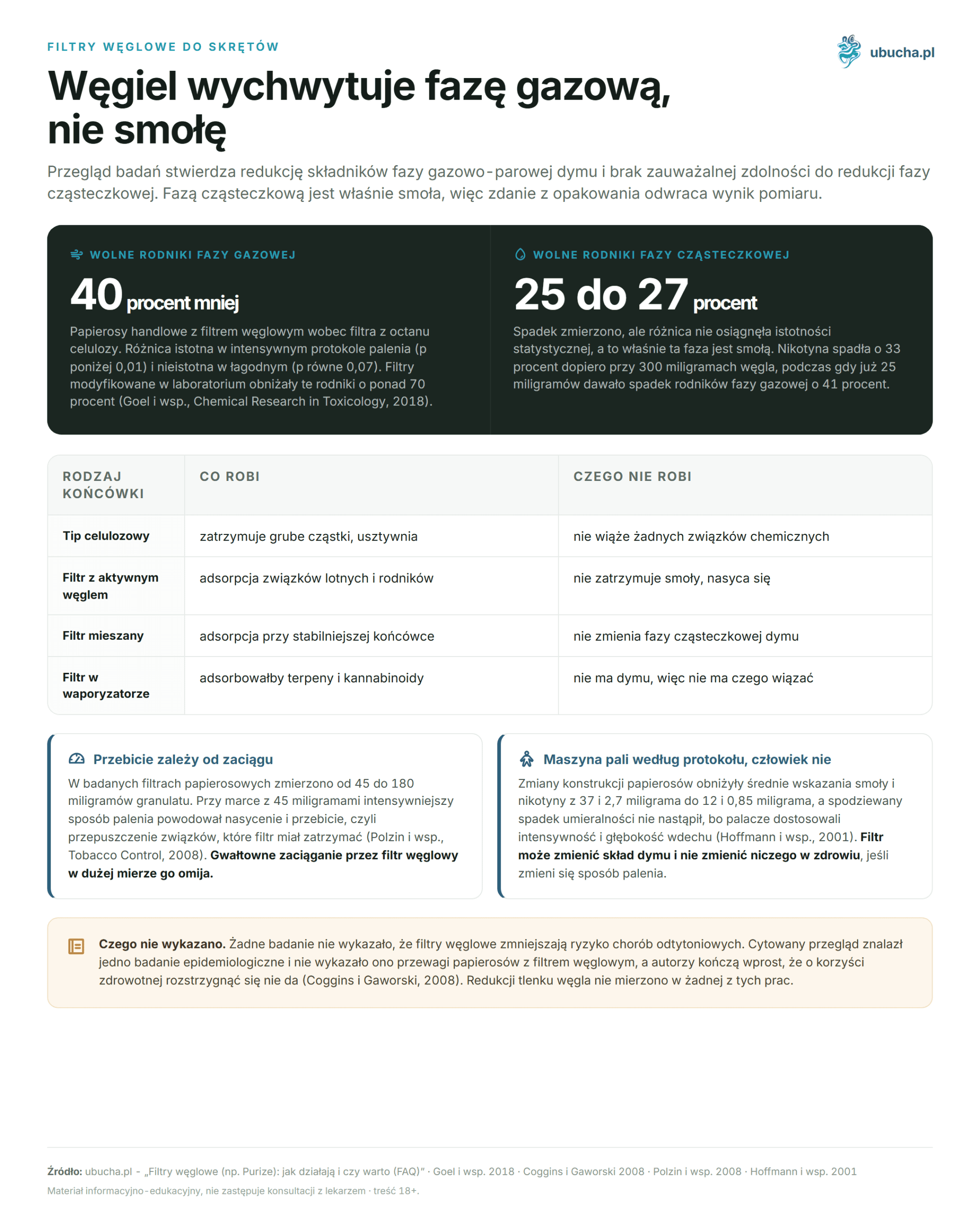
In the gas phase yes, and this has been measured. In tar no, and this has also been measured. A review of the entire body of research on carbon-filtered cigarettes states a reduction in the concentrations of many components of the gas-vapor phase of smoke, while simultaneously showing no noticeable ability to reduce components of the particulate phase (Coggins and Gaworski, Regulatory Toxicology and Pharmacology, 2008). The particulate phase is precisely tar, so the common statement about the filter trapping tar is a reversal of what the measurements show.
The scale of the effect in the gas phase is, however, real. In a study of free radicals, commercial cigarettes with carbon filters produced 40 percent fewer gas-phase radicals than cigarettes with cellulose acetate filters, with the difference being significant in the intensive smoking protocol (p below 0.01) and not significant in the mild one (p equal to 0.07). For the particulate phase, there were 25 to 27 percent fewer radicals, but the difference did not reach significance. Laboratory-modified filters reduced gas-phase radicals by over 70 percent, and just 25 milligrams of carbon resulted in a 41 percent reduction; nicotine decreased by 33 percent only at 300 milligrams (Goel et al., Chemical Research in Toxicology, 2018).
We have noticed that those asking about carbon filters often jump from these numbers straight to the conclusion about safety, and this step is precisely where the literature stops. The cited review found one epidemiological study and it did not show an advantage for carbon-filtered cigarettes; a short clinical study yielded small decreases in biomarkers. The authors conclude directly that health benefits cannot be determined.
Why does lighter smoke not mean lower risk?
Because the dose is determined by the way of smoking, not by the machine measurement itself. The design of the filter changes what the smoke-drawing apparatus shows according to a set protocol. A person does not smoke according to a protocol and adjusts to what they feel.
History knows this scenario well. Changes in the design of cigarettes reduced the average readings of tar and nicotine from 37 and 2.7 milligrams to 12 and 0.85 milligrams, and the expected decrease in mortality from chronic diseases did not occur because smokers adjusted the intensity and depth of inhalation (Hoffmann et al., Chemical Research in Toxicology, 2001). A filter can change the composition of smoke and not change anything in health if the way of smoking changes.
It is also worth knowing who wrote these works. The cited review was produced by the private consulting firm Carson Watts Consulting, while the measurements of volatile compounds were conducted at the American Centers for Disease Control and Prevention. This does not invalidate any of these results, but it is worth knowing when reading the statement about the lack of health benefits.
How does a carbon filter differ from a regular tip?
A tip does only what is mechanical. A carbon filter does the same and adds adsorption of the gas phase. None of the works that we could find show a reduction in carbon monoxide: measurements concerned volatile organic compounds and free radicals, not this component of smoke.
| Type of tip | What it does | What it does not do |
|---|---|---|
| Cellulose tip (cardboard) | Stiffens the tip, traps large particles, prevents pulling the flower into the mouth | Does not bind any chemical compounds |
| Activated carbon filter | Does the same mechanically, plus adsorption of volatile compounds and free radicals from the gas phase | Does not trap tar, carbon monoxide reduction has not been demonstrated, saturates with intense drawing |
| Mixed filter (carbon plus cellulose layer) | Adsorption as above, with a more stable tip and lower risk of pulling granulate | Does not change anything in the composition of the particulate phase of smoke |
The practical conclusion is therefore narrower than the advertisement. If you care about reducing some volatile compounds, a carbon filter makes sense. If you expect that smoking will stop being harmful because of it, none of these three columns carries such a promise.
What size of carbon filter to choose?
Match it to the diameter of the rolling paper or tube. There are two practical widths on the market: thinner, about 6 millimeters, suitable for popular King Slim papers, and wider, matched to the diameter of a regular cigarette. The filter should fit with slight resistance; too loose allows air to pass through the sides and shortens the contact of smoke with carbon.
In practice, the thinner variant dominates the Polish market. All carbon filters available today in the store ubucha.pl have a diameter of 6 millimeters and differ in packaging size and product version. In terms of price per piece, it ranges from about 0.70 to about 1.10 zlotys, depending on how large a package you buy (prices in the store ubucha.pl, as of August 15, 2026). You can find the filters in the filters category.
Choosing the paper is just as important as choosing the filter, as it determines the diameter. We have outlined the sizes, materials, and differences between popular brands in a separate text about which papers to choose. If you are just starting, a guide on how to roll a joint will also be helpful, as placing the filter is part of the same process.
Does a carbon filter wear out and how to store it?
It does wear out, and faster than its size would suggest. However, the saturation of carbon was measured not during storage in a drawer, but during use: with a larger volume of smoke being drawn, breakthrough occurred, and with a filter containing 45 milligrams of carbon, a more intense smoking method was sufficient for this (Polzin et al., 2008). This is the real reason why manufacturers recommend one filter for one use.
The commonly repeated numbers about loss of effectiveness after a few weeks in an open package have no confirmation in the literature we could find. We did not find any study measuring how long a carbon filter retains its adsorption capacity during storage. Recommendations for airtight packaging and a dry place are reasonable because activated carbon binds moisture, but a specific expiration date remains a declaration of the manufacturer, not a measurement result.
The practical conclusion: buy packages that you will use in a reasonable time, keep them closed away from moisture, and replace the filter with each new roll. Reuse is technically possible, but after carbon saturation, it has little to do with what the filter was supposed to do.
Frequently Asked Questions
How do activated carbon filters for joints work?
Through adsorption: some volatile compounds in the smoke bind to the surface of porous activated carbon. In the studied cigarette filters, there were between 45 and 180 milligrams of granulate, and the effectiveness depended on both this amount and the volume of smoke being drawn (Polzin et al., 2008). A slower draw means longer contact and better adsorption.
Does a carbon filter trap tar?
No. A review of studies on carbon-filtered cigarettes found no noticeable ability to reduce the components of the particulate phase of smoke, which is tar (Coggins and Gaworski, 2008). Carbon acts on the gas-vapor phase: volatile compounds and free radicals. The statement about trapping tar is a reversal of the result.
By how much does a carbon filter reduce harmful substances?
In a study of free radicals, cigarettes with carbon filters produced 40 percent fewer gas-phase radicals than cigarettes with cellulose acetate filters, with a significant difference in the intensive smoking protocol. For the particulate phase, the reduction was 25 to 27 percent and was not statistically significant (Goel et al., 2018).
Does a carbon filter make smoking safe?
No. The only epidemiological study included in the review found no advantage for carbon-filtered cigarettes, and the authors concluded that health benefits could not be determined (Coggins and Gaworski, 2008). The filter belongs to the category of harm reduction, not elimination.
Does a carbon filter trap carbon monoxide?
This has not been demonstrated in any of the studies available: measurements of the effectiveness of carbon filters concerned volatile organic compounds and free radicals. This is significant because carbon monoxide is one of the main toxic factors in tobacco smoke mentioned in the literature (Hoffmann et al., 2001). Therefore, the filter does not protect against this component.
Do carbon filters change the taste?
Slightly yes, because carbon adsorbs volatile compounds, which largely create the aroma. With cannabis, this means a less pronounced terpene profile. No one has measured the scale of this change separately for cannabis, so it remains a matter of individual perception.
How many times can one carbon filter be used?
Once. The saturation of carbon occurs already during a single use, and with intense drawing and a smaller amount of granulate, breakthrough occurs even before the end (Polzin et al., 2008). Reuse is technically possible, but the filter no longer performs its adsorption function.
Do carbon filters fit in a vaporizer?
No, and they should not be used for that. Carbon filters are designed for smoke from combustion, and a vaporizer does not produce smoke. The carbon would adsorb what the user is looking for, namely terpenes and cannabinoids, reducing the effectiveness of the device without any benefit on the other side.
This article is for informational and educational purposes. It contains internal links to product categories available in the u Bucha store. Prices and specifications may change: check the current data on the product page before purchasing.
Author: Michał Waluk · Published: 2026-07-03 · Updated: 2026-08-15