
Liposomal CBD: what is it and is it worth the extra cost (FAQ)
Does liposomal CBD absorb better than regular oil? In humans, the nano carrier did not outperform oil, and a fatty meal increased exposure fourfold.
Products described as liposomal cost more than regular oils and promise better absorption for that difference. The technology itself is real and old: liposomes were discovered in the 1960s and are now considered the best-tested carrier system in pharmacy (Bozzuto and Molinari, International Journal of Nanomedicine, 2015). The question, however, is different: has anyone measured in humans that the nano carrier provides an advantage over regular oil in the case of cannabidiol? The answer changes the purchasing calculation, as the extra cost pertains to the carrier itself, not the amount of cannabidiol in the package. Liposomes and nanoemulsions are two different structures, although they are often confused in descriptions. This text shows what has been measured, on whom, and why the cheapest method of improving absorption does not require any extra payment.
KEY INFORMATION
• In a study of 12 healthy volunteers, the nanoemulsion carrier did not provide higher exposure to CBD than regular sesame oil; both outperformed the pure powder (Izgelov et al., 2020).
• A fatty meal increased CBD exposure more than fourfold, and peak concentration from 4.85 to 14 times (Taylor et al., 2018; Birnbaum et al., 2019).
• The absolute bioavailability of CBD has only been measured in humans for smoking (31 percent), so the percentages attributed to liposomes have no measurement (Millar et al., 2018).
• The temporary safe dose from EFSA applies only to preparations without nanoparticles, meaning it does not include liposomal forms.
• The store ubucha.pl does not carry liposomal CBD preparations; catalog status as of August 16, 2026.
What is a liposome and how did it come to be in CBD supplements?
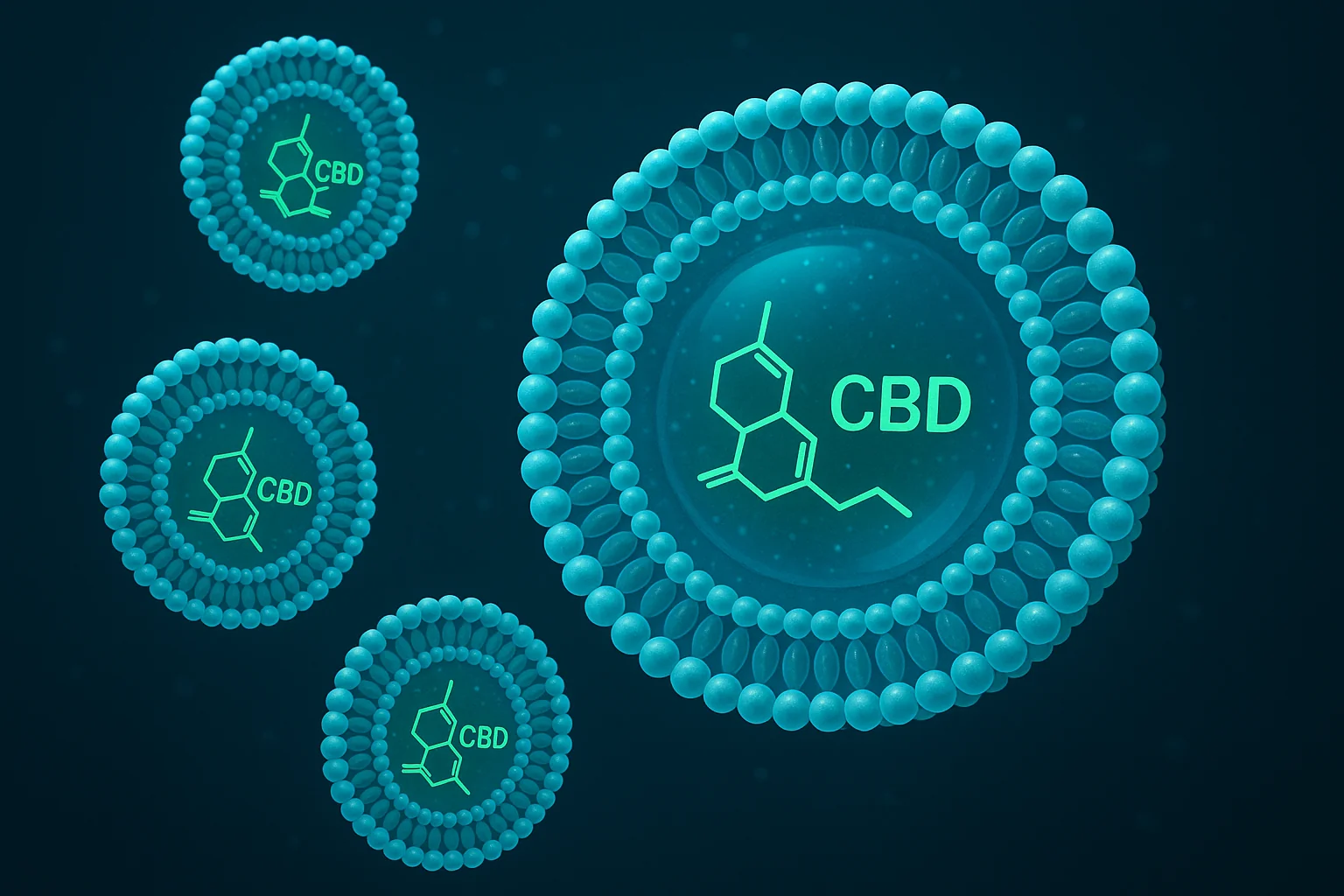
A liposome is a vesicle made up of a double layer of phospholipids, which is the same material as a cell membrane. The interior of such a vesicle can carry an active substance through an aqueous environment, protecting it from degradation, and the shell itself facilitates contact with cell membranes.
They were discovered in the 1960s and have been studied so intensively since that a review dedicated to liposomes as nanomedical products calls them the most effective known drug delivery system, with preparations approved for use and others in clinical trials (Bozzuto and Molinari, 2015). However, it is worth noting what this achievement pertains to: drugs and their carriers, not swallowed supplements.
In the case of CBD, the problem that liposomes are supposed to solve is real. Cannabidiol dissolves in fats, not in water, so it behaves poorly in intestinal content, and after passing through the intestinal wall and liver, it loses part of the dose in first-pass metabolism. Transferring this reasoning from an intravenous drug to a swallowed capsule is, however, an assumption, not a result, and requires verification in humans.
Does liposomal CBD absorb better than regular oil?
The closest study to this question in humans indicates that the nano carrier did not provide an advantage over oil. Twelve healthy men took synthetic cannabidiol in three forms in a crossover design: as a powder, in sesame oil, and in a self-nanoemulsifying carrier system. Fatty carriers clearly outperformed the powder, but total exposure to CBD did not differ between sesame oil and the nano carrier (Izgelov et al., European Journal of Pharmaceutics and Biopharmaceutics, 2020).
The nano carrier had one advantage in this study, and it was not the amount of the dose that reached the blood. After regular oil, some participants absorbed the substance quickly, while others did so with a delay; after the nanoemulsion carrier, the absorption profile was uniformly fast for all. This is an argument for predictability, not for a greater amount.
The self-nanoemulsifying carrier system is not the same as a liposome, and this must be stated clearly. A search for cannabidiol and liposomes in the public Europe PMC database currently returns no studies, so comparative research in humans for liposomes with CBD could not be found. A technologically similar form is discussed in the text about water-soluble CBD and nanoemulsions.
How much does a fatty meal add to CBD absorption?
More than has been shown for any carrier, and for free. In a phase 1 study, twelve healthy participants took 1500 mg of cannabidiol once on an empty stomach and after a fatty meal; the meal increased peak concentration by 4.85 times and total exposure by 4.2 times (Taylor et al., CNS Drugs, 2018).
The second measurement comes from patients. Eight adults with drug-resistant epilepsy took a 99 percent pure CBD capsule on an empty stomach and after a meal worth 840-860 kcal. The peak concentration was on average fourteen times higher in the fed state, and exposure was four times higher (Birnbaum et al., Epilepsia, 2019).
A review of 44 clinical data sets confirms this direction and adds something more significant: in the fed state, differences between patients were smaller, and the concentration profile was more predictable (Silmore et al., Pharmacotherapy, 2021).
| Study | Who | What was compared | Result |
|---|---|---|---|
| Izgelov et al. 2020 | 12 healthy men | powder, sesame oil, nano carrier | fatty carriers better than powder; nano not better than oil |
| Taylor et al. 2018 | 12 healthy individuals | 1500 mg on an empty stomach and after a fatty meal | exposure 4.2 times higher, peak concentration 4.85 times |
| Birnbaum et al. 2019 | 8 individuals with drug-resistant epilepsy | capsule on an empty stomach and after a meal 840-860 kcal | exposure 4 times higher, peak concentration 14 times |
| Millar et al. 2018 | humans, review of 24 studies | absolute bioavailability | determined only after smoking: 31 percent |
Where do the percentages attributed to liposomes come from?
Usually from another substance. The percentage values given for liposomal CBD most often come from studies on liposomal curcumin or vitamin C and are transferred to cannabidiol without any intermediate measurement. The methods for increasing the absorption of curcumin have been described in a separate text, and it is clear there that it is a different molecule and a different problem.
The second source is studies on cell cultures, which are then presented as results in humans. Permeation through a membrane in a laboratory vessel says nothing about how much substance will reach the blood after swallowing a capsule.
The third reason is the simplest: there is nothing to compare with. A review of 24 studies with pharmacokinetic measurements in humans established that the absolute bioavailability of cannabidiol was determined only after smoking, at 31 percent, and that no one has attempted such a trial for the oral or sublingual routes (Millar et al., Frontiers in Pharmacology, 2018). Since there is no reference point for regular oil, no number describing the advantage of a liposome over it can be a measurement. Reliable comparisons of routes of administration have been gathered in the post about CBD bioavailability.
What does the EFSA safety assessment say about forms with nanoparticles?
It explicitly excludes them, and this is the most important finding here. The EFSA panel derived a temporary safe dose of 0.0275 mg per kilogram of body weight per day, or about 2 mg daily for a person weighing 70 kg, using the benchmark dose method with an uncertainty factor of 400 in 2026 (EFSA, EFSA Journal, 2026).
However, this value applies exclusively to supplements with a purity of cannabidiol of at least 98 percent and without nanoparticles. Therefore, liposomal or nanoemulsion preparations fall outside the only reference point for safety that currently exists. The panel also states that the safety of CBD cannot be established in individuals under 25 years of age, in pregnant and breastfeeding women, and in individuals taking medications simultaneously.
This last group has a reason for caution confirmed in humans. In thirteen children taking clobazam along with cannabidiol, the concentration of the active metabolite of the drug increased on average by 500 percent (Geffrey et al., Epilepsia, 2015). In a phase 1 study in adults, at a dose of 750 mg twice a day, CBD increased exposure to caffeine by 95 percent, and six participants discontinued participation due to elevated liver transaminases (Thai et al., Clinical Pharmacology in Drug Development, 2021). If the carrier indeed increases absorption, it also raises that risk.
How to recognize a liposomal product and can you buy it in Poland?
By technical data, not by the word on the label. A truly liposomal product contains a phospholipid forming the shell, namely phosphatidylcholine or lecithin, and the stated particle size in nanometers. Without this number, it is impossible to distinguish a liposome from a regular emulsion, and the word placed on the packaging is not a parameter.
The consistency can be a helpful clue: liposomal forms are usually cloudy emulsions, not clear oil. The production itself is costly, so a price close to that of a regular oil with a liposomal declaration is a warning sign. None of these signs, however, replaces a certificate of analysis confirming the content of cannabidiol.
As for purchasing: in the catalog of the store ubucha.pl, as of August 16, 2026, there are no liposomal CBD preparations in any category. Classic hemp oils on an oil carrier are available, which is exactly the form that performed as well as the nano carrier in the Izgelov study. If you are looking for a cheap way to improve absorption, the results of both studies with a fatty meal are a clue available without extra payment, although it does not replace a conversation with a doctor.
Frequently Asked Questions
Does liposomal CBD absorb better than regular oil?
In a study involving twelve healthy men, the nanoemulsion carrier did not provide higher total exposure to cannabidiol than regular sesame oil, although both performed better than the powder (Izgelov et al., 2020). Comparisons of liposomes with oil in humans could not be found in the Europe PMC database.
How much does taking CBD after a fatty meal increase absorption?
In a phase 1 study, a fatty meal increased total CBD exposure by 4.2 times and peak concentration by 4.85 times (Taylor et al., 2018). In eight patients with drug-resistant epilepsy, exposure was four times higher and peak concentration fourteen times higher (Birnbaum et al., 2019).
What is the difference between a liposome and a nanoemulsion?
A liposome is a vesicle surrounded by a double layer of phospholipids, the same as a cell membrane. A nanoemulsion is a suspension of very small oil droplets in water, stabilized by an emulsifier. These are two different structures, so research results on one do not automatically transfer to the other, even though labels often do not distinguish between them.
Where do the percentages attributed to liposomal CBD come from?
They most often come from studies on other substances, especially liposomal curcumin and vitamin C, or from work conducted on cell cultures. The absolute bioavailability of cannabidiol has not been measured in humans for the oral route, so there is no reference point for such a comparison (Millar et al., 2018).
Does the temporary safe dose from EFSA include liposomal forms?
No. The value of 0.0275 mg per kilogram of body weight per day, or about 2 mg for a person weighing 70 kg, refers exclusively to supplements with a purity of at least 98 percent and without nanoparticles. Liposomal and nanoemulsion preparations fall outside this reference point.
How can you tell if a product is truly liposomal?
By the presence of phosphatidylcholine or lecithin in the ingredients and by the stated particle size expressed in nanometers. The absence of technical data alongside the term on the label does not allow for distinguishing a liposome from a regular emulsion. A certificate of analysis confirms the content of cannabidiol in the product but does not provide any information about the structure of the carrier itself.
This article is for informational and educational purposes only and does not constitute medical advice. Before starting to use cannabis or CBD for therapeutic purposes, consult a doctor, especially if you are taking other medications, are pregnant, or breastfeeding.
Author: Michał Waluk · Published: 2026-08-09 · Updated: 2026-08-16