
The First-Pass Effect: Why Swallowing CBD Oil Wastes Most of the Dose
What really happens to CBD after swallowing: the first-pass effect, the impact of a fatty meal, and what no one has measured about oral bioavailability.
The route of administration changes exposure to CBD more than the size of the dose itself, and this is well documented. The numbers typically used to describe this are less reliable: tables of oral bioavailability circulating online provide values that have never been measured in humans. One study showed that the same preparation taken on an empty stomach and after a fatty meal results in concentrations differing by fourteen times. This difference is greater than any portion adjustment a user might consider, yet it is significantly less frequently described than unsupported percentages. This article explains what the first-pass effect is, what has really been established about the absorption of cannabidiol, and what is merely a repeated number without a source.
KEY INFORMATION
• The absolute bioavailability of CBD in humans has only been measured after smoking and was 31%; no study has established it for oral or sublingual routes (Millar et al., Frontiers in Pharmacology, 2018).
• The same CBD preparation after a fatty meal produced a maximum concentration 14 times higher than when taken on an empty stomach, and the area under the curve was 4 times greater (Birnbaum et al., Epilepsia, 2019).
• About 60% of prescription medications pass through the CYP3A4 enzyme that metabolizes CBD.
• Popular oral bioavailability values of 6-19% do not come from any human studies.
What is the first-pass effect?
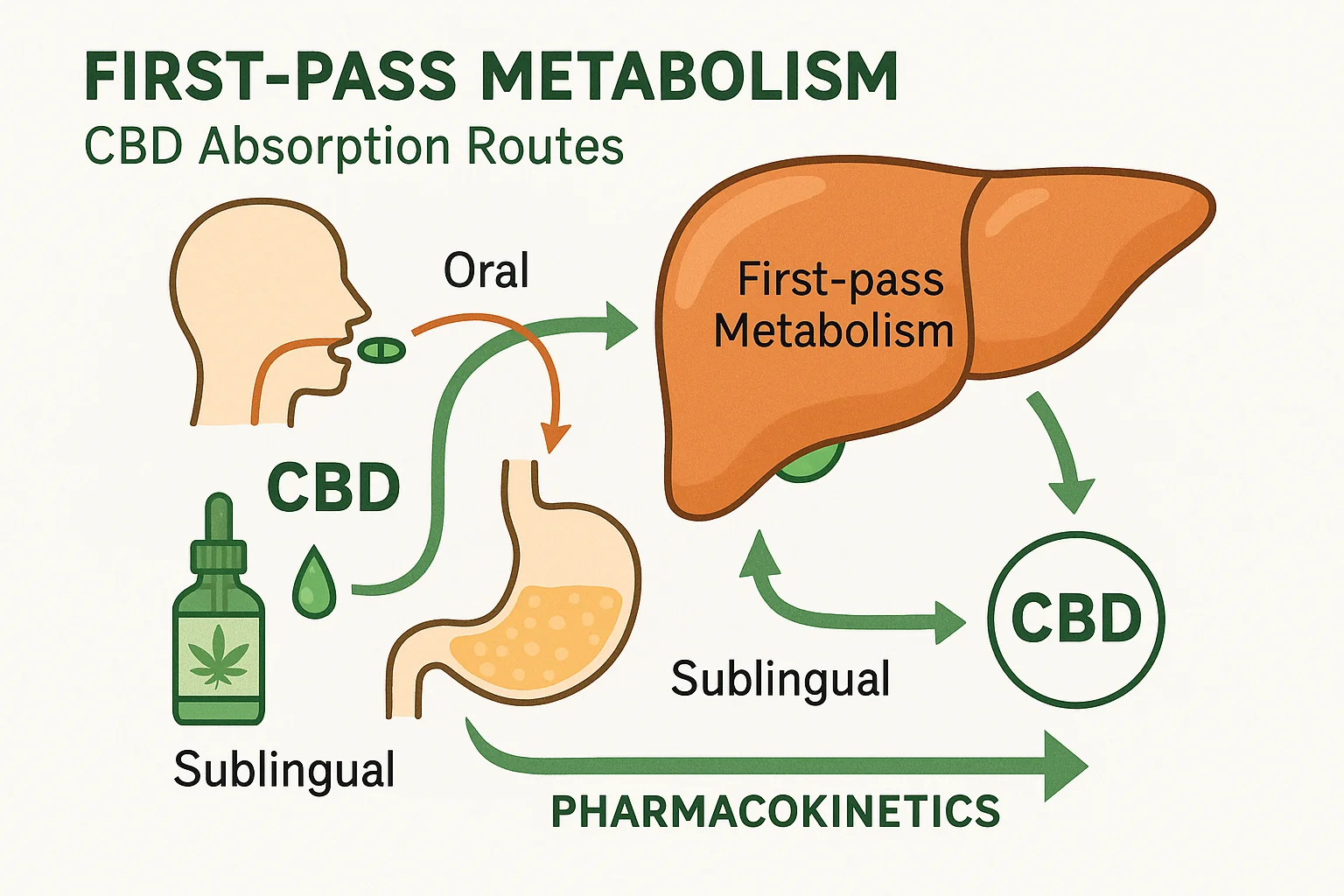
It is the phenomenon in which a substance absorbed from the intestine first travels through the portal vein to the liver, and only then to the systemic circulation. The liver metabolizes part of the dose before it can reach the tissues. For many substances taken orally, this means that significantly less reaches the bloodstream than was swallowed.
The liver is adapted for this: it contains a dense network of enzymes from the cytochrome P450 family that convert chemical compounds into more polar forms, easier to excrete. CBD is primarily processed by CYP3A4 and CYP2C19, and the resulting metabolites have weaker biological activity than the parent compound.
It is worth noting that the first-pass effect only applies to substances absorbed from the gastrointestinal tract into the portal circulation. Routes that bypass the intestine, such as inhalation, sublingual, or intravenous, do not undergo this effect by definition, as blood from these areas flows directly into the systemic circulation. This is why the same dose administered via two different routes produces two different blood concentration profiles.
The mechanism itself is undisputed and is textbook knowledge. Doubts arise when asking how significant this loss is specifically for cannabidiol, and that is the content of the next section.
How much CBD do you really lose after swallowing?
We do not know. This is a disappointing answer, but it is the only one consistent with the state of research, and it is worth stating it before any table. Commonly cited oral bioavailability values of 6-19% do not come from human studies.
Millar et al. (Frontiers in Pharmacology, 2018) reviewed 792 articles and selected 24 containing pharmacokinetic parameters of CBD in humans. Their finding is unequivocal: bioavailability after smoking was 31%, but no other study has attempted to determine absolute bioavailability for other routes of administration, even though intravenous preparations, without which such measurement cannot be made, were available. The authors note in the introduction that low oral bioavailability is suggested by animal studies, and the literature regarding humans is insufficient.
What has been measured in humans is summarized in the table below. What stands out is not so much the content itself, but the number of empty spaces.
| Route of administration | Absolute bioavailability | Half-life |
|---|---|---|
| Inhalation (smoking) | 31% | 31 hours |
| Intravenous | by definition 100% | 24 hours |
| Oral, chronic | not established | 2-5 days |
| Mucosal aerosol | not established | 1.4-10.9 hours |
| Sublingual | not established | no data |
Millar also states two more certain things: the area under the curve and maximum concentration increase with the dose, and are reached faster after smoking or inhalation than after oral administration. The temporal advantage of routes bypassing the intestine is therefore measured, unlike the quantitative advantage.
How much does a meal change CBD absorption?
A lot, and this is the best-documented practical information on the entire topic. The same preparation taken after a fatty meal produced a maximum concentration fourteen times higher than when taken on an empty stomach.
Birnbaum et al. (Epilepsia, 2019) administered a single dose of capsules containing 99% pure CBD to eight adults with drug-resistant epilepsy, once on an empty stomach and once after a high-fat meal worth 840-860 calories. Blood was collected for 72 hours after administration. The maximum concentration was on average 14 times higher in the fed state, and the area under the curve was 4 times greater. The 90% confidence interval for the ratio of maximum concentrations ranged from 7.5 to nearly 32, showing how large the variability is among individuals.
The authors conclude that this is significant for anyone taking CBD orally: the fat content in the meal can explain fluctuations in drug exposure in the same patient. In other words, the same dose taken at two different times of the day results in two different exposures. This is also confirmed by the EFSA panel, which summarized in 2026 that CBD bioavailability is variable and depends on the carrier matrix and the food consumed.
From our observations, the advice to take CBD with fat is widely circulated, but it is almost never accompanied by a scale of the phenomenon. A fourteen-fold difference is not a nuance for advanced users, but a factor greater than any change in portion size that a user might consider themselves.
Why does sublingual administration bypass the liver?
The reason is anatomical. The mucous membrane under the tongue is thin and richly vascularized, and blood from this area drains through veins leading to the systemic circulation, bypassing the portal vein. A substance absorbed this way does not pass through the liver before reaching the tissues.
This is a conclusion drawn from body structure, and no one disputes it. The open question remains how much of the dose is actually absorbed in the oral cavity before the rest is swallowed and follows the regular digestive route. This has not been measured in humans, so comparisons like sublingual bioavailability of 13-35% versus oral 6-19% juxtapose two numbers, neither of which has a source.
We have noticed that many users hold the oil under their tongue for a few seconds and then swallow. Since absorption through the mucous membrane requires contact time, a short hold brings sublingual administration closer to regular swallowing. The several dozen seconds recommended by manufacturers is a reasonable practice, although it must be honestly added that the optimal contact time has not been established in studies either.
The practical conclusion is therefore more modest than suggested by tables: sublingual administration has a reasonable anatomical justification and costs nothing, but it cannot be said today how much it exactly increases exposure compared to swallowing. This is the difference between a probable mechanism and a measured quantity, and this difference is precisely what commercial materials tend to obscure.
Which medications alter CBD metabolism?
Those that inhibit or stimulate CYP3A4, and there are many: about 60% of prescription medications pass through this enzyme. The direction of change is predictable, but the scale is not always.
Iffland and Grotenhermen (Cannabis and Cannabinoid Research, 2017) compiled these observations in a review of the safety of cannabidiol. Ketoconazole, an antifungal drug that inhibits CYP3A4, nearly doubles the peak concentration of CBD in the blood. Rifampicin, an antibiotic that stimulates the same enzyme, lowers CBD concentration. The relationship thus works both ways and applies to substances taken concurrently.
A more interesting case is one where prediction failed. Omeprazole, which inhibits CYP2C19, did not significantly affect the pharmacokinetics of CBD, even though CYP2C19 is involved in its metabolism. This shows that the mere presence of an enzyme in the pathway is not enough to predict an interaction, and that reasoning from mechanism can be unreliable.
The authors add a caveat worth repeating: in vitro studies on which inhibition tables are based were conducted at supraphysiological concentrations of CBD. More clinical data is needed to determine whether interactions require dose adjustments for concurrently administered medications. With any medication taken regularly, this is a conversation with a doctor or pharmacist, not a topic for self-resolution.
Do nanoemulsions bypass the first-pass effect?
No, and claims about the scale of their advantage are not currently supported by human studies. Nanoemulsion may accelerate absorption, but the majority of absorbed CBD still travels through the portal vein to the liver.
The idea itself is technologically sound. CBD enclosed in oil droplets with a diameter of less than two hundred nanometers, stabilized by an emulsifier, does not have to wait for slow emulsification by bile acids, as it is already in a form similar to micelles. Some of these droplets may also enter the lymphatic vessels of the intestine, thus bypassing the portal vein on the first pass.
The problem lies in the data. Claims of twofold or fourfold increases in bioavailability usually come from in vitro studies or animal models, and independent comparative studies in humans are simply lacking. Since absolute bioavailability has not been established for any oral form, it cannot be fairly stated that any form raises it from one value to another. We have detailed the comparison of oral forms in the post CBD water-soluble and nanoemulsion.
What does this mean in practice?
Three things, all based on what has actually been measured, not on tables without sources. None of them require changing the portion size.
First, the repeatability of conditions matters more than the portion size itself. Since a fatty meal can change the maximum concentration fourteenfold, taking CBD once on an empty stomach and once after lunch introduces variability greater than any adjustment a user would consciously make. A consistent time and a consistent meal context organize this without increasing anything.
Second, the method of administration should be chosen based on the expected duration of action, as the time differences between routes have been measured, unlike the quantitative differences. Third, when taking any medications, it is the doctor or pharmacist who decides on the appropriateness of combining them, as interactions through cytochrome P450 work both ways.
The practical consequences of choosing between swallowing and holding under the tongue are described in more detail in the post How to use CBD oil, and the differences between routes of administration in the post CBD Bioavailability. You can find ready-made preparations in the oils category.
Frequently Asked Questions
What is the first-pass effect?
It is the process in which a substance absorbed from the intestine travels through the portal vein to the liver before reaching the systemic circulation. The liver metabolizes part of the dose through cytochrome P450 enzymes. CBD is primarily processed by CYP3A4 and CYP2C19 into metabolites with weaker biological activity.
How much CBD is lost after swallowing oil?
This has not been measured in humans. Millar et al. (Frontiers in Pharmacology, 2018) established that the absolute bioavailability was determined only after smoking, where it was 31%, and no other route of administration has been studied for this yet. Values of 6-19% have no source.
Does eating fat with CBD improve absorption?
Yes, and quite significantly. Birnbaum et al. (Epilepsia, 2019) administered capsules containing CBD to eight adults on an empty stomach and after a high-fat meal worth 840-860 calories. The maximum concentration was on average 14 times higher in the fed state, and the area under the curve was 4 times greater.
Does holding oil under the tongue really help?
Anatomically, it makes sense: blood from under the tongue bypasses the portal vein and the liver. However, it has not been measured in humans how much of the dose is absorbed this way, nor what the optimal contact time is. A short hold, however, brings sublingual administration closer to regular swallowing.
Does CBD interact with medications?
Yes, through cytochrome P450. Iffland and Grotenhermen (2017) report that ketoconazole nearly doubles the peak concentration of CBD, while rifampicin lowers it. About 60% of prescription medications pass through CYP3A4, so if you are on regular treatment, make decisions with your doctor.
This article is for informational and educational purposes only and does not constitute medical advice. Before starting to use cannabis or CBD for therapeutic purposes, consult with a doctor, especially if you are taking other medications, are pregnant, or breastfeeding.
Author: Michał Waluk · Published: 2026-08-09 · Updated: 2026-08-11