
CBD for Weight Loss: How It Works, Does It Help, and What Studies Say 2026
CBD and weight loss without marketing: what has been shown in rats, in cells, and in humans, why the claim about lowering cortisol is uncertain, and what EFSA says.
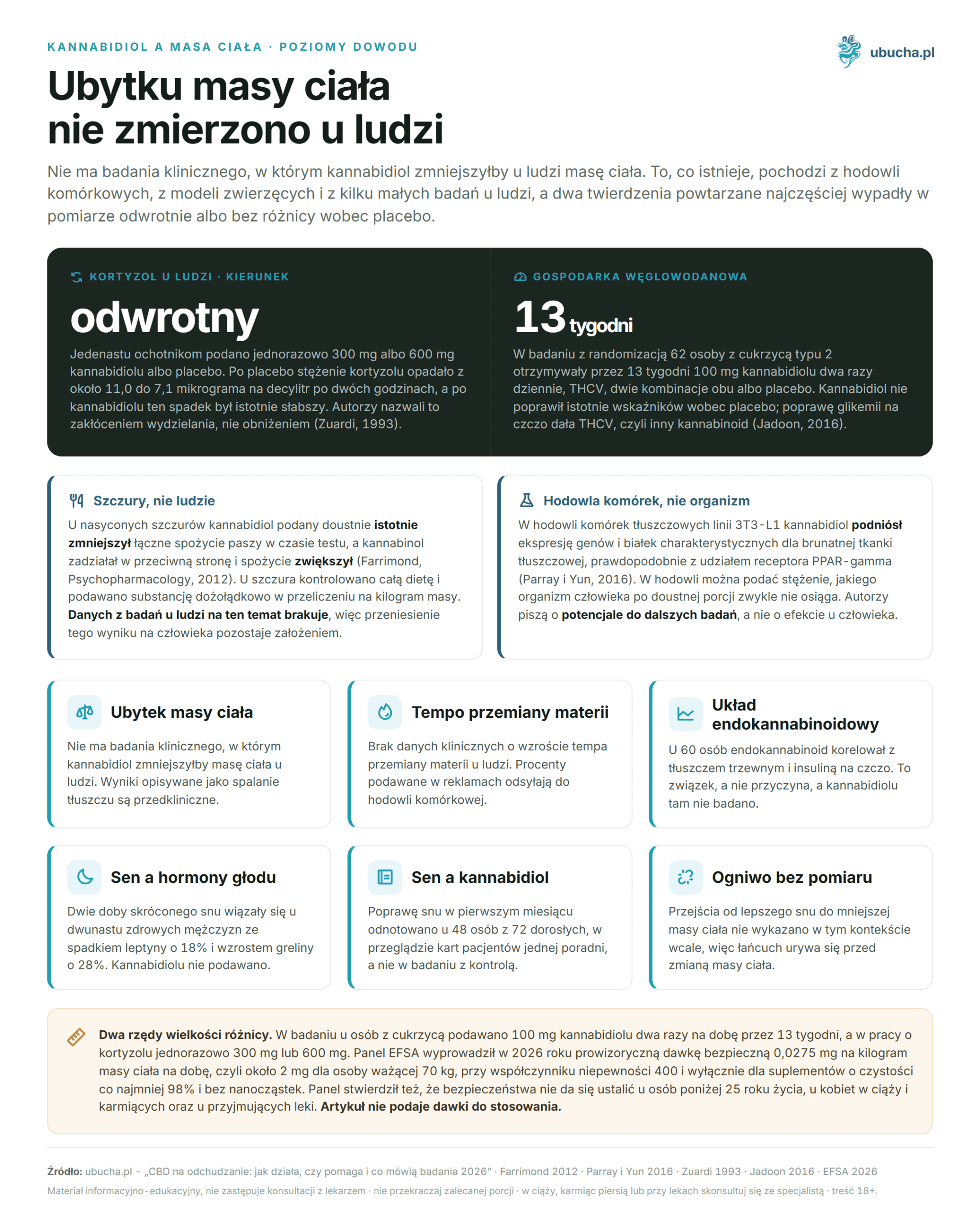
The claim that CBD melts fat regularly resurfaces in advertisements and has no basis in research. No clinical work has shown that cannabidiol causes weight loss in humans. What exists is a set of results from cell cultures, animal models, and a few small studies on humans that describe mechanisms that may indirectly affect metabolism. The difference between the two is enormous, and most texts online blur that distinction. Below, I separate these levels of evidence and indicate on whom and under what conditions each result was obtained. Along the way, I clarify two claims that frequently recur in Polish articles about CBD and weight, which do not withstand scrutiny at the source.
KEY INFORMATION
• There is no clinical study in which CBD reduced body weight in humans.
• Cannabidiol reduced food intake in saturated rats and stimulated browning of fat cells in culture; both results are preclinical.
• The claim that CBD lowers cortisol has no confirmation: in a controlled study in humans, cannabidiol weakened the natural morning drop in cortisol, acting in the opposite direction.
• In a study of patients with type 2 diabetes, CBD did not improve glycemia; the metabolic effect was provided by THCV, another cannabinoid.
• EFSA (2026): the provisional safe dose of cannabidiol is 0.0275 mg/kg body weight per day, or about 2 mg for a person weighing 70 kg; safety cannot be established in individuals under 25 years of age, in pregnant and breastfeeding women, and in those taking medications.
Does CBD burn fat?
No. There is no clinical study in which cannabidiol led to a loss of fat tissue or body weight in humans. All results described as fat burning come from cell cultures and studies on rodents, and translating them to humans remains an assumption, not an observation.
It is worth seeing where the discrepancy comes from. In fat cell cultures, one can provide a concentration that the human body typically does not reach after an oral dose of oil and measure changes in gene expression over a few days. In a rat, one can control the entire diet and administer the substance intragastrically based on body weight. In humans, the bioavailability of cannabidiol is variable, depending on the meal and form of the preparation, and fat metabolism changes over months, not days. The result obtained in the first two conditions does not predict the result in the third.
This does not mean that the topic is empty. It means that the question is different from what advertising poses. It is not about whether CBD burns fat, as the answer is known and negative. It is about whether it affects factors that hinder weight loss, such as sleep quality, stress, or evening appetite. For this, the answers are partial, and the rest of the text is dedicated to them.
What does the endocannabinoid system have to do with body weight?
The endocannabinoid system regulates appetite and energy metabolism, and its receptors are found not only in the brain but also in adipose tissue, liver, and pancreas. Its dysregulation is associated with abdominal obesity, which has been measured directly in humans.
In a study involving 60 people divided into a lean group, a subcutaneous obesity group, and a visceral obesity group, the circulating levels of 2-arachidonoylglycerol, one of the endocannabinoids, correlated with the amount of visceral fat and fasting insulin levels. The expression of the CB1 receptor gene in visceral tissue correlated with the same indicators (Blüher et al., Diabetes, 2006).
However, it must be said immediately what this study does not show. It shows a correlation, not a cause: it is unknown whether dysregulation of the system leads to the accumulation of visceral fat or is a consequence of it. It also says nothing about cannabidiol, as it was not studied. It only establishes that the endocannabinoid system is altered in abdominal obesity, and that is enough to consider it a reasonable target for research. The rest of the reasoning, that is, the transition from this observation to the conclusion about the action of a cannabidiol supplement, is already added by marketing, not by the authors of this work.
What have studies shown about CBD and body weight?
They have shown two things, both outside the human body. In saturated rats, orally administered cannabidiol significantly reduced total food intake during the test, while cannabinol acted in the opposite direction and increased intake (Farrimond et al., Psychopharmacology, 2012).
The second observation concerns so-called browning. In 3T3-L1 fat cell culture, cannabidiol increased the expression of genes and proteins characteristic of brown adipose tissue, probably involving the PPAR-gamma receptor (Parray and Yun, Molecular and Cellular Biochemistry, 2016). Brown fat uses energy to produce heat instead of storing it, so the direction is theoretically beneficial. However, the authors write about the potential for further research, not about the effect in humans, and it is not worth crossing that boundary for them.
The following table organizes what has actually been studied on this topic, along with information on whom.
| Study | On whom | What it showed | Level of evidence |
|---|---|---|---|
| Farrimond 2012 | Saturated adult rats, intragastric administration | Cannabidiol significantly reduced total food intake; cannabinol acted in the opposite direction and increased it | Animal |
| Parray 2016 | 3T3-L1 fat cell culture | Increased expression of brown adipose tissue markers, presumably through PPAR-gamma and PI3K | Cellular |
| Zuardi 1993 | 11 healthy volunteers | Weakening of the natural morning drop in cortisol, which is the opposite direction to the common thesis | Human, small |
| Jadoon 2016 | 62 people with type 2 diabetes, 13 weeks | No significant effect of cannabidiol on glycemia; the metabolic effect was shown by THCV | Human, randomized |
| Penner 2013 | 4657 adults, NHANES data | Lower fasting insulin and lower HOMA-IR index in cannabis users; no dose dependency | Observational |
Does CBD lower cortisol?
There is no evidence for this, and the most frequently cited number in Polish texts does not come from any verifiable work. A controlled study in humans that initiated this thread produced a result contrary to the popular thesis.
Eleven volunteers were given orally 300 mg or 600 mg of cannabidiol or placebo. After placebo, cortisol levels dropped according to the normal daily rhythm, from about 11.0 to 7.1 micrograms per deciliter after two hours. After cannabidiol, this drop was significantly weaker. The authors summarized this as a disruption of cortisol secretion, not as a reduction (Zuardi et al., Brazilian Journal of Medical and Biological Research, 1993).
This same work noted the calming effect of cannabidiol in self-assessment scales, and this is an observation that has withstood the test of time better than the hormonal thread. Separating these two things has practical significance: subjective calming can realistically help control eating under stress, but it is not the same as a proven effect on the hormone responsible for the accumulation of visceral fat. If stress is the main problem, it makes more sense to seek help where the data is stronger, as discussed in the text about CBD for Chronic Stress.
How does sleep relate to appetite and where does CBD fit in?
Sleep is related to appetite through hormones and is one of the better-documented connections in this whole topic. Shortening sleep raises ghrelin levels, the hunger-stimulating hormone, and lowers leptin levels, which signal satiety.
This was measured in controlled conditions in twelve healthy men, with a constant calorie intake and constant physical activity. Two days of shortened sleep were associated with an 18% drop in leptin, a 28% increase in ghrelin, and a 24% increase in perceived hunger, with appetite rising most for caloric and carbohydrate-rich products (Spiegel et al., Annals of Internal Medicine, 2004).
Where cannabidiol stands in this chain is much less clear. The most frequently cited observation comes from a retrospective review of psychiatric clinic records involving 72 adults. Sleep quality improved in the first month for 48 people, or 66.7%, but the authors noted that sleep results varied over time, unlike the sustained improvement in anxiety scales (Shannon et al., The Permanente Journal, 2019). This is a review of patient records, not a study with a control group, so it speaks to what was recorded in the practice of one clinic, not about effectiveness established against placebo.
Does CBD improve insulin sensitivity?
A randomized study in which insulin sensitivity was one of the assessed endpoints showed no benefits. Sixty-two people with type 2 diabetes not treated with insulin were given cannabidiol at a dose of 100 mg twice daily for 13 weeks, THCV, two combinations of both, or placebo.
Cannabidiol did not significantly improve carbohydrate metabolism compared to placebo. It lowered resistin levels and raised gastric insulinotropic peptide levels, but only compared to baseline values, not with the placebo group. However, THCV, another cannabinoid, improved fasting glycemia and pancreatic beta cell function (Jadoon et al., Diabetes Care, 2016). This topic is further developed in a separate text about THCV and Insulin Sensitivity.
Separately, there are observational data from an American population study, NHANES, involving 4657 adults. Cannabis users had 16% lower fasting insulin and 17% lower HOMA-IR index and smaller waist circumference, but the authors found no frequency of use dependency (Penner et al., The American Journal of Medicine, 2013). The lack of dose dependency weakens causal interpretation, and the study concerned cannabis as a whole, not cannabidiol.
What doses were used in metabolic studies?
Doses from metabolic studies are significantly higher than those carried by a typical supplement, and this discrepancy is more important in this topic than the numbers themselves. In the cited study of people with diabetes, 100 mg of cannabidiol was administered twice daily for 13 weeks, and in the cortisol study, a single dose of 300 mg or 600 mg.
On the other side stands the regulatory assessment. The EFSA panel derived a provisional safe dose of cannabidiol in 2026 at 0.0275 mg per kilogram of body weight per day, or about 2 mg per day for a person weighing 70 kilograms, using a 400 uncertainty factor. This value applies only to supplements with a purity of cannabidiol of at least 98% and without nanoparticles. The panel also stated that safety cannot be established in individuals under 25 years of age, in pregnant and breastfeeding women, and in those taking medications (EFSA, EFSA Journal, 2026).
The comparison of these two orders of magnitude leads to a simple conclusion: the numbers from metabolic studies cannot be transferred to one’s own shelf, as they are separated from the values considered safe by two orders of magnitude. Therefore, this text does not provide a dose for use. The issue of conversions and what is known about dosing is discussed in a separate CBD dosing guide, and in the case of metabolic disease and when taking medications, the decision lies with the doctor.
What CBD will not do for weight loss?
It will not replace a negative energy balance and will not speed up metabolism in a way that could be measured in humans. Promises of a percentage increase in calorie burning after cannabidiol refer to results from cell culture, not to measurements in humans.
What can be reasonably expected are intermediate and uncertain things. If stress or poor sleep is a barrier to weight loss, then improvement in these areas may help stick to a dietary plan. However, the chain is long, and each link has a different level of documentation: the effect of sleep on hunger hormones has been measured in humans, the effect of cannabidiol on sleep has been described in a review of patient records, and the transition from better sleep to lower body weight has not been demonstrated in this context at all.
This caution does not only apply to cannabis. The same situation applies to most popular weight loss aids, where the scale of the real effect can be much smaller than the promise, as shown by the text about apple cider vinegar for weight loss. If you still want to try cannabidiol for sleep or stress, and not for fat burning, oil is the simplest form to measure, and you can find it in the oils category.
Frequently Asked Questions
Does CBD help with weight loss?
There is no clinical study showing that cannabidiol reduces body weight in humans. Observations indicating an effect on fat metabolism come from cell cultures and studies on rodents. Any potential benefit may be only indirect and relate to sleep or stress, not fat burning.
How does CBD affect appetite?
In saturated rats, cannabidiol significantly reduced total food intake, while cannabinol increased it (Farrimond et al., 2012). There is a lack of human studies on this topic, so transferring this result to one’s own appetite remains an assumption, not a conclusion from research.
Does CBD lower cortisol levels?
This has not been demonstrated. In a controlled study of eleven volunteers, cannabidiol weakened the natural morning drop in cortisol, acting in the opposite direction to the popular claim (Zuardi et al., 1993). A calming effect was noted in self-assessment scales.
Does CBD speed up metabolism?
There is no clinical data confirming an increase in metabolic rate in humans. An increase in markers of brown adipose tissue was shown in 3T3-L1 cell culture (Parray and Yun, 2016), which is a cellular observation and says nothing about the scale of the phenomenon in the human body.
Does CBD improve insulin sensitivity?
In a randomized study of 62 people with type 2 diabetes, cannabidiol did not significantly improve carbohydrate metabolism compared to placebo; the metabolic effect was provided by THCV, another cannabinoid (Jadoon et al., 2016). Observational data are more favorable but do not show a dose-dependent relationship.
What doses of CBD were used in metabolic studies?
In a study of people with type 2 diabetes, 100 mg of cannabidiol was administered twice daily for 13 weeks. In comparison, EFSA derived a provisional safe dose of about 2 mg per day for a person weighing 70 kilograms. This article does not provide a dose for self-administration.
This article is for informational and educational purposes and does not constitute medical advice. Before starting to use cannabis or CBD for therapeutic purposes, consult a doctor, especially if you are taking other medications, are pregnant, or breastfeeding.
Author: Michał Waluk · Published: 2026-06-22 · Updated: 2026-08-11