
Apple Cider Vinegar in Gummies: Do They Work Like Liquid?
Apple cider vinegar gummies have not been tested on humans even once. What do meta-analyses say about the liquid, how much a serving costs, and why enamel risks more.
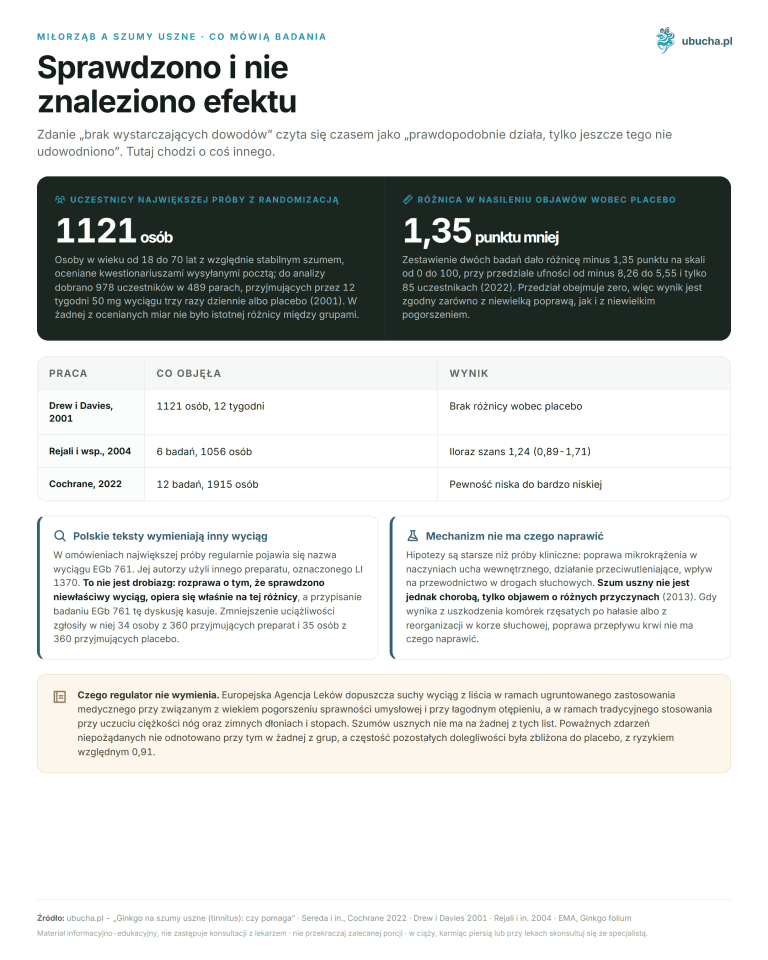
Apple cider vinegar gummies have not been tested on humans even once, and all data from the packaging comes from studies on liquid: a 2026 umbrella review included ten meta-analyses and 38 studies on vinegar, exclusively in this form. Only with this caveat is it worth reading the promise from the jar, meaning all the power of vinegar without the sour taste and without risk to teeth. Reach for gummies when the real alternative is not taking vinegar at all, as the taste or stomach irritation discourages you from the liquid. The effects of vinegar are attributed to acetic acid, and its content in gummies is usually not declared. From this article, you will learn what is really known about both forms, where gummies win in reality, and where only marketing, and why the argument about protecting enamel works in the opposite direction in this matter.
KEY INFORMATION
• A 2026 umbrella review (Shahmohammadi et al., Food Science & Nutrition) included 10 meta-analyses and 38 studies on vinegar, exclusively in liquid form. Gummies have not been tested on humans even once.
• Acetic acid works, and its content in gummies is usually not declared (Hill et al., 2005).
• Liquid vinegar reduces body weight by 1.06 kg and systolic blood pressure by 2.94 mmHg, but not diastolic.
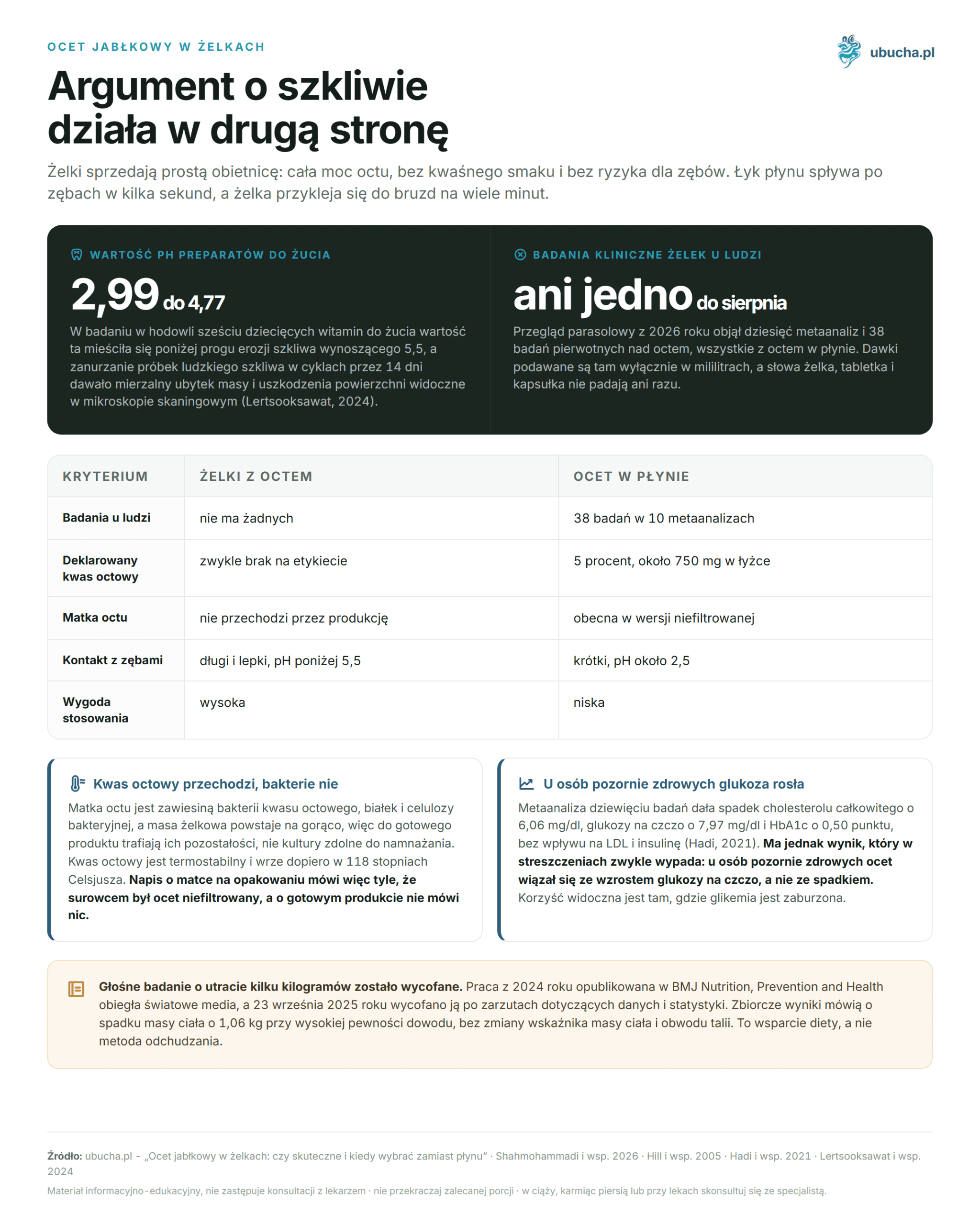
• Children’s chewable vitamins have a pH from 2.99 to 4.77, which is below the enamel erosion threshold.
Has anyone tested apple cider vinegar gummies on humans?
No. As of August 2026, not a single clinical study has been published in which participants received apple cider vinegar gummies. The broadest available compilation, the 2026 umbrella review, included ten meta-analyses and 38 primary studies. We read it in full: doses are given only in milliliters, and the words “gummy,” “tablet,” and “capsule” do not appear even once.
A search of the Europe PMC database using terms combining apple cider vinegar with gummies returned works on food technology, a case report of acute pancreatitis after a weight loss supplement, and unrelated reviews. Not a single clinical trial with a gummy as an intervention.
This has a consequence that is easy to overlook. Every sentence like “gummies support metabolism” is based on two unverified assumptions: that the gummy contains the same active substance as the liquid and that it contains the same amount. The first assumption can be partially defended by chemistry, which I will discuss shortly. The second cannot be verified, as manufacturers rarely provide the content of acetic acid.
We noticed while browsing offers in this category that commercial descriptions almost always refer to “studies on apple cider vinegar” without indicating that a different form of the product was studied. This is not a lie in the strict sense. However, it is an omission that changes the meaning of the entire paragraph, and it is precisely this that accounts for the discrepancy between promise and evidence.
What works in apple cider vinegar and does it survive gummy production?
The measurable effects of vinegar are due to acetic acid, and only it passes through gummy production unscathed. The mother of vinegar, a cloudy suspension of acetic acid bacteria, proteins, and bacterial cellulose, is sensitive to temperature, and the gummy mass is created hot.
Apple cider vinegar is produced in two stages: yeast convert apple sugars into alcohol, then Acetobacter bacteria oxidize the alcohol into acetic acid. The unfiltered version retains the mother and some apple polyphenols. Dissolving gelatin or pectin requires heating the syrup well above the temperature at which acetic acid bacteria survive, so what ends up in the finished product are their remnants, not cultures capable of multiplying. You can find more about the process itself in the post about how apple cider vinegar gummies are made.
Acetic acid behaves differently. It is thermally stable, boils only at 118 degrees Celsius, and is transferred to the powder along with the carrier from which the vinegar has evaporated. The label “with mother” on the gummy packaging thus indicates only that the raw material was unfiltered vinegar. It says nothing about the finished product. A gummy is a carrier of acetic acid with added sweeteners and flavoring, usually also with one vitamin added for health claims.
One caveat to avoid drawing too broad a conclusion. Acetic acid bacteria from the mother will not survive, as they are vegetative bacteria. A separate matter is spore-forming strains, such as Bacillus coagulans, added to gummies specifically because they survive heat processing. If the packaging states a probiotic with a specified number of CFU units, it is usually such a strain, not the surviving mother of vinegar.
How much acetic acid is in one gummy?
It is unknown, as almost no one declares this. Labels provide milligrams of powder or extract from apple cider vinegar, which is not the same as milligrams of acetic acid. Food vinegar with a concentration of 5 percent provides about 750 mg of acetic acid in one tablespoon, or 15 ml. There is simply no analogous conversion for powder.
This has been checked once and the results were poor. The authors of a study published in the Journal of the American Dietetic Association examined eight apple cider vinegar tablets for pH, content of individual acids, and microbial growth. Brands varied in tablet size, pH, acid content, and declaration content, and the authors stated outright that there remains doubt as to whether apple cider vinegar was even an ingredient in the studied products (Hill et al., 2005). No newer systematic market analysis has been published.
We reviewed the label of the only product with apple cider vinegar in our own offer, and it came out the same. The declaration is detailed everywhere except one place: it lists apple cider vinegar in powder form, pectin as a gelling agent, maltitol syrup and sorbitol instead of sugar, citric acid, apple flavoring, Bacillus coagulans culture, vitamins B6 and B12, chromium, and folic acid. The daily serving is two pieces. There are no milligrams of acetic acid listed at all. It is worth noting two thought habits: pectin instead of gelatin means that such gummies can be vegan, and maltitol and sorbitol mean that they can be sugar-free. Both hold true on the label of a specific package, as there are significant differences between brands.
What do studies on liquid vinegar show?
Liquid vinegar has data, and they are not weak. Aggregate results from 2026: fasting glucose lower by 9.40 mg/dl, postprandial glucose by 14.59 mg/dl, HbA1c by 0.70 percentage points, total cholesterol by 9.39 mg/dl, body weight by 1.06 kg, and systolic blood pressure by 2.94 mmHg.
However, the certainty of these results is uneven. The authors of the review rated only two items as high: body weight and systolic blood pressure. Glycemic effects have moderate certainty, total cholesterol very low certainty, and no effect was found at all for LDL, HDL, triglycerides, BMI, waist circumference, and HOMA-IR index. The last list also includes diastolic blood pressure, which is easy to forget when the headline simply mentions blood pressure.
An earlier meta-analysis of nine studies provided a similar picture: a decrease in total cholesterol by 6.06 mg/dl, fasting glucose by 7.97 mg/dl, and HbA1c by 0.50 points, with no effect on LDL and insulin (Hadi et al., 2021). However, it has a result that usually gets left out in summaries, and for the average gummy buyer, it is perhaps the most important: in seemingly healthy individuals, vinegar was associated with an increase in fasting glucose, not a decrease. The glycemic benefit is visible where glycemia is impaired.
The mechanism was described back in 2004: vinegar given with a high-carbohydrate meal improved insulin sensitivity in people with insulin resistance and type 2 diabetes (Johnston et al., Diabetes Care, 2004). Acetic acid slows gastric emptying and starch digestion. This is dietary support, not treatment, and does not replace diabetes therapy. We discuss this data more broadly in the post about apple cider vinegar and glycemia.
Does apple cider vinegar help with weight loss?
A little, and clearly less than the internet promises. An aggregate analysis from 2026 shows a weight loss of 1.06 kg with high certainty of evidence, with no changes in BMI and waist circumference. This is a real effect, only around one kilogram after weeks of use.
A meta-analysis of ten studies involving 789 people, published in 2025, confirms the direction. Vinegar reduced body weight, BMI, and waist circumference, with significant changes appearing in subgroups: at a dose of 30 ml per day, with a duration not exceeding 12 weeks, and in people with overweight, obesity, or type 2 diabetes (Castagna et al., Nutrients, 2025). Heterogeneity reached 83%, so the variation between studies remains large. Note that the two papers do not agree on BMI and waist circumference: the umbrella review sees no effect there, while this meta-analysis does.
There is one more thing to know. A study from 2024 published in BMJ Nutrition, Prevention and Health, which showed a loss of several kilograms and made headlines worldwide, was retracted on September 23, 2025 due to allegations regarding data and statistics. If you come across a text referring to the spectacular effect of vinegar on weight, check if the source is that paper. With gummies, there is also the caloric account of the carrier itself, which in versions sweetened with sugar can negate the effect of around one kilogram.
Are gummies gentler on enamel than liquid vinegar?
Not as much as advertising suggests, and in one respect, they are worse. A caveat must be made immediately: no one has tested gummies in this regard, so the closest data comes from other chewing products. In an in vitro study, six children’s chewable vitamins had a pH between 2.99 and 4.77, which is below the enamel erosion threshold of 5.5, and immersing samples of human enamel in cycles for 14 days resulted in measurable mass loss and surface damage visible under scanning electron microscopy (Lertsooksawat et al., 2024).
A newer work from BMC Oral Health describes the same mechanism in more detail, also on children’s multivitamins. Gummies and chewable tablets contain citric and ascorbic acid, causing their pH to drop below the erosion threshold, and a six-month simulation of daily contact reduced the hardness and increased the roughness of filling materials, with gummies performing worse than tablets in most tested comparisons (Elbatanony et al., 2026). These are data about fillings, not enamel, but they indicate the same direction and the same culprit: an acidic, sticky carrier held in the mouth.
Additionally, there is what liquid does not have: stickiness. A sip of vinegar flows over the teeth in a few seconds, while a gummy sticks to the grooves and maintains an acidic environment for many minutes. In sugar-sweetened versions, it also provides a food source for cavity-causing bacteria. Liquid, of course, also harms when consumed undiluted. Enamel erosion has been reported in a teenager drinking a glass of apple cider vinegar daily (Gambon et al., 2012). After each of these forms, rinse your mouth with water and wait half an hour before brushing your teeth, as the enamel is softened at that time.
What side effects have been reported after apple cider vinegar?
There are few case reports, but they are specific and also concern supplements, not just liquid. The work that prompted the authors to examine eight brands stemmed from esophageal damage caused by apple cider vinegar tablets (Hill et al., 2005). Earlier, Nephron described hypokalemia, hyperreninemia, and osteoporosis in a patient consuming large amounts of apple cider vinegar (Lhotta et al., 1998). This work does not have a summary in open databases, so apart from what the title carries, it cannot be verified today.
A newer case report from 2024 links acute pancreatitis in an 84-year-old patient to a recently introduced weight loss supplement containing apple cider vinegar (Alvarez et al., ACG Case Reports Journal, 2024). The authors explicitly state a possible, not proven, connection and emphasize that data on the risks of such preparations are very limited. A separate matter is external use: chemical burns to the skin have been reported after applying apple cider vinegar (Bunick et al., 2012).
There are three practical conclusions. With esophageal and stomach diseases, acetic acid in any form irritates the mucous membrane. With diuretic medications, the effect of lowering potassium accumulates. With blood sugar-lowering medications, vinegar adds its own effect, which with insulin increases the risk of hypoglycemia. Similar precautions have been described regarding apple cider vinegar for joints.
When do gummies make sense, and when is it better to reach for liquid?
Choose gummies when the real alternative is not taking vinegar at all. This applies to situations where taste or stomach irritation effectively discourage you from the liquid, and for trips where a bottle is simply impractical. Choose liquid when you care about the dose that has actually been studied.
Our observations from comparing labels in this category are that the more the packaging emphasizes the mother of vinegar, the less often it provides the content of acetic acid. If you want to buy gummies despite the lack of clinical data, check the label for two things: whether milligrams of acetic acid are provided and how much sugar or sweetener is in the daily serving, not in one piece. This same note applies to every item in the gummy category: the daily serving from the label, not a single piece, is the only comparable unit here.
The cost comparison is similarly clear-cut. A package of 60 gummies costs in Polish pharmacies from about 26 to 60 PLN, or 0.45-1.00 PLN per piece, while a tablespoon of vinegar from a 500-700 ml bottle for 9-16 PLN comes out to 0.20-0.50 PLN. Comparing the cost of the dose that has actually been studied is impossible for gummies, as the label does not provide milligrams of acetic acid. Prices are from offers of online pharmacies and grocery stores, as of August 2026.
| Criterion | Gummies with vinegar | Liquid vinegar |
|---|---|---|
| Human studies | none | 38 studies in 10 meta-analyses |
| Declared acetic acid | usually none | 5 percent, about 750 mg in a tablespoon |
| Mother of vinegar | does not survive production | present in unfiltered version |
| Added sugar | depends on the brand, can also be maltitol | none |
| Contact with teeth | long and sticky, pH below 5.5 | short, pH around 2.5 |
| Ease of use | high | low |
| Cost per serving | 0.45-1.00 PLN per gummy (60 pieces for 26-60 PLN); cost of the studied dose cannot be calculated | 0.20-0.50 PLN per tablespoon 15 ml (bottle 500-700 ml for 9-16 PLN) |
Frequently Asked Questions
Do gummies with apple cider vinegar work the same as liquid vinegar?
It is unknown, as no one has tested it. A 2026 umbrella review included 10 meta-analyses and 38 primary studies on vinegar, all involving liquid vinegar. No published clinical study has tested gummies, so any promise on the packaging is a transfer of results from another form of the product.
How much acetic acid is in an apple cider vinegar gummy?
Labels usually do not provide this information. They declare milligrams of powder or extract from vinegar, which is not the same as milligrams of acetic acid. An analysis of eight apple cider vinegar tablets showed varying pH, varying acid content, and labels that could not be verified (Hill et al., 2005).
Do apple cider vinegar gummies damage enamel?
They may, although this has been studied on other chewing products. Six children’s chewable vitamins had a pH ranging from 2.99 to 4.77, which is below the enamel erosion threshold of 5.5, and caused measurable enamel mass loss and surface damage visible under scanning electron microscopy. Gummies are also sticky and linger on teeth longer than a sip of liquid.
Does the mother of apple cider vinegar survive in gummies?
No. The mother is a suspension of acetic acid bacteria, proteins, and bacterial cellulose, and the gummy mass is created hot. The label stating ‘with mother’ only indicates that the raw material was unfiltered vinegar. Acetic acid is thermally stable and survives production, but acetic acid bacteria do not. The probiotic declared on the label is usually a separate spore-forming strain, specifically chosen for heat processing.
Does apple cider vinegar help with weight loss?
Slightly. Aggregate results from 2026 show a weight loss of 1.06 kg with high certainty of evidence, without changes in BMI and waist circumference. A prominent study from 2024, which showed a much larger effect, was retracted in September 2025. An effect of around one kilogram is supportive of a diet, not a weight loss method.
Who should avoid apple cider vinegar in any form?
People with esophageal and stomach diseases, those taking diuretics or blood sugar-lowering medications, and individuals with advanced osteoporosis. Hypokalemia and osteoporosis have been reported in a patient consuming large amounts of apple cider vinegar (Nephron, 1998). For diabetics, added sugar in gummies can also be a problem.
Apple cider vinegar gummies and other chewing products can be found in the supplements category; check the composition and availability regularly, as the assortment changes.
This article is for informational and educational purposes and does not constitute medical advice. Before starting supplementation, consult your doctor, especially if you are taking medications regularly, are pregnant or breastfeeding, or have chronic illnesses.
Author: Michał Waluk · Published: 2026-05-28 · Updated: 2026-08-24