
Edible CBD and the 11-hydroxy metabolite: what has really been measured about the oral route
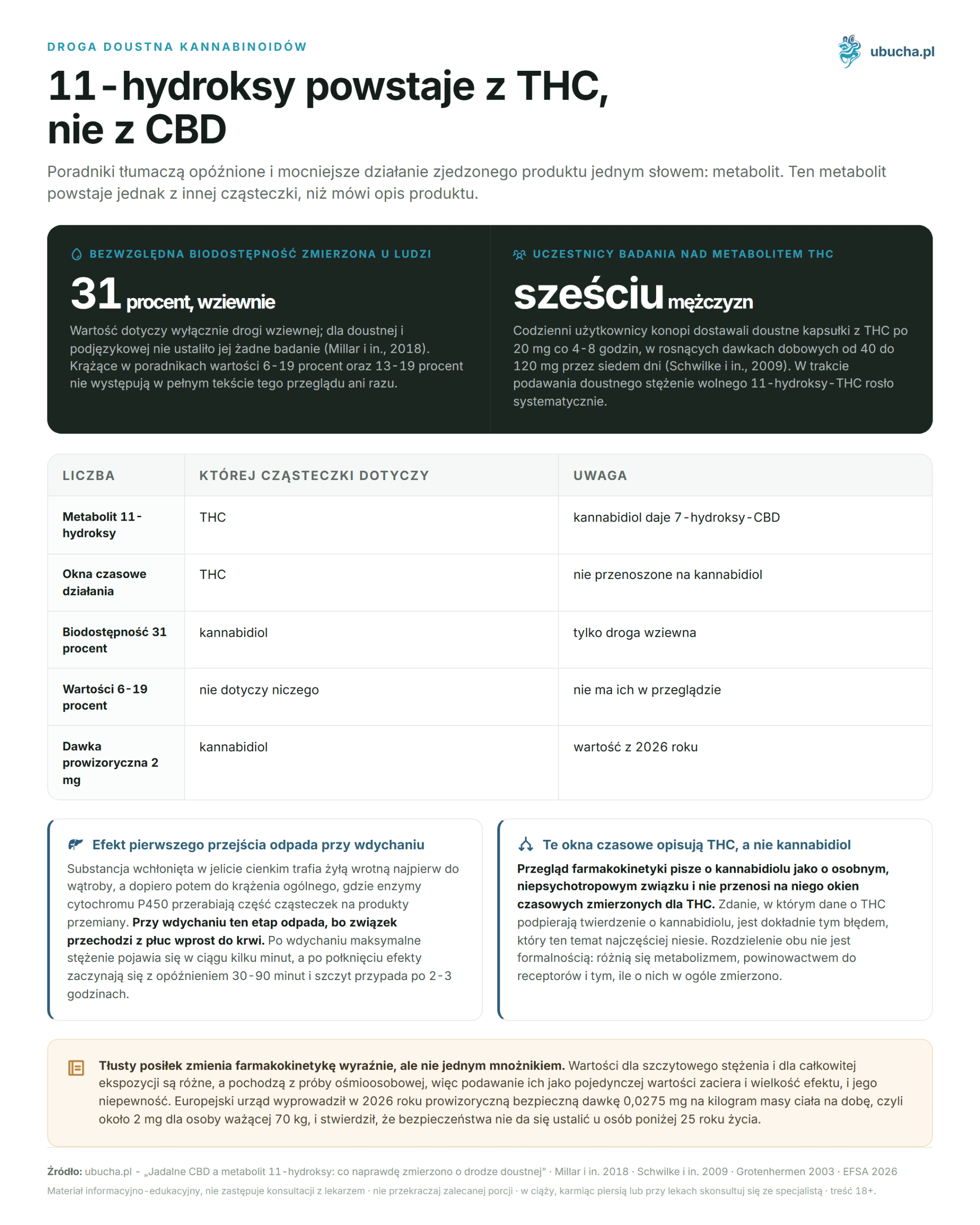
The 11-hydroxy metabolite is formed from THC, not from CBD. We check at the source what has really been measured about the oral route in humans and which numbers have no backing.
Someone eats a gummy with hemp extract, after forty minutes feels nothing and reaches for a second. Two hours later, the effect is stronger than planned. Guides explain this with one word: metabolite. The title of this article does the same and requires correction because the 11-hydroxy metabolite is formed from THC, not from cannabidiol. Below, we separate these two molecules, show what has really been measured about the oral route in humans, and indicate numbers that circulate on the internet without any measurement. We have checked each value in the work we refer to, including whether it is even present in it. A few of them were not found anywhere and were removed from this text along with the sentences that carried them. Instead, we provide what has really been measured: who studied it, how many participants there were, and what the results were.
KEY INFORMATION
• The 11-hydroxy metabolite is formed from THC. Cannabidiol produces a different metabolite, 7-hydroxy-CBD, and no one has shown in humans that it acts stronger than the parent compound.
• The absolute bioavailability of CBD in humans has been measured only for the inhalation route and is 31 percent. No study has done this for the oral and sublingual routes (Millar et al., Frontiers in Pharmacology, 2018).
• The circulating values of 6-19 percent and 13-19 percent do not appear in the full text of this review even once.
• A fatty meal clearly alters the pharmacokinetics of oral CBD, but the multipliers for peak concentration and total exposure are different and come from a study of eight participants.
• EFSA in 2026 derived a provisional safe dose of 0.0275 mg per kilogram of body weight per day, which is about 2 mg for a person weighing 70 kg, and stated that safety cannot be established for individuals under 25 years of age, pregnant and breastfeeding women, and those taking medications.
What happens to the cannabinoid you swallow?
The substance absorbed in the small intestine first goes to the liver via the portal vein, and only then to the general circulation. This is the first-pass effect. Hepatic cytochrome P450 enzymes convert some of the molecules into metabolites, not all of which are biologically inert. When inhaled, this stage is bypassed, as the compound goes directly from the lungs to the blood.
The difference in time was described by Grotenhermen in a review of cannabinoid pharmacokinetics (Grotenhermen, Clinical Pharmacokinetics, 2003). After inhalation, the maximum concentration in plasma appears within a few minutes, the psychoactive effects peak after 15-30 minutes, and wane within 2-3 hours. After swallowing, effects begin with a delay of 30-90 minutes, peak after 2-3 hours, and the whole lasts approximately 4-12 hours, depending on the dose.
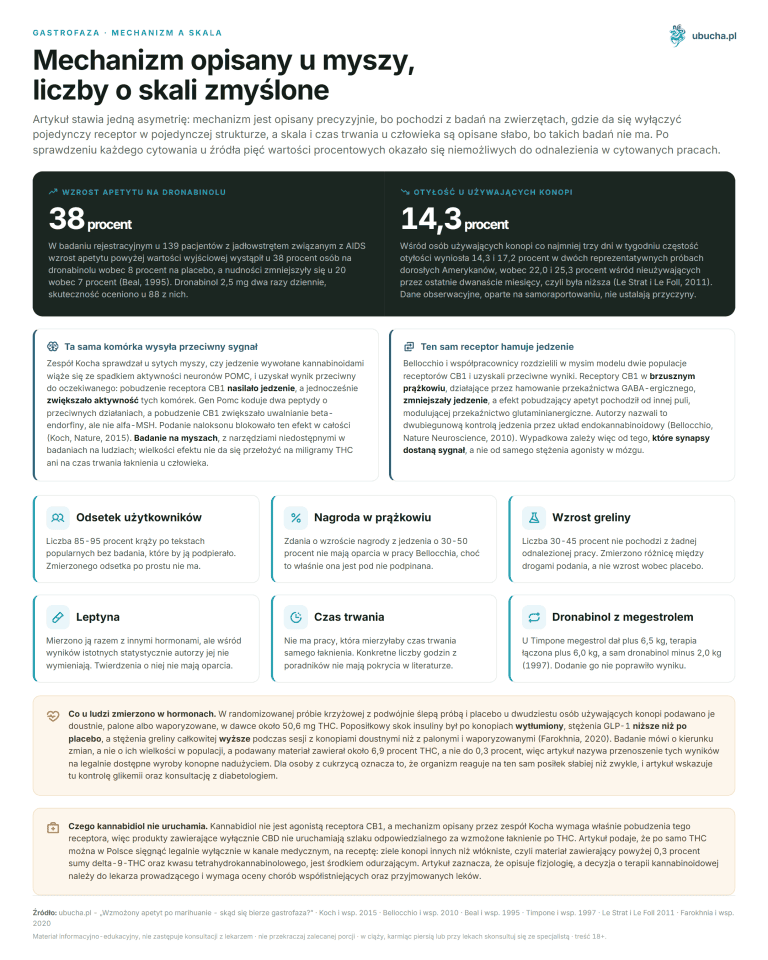
There is a caveat here that guides usually do not make. These values describe THC. Grotenhermen writes about cannabidiol as a separate, non-psychoactive compound and does not transfer those time windows to it. A sentence in which data about THC supports a claim about CBD is exactly the error that this article aimed to clarify, and for years it itself perpetuated. Separating both molecules is not a formality: they differ in metabolism, affinity for receptors, and how much has actually been measured about them.
Does the 11-hydroxy metabolite come from CBD?
No. The 11-hydroxy metabolite is formed from THC when the liver attaches a hydroxyl group at the eleventh carbon atom. Cannabidiol has a different numbering and pathway: its main hydroxyl metabolite is 7-hydroxy-CBD. Therefore, the title of this entry connects edible CBD with a metabolite that does not arise from cannabidiol, and this is the correction that must be made.
The mechanism on the THC side has been measured. Schwilke and colleagues administered oral capsules with THC to six adult men, daily cannabis users, at 20 mg every 4-8 hours, with increasing daily doses from 40 to 120 mg over seven days (Schwilke et al., Clinical Chemistry, 2009). During oral administration, the concentration of free 11-hydroxy-THC increased systematically, while the concentration of THC itself did not rise. Peak values were 3.8 micrograms per liter for THC and 3.0 for its metabolite, meaning that via the oral route, the metabolite matches the parent compound.
On the cannabidiol side, nothing like this has been shown in humans. The existing data comes from cell cultures. Li and colleagues examined 7-hydroxy-CBD and 7-carboxy-CBD in primary human hepatocytes and in the HepG2 line, finding that both metabolites damage cells similarly to cannabidiol itself (Li et al., Archives of Toxicology, 2025). This is a result from a test tube, describing toxicity to liver cells, not potency in humans. The statement “CBD metabolite acts stronger” has no measurement supporting it today, and neither does the reverse statement.
How much cannabidiol really reaches the blood after swallowing?
There is no number for this question, although the internet reflexively provides one. Millar and colleagues reviewed 792 works and found 24 that provide pharmacokinetic parameters for CBD in humans (Millar et al., Frontiers in Pharmacology, 2018). The conclusion is clear: absolute bioavailability was measured only after smoking and was 31 percent, and for no other route of administration has anyone conducted such a measurement in humans, even though intravenous forms were available.
Values of 6-19 percent for the oral route and 13-19 percent for the sublingual route, repeated in hundreds of guides and until recently also in this article, do not appear in the full text of this review even once. We checked this in the entire document, which contains over 50 thousand characters. These are not underestimated or overestimated numbers: they do not come from there at all.
The review does provide what has actually been measured. The half-life ranged from 1.4 to 10.9 hours after aerosol on the oral mucosa, 2-5 days after chronic oral administration, 24 hours after intravenous administration, and 31 hours after smoking. The time to peak concentration ranged from zero to four hours, and the area under the curve and peak concentration increased with the dose. The authors themselves describe the state of knowledge as insufficient and point out discrepancies between studies. One of the co-authors was employed by Artelo Biosciences at the time of publication, and the work was funded by the UK BBSRC council.
| Route of administration | Absolute bioavailability in humans | Half-life |
|---|---|---|
| Smoking | 31 percent | 31 hours |
| Aerosol on mucosa | not measured | 1.4-10.9 hours |
| Orally, chronically | not measured | 2-5 days |
The table collects values from the same review. The empty space in the middle column is not an oversight, but the state of knowledge as of today.
How much does a fatty meal change the absorption of oral CBD?
It changes it clearly, just not as much as guides state, and not uniformly for every parameter. Birnbaum and colleagues administered a single dose of 99 percent pure cannabidiol capsules to eight adult patients with drug-resistant epilepsy, once on an empty stomach and once after a high-fat breakfast worth 840-860 kilocalories, in an alternating design (Birnbaum et al., Epilepsia, 2019). The peak concentration was on average 14 times higher after the meal, and the area under the curve, i.e., total exposure, was 4 times higher. The 90 percent confidence intervals were 7.47-31.86 and 3.42-7.82, respectively.
It is worth seeing how far these values stand from what was previously stated here. The article reported a threefold increase in peak concentration and a fivefold increase in exposure, meaning a smaller number for the parameter that increased the most in the study and a larger one for the one that increased the least. The direction of the relationship was maintained, but the proportions were reversed.
Eight patients is a very small sample, and drug-resistant epilepsy is not the average reader’s population. An independent signal comes from the work of Abbotts and colleagues, who studied fourteen men with a body mass index of at least 25, administering them five different cannabidiol preparations in standardized doses of 30 mg (Abbotts et al., Nutrients, 2022). Eating noticeably changed pharmacokinetics and increased systemic availability, and the differences between the commercial preparations themselves turned out to be significant.
Why does the same dose work differently for different people?
Part of the answer lies in the genes of liver enzymes, but it has been measured for THC, not for cannabidiol. Sachse-Seeboth and colleagues studied 43 healthy volunteers who were given THC orally (Sachse-Seeboth et al., Clinical Pharmacology and Therapeutics, 2009). The CYP2C9*2 variant did not change anything. In individuals with the double variant CYP2C9*3, the median area under the curve for THC was three times higher than in carriers of the wild-type variant, and for the metabolite 11-carboxy-THC, it was 70 percent lower. The authors also noted a tendency towards stronger drowsiness in this group.
The previous version of this paragraph stated a fivefold slower metabolism and higher concentrations of 11-hydroxy-THC. The work measures something different: three times higher exposure to THC itself and lower concentration of the carboxyl metabolite. This is not a cosmetic difference, as it reverses the direction for the metabolite.
The second part of the answer is less spectacular. Millar’s review speaks directly about discrepancies between studies and the lack of data, while Abbotts’ work shows that even commercial preparations with the same declared content behave differently. Before reaching for explanations from the microbiome or fat tissue, it is worth knowing that the form of the product itself and whether you took it with food already explains a lot. The claim about gut flora had no supporting work and was removed. The accumulation in fat tissue is different: a 2018 WHO report considers it likely due to the lipophilicity of cannabidiol (WHO Expert Committee on Drug Dependence, Cannabidiol Critical Review Report, 2018). However, it does not link it to the increasing strength of the effect with repeated use, as this article claimed, and that sentence has disappeared.
Where is the safety boundary for edible CBD?
The European Food Safety Authority set it in an update of its position in 2026 (EFSA NDA Panel, EFSA Journal, 2026). The panel applied benchmark dose modeling based on subchronic studies and, with an uncertainty factor of 400, derived a provisional safe dose of 0.0275 mg per kilogram of body weight per day, which is about 2 mg daily for a person weighing 70 kg. The caveat is narrow: the value applies only to supplements with a purity of cannabidiol of at least 98 percent, without nanoparticles.
This is a ceiling, not a recommendation. It does not say how much you should take, only above what value the agency cannot guarantee safety. The panel adds that safety cannot be established for individuals under 25 years of age, pregnant and breastfeeding women, and those taking medications. Animal studies have provided a consistent picture of liver toxicity, and in humans, potential hepatotoxicity has been noted, especially with concurrent use of medications. Cannabidiol crosses the placenta and accumulates in the body.
Separately, it is worth knowing that in the European Union, cannabidiol remains a novel food ingredient without authorization, and its assessment is still ongoing. A health notification submitted by the manufacturer is not an authorization and does not change the status of the ingredient. If you are looking for edible products, you will find them in the gummy category; their content is declared on the packaging and that is the only number you can check before purchase.
Frequently Asked Questions
Does the 11-hydroxy metabolite come from cannabidiol?
No. It is formed from THC when the liver attaches a hydroxyl group at the eleventh carbon. Cannabidiol produces a different hydroxyl metabolite, known as 7-hydroxy-CBD. All measurements describing the stronger effect of the metabolite via the oral route pertain to THC, so transferring them to products with cannabidiol has no basis.
How much CBD is absorbed after swallowing?
It is unknown. Millar’s review from 2018 established that the absolute bioavailability of cannabidiol in humans was measured only after smoking and was 31 percent. For the oral, sublingual, and any other route, such measurements have not been conducted.
How much does a fatty meal increase absorption?
In Birnbaum’s study, eight patients with drug-resistant epilepsy took capsules with cannabidiol on an empty stomach and after a breakfast worth 840-860 kilocalories. The peak concentration was on average 14 times higher after the meal, and total exposure was 4 times higher. The sample size is very small, and the population is specific.
Why do edible products work longer than inhalation?
Because absorption from the gastrointestinal tract is spread over time. Grotenhermen states that for THC, the peak occurs after 15-30 minutes and subsides within 2-3 hours after inhalation, while after swallowing, onset is after 30-90 minutes, peak after 2-3 hours, and duration ranges from 4-12 hours. Such windows have not been measured for cannabidiol.
Do genes affect how a dose works?
In 43 healthy volunteers who were given THC orally, those with the double variant CYP2C9*3 had three times higher exposure to THC than carriers of the wild-type variant and showed a tendency towards stronger drowsiness. The study concerned THC. For cannabidiol, there is no analogous genetic measurement.
What dose of cannabidiol is considered safe?
EFSA derived a provisional safe dose of 0.0275 mg per kilogram of body weight per day in 2026, which is about 2 mg for a person weighing 70 kg, and this is only for supplements with a purity of at least 98 percent. Safety cannot be established for individuals under 25 years of age, pregnant and breastfeeding women, and those taking medications.
If after eating a product with cannabidiol the effect turned out to be stronger than you expected, we separately described what to do then and when to seek medical help. The mechanism of the first-pass effect is elaborated in the text about why swallowing oil wastes part of the dose, and how long THC metabolites remain in the body is described in the entry about THC pharmacokinetics and drug tests.
This article is for informational and educational purposes and does not constitute medical advice. Before starting to use cannabis or CBD for therapeutic purposes, consult a doctor, especially if you are taking other medications, are pregnant, or breastfeeding.
Author: Michał Waluk · Published: 2026-08-09 · Updated: 2026-08-16