
Iod (Lugol’s solution): dosage and safety (table)
Iodine and Lugol's solution: intake norms, European and American upper limits, risks of excess with the thyroid, and what the 2017 study showed about Poland.
Iodine is an essential element for the production of thyroid hormones and one of the few nutrients for which excess can be as problematic as deficiency. Lugol’s solution has returned to circulation as a home remedy for the thyroid, although it is a solution with a concentration many times exceeding daily requirements, and measuring it in drops from an article on the internet is not a safe practice. This text gathers what can be said about iodine based on verifiable sources: what the intake norms and upper limits established on both sides of the Atlantic are, what the iodine supply looks like in Poland, what risks are associated with excess, and what role selenium plays in thyroid diseases and what has not been shown about it.
KEY INFORMATION
• Adequate iodine intake for adults is 150 µg daily (EFSA, 2014).
• The upper limit is 600 µg daily in Europe and 1100 µg in the USA.
• In populations with excessive intake, hypothyroidism occurred more than twice as often.
• A Polish study from 2017 showed deficiency in pregnant and breastfeeding women, not in the general population.
• We do not provide conversions to drops: iodine dosing is determined by a doctor.
How much iodine does the body need and where do the different numbers come from?
Intake norms and safety limits are established by different institutions, and their values are not consistent. This is the main reason for misunderstandings in discussions about iodine: two people can provide conflicting numbers and both can cite credible sources.
The European Food Safety Authority derived sufficient intake values for iodine. For adults, it is 150 µg daily, and the basis was a European epidemiological study in school-aged children, in which the frequency of goiter was lowest at urinary iodine concentrations above about 100 µg/l. For pregnant women, the authority proposed 200 µg daily and the same for breastfeeding women (EFSA, EFSA Journal, 2014).
The American Office of Dietary Supplements states the same 150 µg daily for adults, but for pregnancy 220 µg, and for the breastfeeding period as much as 290 µg. The upper limit of intake is set at 1100 µg daily (NIH ODS). The European upper limit is significantly lower at 600 µg daily for adults. The discrepancy between both sides mainly concerns the pregnancy and breastfeeding periods and the safety ceiling, not the basic norm.
These numbers refer to total daily intake from all sources, i.e., diet together with supplements, and not to a portion of the preparation. They are also not a recommendation for taking anything additionally. These are reference values and ceilings, below which one should remain, and the decision about supplementation for a specific person lies with the doctor, especially in the case of diagnosed thyroid disease.
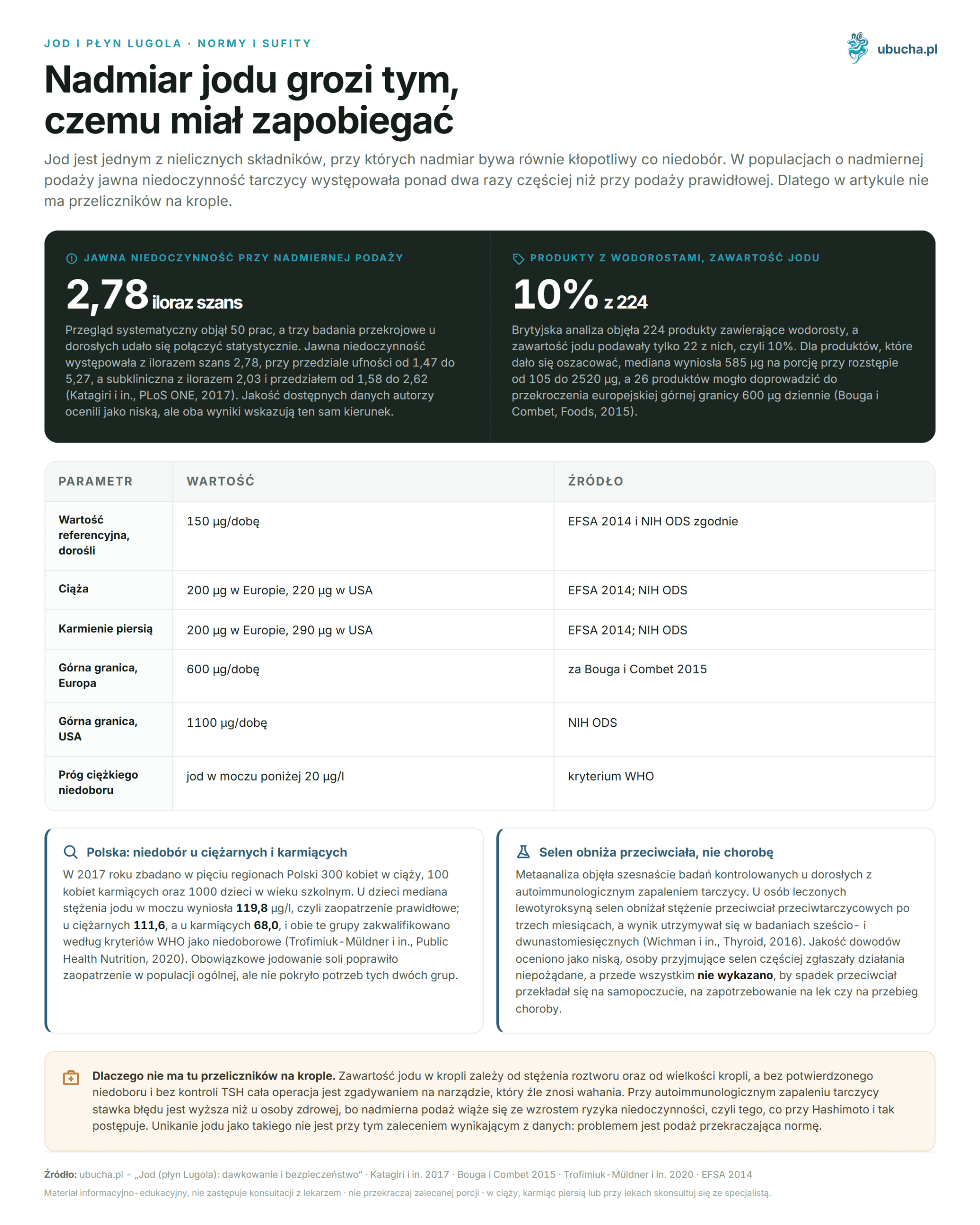
| Parameter | Value | Source |
|---|---|---|
| Reference value, adults | 150 µg/day | EFSA 2014 and NIH ODS accordingly |
| Reference value, pregnancy | 200 µg/day in Europe, 220 µg/day in the USA | EFSA 2014; NIH ODS |
| Reference value, breastfeeding | 200 µg/day in Europe, 290 µg/day in the USA | EFSA 2014; NIH ODS |
| Upper limit of intake, Europe | 600 µg/day | according to Bouga and Combet 2015 |
| Upper limit of intake, USA | 1100 µg/day | NIH ODS |
| Severe deficiency threshold, iodine in urine | below 20 µg/l | WHO criterion, according to Weikert et al. 2020 |
| Risk of hypothyroidism with excess | odds ratio 2.78 compared to normal intake | Katagiri et al. 2017 |
| Algae supplements, content per serving | median 585 µg, range 105-2520 µg | Bouga and Combet 2015 |
Do Poles have an iodine deficiency?
The general population does not, but pregnant and breastfeeding women do. This distinction has been measured and published, so it does not need to be estimated.
In 2017, as part of the National Health Program, 300 pregnant women, 100 breastfeeding women, and 1000 school-aged children aged 6 to 12 years were examined in five regions of Poland. In children, the median urinary iodine concentration was 119.8 µg/l, which corresponds to adequate supply. In pregnant women, it was 111.6 µg/l, and in breastfeeding women 68.0 µg/l, and according to WHO criteria, both of these groups were classified as deficient (Trofimiuk-Müldner et al., Public Health Nutrition, 2020).
The authors’ conclusion is balanced: mandatory iodization of table salt has led to a lasting improvement in supply in the general population, but has not ensured adequate intake during pregnancy and breastfeeding. The widespread thesis of a general iodine deficiency among Polish adults is not confirmed by these data.
A separate risk group is people on a plant-based diet. In a German study comparing 36 vegans with 36 people on a traditional diet, iodine excretion in urine was significantly lower in vegans, and one-third of them fell below the threshold of 20 µg/l, considered by WHO as an indicator of severe deficiency (Weikert et al., Deutsches Ärzteblatt International, 2020). In the same group, the supply of vitamin B12 was good, as vegans commonly supplement it. Iodine remained neglected.
What are the risks of excess iodine?
Primarily hypothyroidism, which is exactly what iodine supplementation usually aims to prevent. A systematic review from 2017 covered 50 studies, and three cross-sectional studies in adults were statistically combined. In populations with excessive iodine intake, overt hypothyroidism occurred with an odds ratio of 2.78, with a confidence interval from 1.47 to 5.27, and subclinical hypothyroidism with an odds ratio of 2.03 and an interval from 1.58 to 2.62 compared to populations with normal intake (Katagiri et al., PLoS ONE, 2017).
The authors note two things. The source of excess in the analyzed studies was mainly iodized salt or drinking water, and the quality of available data was low, so the magnitude of risk should be treated as an approximation. However, both combined results indicate the same direction of dependence.
The second problem is preparations with unknown content. A British analysis covered 224 seaweed-containing products available in retail. Only 22 of them, or 10%, reported iodine content, and another 40 provided enough information to estimate it. For these products, the median was 585 µg of iodine per estimated serving, with an interquartile range from 105 to 2520 µg, and 26 products could lead to exceeding the European upper limit of 600 µg daily (Bouga and Combet, Foods, 2015). The same note applies to high-concentration solutions, including Lugol’s solution: without knowing the content per serving, it is impossible to assess whether we are below the ceiling.
Can iodine be supplemented with Hashimoto’s?
This question is for an endocrinologist, not for an article, and the reason is precisely the dependence described above. In autoimmune thyroiditis, the margin of error is higher than in a healthy person, as excessive iodine intake is associated with an increased risk of hypothyroidism, which is exactly what is already progressing with Hashimoto.
Meeting the norm from diet is different from intentionally increasing intake. The thyroid needs iodine to produce hormones regardless of whether an inflammatory process is occurring, so avoiding iodine as such is not a recommendation derived from the data. The problem is intake exceeding the norm, and with a high-concentration solution, it is difficult to control.
For the same reason, we advise against measuring Lugol’s solution according to instructions found on the internet. The iodine content in a drop depends on the concentration of the solution and the size of the drop, and without confirmed deficiency and without TSH control, the whole operation is guessing on an organ that does not tolerate fluctuations well. If you are looking for context on how iodine and selenium are treated together in relation to the thyroid, we have gathered it in a text about selenium and iodine for the thyroid, and a separate discussion of Hashimoto itself can be found in the entry about Hashimoto and the thyroid.
Why selenium with iodine?
Selenium is often advised together with iodine, and its best-documented effect on the thyroid concerns not hormone synthesis, but antibodies. A meta-analysis published in the journal Thyroid included sixteen controlled studies in adults with autoimmune thyroiditis.
In individuals treated with levothyroxine, selenium supplementation reduced the concentration of thyroid antibodies after three months, and the result was maintained in six- and twelve-month studies. In individuals not yet treated, a decrease was noted after three months, but not after six or twelve (Wichman et al., Thyroid, 2016).
The authors add two caveats that usually get lost in summaries. The quality of evidence was generally rated as low, and individuals taking selenium reported adverse effects significantly more often than control groups. Above all, it has not been shown that a decrease in antibody concentration translates into any clinically significant outcome, i.e., into well-being, medication needs, or disease progression. Selenium lowers the number in the test. Whether it lowers the disease remains unproven. A similar discrepancy between a parameter and perceived improvement is described in relation to ashwagandha and subclinical hypothyroidism.
Frequently asked questions
How much iodine does an adult need daily?
For adults, both sides agree on 150 µg daily. For pregnancy, the European value is 200 µg, and the American is 220 µg; for the breastfeeding period, respectively 200 µg and 290 µg. These are reference values for total intake from diet and supplements combined, not a recommendation for taking the preparation.
What is the upper limit of safe iodine intake?
The European and American limits differ. The European upper tolerable intake level for adults is 600 µg daily, while the American is 1100 µg daily. Both values refer to the sum of iodine from diet and supplements and both are ceilings, not goals to achieve.
Can Lugol’s solution be dosed independently?
We do not recommend this and do not provide conversions to drops. The iodine content in a drop depends on the concentration of the solution and the size of the drop, and exceeding the norm is associated with an increased risk of hypothyroidism. Dosing of high-concentration solutions should be established with a doctor.
Does excess iodine harm the thyroid?
In a systematic review covering 50 studies, populations with excessive iodine intake had overt hypothyroidism with an odds ratio of 2.78, and subclinical with an odds ratio of 2.03 compared to populations with normal intake. The authors rated the quality of evidence as low, but both results indicated the same direction.
Do Poles have an iodine deficiency?
A 2017 study showed adequate supply in school-aged children, thus in the general population, while deficiency according to WHO criteria in pregnant and breastfeeding women. Mandatory iodization of salt improved the overall situation, but did not cover the needs of these two groups.
Are algae supplements a good source of iodine?
Their content can be unknown and very variable. In an analysis of 224 products with seaweed, only 10% reported iodine content, and the median for a serving was 585 µg with a range from 105 to 2520 µg. Twenty-six products could lead to exceeding the European upper limit.
Preparations with iodine and selenium can be found in the supplements category; when dealing with thyroid diseases, choose and dose in advance with a doctor.
This article is for informational and educational purposes and does not constitute medical advice. Before starting supplementation, consult a doctor, especially if you are taking medications regularly, are pregnant or breastfeeding, or have a chronic illness.
Author: Michał Waluk · Published: 2026-08-09 · Updated: 2026-08-11